
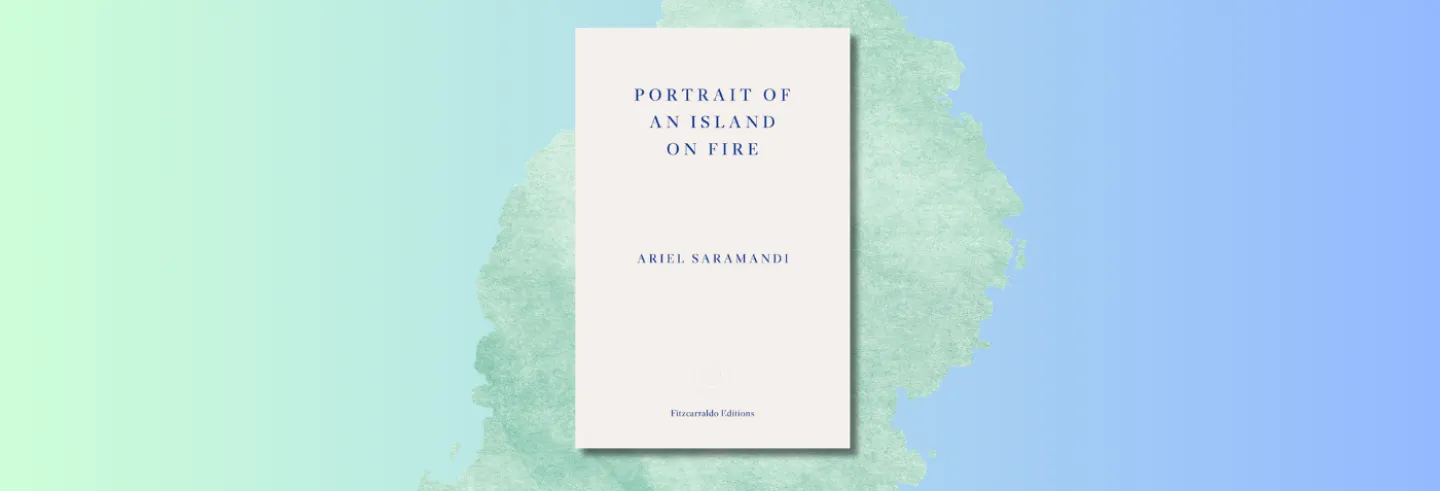
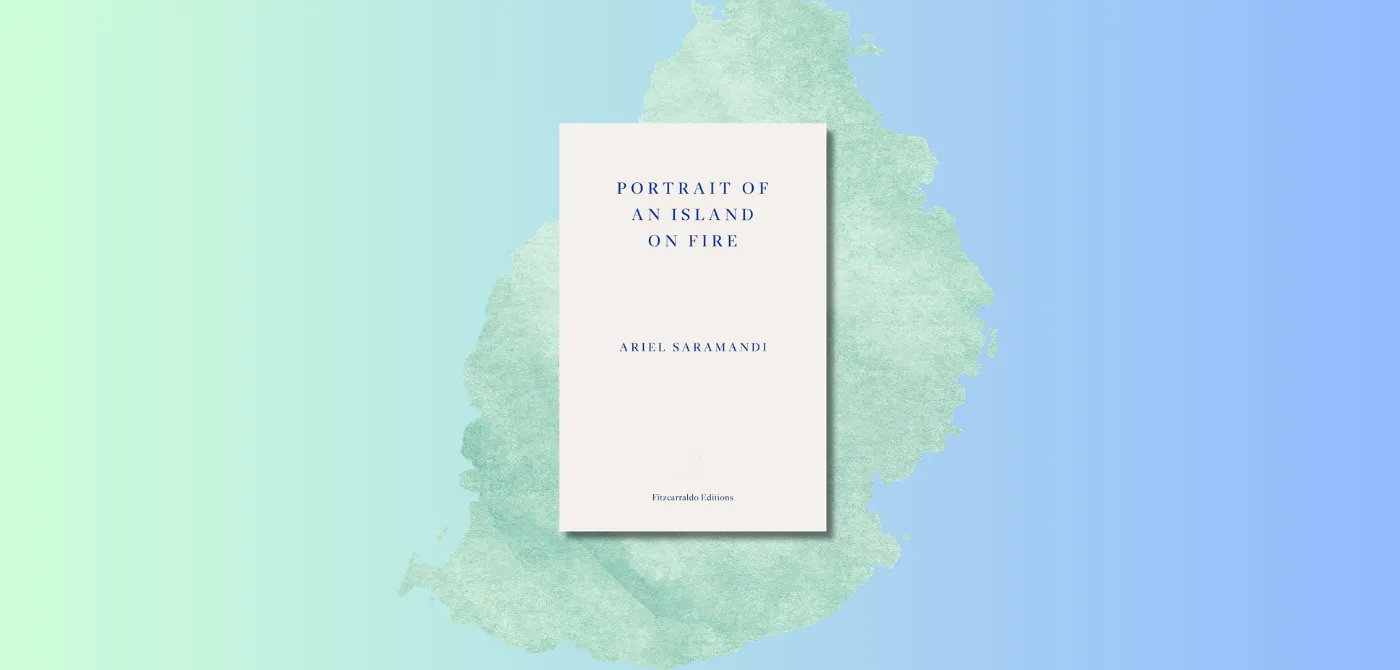



I read Ariel Saramandi’s Portrait of an Island on Fire against a backdrop of daily news headlines that signalled a mounting global bedlam. Humanitarian crises continued to wreak havoc in Sudan, Ukraine, and Gaza, now in its third year of war, with a death toll exceeding 70,000 people. Political tensions and violent crackdowns on protest and dissenting voices intensified in Iran, Bangladesh, and Haiti. Climate disasters fuelled extreme food crises in Somalia. Meanwhile, the US and India appeared to be descending firmly into fascism, with the erosion of democratic institutions, the demonisation of ethnic and religious minorities, and the concentration of power in leaders with cult-like followings and influence.
We live in a state of surrounding chaos. This chaos constantly threatens to upend our lives. Yet it is also a chaos to which we have largely grown immune.
These were the weeks in which the US President authorised the invasion and overthrow of the Venezuelan government. In the same period, his administration doubled down on Immigration and Customs Enforcement in the state of Minnesota, despite widely publicised killings of citizens at the hands of its officers. The President also announced that he was setting up the Board of Peace, signalling his rejection of the United Nations and all that the organisation represents. Somewhere along the way, he even briefly suggested taking over Greenland.
This was also around the time when Gauri Lankesh’s murder accused, Shrikanth Pangarkar, was elected to local governance in Maharashtra. During the same time, the Supreme Court of India continued to deny bail to student activists Umar Khalid and Sharjeel Imam—now in their sixth year of detention without trial—on flimsy charges of a “larger conspiracy” to cause harm to the nation.
“Ambient dystopia”, a friend called it. We live in a state of surrounding chaos. This chaos constantly threatens to upend our lives. Yet it is also a chaos to which we have largely grown immune. It has become part of the ecosystem we inhabit—inconvenient, but something we put up with, simply because it is just there.
That famous image of mud and fog pervading London at the beginning of Charles Dickens’ Bleak House (1853) comes to mind. Flooding and climate change are important subjects in Saramandi’s collection, which makes this image feel especially apt.
Many of us seek to save ourselves first from this engulfing chaos. So we hitch our hems higher against the seeping filth. Some of us, however, wade in deeper, scooping up the muck, running it through our fingers, examining its texture, sniffing it, trying to work out how it became so pervasive. Could we have stopped it? Was there a moment when all of this could still have been salvaged? Saramandi belongs to this latter group.
Saramandi’s book chronicles the island of Mauritius from its inception—when a volcano erupted in the middle of the Indian Ocean 10 million years ago to form this tiny island—to the present day. In a series of essays in which she marries the personal with the historical and the political, she pores over stories of plantation slavery and indentured labour, of French and British colonisations and their lasting imprint on the face of the island.
In the essay “All My Languages”, she reveals herself as a British-born, white-passing Creole woman, from the upper echelons of the Mauritian elite, who refuses to abide by the unspoken rules of … class and community...
She also traces the schisms that continue to drive people apart in contemporary Mauritius—race and ethnicity, gender, class, and caste. This registering of key events is the subject of Saramandi’s first entry in the collection, where she stops at the overthrow of the previous saffron-flag-wielding government, which she presents as a kind of watershed moment.
At an elemental level, Saramandi demonstrates how many of the issues that plague Mauritius today are entrenched in the legacies of colonialism. Because history does not happen in isolation, its consequences continue to ripple out decades later, shaping long-term political, social, and economic spheres within Mauritius and across its diasporas.
In the essay “All My Languages”, she reveals herself as a British-born, white-passing Creole woman, from the upper echelons of the Mauritian elite, who refuses to abide by the unspoken rules of the class and community to which she belongs. She interrogates the constructs of whiteness, and she reflects on what it means for a white-passing woman to be engaging with this subject. She presents herself as an anomaly.
She continues this self-revelation in “An Education” (perhaps the most provocative and vulnerable of the essays). Here she addresses how entrenched Mauritian attitudes of anti-Blackness are, turning the lens on her own mixed-race family and on the elite educational institutions that white and white-adjacent Mauritians, including members of her own family, traditionally frequent and patronise.
“The Inheritors” captures stories of how several Creole children of white landowners are tricked out of their inheritance by a system designed to keep Black and mixed-race Mauritians at bay, in a perpetuation of the colonial set-up. She returns to this subject in “Real Estate”, where she chronicles how land and property sales continue to be guided by exclusionary politics. These are dressed up in fancy language but conceal the same racist heart. She narrates the complicity of class elites, across the colour spectrum, in sustaining these intersecting oppressions.
“Bann-La” (literally Mauritian Creole kreol for “those other ones”) also addresses the intersections of oppressions. It shows how formerly marginalised communities, especially the descendants of indentured labourers, adopt and internalise the same dehumanising and violent tactics as their oppressors. Here, she turns the lens on contemporary anti-immigrant sentiment and rhetoric. This hostility is aimed specifically at dark-skinned African immigrants and Bangladeshi migrants, and not at the increasing population of French or white South African “expatriates”, of course.
“Snapshots of an Island on Fire”, “Pandemic in Nine Acts”, and “Death Takes the Lagoon” all address climate change. They also expose the administrative reluctance to prioritise public health and safety over profit-making. This reluctance exacerbates social inequality. It is one of the forces that would eventually contribute to the overthrow of the previous administration, as she chronicles in “Ten Years in Power”.
She notes how the chief British archivist took 17 suitcases’ worth of documents and registers to London in the 1820s, many of them records of former enslaved and indentured labourers.
“Getting Rid of It” and “Too Much Feminism” both shine a light on misogyny and the plight of the Mauritian woman, especially women from non-elite classes and castes. One essay traces the rise of the alternative right wing online. The other chronicles archaic abortion laws leftover from the Victorian era, which Mauritius continues to hold on to.
Much of what she writes about here will be very familiar to Indian readers. If these are not shared experiences, then many of them have their own Indian variations unfolding around the same time. The deliberate strategy of colonisation is, of course, part of a common history. This included the export of about half a million indentured labourers from India to the island colony by a common despot, the British Raj, between 1835 and 1870.
At one point, she mentions the theft of artefacts and the pillaging of the archives. She notes how the chief British archivist took 17 suitcases’ worth of documents and registers to London in the 1820s, many of them records of former enslaved and indentured labourers. Of course, India witnessed this on a much larger scale over the 200 years of British colonial rule.
A more recent common ground emerges in her account of pandemic handling. She describes hurried and unplanned lockdowns, the unequal availability of care, and the corruption involved in awarding contracts for procuring protective equipment. She also shows the disproportionate impact on smaller businesses and impoverished communities. This is yet another story that will read like an extension of what was happening in India at the same time.
There are, however, times when she implicates India directly. In some instances, she refers to wealthy Indian immigrants or businessmen who move to Mauritius, or incorporate their businesses there, after “falling in love” with the island. This affection, of course, has nothing to do with a lenient tax regime, as she wryly suggests. She also refers to exploitative business practices by some Indian organisations, including Larsen & Toubro’s employment of Bangladeshi contract workers in a set-up that is oddly reminiscent of indentureship.
What Saramandi does is follow the threads into the silence of the discarded, naming those who were previously unnamed, especially the former enslaved and indentured labourers. She puts a direct finger on racism, without dancing around it.
More gravely, she reflects on rumours about the Indian government’s complicity in potentially helping the former prime minister of Mauritius to snoop on its own citizens via Internet surveillance. Saramandi reports that former Prime Minister Pravind Jugnauth himself claimed that he “personally asked Narendra Modi” for help, following a “security issue” that he does not explain, of course.
Saramandi also reflects on the theories surrounding the Indian government’s interest in helping the Mauritian government further develop military infrastructure on its territory of Agaléga. This island lies about 1,000 kilometres north of Mauritius and is therefore a key surveillance and logistics base for India. It is especially attractive for its 3,000-metre airstrip and deep-sea jetty, although Jugnauth refused to acknowledge that this military base already existed.
Perhaps the most direct accusation she levels at India concerns the chokehold of Hindutva over one of its oldest diasporas. Indo-Mauritians are, by and large, removed from India by at least four to five generations. And yet the rise of Hindutva nationalism in the country—with its anti-Black, anti-Muslim, and anti-Bangladeshi rhetoric and its tacit embrace of “right-wing economics and social stratification” (314)—is a sign of the long game of Hindutva coming into effect.
Saramandi’s book is no Stone Boy story. Stone Boy was a children’s television series that aired on Doordarshan in 1991. In it, a poor Mauritian farmer cursed by fairies is momentarily freed from his curse through his friendship with the children of an Indian writer who is researching the history of Mauritius. Saramandi suggests that the Stone Boy story might originally have been a Creole myth. She argues that it was erased when Ganga Talao, the lake where the fairies reside, became a sacrosanct Hindu site of pilgrimage.
What Saramandi does is follow the threads into the silence of the discarded, naming those who were previously unnamed, especially the former enslaved and indentured labourers. She puts a direct finger on racism, without dancing around it, and pokes at the gashes left by the ravages of colonialism. Her book is also a deeply hopeful plea. She insists that this can all be stopped in its tracks. She uses the term “wake work” at one point to describe how people reacted to her naming racism in an early essay that she published. This entire book is, indeed, “wake work”.
Perhaps the most direct accusation she levels at India concerns the chokehold of Hindutva over one of its oldest diasporas.
A common accusation often levelled at books that are so firmly geographically anchored is that readers who are not from that place tend to begin with a disclaimer along the lines of “I know nothing about this country…”. Perhaps Saramandi’s truest feat as a writer is showing how we are all part of the same unfolding narrative.
What happens in the US has resonance in Mauritius, and what happens in India continues to inform how Mauritians fashion their selves. The conversations in this book are not just about Mauritian pasts and presents. They are also conversations with different parts of the world, where each reader can find resonance, regardless of where they are reading from.
None of us is completely isolated from the butterfly’s wings anymore. Portraits are not just portraits. They are also windows and mirrors.
Vedita Cowaloosur is a California-based language teacher and writer.