




In his book, Pillars of Justice (Harvard University Press, 2017), legal theorist and Yale Law professor Owen Fiss offers a set of profiles of 13 figures who shaped American law over half a century. These range from Thurgood Marshall, Harry Kalven, and Catharine Mackinnon to less prominent persons such as the human rights lawyers Burke Marshall and John Doar, who worked in the Justice Department’s Civil Rights Division, and Carlos Nino, an Argentine lawyer who helped bring in military leaders who perpetrated terrible crimes during the country’s “dirty war” in the 1970s.
Several of the 14 held the highest law offices in the land, but many of them are unheralded in the sense that matters to the present.
The collection of men and women chosen, Fiss argued, was held together by their shared devotion to Brown v. Board of Education, which he saw as the germinal moment when American law took a turn towards becoming an instrument for realising the nation’s highest ideals. Some reviewers were sceptical of this thesis. The devotion perhaps was more Fiss’ than his subjects’, they thought. But the basic animating conviction beneath the link he drew—that a life in the law is worth recording not just for the fees that a counsel may command but also for the ends it serves—could not be doubted.
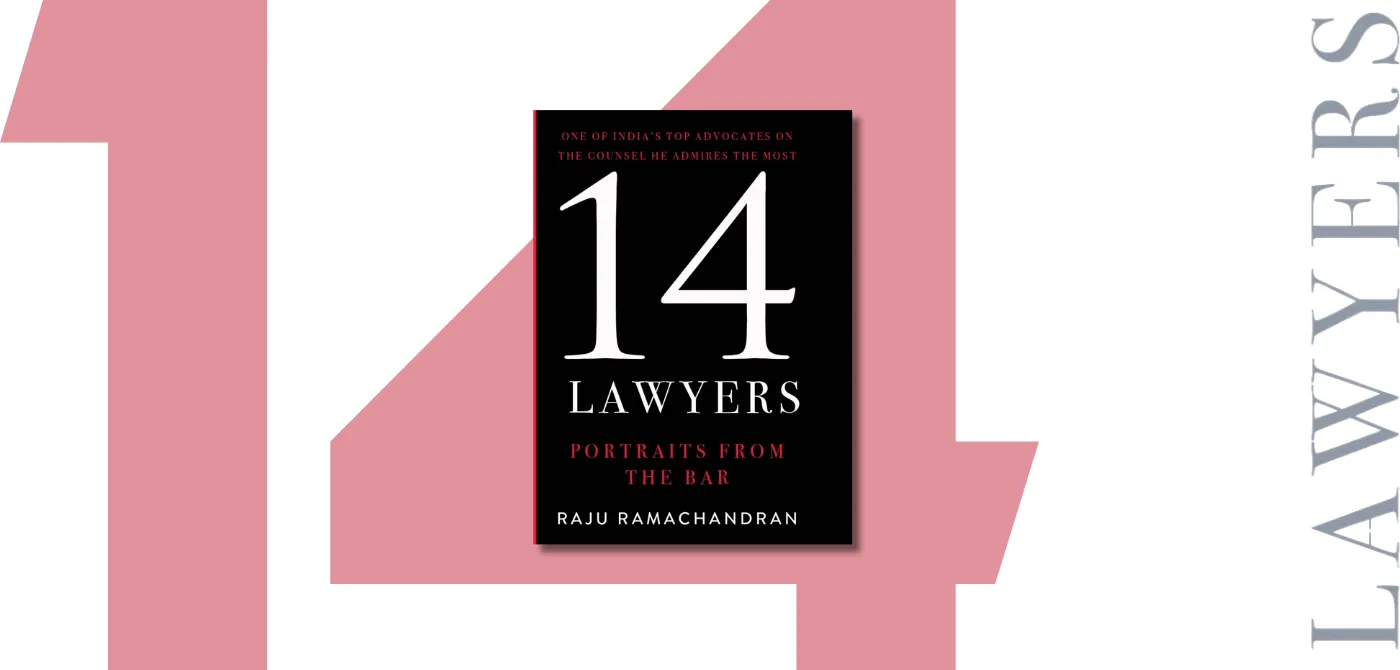
Raju Ramachandran’s 14 Lawyers: Portraits from the Bar belongs, in spirit, to the same shelf. It is a slimmer, warmer, and more anecdotal book than Fiss’, and it makes no claim to a grand, unifying doctrine. Yet, at its root is a similar instinct, an idea that the measure of an advocate is more than what he or she is worth in the marketplace, that it is important that the record also remembers those who might otherwise slip out.
Having recently completed 50 years at the bar, Ramachandran is candid about how the book came to be. He says he was offered by his publishers the choice of a memoir, a treatise on a legal subject of his choosing, or a book on the lawyers he had admired. He took the third option, but the book also works partly as the first, as a personal, if by no means hagiographical, account of those whom he both admired and felt had been neglected.
The figures profiled are by no means obscure. Several of the 14 held the highest law offices in the land, but many of them are unheralded in the sense that matters to the present.
Ramachandran is explicit about this. “They may not have enjoyed the eminence of the marketplace, and they are unlikely to figure in lists of ‘top lawyers’ polled by glossy magazines”, he writes. “But their life stories have inspired me, and I am sure my contemporaries will remember them”. In many ways, this sentence represents the book’s kernel and it is worth dwelling on, mainly because it cuts against the grain of how the profession seems to now speak of itself.
If we are to see the law as an instrument of social change, those practising it must serve to engineer that transformation. But in the past two decades we have grown accustomed to ranking lawyers in a particular way. The metric we use is invariably the fee that the lawyer charges, and the size and nature of her practice. As a result, we have but a handful of senior advocates who are seen as the country’s best.
Then there are the Hingoranis, Kapila and Nirmal, the wife-and-husband team, in whose profiling, Ramachandran’s method pays its richest dividend.
Ramachandran does not sneer at these lists. He is too generous a writer for that and he himself is a senior advocate of long standing. Instead, he refuses to accept this as the whole story.
Consider some of the figures he gathers. There is V.M. Tarkunde (1909–2004), who stepped down in 1965 from the Bombay High Court at 60 to begin again as an advocate just four years later in the Supreme Court. He was one of the few to stand openly against the government through the Emergency years. Ramachandran recalls how Tarkunde, speaking in a calm and dispassionate voice at a meeting, warned that the supersession of judges in 1973 was only the beginning.
There is Gobinda Mukhoty (1927–1995), fearless enough to tick off Justice Chinnappa Reddy for keeping the bar waiting late without the courtesy of notice. Mukhoty was also a fearless advocate of the Emergency years, who, as Fali Nariman once observed, in Ramachandran’s recollection, “would sit in the library roundly and loudly swearing at Chief Justice Ray, confident that whatever was said in the Bar library did not constitute contempt. Others remained tight-lipped. They were not so sure. Walls had ears”.
Mukhoty was influential in establishing the People’s Union for Democratic Rights (PUDR) and appeared in several cases where civil liberties and the right to equal treatment were at stake. Among those was Bhagwan Dass v. State of Haryana (1987) and R.D. Gupta v. Lt. Governor (1987), where he fought for equal pay for equal work, and Krishan Yadav v. State of Haryana (1994), where he argued against corruption in public employment.
There is in the book, M.K. Ramamurthi (1921–1993)—Ramachandran’s own senior, and his mother’s first cousin—an atheist who never addressed a judge as ‘My Lord’ and never once appeared for management against labour. Ramamurthi’s “vigorous advocacy”, the book notes, was at the forefront of the labour and service jurisprudence developed by the Supreme Court, in the 1960s and 19670s.
Ramamurthi led arguments in Hindustan Antibiotics Ltd. v. The Workmen (1996), where the Supreme Court laid down guidelines for wage structure in public sector undertakings, and argued the famous Bangalore Water Supply & Sewerage Board v. A. Rajappa & Ors. (1978), where the court gave an expansive meaning to the word “industry” under the Industrial Disputes Act, 1947.
Then there are the Hingoranis, Kapila (1927–2013) and Nirmal (1921–2015), the wife-and-husband team, in whose profiling, Ramachandran’s method pays its richest dividend. Their story, as he puts it, is also the story of how public interest litigation was pioneered in India. In January 1979, two articles by K.F. Rustamji (1916–2003) in the Indian Express described the plight of undertrials in Bihar’s jails, men and women who had spent longer awaiting trial than the maximum sentence for the offences they were charged with. The Hingoranis conceived a petition on their behalf under Article 32 of the Constitution, invoking the Supreme Court’s extraordinary writ jurisdiction.
Crucially, Ramachandran refuses the hagiography, which he rightly identifies as a vice that the profession’s commemorations are often prone to.
This was unusual, as they held no vakalatnama (power of attorney) for the prisoners. The court’s registry objected to the petition. But Kapila insisted that the case be listed before the bench with its defects intact and that counsel would take up the objections with the judges directly. What followed was Hussainara Khatoon v. Home Secretary, State of Bihar (1979), and the birth of a then revolutionary jurisprudence.
Neither of the Hingoranis was or is a household name. But this is the sense in which the book works, above all as an act of record-keeping.
Ramachandran is a self-described collector of trivia with, by his own admission, a grasshopper mind, and the book is the better for it. His idea was not to reproduce creatively interpreted resumes. So, what he did instead was to sit down with the families, the close friends, and the surviving associates of the individuals profiled. The result is a set of rich, highly readable profiles.
There are profiles of Shyamala Pappu (1933–2016), one of the first women to be designated a senior advocate in the British Commonwealth, who was passed over for additional solicitor general because a moralistic chief justice disapproved of her private life. There is Barry Sen (1925–2015), invited home from the privy council bar in London by the first chief justice of India to help form the nucleus of a Supreme Court bar that did not yet exist.
And then there are Ramachandran’s heroes, Dipankar Gupta (1934–2019) and Tehmtan Andhyarujina (1933–2017), “two sober, mild-mannered gentlemen who did not indulge in theatrics or raise their voices. And yet, they were highly respected by both lawyers and judges”.
Crucially, Ramachandran refuses the hagiography, which he rightly identifies as a vice that the profession’s commemorations are often prone to. Lawyers, he observes, tend to eulogise.
In full court references, where a court and its judges gather to pay respect to departed judges or senior lawyers, each of the departed invariably tend to have razor-sharp minds, tend to have shown unfailing courtesy, and tend to be persons of unimpeachable character. He sets out, instead, to look at his heroes as humans. R.K. Garg’s rudeness is not softened, Ramamurthi’s messy personal life is not ignored, and Pappu’s unconventional relationship with Ramamurthi is set down plainly, because it impacted her career.
Rohinton Nariman’s foreword to the book, borrowing from Thomas Babington Macaulay on the navy of Charles II (The History of England from the Accession of James the Second), sorts the 14 into “gentlemen” and “seamen”: the soft-spoken and the loud, those who prevailed by courtesy and through soft-spoken advocacy, and those who prevailed by raising their voices. But the book’s deeper division is between the lawyer as a market-figure and the lawyer as an agent of change.
It serves as an invitation to tell stories of not just lawyers, but also other figures who act as agents of change from across the country.
Barring S. Govind Swaminadhan (1909–2003), a former Advocate General of Tamil Nadu, the only lawyer of the 14 whom Ramachandran never actually met, the rest were practitioners before the courts of Delhi, and chiefly before the Supreme Court. Ramachandran writes about his admiration for Swaminadhan, having seen him from a distance, watching him argue E.P. Royappa (1973) in a Supreme Court courtroom with the aura, as he memorably puts it, of a Roman senator. Swaminadhan’s practice, though, was based almost entirely out of Madras.
That the book does not look beyond figures from Delhi is, however, no failure. Ramachandran’s 50 years were spent as part of the Supreme Court bar. That Swaminadhan is the exception rather than the rule is, in the end, a mark of how much further the project can be taken by others. It serves as an invitation to tell stories of not just lawyers, but other figures who act as agents of change from across the country—from the courts at the mofussil level to the high courts and beyond.
Ramachandran intentionally chose to write only about the dead. Distance and time, he says, give a better perspective, and had he written about the living, more women would have figured.
The book comes with a further admission. “At this stage, a disclosure—nay, a confession—is in order”, Ramachandran writes. “In a life of 72 years and a career of 50, I have made my mistakes. Some personal and some professional; some huge and some small. The younger reader must know that there is no maximum age for making an ass of oneself”.
There is however also no expiry date on the obligation to remember well, something which Ramachandran has done with extraordinary elegance and grace.
Suhrith Parthasarathy is an advocate practising at the Madras High Court.