
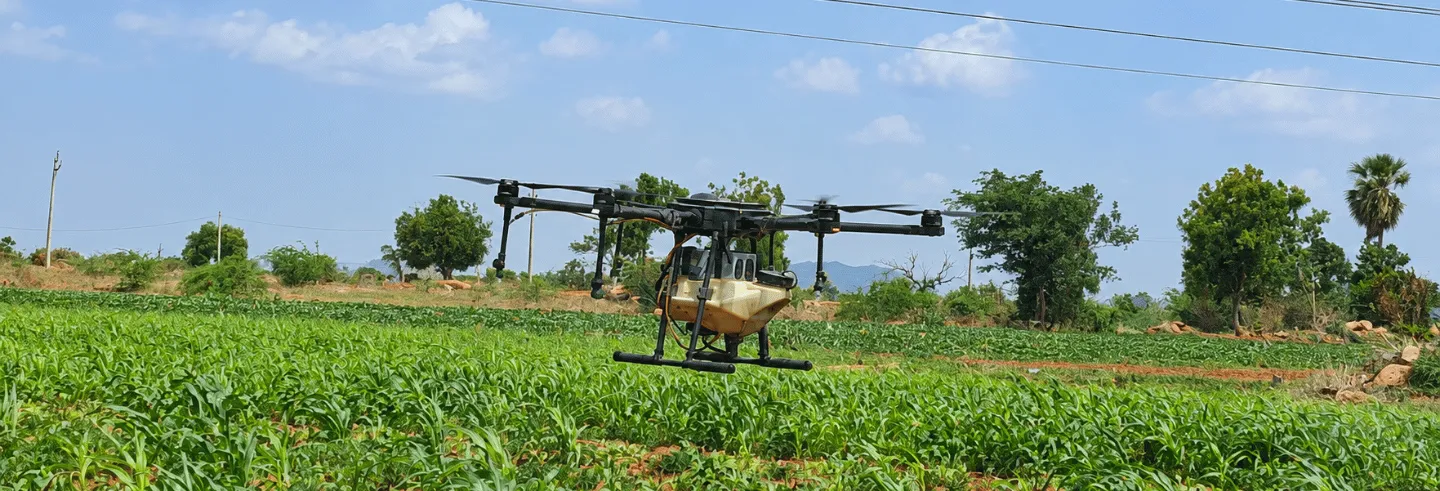
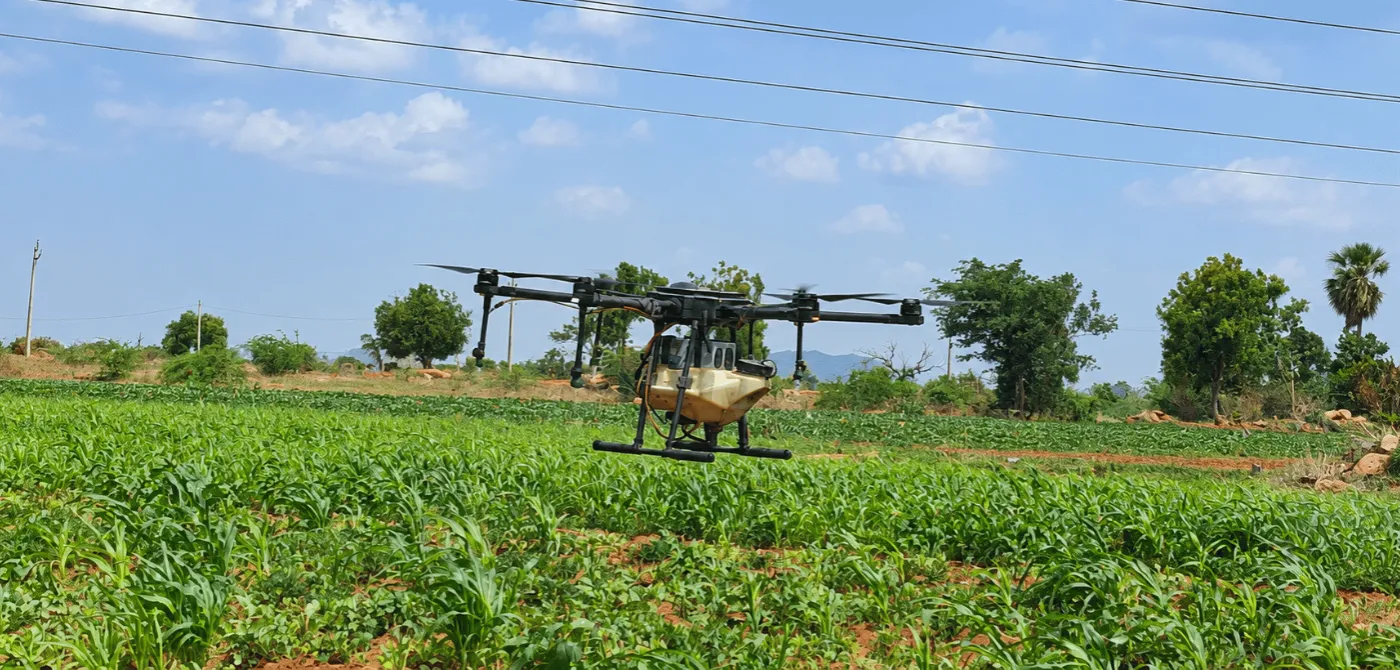



Indian agriculture is experiencing a phenomenal change hiding in plain sight. Until a few years ago, the use of drones on India’s small farms with fragmented holdings seemed unthinkable, even absurd. Yet, the drone revolution is well underway in India. This diffusion has been overwhelmingly spontaneous and organic.
A defining characteristic of the drone sector in Indian agriculture is its duality – a small formal, organized sector and a large informal sector.Drones in India are required to be registered with the Directorate general of Civil Aviation (DGCA) and drone pilots require a license to fly them. The organized or formal sector refers to this segment. Despite highly visible efforts by the government to promote drone use in agriculture and domestic drone manufacturing, the formal organized sector, with registered drones and licensed operators, remains small. In contrast, agricultural drone diffusion is being led by a rapidly growing informal unorganized sector assembling drones with imported components, offering farmers the most recent advances in drone technology and a nimble ecosystem for repairs and maintenance.
This article describes this ongoing revolution, highlighting that this presents a policy dilemma but also an opportunity for the government to shape this consequential transformation.
Global Diffusion of Drones
A remarkable feature of global drone diffusion is it’s spread from the Global South (East, South-east Asia, Latin America) to the Global North, reversing the historical pattern of agricultural technology diffusion, in which advances in the Global North, (like mechanization on large farms) percolated gradually to the South (Belton et al., 2025; 2026). Drone use has expanded most rapidly in contexts where agricultural holdings are extremely small and farm wages are high, enabled by rapid advances in drone technologies that reduced costs of deploying drones. As Belton et al. (2025) point out, smallholder rice farmers in Asia can now access, for as little as $10 per hectare from an outsource service provider, technology with capabilities comparable with the most state-of-the-art computer-assisted $400,000 ground rig on a 1000-hectare soybean farm in the American Midwest. This revolution has scaled up globally in just five years, with China leading the way. Belton et al. (2025) note that by 2024, China had approximately 251,000 agricultural drones in operation, followed by Japan (19,939), Thailand (15,038), Brazil (12,000).
Growth and Drivers of Drone Use in Indian Agriculture
The scale and pace of drone use and expansion in India is hard to establish with certainty. The estimated number of registered drones for agriculture was reportedly just 7,000 in India in 2024 (Belton et al., 2025). As of July 5, 2026, 41,196 drones of all types were registered with the DGCA. Agricultural drones probably constitute a fair share of the registered fleet. Drone market observers in India estimate that the actual number of operational drones, including those that are not registered, may be far greater and may well account for a staggering 90% of all drones in India!This number is cited by industry observers for drones overall; for agriculture, this estimate that 90% of agricultural drones too are unregistered, more reliably, comes from a field study in Nalgonda (Kotu et al 2025).
Studies on agricultural drone use based on small -scale surveys of farmers present a range of estimates for the share of sample farmers using drones for spraying – from 3% to 22%...
To be clear, at the national level, the overall reach of drones at present apparently remains small. No reliable estimate exists of the extent of drone use. One recent estimate put the total number of drones in Indian agriculture at 29,500 covering 30 lakh hectares across 12 states (Singh and Singh, 2025; Masih et al. 2025). If this is correct, it accounts for less than 2% of the 14,10 lakh hectares that is counted as net sown area in the country. Drone use is currently geographically concentrated in southern and western states, particularly Tamil Nadu, Andhra Pradesh, Telangana, Karnataka, Punjab, and Haryana (Singh and Singh, 2025). But the small footprint of drones should not be dismissed as inconsequential, for we are still at a nascent stage of a significant transformation.
Studies on agricultural drone use based on small -scale surveys of farmers present a range of estimates for the share of sample farmers using drones for spraying – from 3% to 22%, varying by region and crop across samples (see Narayanan et al. 2026). These studies also note that drone users tend to be young, educated and wealthier, but are not necessarily exclusively large farmers.
The primary uses of drones currently are pesticide and herbicide spraying and nutrient application, mostly on paddy, maize, cotton and soybean monocropped fields or oil palm plantations and orchards. Drone use is, however, expanding to newer contexts, sometimes in unexpected ways, no longer confined to monocropped systems. In Andhra Pradesh, we noted that drones were being used for spraying bio stimulants and biopesticides on natural farming fields of less than an acre with as many as 15 crops, signifying the potential of drones to tackle the big challenges of chemical use, a troubling legacy of the Green Revolution. Farmers and scientists are testing direct sowing of seeds via drones (see here too) and managing ponds, broadcasting feed in aquaculture systems. Further, agribusinesses are exploring several applications including crop surveillance, yield estimation and prediction, and insurance. Not all these applications are likely to be (equally) successful, but it seems that drones for basic operations in agriculture are here to stay.
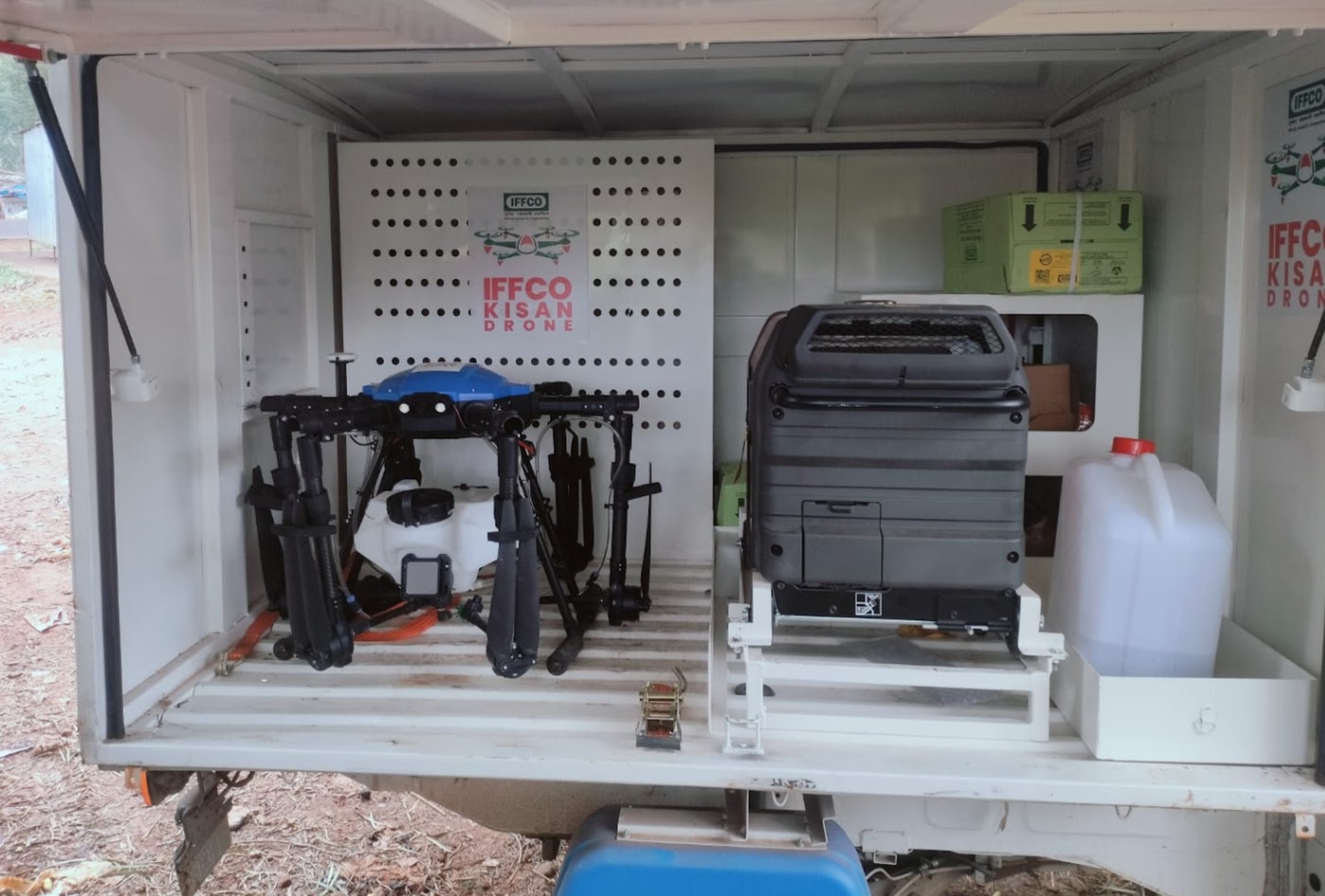
What are the drivers of drone use in India? As in other parts of the Global South, drone uptake appears to be highly correlated with labour shortages locally and high agricultural wages. The drivers of drone use are similar in this respect to the uptake of herbicides (Haggblade et al 2017). Drone use in some regions also seems to be predicated on reliable power supply for charging drones (Kotu et al., 2025). Apart from these spontaneous catalysts, the impetus for drone adoption has also come from the Government of India, which has rolled out a number of schemes in an effort to promote drone manufacturing, ownership and use in agriculture.The Sub-Mission on Agricultural Mechanization (2022) The SMAM is a Centrally Sponsored Scheme launched in 2014-15, drone guidelines were added Jan 2022; revised May 2025, for example, provides subsidies ranging from 40% for individual farmers to 75% for Farmer Producer Organisations (FPOs) and 100% for agricultural research institutions) In September 2025, the Goods and Services Tax (GST) on drones was reduced from eighteen to five per cent. The most visible initiative – the Namo Drone Didi scheme, launched in November 2023, with an outlay of Rs. 1,2610 million – aimed to equip up to 15,000 women’s self-help groups with drones for providing rental spraying services, with eighty per cent subsidy, fifteen-day training, and maintenance support. Apart from subsidies for manufacturing or purchasing drones, state initiatives include the establishment of Custom Hiring Centres and Village Level Farm Machinery Banks (FMBs) leveraging cooperatives, Farmer Producer Organizations (FPOs), local governments and Self-Help Groups (SHGs).
In the next sections we focus first on the duality of the drone sector and then the trinity of channels via which drones reach farmers.
Duality in Production and Assembling
A key reason for the duality in the agricultural drone sector is a policy and regulatory framework that has multiple priorities in mind. To boost a fledgling drone manufacturing industry, the government banned imports of drones and drone assembly kits, while allowing imports of individual drone components and extended subsidies to domestic manufacturers. Domestic drone manufacturing is taking off but thus far it is more oriented towards the defence and logistics sectors than agriculture. Agricultural users in the meantime find that assembled drones using imported parts make abundant economic sense.
Private Capital Flows in Manufacturing
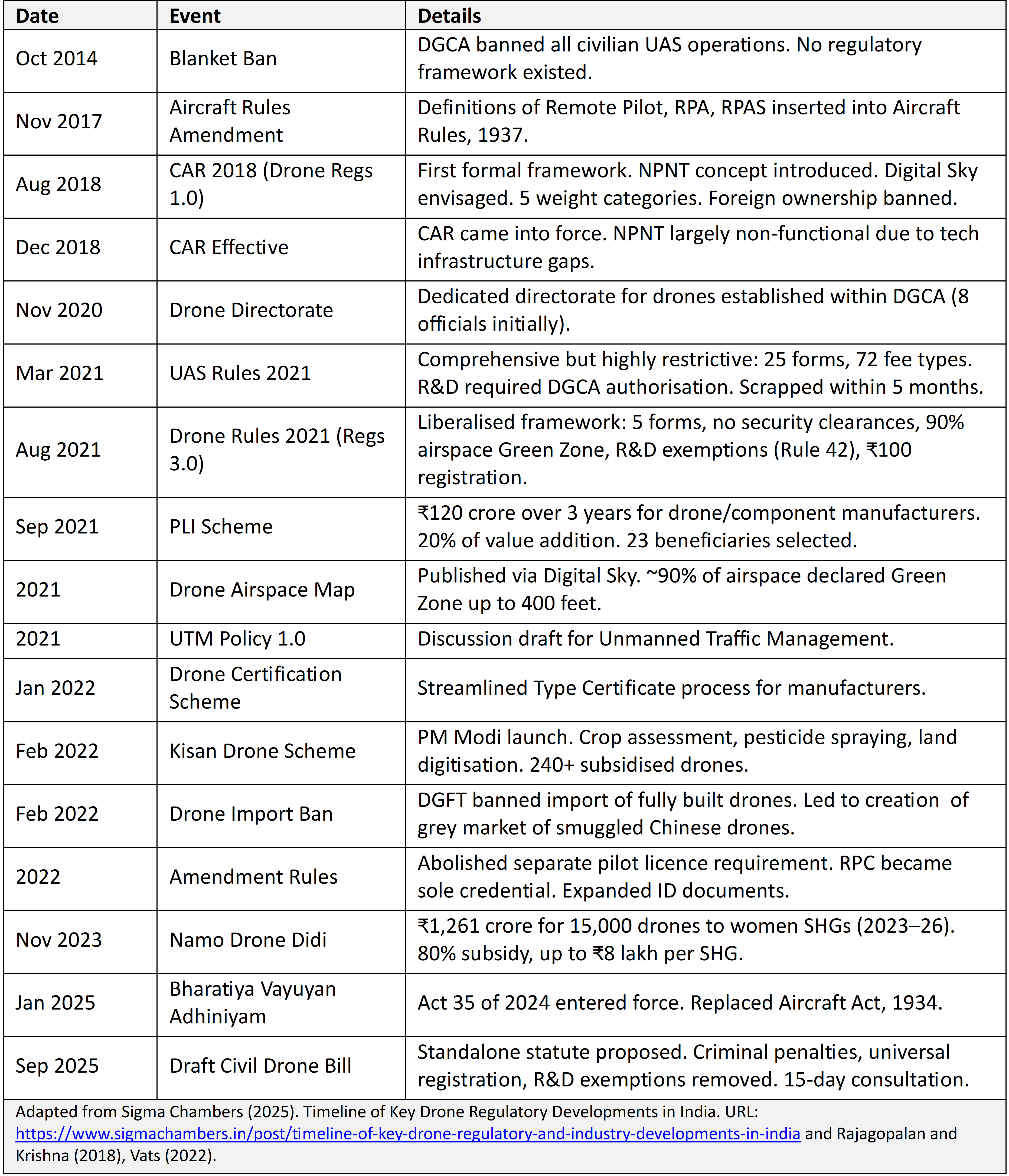
Domestic manufacturing of drones in India took off in earnest in 2021. Until 2014, there was a blanket ban on drones that gave way to legalization in 2018, followed by substantive efforts to install a liberal policy for drones. These steps are widely credited for the growth of demand for drones and accelerating domestic drone production.The Drone Rules of 2021, and amendments in 2022, dramatically simplified regulation of manufacturing and use, reducing required permissions from the DGCA from 25 to 5, reduced approval requirements from 72 to just 4, and introduced the Digital Sky platform for online registration of drones.[4] Several schemes soon followed to push for domestic manufacturing of drones under Atmanirbhar Bharat. The Production Linked Incentive (PLI) scheme (2022-23 to 2024-25) offered ₹120 crore over three years to stimulate domestic manufacturing, with a minimum 40 per cent value addition requirement. An enhanced PLI 2.0 with a possible allocation of ₹500 crores was awaiting approval at the time of writing.
Table 1: A Timeline of Drone Regulation Pertinent to Agriculture
Yet, it seems that the domestic drone manufacturing industry is substantially more oriented to defence and logistics than to agriculture. Out of the 1090 drone companies in India in 2026, about 70% of them were specialized in military drones and had received $757 million in cumulative funding.We draw on a proprietary subscription-based database Traxcn, that tracks private venture capital investments. Drone-based delivery services encompass close to 27% of companies with $34.2 million in funding. Agricultural drones, the segment that has implications for millions of Indian farmers, accounts for a measly 3% of companies, $1.3 million in total funding in India, more like a rounding error against the defence drone venture capital flow.This is for the category Crop Management using Drones, as per Traxcn’s database. The Drone Federation of India’s projections estimate agriculture drone revenue potential at $1.97 billion by 2030, barely half of the $3.56 billion projected for military drones.
So far, India’s innovation in agricultural drones has been primarily in how the technology is configured, combined with other innovations (like nano-urea), and in how it is delivered to farmers. The most interesting adaptations are in applications rather than hardware. Spray system configurations: nozzle arrangements, tank designs, flow control calibrated for Indian crops and chemicals, including emerging applications for natural farming inputs are areas of notable local adaptation. Motors, electronic speed controllers, flight controllers, batteries, and GPS modules mostly continue to be imported.
Emergence of a Drone Assembly Industry
In February 2022, the government banned the import of fully assembled foreign drones, including assembly kits and knocked down drones, effectively blocking the leading global agricultural drone manufacturers from the Indian market.DGFT Notification No. 54/2015-20 dated 09.02.2022 regarding ‘Indian Trade Classification (Harmonised System) of Import Items, 2022 [ITC (HS), 2022].
Assembled drones from MSMEs and household enterprises in the informal sector are the most striking and significant channel of drone diffusion in Indian agriculture.
The import ban, intended to allow domestic drone manufacturers to grow, also inadvertently spurred a domestic drone assembly industry dominated by informal MSMEs and household enterprises. In states which lead the agricultural drone revolution, for example, Maharashtra, Tamil Nadu, and Andhra Pradesh, commercially oriented landed farmers are acquiring imported drone components and assembling functional spraying units with the help of local electronics technicians and YouTube tutorials; they operate them on their own holdings and those of other farmers for a fee. They may sell these assembled drones to other spraying service providers as well. These assembly units rely on imports of components – both those that were officially permitted and those that were not, i.e. parts of assembly kits and knocked down drones. The latter reportedly flow via rerouted supply chains – through online marketplaces, through electronics bazaars in several major Indian cities and are often declared as toys or electronics when imported.
The indigenous assembly and adaptation of imported sub-components enable a reliable supply of agricultural drones at a fraction of the cost of domestically manufactured drones, reportedly as little as ₹1.5 lakh as compared with ₹4-5 lakh for domestically manufactured drones. As Kotu et al (2025) note insightfully, unregulated drones paradoxically use newer, more advanced technology than the regulated ones, partly because the informal supply chain can source the latest Chinese components more quickly than formal manufacturers can navigate DGCA certification processes.
A Trinity of Distribution Channels
The dominant pathway for drones has been the early emergence of Drone as a Service (DaaS), i.e. drone outsourcing services. This makes expensive technology more scale-neutral, i.e. accessible to small farmers nearly as much as to the large farmers (Belton et al. 2025). We identify a trinity of overlapping channels, with diverse service delivery models. The largest of these is the informal Micro-Small-Medium Enterprise (MSME) and household enterprises-led expansion of assembled drones; the second is a formal sector corporate-led diffusion of drone use and the third channel is a state-led channel that supports and subsidizes farmer and women’s collectives and rural entrepreneurs to set up DaaS services.
Assembled drones from MSMEs and household enterprises in the informal sector are the most striking and significant channel of drone diffusion in Indian agriculture. These drones are typically not certified by the DGCA and its operators often lack remote pilot licences, both legal requirements for drone service provision in India. A compelling account by Kotu et al. (2025) based on field studies in Nalgonda district of Telangana state suggests that repair networks for assembled drones function outside the formal regulatory framework and are local and responsive, in contrast to the centralised and often slow service centres of formal registered drone companies. Kotu et al. (2025) further find that in Nalgonda district increased competition among service providers has kept spraying rates affordable to small farmers, who sometimes also hire these services collectively. This burgeoning segment is oddly invisible – unregistered, undocumented, and uncaptured by any official data, yet accounts for most of the actual drone use in agriculture.
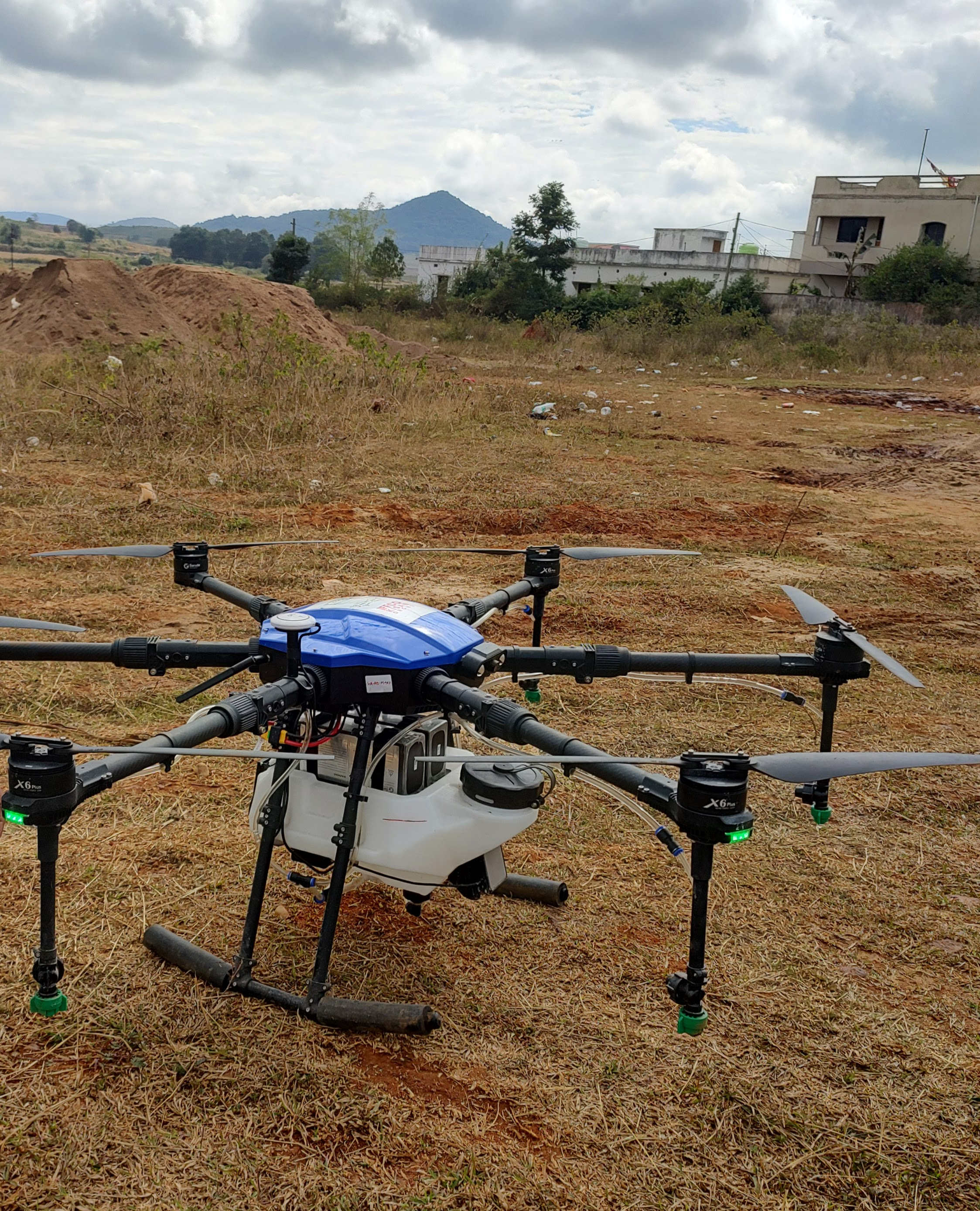
In contrast, the formal sector is highly visible to the public and “legible” to the state: registered, subsidised, documented, countable. Paradoxically though, it is small in scale. In the regulated sector, large-scale formal businesses lead the drone diffusion process and constitute a second channel of the trinity. Large agrochemical and fertilizer companies are integrating drone spraying into their input distribution and service chains. Drones thus become a delivery mechanism for the company’s own products – nano fertilizers, pesticides, bio-stimulants. Such companies either deploy their own fleet or maintain contracts with drone manufacturers.However, the evidence base for its actual scale and impact rests almost entirely on company announcements and press releases. Company websites that report agricultural drone use tend to be either dated and report cumulative acreage over years and number of sprays or report future plans that are hard to track. These numbers can be large but remain unverifiable. For example, reports of IFFCO’s partnership with Marut Drones note that 5 lakh acres in Andhra Pradesh and Telangana would be the target, its separate agreement with Thanos Technologies is for 10 lakh acres, and Coromandel International’s Gromor Drive estimates crossing 16,000 acres of drone-led spraying. Similar initiatives reported in the trade press by FMC Corporation’s Indian arm, United Phosphorus Ltd., and Syngenta represent a model in which the agrochemical company becomes the service intermediary. In other cases, they create rural entrepreneur networks that spray the firm’s products on a pay-per-acre basis. This channel benefits from the institutional and financial capacity of large firms, access to formal credit, regulatory compliance, and product quality control. There is, however, a risk that drone spraying becomes a tool for agrochemical marketing, privileging the promotion of input application rather than the precision reduction in chemical use that drone technology enables. Another set of players in this segment are the drone manufacturers themselves extending into services on their own, blurring the line between equipment supply and agricultural service provision. Finally, agro-processor-driven drone service models have emerged as well, notably in sugar and oil palm, where downstream agribusinesses provide or coordinate spraying services to contract farms or to their farmer-suppliers.
…[Y]oung entrepreneurs in rural areas who may or may not be farmers themselves purchase drones with the help of government subsidies … independently enrol in pilot training to obtain licences and offer spraying services at per-hectare rates…
The third of the trinity of channels, also in the formal sector, is best described as a state-promoted model of drone ownership and delivery or state-assisted third-party commercial service provision (i.e. state assisted DaaS). Recent parliamentary disclosuresRajya Sabha reply dated 14 February 2026, reaffirmed in a further Lok Sabha reply on 24 March 2026. note that 1,094 drones had been distributed to Drone didis of women’s self-help groups (SHGs), with 500 of them routed specifically through the Namo Drone Didi Scheme and the remainder distributed by Lead Fertilizer Companies, identified by the Government. According to the parliamentary discussion, distribution so far has been concentrated in Uttar Pradesh (128), Karnataka (145), Andhra Pradesh (108), and Haryana (102), with smaller numbers spread across most other states and union territories. Government initiatives are truly impressive, but they are not without challenges. For instance, not all trained operators are currently active as commercial service providers. Many report that operations are constrained by battery and servicing logistics. Purportedly, programme delays and operational constraints in distributing these drones have slowed the pace of progress. Beyond the drone didis, young entrepreneurs in rural areas who may or may not be farmers themselves purchase drones with the help of government subsidies under SMAM, independently enrol in pilot training to obtain licences and offer spraying services at per-hectare rates that have converged around ₹400-750 in most regions.
DaaS, i.e. outsourced drone services, is the dominant channel, whether formal or informal. But there are concerns that not all of these enterprises are viable. In Odisha, in an interview, a young drone operator noted that the battery-operated vehicles he received as part of the government subsidy package can only travel 80 km. on a single charge, limiting the radius within which he can service farms. Without reliable electricity to power these vehicles, he noted he would have to rely on fuel-operated vehicles that would undermine his ability to recoup his costs of operation. Others note that at the rates charged, operators may have to cover 40 acres per day within a 1-2 km. vicinity each day to be viable, which is unrealistic in many contexts (Kuruganti, 2025). DaaS services in the informal sector appear to be more viable given the cost advantages of assembling drones (that can be as low as ₹1-1.5 lakhs compared to registered, domestically manufactured drones that can set back operators by ₹2-5 lakhs, even post-subsidy). We need more evidence on how many of the state assisted and private DaaS enterprises will remain operationally viable.
Challenges in Diffusion
Environmental risks
Our ongoing review of evidence on both experimental plots and in-situ use suggest that most of the existing evidence is from controlled experiments and not actual drone use by farmers. Further, it appears that research on the latter has not kept pace with the diffusion of drone in areas where drone use has taken off.
Existing evidence from experiments and in-situ suggest that drone use reduces pesticide use by 25-40%, and labour requirements by 40-51%, while raising crop yields by 5-16% for paddy and wheat, cutting cultivation costs by 6-32%, and increasing net farm profits by 37-88%, with no observed adverse effects on soil health or beneficial insects (Narayanan et al. forthcoming). Some trials note drone use can reduce pesticide runoff and lower CO2 emissions (Ramteke et al., 2025). While there is a need for better quality and more rigorous evidence on drone use and impacts, these estimates emphasize the many positive benefits of drone use in agriculture.
The absence of systematic monitoring means that potential environmental harms – to pollinators, to water sources, to neighbouring fields growing different crops – may be accumulating undetected.
At the same time, serious concerns around safety standards, spray quality, chemical handling, and operator protection remain, especially in the informal sector that operates entirely outside regulatory oversight. Kuruganti (2025) warns rightly that agricultural drones as currently used is “tech without guardrails”. India has invested significantly in developing and adopting formal spraying protocols including crop-specific standard operating procedures for at least ten crops, and interim approval of an estimated 479 pesticide formulations for drone application. Amongst developing countries, this reflects advanced preparedness. Yet there is little empirical evidence that these protocols are followed in practice. Ultimately, even registered drone pilots are taught to fly drones, but not necessarily about safe chemical spraying practices.
There is already some evidence that all might not be well. For example, in Odisha, drone some didis report that farmers insist on mixing chemical pesticides with nano-urea, not typically recommended, to save on costs (Kuruganti 2025). Research studies so far note that drones increase spray accuracy in experimental settings but may be a problem in high wind conditions and poor technique in the real world (Singh et al. 2025). The issue of liability for spray drift and collateral damage remains unclear. The absence of systematic monitoring means that potential environmental harms – to pollinators, to water sources, to neighbouring fields growing different crops – may be accumulating undetected.
Social consequences
The class-caste dimensions of this diffusion are also cause for concern. On the one hand, some worry that the drone revolution in agriculture led by the informal unorganized sector could leave dominant agrarian households controlling the supply chain. This may be less of a concern where there is thick competition and the formal and informal sectors coexist. More concerning are the stray incidents that have emerged elsewhere. In Tamil Nadu, there are disturbing reports of Dalit farmers’ crops on panchami land getting destroyed overnight by spaying harmful chemicals, possibly to settle old scores (Kuruganti, 2025).Panchami land, also known as Depressed Class (DC) land, was distributed to Dalits in Tamil Nadu under the Depressed Classes Land Act of 1892. Courts are still weighing in on whether drones can be deemed to have criminally trespassed. Other concerns about data use and data rights, whether of land parcels and farmer details, etc. remain unanswered.
A greater concern is perhaps the distributional consequences of who participates, who gets left out and who survives. The state-assisted channel is highly inclusive of women and youth. Yet, our interactions with drone didis and scheme beneficiaries confirm several challenges that journalists and researchers have flagged. In Tamil Nadu, enthusiastic drone didi beneficiaries note that the drones were too heavy and most rely on male members of the family to help them operate them. In Madhya Pradesh, a drone didi and her family noted that spare parts and repairs are a big problem. They also pointed to licensing as a barrier to drone adoption, as many didis struggled to pass the examination required to obtain a drone operator's licence.
Our interactions with these service providers in Andhra Pradesh and Odisha suggest that educated youths seeking rural employment have found drone operations to be a job associated with independence and dignity.
Despite the steady supply of remote pilots, demand for skilled remote pilots and drones in agriculture is reportedly way short of demand, during peak seasons. As of February 2026, official estimates suggest there are 39,890 DGCA-certified remote pilots, and 244 approved Remote Pilot Training Organisations (RPTOs). Yet, training to be a licenced agricultural drone pilot does not come cheap at ₹30,000-50,000 on average; nor is the cost of owning and operating a drone and securing insurance, even with subsidies. So far, those who have trained and qualified as drone pilots, are not the traditional backpack sprayers, but a new class of educated urban youth. Our interactions with these service providers in Andhra Pradesh and Odisha suggest that educated youths seeking rural employment have found drone operations to be a job associated with independence and dignity. It remains to be seen if increase in on-farm efficiency and profitability can generate new and better-quality jobs that can absorb backpack sprayers should they be rendered redundant if drone diffusion spreads rapidly.
Spring in the Air
India is at a critical juncture, a “transition stage”, in the drone diffusion process within agriculture. Drones can play a positive role and usher in a new spring, increasing input and resource use efficiency while augmenting profits for farmers. It can also generate jobs for youth in rural areas and a renewed interest in agriculture amongst the next generation of farmers. The central dilemma for the government is how to regulate agricultural drone use, making it safer and more inclusive without choking the growth and diffusion of drones and stamping out the benefits to farmers and workers, including women and youth.
We thank Ben Belton for his valuable inputs and insights.
The views expressed in this article are personal and do not necessarily reflect the views of the institutions to which the authors belong.
Sudha Narayanan is with the International Food Policy Research Institute. Shree Saha is with the World Bank, Washington D.C. Aditi Gautam is with Michigan State University, East Lansing. Thomas Reardon is with Michigan State University, East Lansing, U.S. and the International Food Policy Research Institute.