



In Antonio Gramsci’s terms, common sense is “the folklore of philosophy”—a kind of “spontaneous philosophy” that everyone uses and practises in daily life. Each person belongs to particular social groups and expresses the common sense that has formed historically within those groups. Changing this uncritical, inherited view of the world, acquired simply by being born into a group, requires the work of critical philosophy.
The dominance of Hindu forward castes in Indian universities must … be read together with the production of a caste-governed notion of civic sense.
With this rationale, it becomes important to read theories of space together with the history of social hierarchies and caste-based exclusion. This is necessary if we are to develop a critical and coherent understanding of the common-sense idea of “civic sense” as it appears in Indian universities.
These institutions are not neutral or universal spaces—they function as extensions of a caste-ordained society, where ideas of superiority and inferiority are already present, and where superiority is defined through graded caste positions. To imagine, and rhetorically “conquer”, the belief that these social and material determinants of caste do not exist in academic spaces is deeply apolitical. Such an imagination is detached from the realities of Dalit-Bahujan communities.
We are both alumni of the University of Delhi, and we come from Dalit-Bahujan caste backgrounds. We have closely observed the conversations and collective behaviour of upper-caste (savarna) and Dalit-Bahujan-Adivasi students, faculty members, peers, and administrative staff. Over the years, through ethnographic research and journalistic work—both in our personal archives and in published pieces—we have seen the same pattern of unequal evidence and experience shared by Dalit-Bahujan-Adivasi and non-Dalit-Bahujan-Adivasi communities and individuals across many Indian academic spaces.
For marginalised and minority individuals, caste is not an abstract idea—it is a lived experience. In universities, this experience often turns into deep, enduring scars on one’s personal and emotional life and on one’s subconscious. For students, this is an oppressive, overwhelming, everyday reality.
The dominance of Hindu forward castes in Indian universities must therefore be read together with the production of a caste-governed notion of civic sense. This notion of civic sense is used to legitimise agitations against Dalit-Bahujan and Dalit-Bahujan-Adivasi communities, and in doing so it consistently favours “higher” over “lower” castes.
In this process, common sense itself becomes a tool for creating the “folklore of the future”. Common sense becomes the ideological medium through which a particular social order reproduces itself, not only by coercion, but also through a manufactured, mythical consent—through the quiet production of what feels normal.
Unlike older forms of common sense, this version of “civic sense” does not evolve slowly. It is industrially produced and algorithmically amplified, polished, and packaged for mass circulation through media ecosystems.
Caste, then, operates as a fundamental determinant that remains embedded in our institutions and our everyday lives. This raises a central question—who shapes and sustains this common sense in the first place?
Since economic liberalisation, the upper-caste middle class has effectively claimed a near-pedagogical authority to instruct others on civic behaviour—through moral policing, and now through demands for “campus harmony”. This segment of the middle class carries caste privilege as an unspoken qualification; its sensibilities appear as an unquestionable status quo. In contrast, the lived realities and political assertions of Dalit-Bahujan-Adivasi and other marginalised and minoritised groups are cast as irrational, excessive, or disruptive.
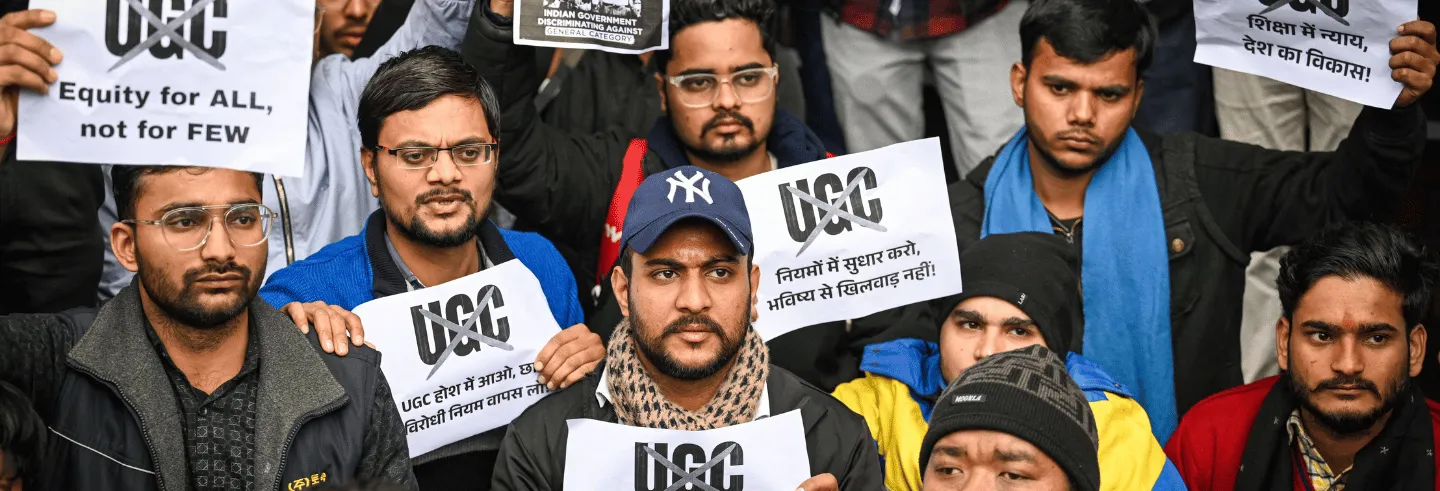
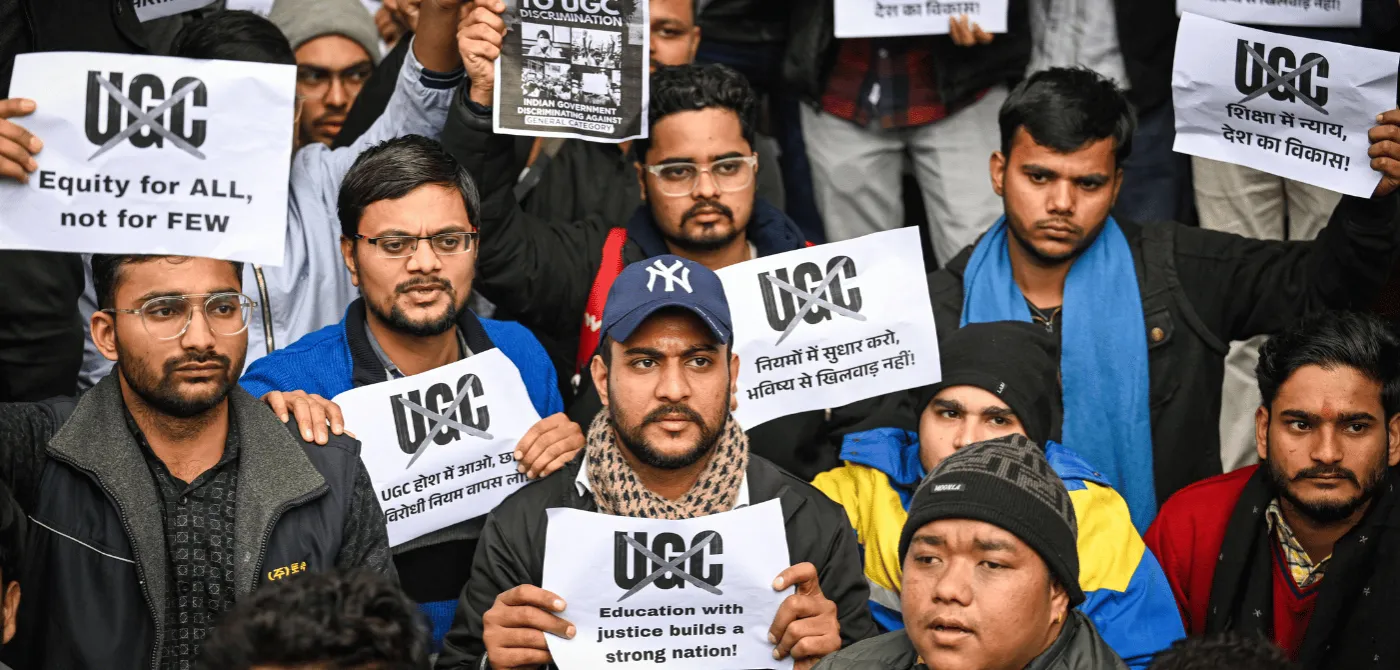
It is this manufactured, self-righteous form of caste-shaped common sense that we seek to question and challenge in this article. We do so by unpacking the accusation that the recently announced University Grants Commission (UGC) Equity Regulation 2026 is “dividing people on caste lines”. This accusation invents a fictitious forward-caste victim in spaces of higher education, supposedly harmed by such “caste division”. In this narrative, the protests, agitations, noise, and theatrics directed against the equity regulation are allowed to pass as natural, unquestioned expressions of civic sense.
The common sense produced and circulated by forward castes now moves rapidly as an imposed myth. It spreads through mass media, prime-time television debates, YouTube channels, Instagram reels, and the breathless rhetoric of social media influencers. It is organised around ideas of discipline, cleanliness, obedience, decorum, and respectability.
Unlike older forms of common sense, this version of “civic sense” does not evolve slowly. It is industrially produced and algorithmically amplified, polished, and packaged for mass circulation through media ecosystems. It presents itself not only as the ideology of particular political groups but as obvious good manners—a way of “keeping the peace” and of opposing what is described as “dividing the universities on caste lines”.
Drawing on various studies (Chand and Karre 2019; Chand 2024; Pathania 2018; Subramanian 2019), and on our own positions as both knowledge producers and lived-experience insiders, we observe that Dalit-Bahujan-Adivasi students often occupy a liminal social and political position. They exist as “bare life”—excluded from full institutional recognition and protection, and kept vulnerable by entrenched caste hierarchies. This condition exposes them to everyday caste-based microaggressions and practices of exclusion.
“Precaution” becomes a style of governance. Collective speech is treated as a risk, solidarity is turned into a problem of crowd control, and anti-caste dissent is recast as disturbance.
We argue that this discourse of civic sense actually functions as a spatial technology of caste. It sorts bodies. It regulates how close people can be to one another. It grants permission to some and casts suspicion on others.
On university campuses, this transforms spaces of learning into tightly controlled grids. Within these grids, the policing of speech, dress, diet, friendships, and gatherings is made to appear as neutral administration of shared standards, rather than as discrimination. In practice, these standards consistently privilege some groups over Dalit-Bahujan communities.
In this arrangement, caste privilege operates like infrastructure. Those whom it protects experience it as an atmosphere of comfort. Those whom it excludes experience it as constant obstruction and friction (Guru 2012). The recent controversy over the UGC’s 2026 equity regulations, and the violent incidents at the University of Delhi early this year, made visible how this mechanism operates and what it costs when anyone dares to challenge it.
Architecture of Exclusion
The Indian university campus carries a deeply felt, often angry, caste-conscious mindset that both permits and forbids. This (spiritual and) spatial organisation of caste does not work only through open, obvious acts of discrimination. It also works through an architecture of “normal” life—through what is treated as appropriate behaviour, legitimate use of space, acceptable forms of association, and permissible ways of expressing grievances.
The speed with which a demand for anti-discrimination measures is turned into a “law and order” file shows that the campus is treated as an administrative grid before it is treated as a shared space for learning. After the confrontation at the University of Delhi over the UGC rules, the administration shifted quickly from discussion to restrictions, including a month-long ban on protests and public gatherings (Dutta 2026).
“Precaution” becomes a style of governance. Collective speech is treated as a risk, solidarity is turned into a problem of crowd control, and anti-caste dissent is recast as disturbance.
A key change, which may appear merely technical, was noted by a member of the 2012 UGC committee. The UGC Regulations, 2026 created a revised and expanded framework, grounded in the constitutional guarantee of equality, that replaced the UGC Regulations, 2012. They were notified on 13 January 2026 and explicitly superseded the 2012 regulations. The 2012 framework itself had been formulated in the shadow of a 2019 public interest litigation filed by Radhika Vemula and Abeda Salim Tadvi.
On 29 January 2026, the Supreme Court suspended the operation of the 2026 Regulations, in response to writ petitions alleging that they would harm “general category” students. In a tense and ironic twist, this effectively put on hold a framework that the Court itself had earlier pushed the UGC to adopt in order to eliminate discrimination on campuses.
The backlash against the Regulations was immediate, organised, and revealing in its language, though it was not unprecedented.
This moment became a political and media flashpoint. In its hearing, the Supreme Court gave institutional backing to the theatrics of victimhood performed by so-called “general category” classes, putting the 2026 Regulations on hold under the claim that they were “completely vague” and indicating that they would remain suspended until further orders (TOI Staff 2026; Jain 2026).
This move effectively erased, at the level of lived experience, the discrimination and violence faced by marginalised and minoritised communities in university spaces. At the same time, it energised both mobilisation and counter-mobilisation on campuses across India.
The backlash against the Regulations was immediate, organised, and revealing in its language, though it was not unprecedented. Claims that the Regulations “divide campuses” act as a pre-emptive moral judgement wrapped in upper-caste assertions of innocence. They transform a structural inequality measured at 118% (The Wire Staff 2026) into a supposed problem of bad manners. They also invert reality by suggesting that naming caste-based harm is the same as causing caste-based harm.
The dispute therefore becomes a struggle over definitions. Is discrimination treated as a rare exception, or as a regular, patterned institutional condition? Is harm reduced to questions of personal intent, or recognised as a built-in feature of the institutional structure? And is a complaint understood as a threat to civic sense, or as a necessary act of naming and resisting injustice?
The Thorat Committee Report of 2007, chaired by Sukhadeo Thorat, documented in painstaking institutional detail what Scheduled Caste (SC) and Scheduled Tribe (ST) students had long known from everyday life. It showed segregation in hostel rooms and dining halls, exclusion from study groups, differential grading, and the constant social violence of being marked as a “reserved category” student in spaces implicitly designed for others. These findings matter because they show that discrimination is embedded in infrastructure and routine practices, rather than being a series of rare, exceptional incidents. The report also presents multiple pieces of evidence that the administration of the All India Institute of Medical Sciences (AIIMS) actively supported “anti-quota” agitations.
Similar agitations, dressed up as civic-minded defence of “merit” (meaning, in effect, Manusmriti-sanctioned exclusivity), were seen in the 1990s. When Prime Minister V.P. Singh noted the near-absence of Other Backward Classes (OBCs) in higher education institutions and announced the implementation of the Mandal Commission recommendations in August 1990, forward-caste students at the University of Delhi and in other cities poured onto the streets in a wave of outrage.
These are two key moments—two points on a long metaphorical and literal line—that separate the popular idea of civic sense, which supports caste governance in Indian universities, from the idea of constitutional morality as imagined and elaborated by B.R. Ambedkar. A more recent point on this line is the reaction to the UGC Regulations, 2026. The events that followed their announcement reveal a recurring pattern—caste power presents itself as “merit”, and any move towards redistribution is framed as a moral injury.
The supposed misfortune of the forward castes—or rather, their actual good fortune—stands in direct opposition to the real national interest of the majority of young people and citizens in this country.
What stands out is not the number of such agitations, but the sameness of the story they tell. These dramatic performances of protest cannot be treated as rare or isolated. They share a strikingly uniform logic of opposition combined with self-victimisation.
The upper-caste backlash relies on a narrow and predictable script. First, it reframes accountability as “reverse discrimination”—petitions claim that the rules “promote discrimination against general category students” and demand supposedly “caste-neutral” protections. Second, it inflates fears of misuse, pointing to the lack of penalties for “false complaints” and invoking the rhetoric used against the SCs and STs (Prevention of Atrocities) Act. Third, it treats the presence of members of reserved categories on enquiry panels as evidence of bias.
At the same time, the final version of the Regulations removed the draft clause on penalties for “false complaints” and expanded the inclusion of OBCs. This is a textbook case of upper-caste groups shifting themselves into a position of innocence—privilege launders itself as victimhood and then names that performance “neutrality”.
While the common-sense idea of civic sense, manufactured by forward castes, is treated as final and as being in the national interest, it is telling that the 2026 Regulations—designed to protect the constitutional rights of caste-marginalised communities, women, and persons with disabilities (across all castes)—are read as a threat. Poet Kumar Vishwas captures this collective outrage in a bitterly ironic line—“Main abhaga ‘savarn’ hoon, mera rounya rounya ukhad lo raja” (“I am the unfortunate upper-caste man; pull out every single hair of my body”).
The supposed misfortune of the forward castes—or rather, their actual good fortune—stands in direct opposition to the real national interest of the majority of young people and citizens in this country, particularly when measured against the welfare and well-being of Dalit-Bahujan-Adivasi students.
Media Validation
In Gramsci’s view, common sense is never produced by accident. It must be shaped intellectually, supported by institutions, and carried through powerful channels of dissemination. In contemporary India, the main carriers of this “civic sense” include the entire digital media ecosystem—YouTube channels with hundreds of thousands of subscribers presenting opinion pieces as “street journalism”; prime-time television anchors staging debates whose questions already contain the answers; Instagram reels that take protest footage out of context; and Twitter/X hashtags engineered to simulate popular agreement (for example, #UGCRollBack).
Phrases such as “caste divide”, “clash”, and “harmony” flatten unequal power relations by treating hierarchy and resistance as if they were simply two equivalent “sides”. “Merit” is presented as a moral virtue rather than a question of fair distribution. “Order” becomes a code word for whose comfort is considered worth protecting. Even the headlines circulating during this period do important political work. By deciding who appears as a defender and who appears as a disruptor, they act as arguments in themselves, shaping the reader’s judgment before any evidence is offered.
On what idea of civic sense and common sense do these violent majorities base their claims? What exactly are they celebrating and for whom?
Within this noise, consider an interview where economist and educationist Sukhadeo Thorat, who served as chairperson of the UGC from 2006 to 2011, speaks about the UGC’s equity regulations. It is titled “Ex-UGC Chairman Sukhdev Thorat Defends UGC Equity Rules Amid Protests Over Caste Divide” and was published as an interview in The Hindu (online edition) in July 2024. This is a textbook example of the language of dominant common sense—the act of naming caste hierarchy is framed as the act of creating caste hierarchy.”
These angry public performances, especially slogans such as “Brahmanvaad Zindabad” (“Long live Brahminism”), raise sharp questions. On what idea of civic sense and common sense do these violent majorities base their claims? What exactly are they celebrating and for whom? What do these slogans mean for marginalised and minoritised communities at an emotional and everyday level? What kind of action do they call for, and why is such fierce expression demanded here?
These assertions also erase and dishonour the struggles and losses of two mothers—Vemula and Tadvi—and of many other Dalit-Bahujan mothers who lost their children to brahminical and casteist practices on campuses.
The performance of upper-caste outrage, the protests against the UGC Regulations, 2026, the institutional bias that enables such inequality, and the repeated failure to protect marginalised and minoritised communities all clearly show whose interests these institutions serve. They also show how these institutions operate within a framework of upper-caste, self-declared innocence.
This leaves Dalit-Bahujan communities with a troubling question—to whom can we turn for protection—for ourselves and for our kin—in these caste-marked university spaces, if not to legal and judicial institutions? If the safeguards rooted in Ambedkar’s work had not given us rights in the Constitution, would upper-caste morality ever have granted us equal space and access in society?
The underlying problem is the structural and social inequality built into institutions. We must ask—for who are these initiatives designed, whom do they truly serve, and who is meant to benefit from them? These tensions call for more strategic engagement, affirmative changes, and institutional reforms.
Drawing on this spiritually and intellectually powerful understanding of our shared humanity, we would welcome careful investigations into whether and when forward-caste claims of hurt are real and measurable.
James Baldwin urges us to see human and individual suffering as a rich, organic resource for understanding—a tool, an entire way of knowing, that can open us to the pain of others, even when that pain has not been inflicted on our own bodies. Drawing on this spiritually and intellectually powerful understanding of our shared humanity, we would welcome careful investigations into whether and when forward-caste claims of hurt are real and measurable.
In doing so, we must be vigilant against performances of imagined pain and symbolic self-sacrifice—whether in the form of actual self-immolation, as in the case of Rajeev Goswami in 1990 during the protests against the Mandal Commission, or in the form of social media performances and “Facebook poetry”, as in the case of Kumar Vishwas. Such acts often exist primarily to oppose efforts to undo suffering that has been historically and systematically imposed on communities other than their own.
Aishwarya AVRaj is a University of Delhi philosophy postgraduate and independent media practitioner. Her work bridges critical philosophy with contemporary discourse on the intersections of caste and gender.
Harshul Singh is an early-career researcher and graduate of SOAS, University of London, researching caste, nationalism, and political discourse in South Asia.