



The uniform civil code (UCC) has been written into law in the Bharatiya Janata Party (BJP)-led states of Uttarakhand and Gujarat. These are the first two laws since India became a republic mandating a UCC. Today, amid the scorching winds of majoritarianism and unremitting state persecution of India’s Muslims and Christians, they do not signal the advance of gender justice that the makers of India’s Constitution had envisaged. Instead, they constitute one more triumph of the Hindutva state, one further eclipse of India’s secular, democratic Constitution.
The laws also alarmingly expand the surveillance and control of young people’s personal choices by the state, by ideologically driven formations, and by families.
During the process of writing the Constitution, Babasaheb Ambedkar was joined by the two women members of the drafting committee, Rajkumari Amrit Kaur and Hansa Mehta, and the Parsi member, Minoo Masani, to propose that an enforceable commitment to a UCC should be introduced in the fundamental rights chapter of the Constitution. (It is perhaps noteworthy that these four persons were not upper-caste Hindu men.) Their proposal was overruled by a thin 5-4 majority (Mitra and Fischer 2002). The constituent assembly finally voted to include this as a non-enforceable recommendation in the Directive Principles chapter.
It took 75 years after the Constitution came into force for the first laws decreeing a UCC to emerge. However, the laws are vastly distant from the UCC that the founding mothers and fathers of the country had envisaged. They had intended a UCC to advance gender equity while protecting every citizen’s fundamental right to religious freedom. Instead, the UCC has been weaponised to further power the Hindutva juggernaut marching to a Hindu India.
The laws treat Hindu personal law as beyond the need for reform. Their subtext instead is of Muslim men being, in the words of feminist lawyer Flavia Agnes, “pre-modern, lustful, polygamous and barbaric” and Muslim women “devoid of rights and lacking agency” who need rescue by the Hindu state (Mitra and Fischer 2002). The laws also alarmingly expand the surveillance and control of young people’s personal choices by the state, by ideologically driven formations, and by families. They discourage, indeed make highly perilous, relationships that cross the orthodox boundaries of religion, caste, and gender.
In the Constituent Assembly
Personal law deals with rules that govern the intimate space of the family, in matters like marriage, divorce, inheritance, and adoption. For centuries, these aspects of individual and social life have been regulated by local religious and cultural rules and institutions. There is a mind-boggling diversity of norms and rules governing the personal sphere, even within each major religious group—Hindu, Muslim, Christian, Sikh, Jain, and Buddhist. Tribal groups and other sects that do not identify with any of these religious identities also have their myriad customs, beliefs, and practices.
India’s British colonisers legislated nationally binding criminal and commercial legal codes. However, in civil matters of personal law, they decided to let local religious and customary laws, practices, and rules prevail. Most of these local personal laws were not codified, so colonial magistrates relied on textual readings and interpretations, and consultations with clerics.
Those interpreting personal laws were almost always men from privileged backgrounds. What was lost in this process of codification was the granularity of rich diversity that flourished within various religious and customary orders. What was also lost was the possibility of progressive and gender-just interpretations of the religious texts.
Therefore, when the Indian republic resolved to retain the personal laws of various religions that prevailed at the time of freedom as law, these were not undisputed formulations of religious prescriptions that were binding on believers.
The proportion of Muslims had plummeted from 25% of the Indian population to 12%, and a million lives had been lost in the riots that engulfed the sub-continent when India and Pakistan were separated.
These were, instead, as feminist scholar Nivedita Menon observes, interpretations of religious texts and simplifications of “vastly heterogeneous family and property arrangements within the ambit of four major religions: Hindu, Muslim, Christian, and Parsi” in ways that were mediated by colonial administrators and male religious clerics. “The resultant personal laws of each of these religions that are being defended today in the name of tradition and religious freedom are”, she argues, “colonial constructions of the late nineteenth and early twentieth centuries” (Mitra and Fischer 2002).
Historian Tanika Sarkar notes that the British colonial government refused the demand of Indian social reformers to legislate on matters such as age of marriage and domestic violence, claiming they sought to protect Hindu customs and traditions.
As freedom approached, the Muslim League expressed its anxieties about whether Muslim education, religion, personal law, and charitable institutions would be protected. Jawaharlal Nehru sought to allay these fears by assuring Mohammed Ali Jinnah in a letter in 1938 that “Muslim personal law and culture should be guaranteed by statute” (Mitra and Fischer 2002).
As Frontline recalls, when India’s constituent assembly finally debated the questions of religious freedom and personal laws during the debate on a UCC on 23 November 1948, this was in a very different India. It was apparent that visibly shaken Muslim members were gripped by a sense of fear. The proportion of Muslims had plummeted from 25% of the Indian population to 12%, and a million lives had been lost in the riots that engulfed the sub-continent when India and Pakistan were separated.
This was why it is unsurprising that all those who spoke against the UCC in the constituent assembly were of Muslim identity. It is perhaps instructive that most of those who argued in favour of the UCC were Hindu upper-caste men (Gundimeda 2024). The same chasm, even wider and more irreconcilable, is visible in Narendra Modi’s India.
It is also interesting that both those who supported the UCC and those who opposed it appealed to the principles of secularism.
Many Muslim members expressed grave anxieties that a UCC would curtail their religious freedoms guaranteed by secularism. M. Muhammad Ismail, for instance, argued that in a secular state, no group or community should be made to abandon their personal laws. A genuinely secular state should allow and respect personal laws.
Mahboob Ali Baig held that in a secular state, the diversity of religion and cultures of people must be acknowledged and they should have the freedom to practice their religion and culture. Imam Hussain, reflecting on the secular character of the Indian republic, made an important distinction between anti-religious and non-religious states. He said the Indian state is non- religious, but not against religion itself. Therefore, the state must secure the freedom of people to practice their religion and cultural practices.
Since every personal law abridged or denied women’s equal rights, the idea of the UCC represented an egalitarian impulse of free India’s founders.
K.M. Munshi, on the other hand, expressed the view that secularism could be strengthened and the entire country consolidated into one only when people abandon their personal laws (Gundimeda 2024). Incidentally, later in his public life, Munshi was a founding member of the Vishwa Hindu Parishad, a prominent affiliate of the Sangh Parivar. His belief that national unity was incompatible with religious pluralism mirrors the Hindutva view, which contradicts the Indian constitutional idea of secularism and the intent of the constituent assembly when it recommended a UCC.
What was this intention? The constituent assembly voted to guarantee the fundamental right to freely “profess, practice, and propagate religion” to all citizens (Article 25[1]). But Article 25(2) that immediately follows clarifies that this freedom is not unlimited. It states that the freedom of religion “shall not affect the state power to regulate or restrain secular activity associated with religious practice and to provide for social welfare and reform”.
Read together, these two clauses help explain the intent of the constituent assembly when it introduced Article 45, which recommended that the state should endeavour to secure for its citizens a UCC throughout the territory of India. This was not in pursuit of a homogenising project to erase the rich diversity of religious custom and practice. Instead, it was to advance social welfare and reform.
Since every personal law abridged or denied women’s equal rights, the idea of the UCC represented an egalitarian impulse of free India’s founders. Its hijack three quarters of a century later by a Hindutva project of stigmatising and denying freedom of religious conscience and practice to India’s religious minorities is a profound betrayal of India’s constitutional morality.
In Free India Before Modi
One of the early legislative initiatives of the Nehru-led government in 1951, with Ambedkar as law minister, was the Hindu Code Bill. However, this met with massive opposition from the Hindu right, including within the Congress Party. This led Nehru to shelve the proposal and Ambedkar to resign from the Cabinet in protest. After receiving a massive electoral mandate in the first general election in 1952, Nehru brought back a watered-down version of the original legislation in 1954, in the form of four statutes—the Hindu Marriage Act, the Hindu Succession Act, the Hindu Minority and Guardianship Act, and the Hindu Adoption and Maintenance Act.
These statutes were not in the nature of far-reaching reforms for gender justice in Hindu personal laws, which, I imagine, was the original aspiration of Ambedkar and Nehru. Equal share for daughters in inherited property had to wait for the 2005 Hindu Succession (Amendment) Act. These earlier statutes were more in the nature of a codification of Hindu personal law. Critics also observe that what was assumed under these statutes to be “Hindu” religious practices and customs were mostly north Indian upper-caste practices that now became the law for all Hindus. They erased both the vast diversity of heterogenous Hindu rules and practices and the practices that were more liberal and progressive.
The dispute reached the Supreme Court, which ruled in her favour in its 1985 judgment … Its ruling was based not just on principles of gender equality, but also on quotes from Muslim religious texts.
Nehru testified to his “extreme sympathy” for the UCC. Still, he did not follow up the codification of Hindu personal law with initiatives to reform Muslim personal law. He was criticised by the Hindu Mahasabha both for what they saw to be unwarranted encroachments of the state in Hindu religious matters, and for not bringing Muslims into a similar process. Nehru had seen the Hindu Code as a way of “preparing the ground” for this. However, he later felt the time was not “ripe” because the wounds of the Partition violence among Indian Muslims had not yet had time to heal (Purandare 2017).
The UCC was always high on the agenda of the Jan Sangh and its successor, the BJP, but for very different ends. It returned to the top of the national agenda only in the 1980s with the political rise of the BJP. Matters came to a head when Shah Bano, a Muslim woman, approached the secular courts because her husband married another woman before divorcing her and refused to pay her a monthly maintenance because it was not mandated in Muslim personal law.
The dispute reached the Supreme Court, which ruled in her favour in its 1985 judgment in Mohd Ahmed Khan vs Shah Bano Begum. Its ruling was based not just on principles of gender equality, but also on quotes from Muslim religious texts. Sections of the Indian Muslim leadership took umbrage to what they saw as an illegitimate assault by the court on Muslim personal law. The All India Muslim Personal Law Board and Jamiat-Ulema-e-Hind launched a mass agitation demanding that the Supreme Court order be nullified.
The Rajiv Gandhi government acceded to this demand by steering the Muslim Women (Protection of Rights on Divorce) Act, 1986. This restricted the husband’s duty of alimony to only 90 days of iddat (mandatory waiting period), and shifted the duty to support the divorced woman to her family and the community (through waqf).
This appeased those segments of the Muslim community who were aggrieved by the judgment because they felt that the law conformed to Muslim personal law. However, it is important to note that there was no unanimity within the Muslim community on this question. The All India Shia Personal Law Board, for instance, supported the idea of the absolute duty of the divorced husband to pay maintenance to the divorced wife.
The first significant statutory intervention annulling Muslim personal law engineered under Modi was to criminalise the practice of oral divorce or triple talaq.
The consequence of the Shah Bano case and the law that followed was to create a further decisive rupture in communal relations between Hindus and Muslims, particularly between Hindutva advocates and the Muslim orthodoxy.
Both through court rulings and legislative actions, reforms in personal laws continued incrementally. Subsequent rulings of the Supreme Court restored the duty of maintenance on the Muslim husband. Divorce among Indian Christians was governed by the Indian Divorce Act, 1869. Sustained discussions within the community led to a reformed Indian Divorce (Amendment) Act of 2001, which eliminated gender discrimination on divorce grounds and introduced mutual consent divorce.
I spoke earlier of the 2005 amendment that gives Hindu daughters equal inheritance rights as sons in ancestral property. The Domestic Violence Act (2005) offers women of all communities protection from domestic violence as well as rights to the matrimonial home. Amendments to the Juvenile Justice Act (2006) opened pathways for Muslim couples who wished to legally adopt a child.
Hindutva and the UCC
Unlike for feminists and liberals, for Hindutva ideologies, the UCC has never been a vehicle for securing gender justice in matters of divorce and inheritance. The UCC is instead weaponised to stigmatise and if possible, criminalise Muslim men as irretrievably oppressive to women and sexual predators. It has also treated both Hindu personal law and Hindu men outside any need for reform. The UCC it envisages would annul Muslim personal law practices related to marriage, divorce, and inheritance, and instead impose rules and practices akin to the Hindu Code. Muslim personal law must go because it allows Muslim men to practice polygamy, inherit a greater share of property, initiate divorce, and deny alimony.
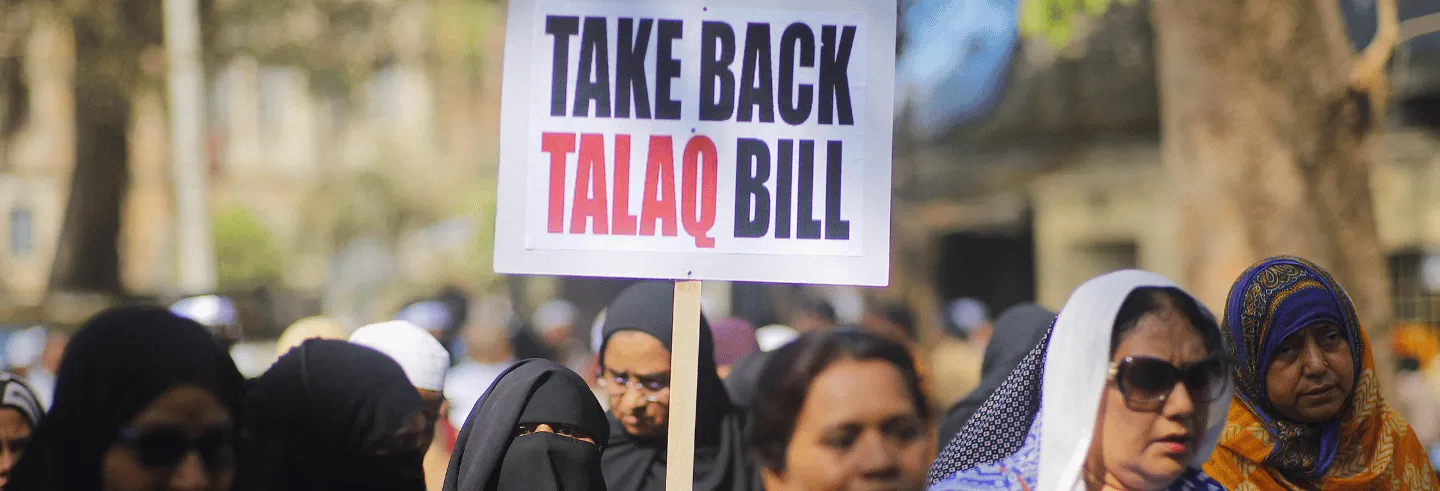
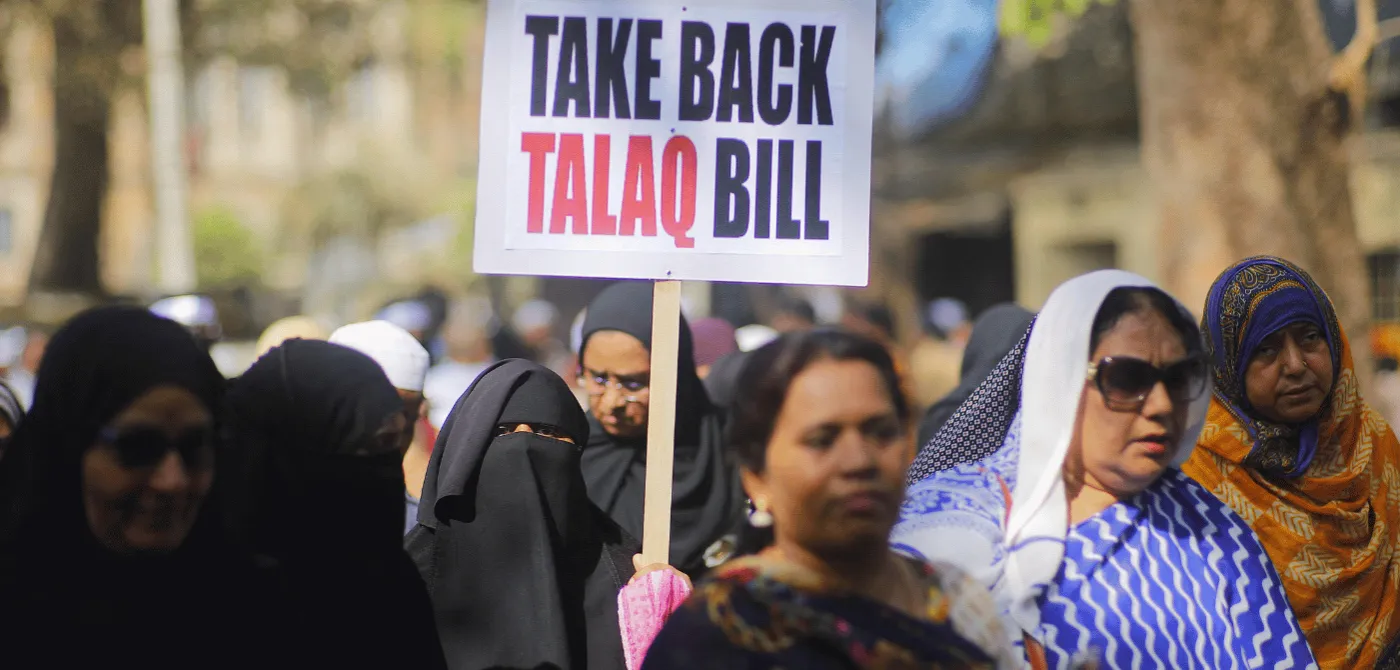
The first significant statutory intervention annulling Muslim personal law engineered under Modi was to criminalise the practice of oral divorce or triple talaq. Many Muslim countries have banned the practice, and a majority of Muslim scholars and clerics deny that this practice is sanctified or permitted under Islamic law. Therefore, there was no significant opposition when the Supreme Court ruled that oral triple talaq did not annul a marriage in its 2017 Shayara Bano judgment.
However, this ruling was not enough to fulfil the unstated objective of the ruling regime of maligning the Muslim man and portraying the Muslim woman as in need of rescue. The union government introduced a bill in 2019, which was then passed by Parliament as the Muslim Women (Protection of Rights on Marriage). This criminalises a man who resorts to triple talaq and can lead to him spending up to three years in prison. This was the first time that criminal law has been introduced into personal civil law, a practice that lawmakers have continued in the two laws on UCC.
What does this criminalisation mean in practice? A Muslim man recites talaq thrice orally and abandons his wife. The Supreme Court ruling is that the marriage is not annulled. Yet the man (who continues to be the woman’s lawful husband) is a criminal who can be punished with a jail sentence.
If abandonment of a wife is to be considered a crime, then this raises the question why this should apply only to Muslim men? If a Hindu man abandons his wife, after saying talaq once, or thrice, or not at all, it is not deemed to be a crime? Does this not violate the constitutional fundamental right to equality?
The UCC law was passed by the Uttarakhand Assembly on 7 February 2024 amid chants of “Jai Shri Ram”, “Vande Mataram”, and “Bharat Mata Ki Jai” by BJP MLAs.
In January 2025, the Uttarakhand state assembly became, as we noted, the first state to adopt a UCC after independence. (The state of Goa is governed by a much older 1867 Portuguese Civil Code.) This was followed by a similar law passed in March 2026 by the Gujarat assembly. It is likely that other BJP-ruled states will follow with similar UCC statutes. Examining the process and content of these two laws will help us understand the Hindutva conception of a UCC, and how this departs in significant ways from how feminists or liberal supporters envisioned it.
The passage of neither law was preceded by consultations with members of minority communities—especially women and sexual minorities. Nor was there any mapping of the existing rules, customs, and practices related to marriage, divorce, succession, and adoption of local communities in the states where the UCC has now replaced them by law.
The UCC law was passed by the Uttarakhand Assembly on 7 February 2024 amid chants of “Jai Shri Ram”, “Vande Mataram”, and “Bharat Mata Ki Jai” by BJP members of the legislative assembly (MLAs). Gujarat Chief Minister Bhupendra Patel was candid in describing the roots of the UCC in Hindu scriptures. Introducing the bill, he declared, “A common legal framework is necessary for a united and undivided nation, and that reflects our Vedic knowledge. Our ancient verses also say that the truth is one, even if expressed in different ways; and if the truth is one, then even if religions are many, justice must be one” (Outlook Web Desk 2026).
Legal experts concur that Uttarakhand’s UCC is derived substantially from Hindu personal law, and that this could result in the erasure of personal law practices of minority communities. Senior advocate Mohan Katarki said to Scroll, “The attempt to impose Hindu practices on non-Hindus is visible.” Advocate Sanjay Ghose agreed. “The community impacted the most by this bill will be the Muslims,” he observed. “There is complete effacement of their personal law.” Katarki was more scathing: “The long and short of the bill is to ban polygamy among Muslims and regulate live-in relationships!” (Scroll Staff 2026).
Not just in matters of marriage and divorce. Scroll compared the Uttarakhand law with the secular Indian Succession Act, 1925, and the Hindu Succession Act, 1956, and found that among the 375 sections dealing with these succession or inheritance, only 14 sections are new. All the others are reproduced verbatim or with minor changes from these existing statutes. The laws also do nothing to tamper with or reform the provisions related to the Hindu Undivided Family except to treat self-acquired property in the same way as ancestral property. It does not change its patriarchal and gender discriminatory provisions (Scroll Staff 2026).
The two statutes also do not in any way incorporate progressive elements from any of these other minority personal law traditions. The Uttarakhand Mahila Morcha, a collective of women’s groups, agrees that the law has followed “the Hindu law template”. It adds that the law “has not incorporated positive and progressive aspects of Muslim law”.
This means that an Uttarakhand resident who wishes to marry in ways that escape the scrutiny of the state, the family, and hardline opponents to inter-faith and inter-caste marriages is left with no safe way to do this.
It maintains that if the lawmakers were genuinely motivated to advance gender justice, it would have extended to women of all communities the Muslim family law practices of compulsory payment of mehr or dowager, which provides financial security to the wife. It would also have incorporated the idea of a nikahnama or marriage contract, which allows the spouses to add mutually acceptable, legally binding conditions to their marriage (Scroll Staff 2026).
The laws erase many gender-unjust practices in Muslim personal law, including polygamy, unequal inheritance between male and female family members, and halala divorce (under which a person can only remarry his divorced spouse after she has married someone else, consummated the marriage, and then obtained a divorce). Divorce can now be granted by courts and not by community mechanisms as laid down in Muslim personal law.
But the laws do not just make these practices unlawful: they make them criminal acts. Continuing with these practices now have criminal consequences, in the same way that the law banning tripe talaq for the first time introduced criminal penalties for civil violations. If, for instance, a divorce is done without a court order in Uttarakhand, this can lead to a prison sentence of three years.
The Uttarakhand law lays down that a person can lawfully remarry a divorced spouse only if there are no conditions such as marrying a third person before such a marriage: this is a prohibition on the practice of nikah halala. But anyone who “compels, abets or induces” a person to observe any such condition before remarriage can be punished with a prison term of up to three years and also be fined up to Rs. 1 lakh (Bhaumik 2024).
The laws make the official registration of marriages mandatory. The Uttarakhand law prescribes that marriages that occur after the enactment of the law have to be compulsorily registered within 60 days. This applies to all marriages within or outside the state as long as at least one person is a resident of Uttarakhand.
This means that a resident of Uttarakhand who wishes to marry in ways that escape the scrutiny of the state, the family, and hardline opponents to inter-faith and inter-caste marriages is left with no safe way to do this. Failing to do this can attract a penalty of up to Rs. 10,000, besides a three-month jail term and a fine of Rs. 25,000 if false information is intentionally given during marriage registration.
Before issuing the marriage certificate, the Gujarat law requires the registrar to “notify the registration in the public domain (for 30 days) through local newspapers, social media and by registered post to the blood relatives of both the parties or by notification in the public domain through any other form as deemed fit by the state government”. The personal and societal consequences of this are obvious. In effect, it requires the consent of parents to the registration of a marriage between two adults. It also informs activists of hardline organisations that are opposed to marriages between people of different religions or castes.
The laws do not stop here. For the first time, they make it mandatory even for couples in live-in relationships to inform public officials and register their live-in relationship. The Uttarakhand law lays down that all heterosexual couples (irrespective of whether they are residents of Uttarakhand or not) who choose to live together in the state must register their live-in relationships by submitting a “statement” to the registrar with their details.
These intrusive laws rob young people of their sexual agency and their right to choose who they wish to befriend, live with, and marry. It renders them vulnerable to social scrutiny and moral policing.
The registrar has 30 days to either register the relationship or deny registration and notify the partners in writing. According to the statute, the registrar must also notify the parents or guardians of any partner under the age of 21 and provide the live-in relationship statement to the head of the local police station, ostensibly for record-keeping. If such a relationship is terminated, the law requires the couple to inform the registrar of this as well (Bhaumik 2024).
The Rules go further: apart from filling a 16-page form, you need a certificate from a religious leader that you are eligible to marry if you so wish, and details of previous relationships. These make inter-faith and inter-caste live-in relationships so perilous as to render them virtually impossible.
In case a couple has spent a month without registering their live-in relationship, they can face a jail term of up to three months or a maximum fine of Rs. 10,000, or both. Any false statement by them will also attract the same jail term, but a higher fine amount of Rs. 25,000, or both. Upon being issued a notice, if they still do not register, they may face six months of imprisonment or a fine of Rs. 25,000 or both (Bhaumik 2024). These punishments are even more severe than for failing to register marriages.
These intrusive laws rob young people of their sexual agency and their right to choose who they wish to befriend, live with, and marry. It renders them vulnerable to social scrutiny and moral policing, both by an ideologically hostile meddling state and violent mobsters. Bhuwan Chandra Kapri, a Congress MLA from Uttarakhand, said to Frontline, “Imagine the nightmare for women—records creating marital havoc, complaints flying from disgruntled relatives or snooping neighbours. An emboldened Bajrang Dal prying into your private life…” (Ara 2024).
Both the UCCs have scrupulously not introduced many reforms for gender justice that feminists have demanded for a long time. For instance, the grounds for divorce that it prescribes include even religious conversion but not “irretrievable breakdown of marriage”. This despite several Supreme Court judgments that recognise this as a legitimate ground for divorce (Bhaumik 2024). And, as feminist commentator Saumya Uma notes, these laws erase recognition of multiple non-heteronormative forms of family and non-biological kinship systems that have historically existed and continue to exist in India (Dudharejiya 2022).
They fall behind the 2022 Deepika Singh judgement of the Supreme Court that expanded the traditional definition of family, to include domestic, unmarried partnerships, and queer relationships (Prakash 2022). This is especially salient for transgender and queer persons whose biological families may reject them, but who form other kinship bonds. The laws also do not recognise same-sex marriages (Uma 2026).
Uma also points to the regressive retention by the Gujarat UCC of the matrimonial remedy of restitution of conjugal rights, which compels an unwilling spouse to cohabit with their spouse. This remedy is a part of the personal law of Hindus, Christians, and persons marrying under the Special Marriage Act, and has been extended to Muslims through case law. The laws are also silent on adoptions (Uma 2026).
Where Do We Go from Here?
One conclusion is inescapable for me. This is that the feminist-liberal project of the UCC must be restored to the law and policy cold storage where it was confined between Nehru’s passing and the rise of the BJP. This is not just because of the malign hijacking of a potentially progressive and egalitarian legal framework by the Hindutva project to fulfil its key objectives.
These are to dismantle secular democracy and replace this with the idea of a Hindu India; to demonise and criminalise Muslim men; to stigmatise minority religious beliefs and practices, to impose unreformed upper-caste north Indian Hindu religious and cultural beliefs on all Indians; to stand in the way of genuine reforms for egalitarian personal laws that respect individual agency and choice; to expand state and mobster surveillance and control over intimate spaces of love, sex, and friendship; and to choke fraternity by making relationships that cross boundaries of religion and caste impossible.
Progressive feminist opinion needs to turn away from its earlier espousal of the UCC not just because Hindutva has poisoned the space for gender-just and choice-based personal laws. Even if there was an authentically liberal government in the future that undertook a project to build an egalitarian UCC in good faith, I am no longer sure this would necessarily be a public good. Just as the planet is sustained by biodiversity, human civilisation is also sustained by human cultural diversity. Uniformity entails homogenisation, the majoritarian imposition of dominant belief systems and practices of the powerful. There is immense merit instead in protecting and nurturing the unparalleled diversity of Indian life, of ways of living, loving, and parting.
You might say, let a “good faith” state survey all the diversity of personal laws in India and choose the best among them. However, as veteran journalist Dilip D’Souza asks pertinently, what yardsticks would you apply to choose the “best” practices? He takes as an example of inheritance rules. Christians and Hindus exclude parents, and Parsis and Muslims do not. What is the “best” among these? (D’Souza 2024).
Feminists also consider certain Islamic marriage practices to be progressive and pro-women—among them, the treatment of marriage not as a sacrament but as a legal contract, and the practice of mehr, the bride price paid by the bridegroom, which is the exclusive property of the bride. But is it feasible to impose these by law on Hindu and Christian marriages as well?
What courts and the executive should examine is whether any religious practices violate the fundamental rights to equality and non-discrimination of any citizen. These, it must strike down.
Am I then suggesting that personal laws should be allowed to operate with no interference by the state even those that might discriminate against women or sexual minorities or certain castes or persons with disability? Absolutely not. The fundamental rights chapter of the Constitution makes amply clear the duties of a secular, democratic state. While it guarantees the fundamental right to freely profess, practice, and propagate religion, it simultaneously underlines the state’s power to regulate or restrict secular activity associated with religion and to provide social welfare and reform.
I go further to argue that India’s secular, democratic Constitution does not simply empower the state to intervene to bring about religious reform for equity and justice. On the contrary, it obliges the state to intervene when religious practices violate fundamental rights of some citizens, particularly those who are disadvantaged by gender, religion, caste, ethnicity, and disability.
The Supreme Court has in around 50 significant matters adjudicated on which are essential religious practices and which are not (Verma 2024). This has entailed India’s highest court to read and sometimes controversially interpret religious texts, with conclusions that are open to question. This too is not what I recommend.
I am convinced that India’s courts should confine themselves to interpreting religious practices in the light of the Constitution, and not religious scriptures. The relevant question should not be whether the religious practices are essential to the religion or not. What courts and the executive should examine is whether any religious practices violate the fundamental rights to equality and non-discrimination of any citizen. These, it must strike down.
For this to happen, people should not be dependent only on the initiative of the state. Three quarters of a century after India resolved to be a secular, democratic state, the most robust defence of secular democracy would be for progressive and feminist forces within religious communities to take leadership for egalitarian religious reform. Let communities initiate extensive consultations to identify and demand the reforms necessary for religious practices to conform to the egalitarian and humanist guarantees of India’s Constitution.
I reiterate that the path ahead for securing secular democracy is not to impose a majoritarian uniformity of personal laws. It is for the state and communities to come together to find ways to defend the rights of individuals and communities to freely practice their religious beliefs and customs, as long as these do not transgress the fundamental rights of any citizen, especially women, sexual minorities, oppressed castes and other religious faiths.
Acknowledgement: I thank Syed Rubeel Haider Zaidi and Nawal Hamd for extensive research support.
Harsh Mander is a human rights activist, peace worker, writer, and teacher. He works with survivors of mass violence and hunger, and homeless persons and street children.