
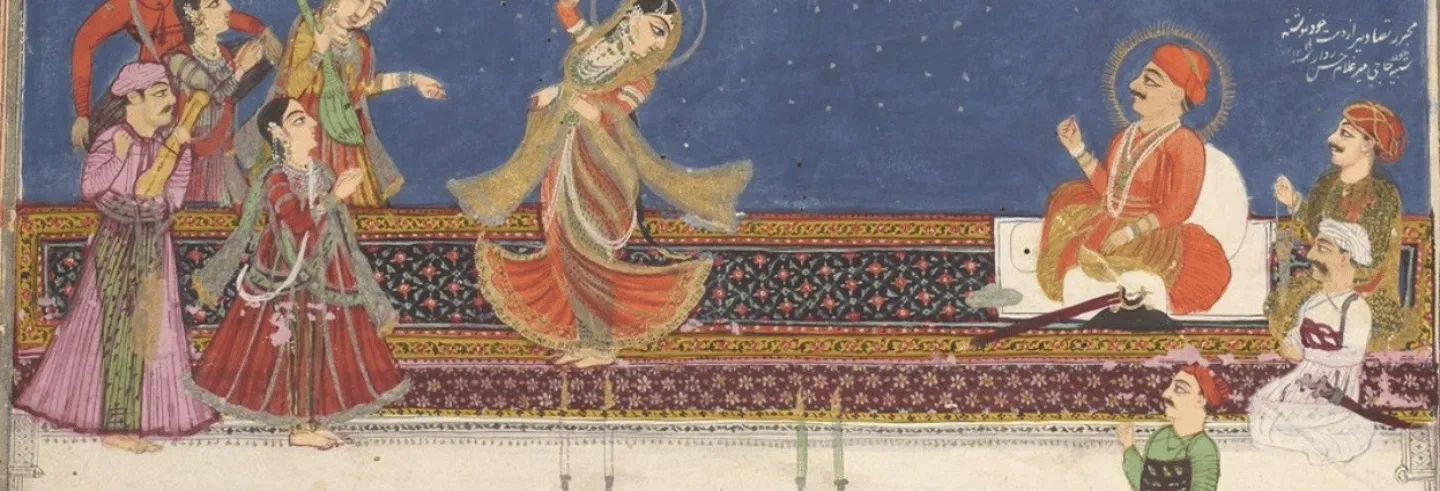
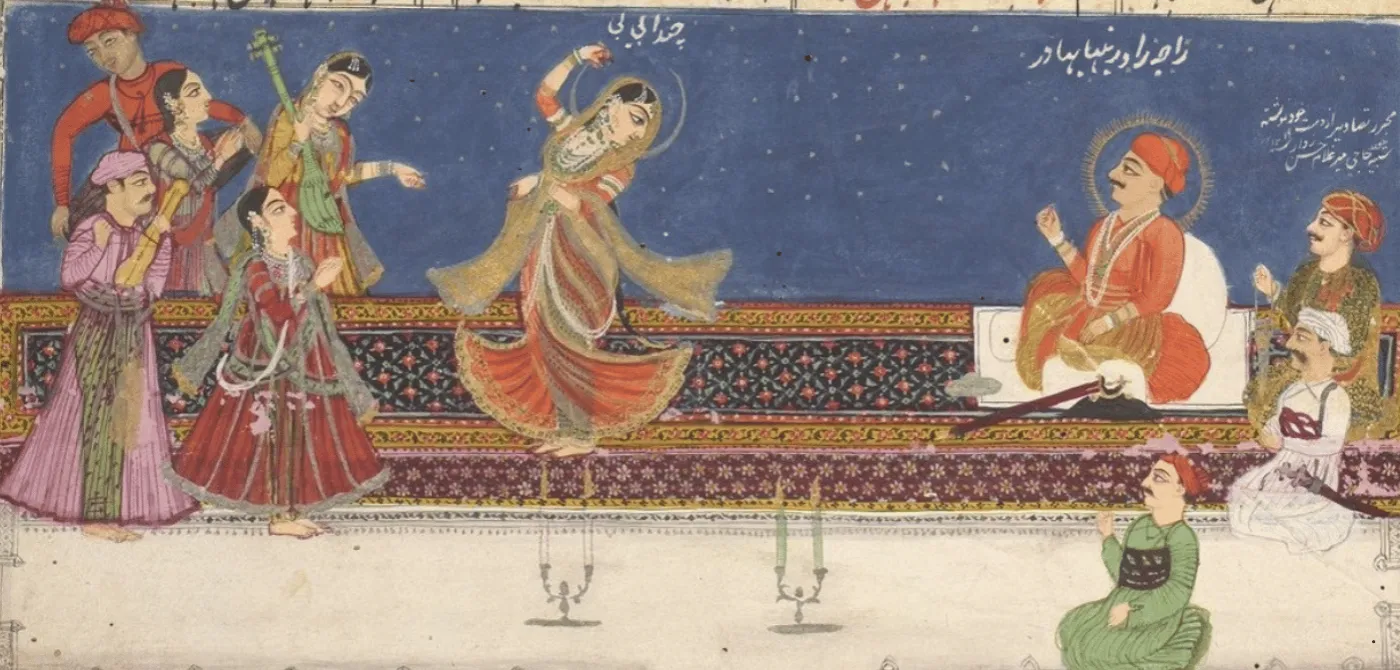



A mujra is an act of paying respect, typically to a higher authority—a patron, someone higher in social rank, or God/the divine. A popular devotional song (bhajan) reads:
राम झरोखे बैठ के सब का मुजरा लेत ।
जैसी जाकी चाकरी वैसा वाको देत ॥
Rama sits at the window and accepts everyone’s mujra.
As a person’s service to him is, so is the reward he gives that person.
Kathak exponent and scholar Pallabi Chakravorty (2008) writes that mujra is often a choreographed ritual of salutation, usually performed by courtesans and Kathak dancers before they proceed to other music and dance performances.
To my pleasant surprise, my grandmother-in-law remembers watching a mujra by courtesans as a young girl, at the jalsa (celebration) hosted by the local ruler in her hometown, Uniara in Rajasthan. “The girls would dance, sit in front of a man, and stretch out their palms, saying mujro sa (please offer me your respectful gift); the man would put some money on their hands,” she recalls.
Although now frowned upon for looking “cheap”, there was a time when even seasoned baijis would do the thumka as part of their performance.
Thumri, by contrast, is a genre of Hindustani music (and of dance and abhinaya [expressive storytelling through gesture and facial expression]), typically associated with both hereditary and non‑hereditary singers and with Kathak dancers. Although prominent male vocalists have sung thumri over many decades, it is considered primarily a feminine voice, one that explores desire, longing, and a complex, layered spectrum of human emotions (Rao 1990). Nakhra (coquetry or playful affectation), nazakat (delicacy or grace), layered interpretation of the text, and thumka (rhythmic sideways hip movement) were all part of the performance.” The word Thumri colloquially comes from the word ‘thumak ke rijhana’ or ‘thumka’, with rijhana meaning to woo.
Although now frowned upon for looking “cheap”, there was a time when even seasoned baijis (courtesans) would do the thumka as part of their performance.
Here is a description of a mujra by Siddheshwari Devi of Banaras:
“Gradually, her face and arms began to move as though she was acting as well as singing. The hand gestures and mime tried to paint different versions of the picture described in the thumri she was singing.
“With each song, the atmosphere in the pandal (festive tent) became more and more informal. After some time an uncle of the bridegroom called out to her with a request to dance: ‘Baiji zara jhumke ke saath ho jai!’
“… She began to tie on her ankle bells. This was obviously a stage of the entertainment that was most eagerly awaited, because the audience hailed it with glad cries.
“... When the atmosphere warmed up, this was meant to turn into a dance recital. The ensemble became mobile within minutes and was now able to address and delight each section of the audience intimately in turn.” (Dhar 2005).
Here, one clearly sees the distinct importance of the thumka and of light dancing as integral parts of the whole performance.
Apart from entertainment, such performances were also part of key social functions. Artists would be invited to perform at weddings, childbirth ceremonies, and other such occasions (Prasar Bharati Archives 2022).
In films, mujra is almost always presented as a song performed by a courtesan. Some filmi mujras are based on thumri, but most are not. One of the earliest filmi mujras I saw was in the movie Bilwamangal (1919), which I watched at the National Film Archives of India, Pune.
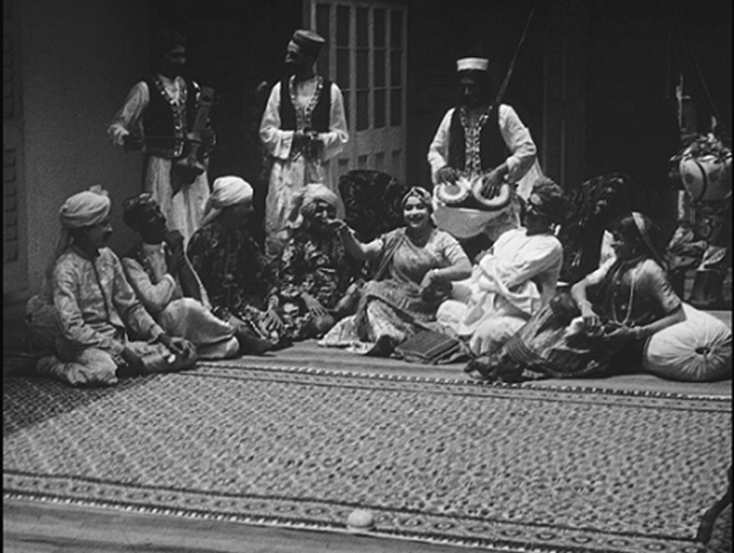
It showed courtesan Chintamani seated with the audience surrounding her, singing while moving her hands, with light dancing.
Since, traditionally, the artist sang and danced or emoted simultaneously, the dance was typically not very fast, extensive, or jumpy, and it was interspersed with short technical dance pieces. In films too, the actors initially sang on the spot. After 1935, with the advent of playback singing and advancements in camera technology, the dancing body had more freedom to move, and gradually the dances incorporated varied, fast, and complex movements.
The performance in Bilwamangal, much like many mujra songs of the late 1930s and 1940s, seemed closer to the traditional live set-up of the dance, where the movements were not very fast. The expressions were naturalistic, and the exaggerated filmi expressions were still a few years away.
The dancer lip-syncs to the song, typically standing and moving her hands with expressive gestures at a moderate speed. The short, technical Kathak‑like tukdas (compact rhythmic sequences), tihais (phrases repeated three times to land on the first beat), or movement patterns are performed separately in between stanzas or at the end, almost as artistic relief, and are not yet integrated into the choreography as a whole. “Ye Raat Phir Na Aayegi” (Mahal, 1949), “Mere Pehlu Mein Hai Zindagani” (Elaan, 1947), and Leela Desai’s dances in Nartaki (1940) are some notable examples of this style of dancing in mujras.
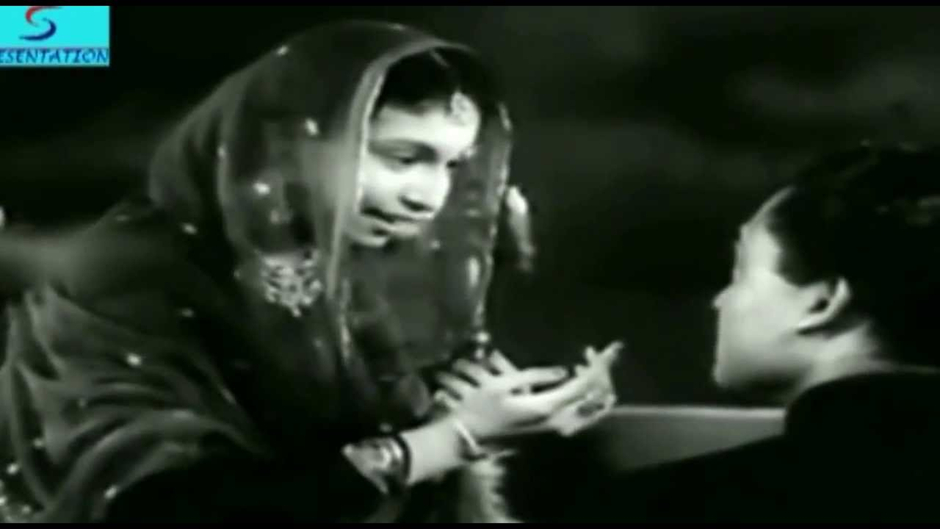
What we now think of as a typical Bollywood style begins to take shape in the 1950s, when a somewhat unified, identifiable genre of dance emerges.
“Pehle ke director, Bimal (Roy) da wagerah, kothon pe jate the, ye dekhne ki ada kya hoti hai,” (In earlier times, directors like Bimal Roy and others used to visit kothas [courtesans’ salons] to see what real ada [graceful style and mannerisms] looked like), said Habiba Rahman, Kathak dancer, film dancer and choreographer in a personal interview.
Producers and directors sent actresses to learn Kathak from dance masterjis. The aim was to incorporate not just fluidity in dance but also the adayegi (the art of expressive performance).
Geeta Thatra’s 2013 paper on Congress House and Nav Bharat (NB) Compound in Mumbai, at one time a prominent venue for mujras, sheds light on this. She quotes Prem Patel, one of the residents of Congress House, “There were a lot of film industry people who used to go there to watch mujra in those days. The Naz Building was the headquarters of the Indian film industry. All the big film producers’ offices were there, and they had their association—the Indian Motion Pictures Producers Association (IMPPA)—and their General Body. Meetings used to be held at Jinnah Hall (in the Congress House premises) every year. Many of the producers would also visit the mujra place during those days” (Thatra 2013).
It must be mentioned here that many actresses themselves in early Bombay Cinema also came from a courtesan background. (Vanita, 2018)
This is important. It shows that the courtesan’s art was also a reference point for film-makers. The way courtesans expressed themselves, how they wooed, how they showed shyness, became templates for actresses to draw from in order to look more desirable and expressive on screen. This also explains why, in my research, I found an unbroken continuity of actresses learning Kathak from the 1940s to the present.
Producers and directors sent actresses to learn Kathak from dance masterjis (dance masters). The aim was to incorporate not just fluidity in dance but also the adayegi (the art of expressive performance). Although this in no way negates the individual star persona or the specific acting process and influences of each actor, it serves as an important reminder of how interconnected the ecosystem of films, courtesans, and Kathak is.
The charm of facial expressions and subtle dancing thus remains a strong presence, even as the overall speed of dance increases in this decade. Songs such as “Ghar Aaja Ghir Aaye Badra,” featuring Sheila Vaz (Chhote Nawab, 1961), “Raat Bhi Hai Kuch Bheegi Bheegi,” featuring Waheeda Rahman (Mujhe Jeene Do, 1963), “Baharon Ki Mehfil Suhani Rahegi,” featuring Meena Kumari (Benazir,1964), and the underrated mujras of Roopmala—“Bajooband Khul Khul Jaye” (Bazooband, 1954) and “Baithe Balma Humare Nazar Pher Ke” (Nastik, 1954)—stand out for their soft beauty.
From this point onwards, especially 1960s and 70s, the dance tends to become jumpy, high-energy, and vivacious. If earlier songs had, figuratively, two movements in four beats, now they have eight movements in the same number of beats.
The style acquires exaggerated nakhra and slightly loud, dramatised expressions. The speed of the choreography is noticeably faster, along with the jhatka-matka (sharp, jerky hip and torso movements). A hybrid Bollywood dance emerges, combining elements of classical, folk, and fusion forms, but also highly original movements that may or may not belong to any older tradition.
Flute, sitar, dholak, etc with catchy beats became part of filmi mujras, in addition to tabla, harmonium, and sarangi, which typically featured in traditional courtesan performances.
Developments in music direction add more orchestration to the songs. Instruments like santoor, flute sitar, fast-paced dholak (a two-headed hand drum) with catchy beats become part of mujras, in addition to tabla, harmonium, and sarangi, that were traditional accompaniments to courtesan performances. The choreography takes its own flight, moving away from “authentic” courtesan performances.
This is now a clear style with distinct, identifiable characteristics. The songs “Aise Waise Thikano Pe Jana Bura Hai,” featuring Vyjayanthimala (Sadhna, 1958), “Saqiya Aaj Mujhe,” featuring Minoo Mumtaz (Sahib Bibi aur Ghulam, 1962), “Tora Man Bada Paapi,” featuring Helen (Gunga Jamuna, 1961), “Roothe Saiyyan Humare,” featuring Bela Bose (Devar, 1966) and “Sooni Re Sejariya” featuring Jayshree T & Habiba Rahman (Namak Haraam, 1973) are prime examples.
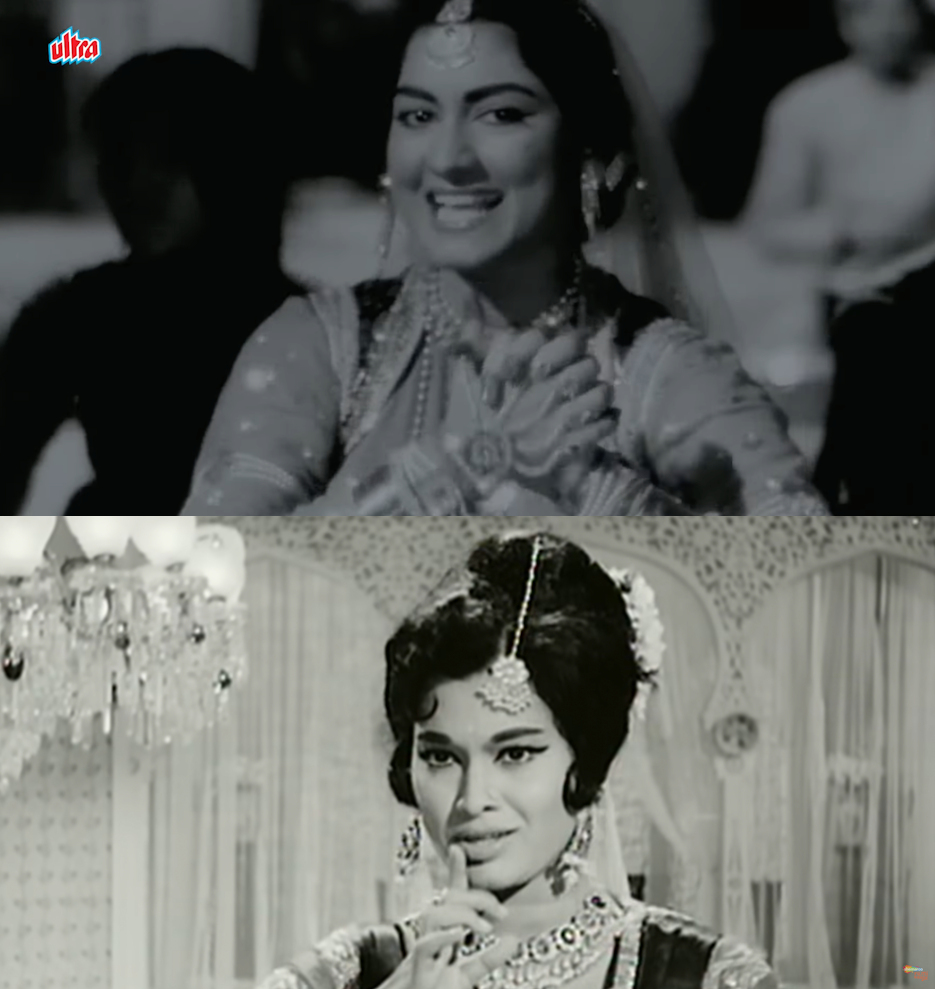
Largely, this style can be traced to two brothers, B. Sohanlal and B. Hiralal, and to some extent Gopi Krishna. All three were established dance directors from hereditary Kathak families, working with hybridity in their craft. It is the prodigy of B. Sohanlal who would dominate Bollywood choreography 30 years later—Saroj Khan.
The faces of this style are not only lead actresses such as Vyjayanthimala, Waheeda Rahman, and Asha Parekh, but also a large number of women dancers like Padma Khanna, Jayshree T, Rani, Jeevankala, and Kumkum, who light up the screen with stellar dancing and charming adayegi (Goel 2026).
The Spectacle Era
In 2002, Kathak-trained star dancer and actor Madhuri Dixit, film director Sanjay Leela Bhansali, and Kathak maestro the late Pandit Birju Maharaj came together to choreograph a courtesan dance ‘Kahe chhed mohe’ for Devdas. It was based on a traditional Lucknow gharana thumri written by Birju Maharaj’s ancestor Bindadin Maharaj and modified for the film. This courtesan dance felt different—its treatment was “classical”, unlike its ancestral film courtesan songs such as “Mohe Panghat Pe” (Mughal‑e‑Azam, 1960) and “Thade Rahiyo” (Pakeezah, 1972), choreographed by Lacchu Maharaj (Birju Maharaj’s paternal uncle) which had a different kind of classicism and tradition in them.
One reason was that the 2002 dance was heavy on technical compositions. Long patterns of Kathak bols (rhythmic syllables) with bandishes (compositions) decorated the beginning, middle, and end of the song. Apart from expressions, there was a focus on technical proficiency—neat, precise, measured movements executed with finish, perfected by the classical world over years of anga shuddhi (purification and alignment of the limbs) after Independence.
The song captured and capitalised on what are the most publicly identifiable elements of Kathak—spins and footwork. It had the refinement associated with the Lucknow gharana: subtle movements of the torso, eyebrows, and wrists, kasak‑masak (controlled chest and wrist work). The music resembled a grand orchestrated symphony, far removed from intimate traditional performances.
The top shots highlighting spins, the song ending in a crescendo of vibrating footwork, with visible ghunghrus on her feet—all this marks a new 20th‑century classical Kathak for films.
This was a new language of choreographing courtesan songs. In the larger‑than‑life set of the courtesan Chandramukhi, the song unfolds like a stage performance. It is almost as if a curtain opens and, with a powerful uthaan (opening segment) accompanied by fast rhythmic layakari (play with rhythm) on percussion, swelling chorus voices, and Maharaj doing padhant (spoken recitation of rhythmic syllables), the song begins like a stage performance with a powerful start.
This is in contrast to traditional performances that might open with a slow aalap (improvised melodic introduction, as in “Mohe Panghat Pe,” Mughal‑e‑Azam, 1960) or with poetry (as in “Thade Rahio,” Pakeezah, 1972). The top shots highlighting spins, the song ending in a crescendo of vibrating footwork, with visible ghunghrus (ankle bells) on her feet—all this marks a new 21st‑century classical Kathak for films, heavy on production quality and invoking grand stage spectacles.
I argue that, in an odd plot twist, the embodiment of Kathak classicism in 21st century Bollywood songs happens on the courtesan’s dancing body, a figure that was stigmatised and erased from mainstream Kathak history. Most Kathak based film songs of the 21st century century such as “Kahe Chhed Mohe” from Devdas (2002), “Mohe Rang Do Laali” from Bajirao Mastani (2015), and “Ghar More Pardesiya” from Kalank (2019) are courtesan songs, have become very popular and circulated far beyond the film world.
They are used by young children and women to dance at local Ganpati functions, school competitions, and residential society events. It is acceptable for girls from “respectable” families to dance to a mujra/courtesan song now, whereas I doubt this would have been possible for women in the 1960s.
The association of Birju Maharaj—a highly respected hereditary Kathak guru, often considered the ultimate authority on Kathak—with many of these songs lends a stamp of authority and social acceptance to Kathak based courtesan dances in films.
However, much of this representation remains at the surface level. By now, the world of courtesans was decades behind us. It was therefore possible to talk about it, even embrace it and revel in its beauty, without confronting the social, political, and material reality of what it meant to live that life.
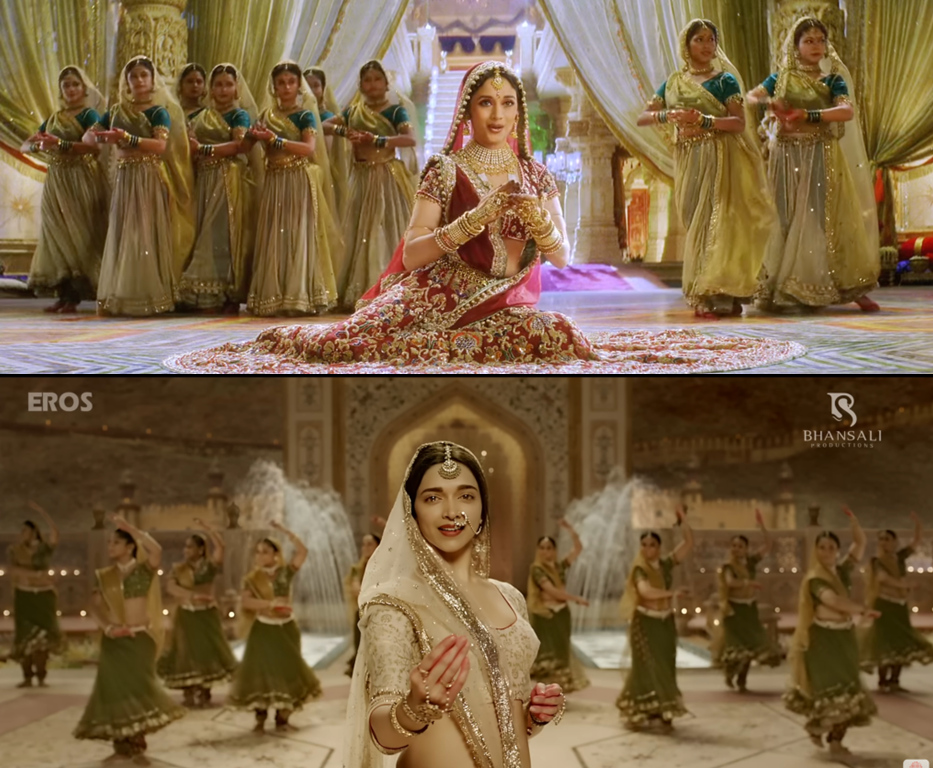
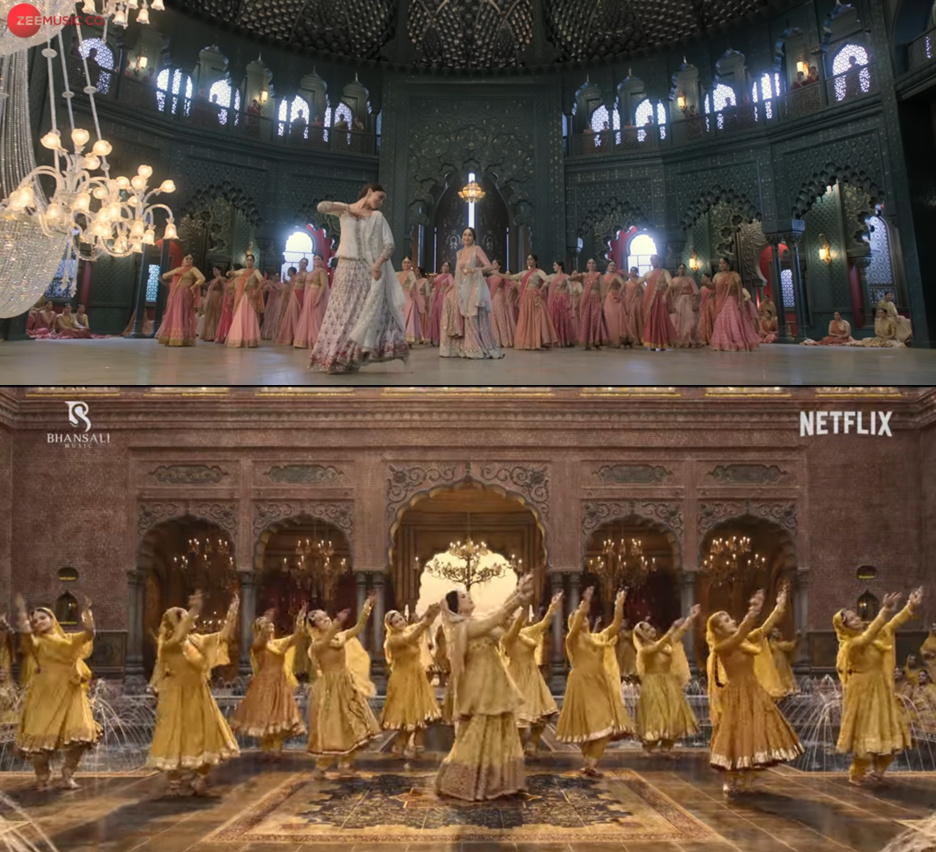
Most courtesan film songs that came after Devdas (2002) follow this template—grand sets, groups of dancers, wide shots, and glittering costumes.
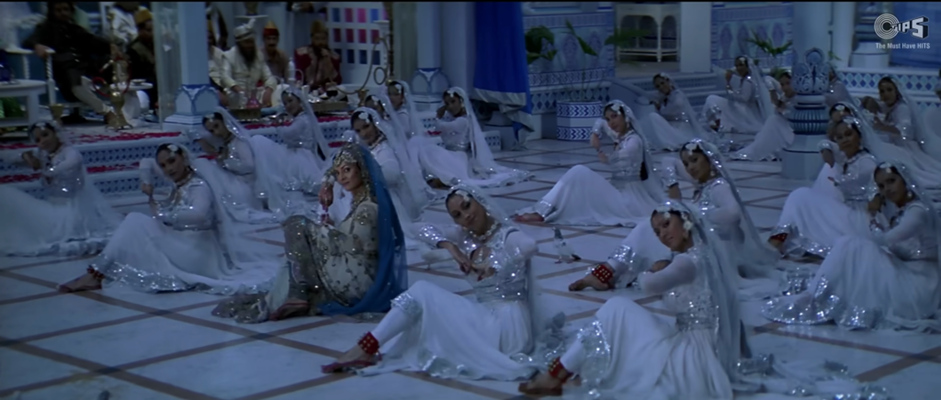
An important feature of courtesan songs after the 2000s is the large number of background dancers. Before the 1990s and 2000s, background dancers in courtesan songs were not the norm, though there are some examples. Mostly, the courtesan sang, danced, and entertained the patron alone, or with just one or two dancers around her.
From the 2000s onwards, the courtesan appears with her entourage, even if she remains the lone singing voice. A large group of 20 to 50 (or more) dancers is now part of almost every main courtesan song. The songs become a group dance spectacle.
The songs seem to be made not just for films, but also in such a way that they will suit their wide circulation in stage performances, dance workshops, and Instagram dance covers.
Now the courtesan does not dance in a kotha; she dances on a grand “set”, a set that is not even trying to resemble the intimacy of a baithak (small recital space). The presence of group dancers is also important. They move rapidly across these grand sets, creating a variety of formations and often settling into stage‑like tableaux. Even the tabla, sarangi, and harmonium players are not clearly visible in these songs. They are usually placed far behind or not present at all (as in “Ghar More Pardesiya,” Kalank, 2019, “Sakal Ban,” Heeramandi, 2024, and many others).
The exit of accompanying musicians—even when they were there only as visual representation—from the mise‑en‑scène of courtesan film songs, indicates that these songs are now imagined almost as recorded stage‑spectacle performances that unfold within the film and exist for the viewer both inside and outside the frame. The songs seem to be made not just for films, but also in such a way that they will suit their wide circulation in stage performances, dance workshops, and Instagram dance covers.
Classical dance is often associated with restraint in performance, which is seen as making it elegant and sophisticated, while excess is unfairly associated with being “loud” or “cheap”. Remarkable scholarship by writers such as Walker, Chakravorty, and others has shown that Indian classical dance has actively removed those parts of it that would be considered obscene, sexually explicit, or suggestive by its new middle‑class patrons.
It is interesting how aesthetic qualities of restraint and excess have come to signify entire value systems. This oversimplifies these binaries and removes nuance and context.
An article by Walker shows how courtesan performances often contained suggestive and explicit gestures and expressions (2014). She writes, for example:
“Use of the eyes in compelling ways is also emphasised in many of the descriptions: the dancer may ‘wound’ her audience with ‘intoxicated’ glances or demurely keep her gaze upon her own breasts. Many of the titles or names of the gats (short stylised dance pieces) are similarly enticing, and the coquettish, virtuous, beauty and beloved gats in Mad’un al‑Musiqi also conjure up evocative scenes of select gatherings or mehfils (musical soirées) where male audience members were entertained and beguiled with sensuous presentations of music and dance.”
Or
“The [dancer’s] lower lip is chewed and taken prisoner by the (upper) teeth, while the right hand is placed on the head. The [dancer’s] glance is directed towards the left breast and the eyebrow raised; the eye appears to be intoxicated.”

(From the ghamza, or amorous glance, gat in Wajid Ali Shah, Saut al‑Mubarak, 1852–53.)
Thumka (the sideways hip‑thrust) has also been systematically erased from present performances of Thumri, even though it was once performed by even senior and renowned courtesans.
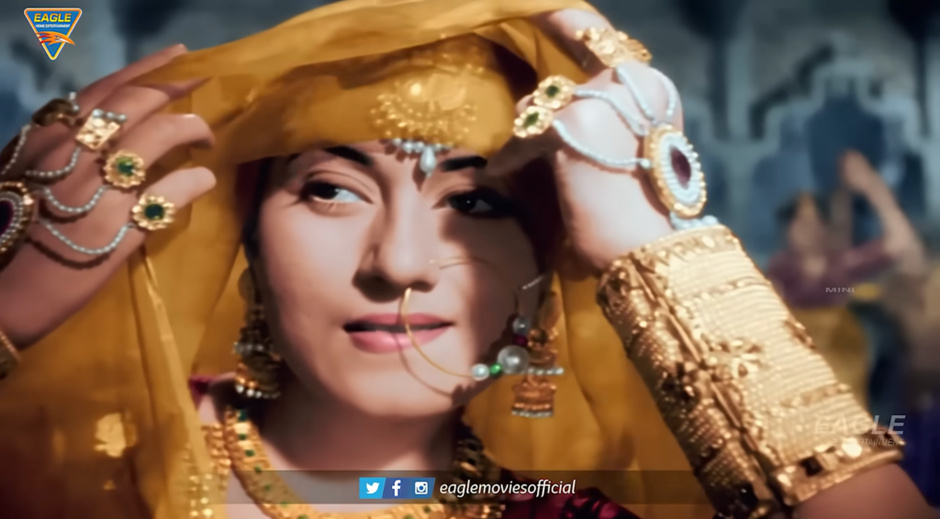
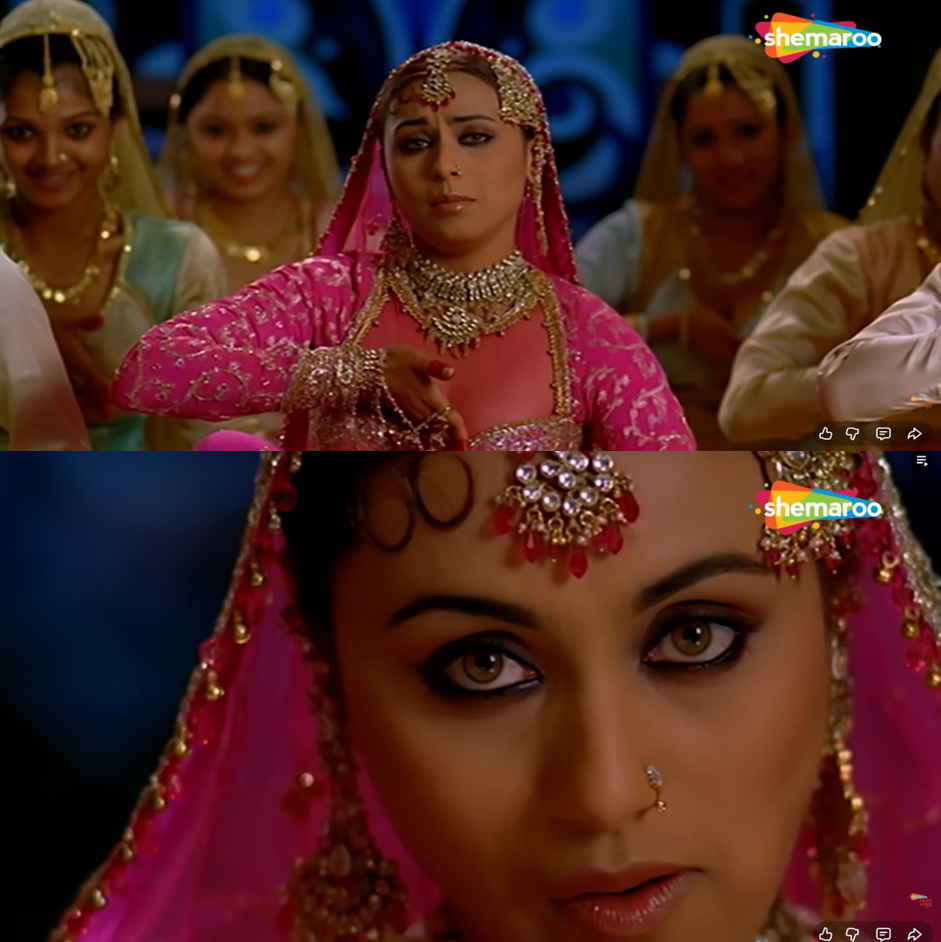
It is striking, however, how these erased explicit gestures have become part of many filmi mujras. The medium of film, with its ability to accommodate excess and absorb moral ambiguity, creates space for these less “respectable” elements—such as the biting of the lip in “Mohe Panghat Pe” or the slightly loud, seductive, “in your face” adayegi of Rani Mukherjee in “Main Vari Vari” from Mangal Pandey: The Rising (2005) or the viral ‘gajagamini’ walk from Heeramandi (2024) with prominent swaying of hips—to re‑enter the performance. Depending on the choreographer’s treatment, they can be a visual delight.
Mujra in Fashion Shows
Over roughly the last decade, an interesting trend has emerged—Kathak and Kathak‑inspired performances now appear in fashion shows, many of them based on filmi mujra songs. Fashion designers (both high‑end and others) invite Kathak or semi‑classical dancers to perform on the ramp, either before the models walk or alongside them.
The designers provide the costumes. The idea is to enhance the designer’s collection and to communicate the value and aesthetic of their work through a different medium. This overlaps with the rise of “experiential” events that integrate multiple art forms. Not only fashion designers, but also organisers of book launches, clothing label launches, and performance walk‑throughs in art exhibitions now use such formats, which are open not just to contemporary dancers but increasingly to Kathak as well.
Not only professional dancers but actresses too now routinely perform Kathak and Kathak/mujra‑inspired pieces at fashion shows, often evoking the bygone era of courtesans.
Because of Kathak’s association with tawaifs (courtesans), both historically and through repeated reinforcement in Bollywood, elements of desirability and seduction can be easily integrated into its performance, especially in compositions like thaat (stylised way of standing with subtle body movements), gat‑nikas (stylised variations of chaal or gait), and thumri.
Songs from classic courtesan films such as Umrao Jaan (1981) and Pakeezah (1972) are especially popular for fashion shows. They evoke immense beauty, attention to detail, and they are familiar to the audience, so they catch on quickly.
Not only professional dancers but actresses too now routinely perform Kathak and Kathak/mujra‑inspired pieces at fashion shows, often evoking the bygone era of courtesans.
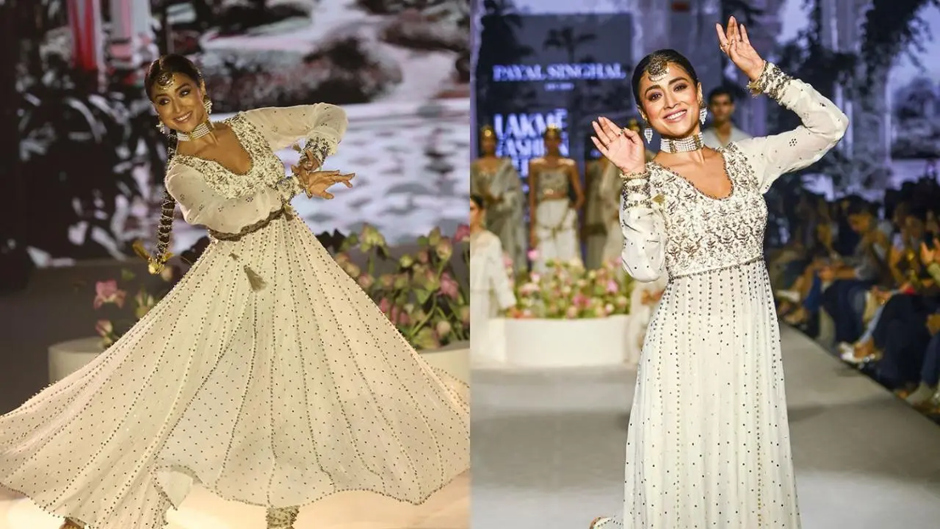
There was a time when courtesans occupied an elite position in society. They often set fashion trends, were associated with the fineries of jewellery, textiles, poetry, song, and dance, and even appeared in popular advertisements (Gupta 2024).
I wonder whether a Kathak dancer’s re‑entry into the world of high fashion and commercial events today is a hat tip to that older time—circling back in some way. One is reminded of how costumes and fashion were among the main promotional strategies of Heeramandi (2024), based on courtesans in pre‑Partition India. The costumes by Rimple and Harpreet Narula gained wide popularity, and the actors walked the ramp at the Miss World 2024 pageant and other fashion shows in their exquisitely beautiful outfits.
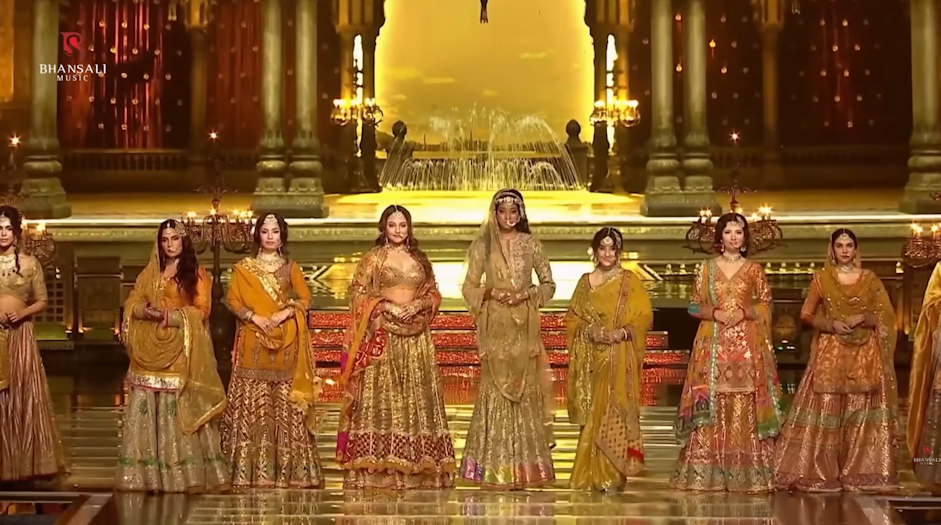
Are mujra/Kathak inspired performances at fashion shows simply a “vibe” or an “aesthetic” that organisers go for? Or is there room for deeper and more involved storytelling?
Kathak dancer Shivani Varma, one of the first artists to take the dance into newer performance venues and formats, offers an answer. “It depends on who you’re working with, and what story you choose to tell. I’ve refused opportunities that came from organisers who wanted only a surface‑level engagement with it. I have used my performances at fashion events to tell a story; in one particular performance I focused on the great choreographers behind the classic film mujra songs.”
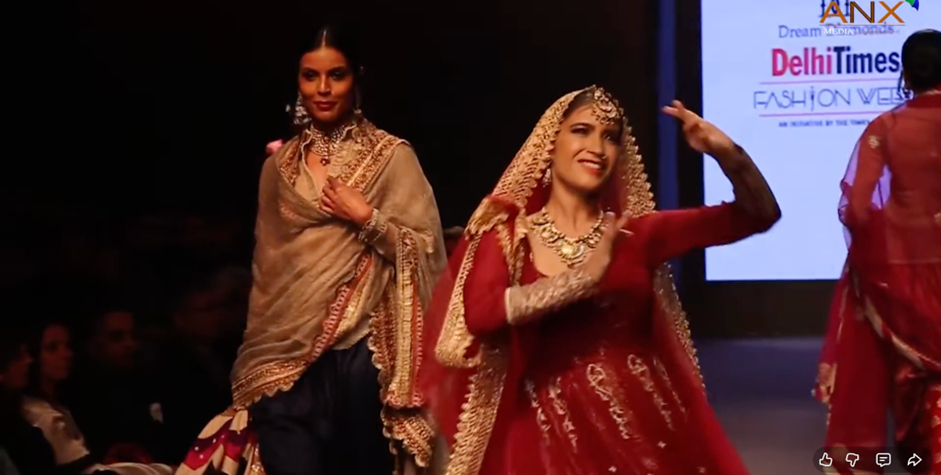
Dancers are naturally good at holding their posture and gaze. They are confident performers, with a sharp sense of timing and coordination, and they are quick to adapt to different settings.
Kathak’s movements are fluid and can respond to a variety of musical styles, which makes it easier to mould into performances at fashion events. Credit is due to many contemporary Kathak dancers who have used their form to explore the art of courtesans and to speak positively about their work, actively trying to change public perceptions of them.
Now, as the courtesan world has disintegrated, inspiration drawn from it continues in popular culture and imagination, appearing in new avatars.
However, it is precisely because the courtesan world no longer exists that such exploration is possible. Dancers can explore its beauty, its shringar (erotic and romantic sentiment), and its richness and depth, while remaining immune to the pitfalls, stigma, and difficult realities of courtesans’ lives. This is not a criticism, just an observation.
Leaders of classical dance worked for decades to remove the association with courtesans and to gain respectability in a society that saw the dance as decadent. Now, as the courtesan world has disintegrated, inspiration drawn from it continues in popular culture and imagination, appearing in new avatars.
This journey from the 1930s to the present shows how the figure of the courtesan and mujra songs continues to occupy and intrigue the popular imagination. It also shows how the connection between Kathak and courtesan dances is portrayed in popular culture—sometimes with historical accuracy, and sometimes through completely inventive or imagined histories.
Acknowledgments: The author’s research was made possible with the support of an Arts Research Grant by the India Foundation for the Arts, 2020-2021.
All images are YouTube screenshots unless otherwise specified.
Siddhi Goel is a Delhi-based Kathak dancer, researcher, and teacher who specialises in the history and evolution of dance in Hindi cinema. She is a disciple of Pandit Jai Kishan Maharaj. Her email address: siddhigoel@allthingskathak.com