



Last year, I was travelling in Kutch with my friends Amrit Gangar (film historian), Riyas Komu (artist-curator), and M.R. Rajan (filmmaker). We went there to take part in an event, “Gandhi in Kutch”: a padayatra organised by a group of Gandhian activists who, along with a batch of school students, were retracing the journey across Kutch that M.K. Gandhi had undertaken a hundred years ago.
Every night the marchers stayed in schools or other simple accommodation provided by villages along the way. During one such night, after dinner and customary songs by children, a few students approached me. After some pleasantries, they hesitantly asked: “We saw the movie, Kerala Story. Is all that true?” I was taken aback—not because of the question itself, since their chances of knowing about Kerala or travelling that far were remote.
What is new about this phenomenon is that films propagating hatred have been consistently produced over the last decade, creating and expanding a market for hatred—with the support of the state and the ruling party.
What surprised me was that all these adolescents from remote parts of Gujarat—from small towns and villages—had seen that film. As a matter of fact, they had all been shown that film. This was unusual, because it was not a blockbuster from the South like Bahubali, KGF, or Pushpa, but an ordinary propagandist film with no aesthetic or technical worth. Clearly, they had watched it as part of a campaign to show such films to children. This augurs a new kind of “federal hostility”, where one particular state is targeted and demonised—without any concern for truth or historical fact.
Stereotyping of communities and regions—the “Madrasi”, the “Punjabi”, the “Goan”—is nothing new in Bollywood. But never before has a region been demonised in this way, and with the active support of Bharatiya Janata Party (BJP)-led governments across the country. That children and students are made to watch such films is the most dangerous part: a diabolical act of indoctrination that no previous governments have indulged in.
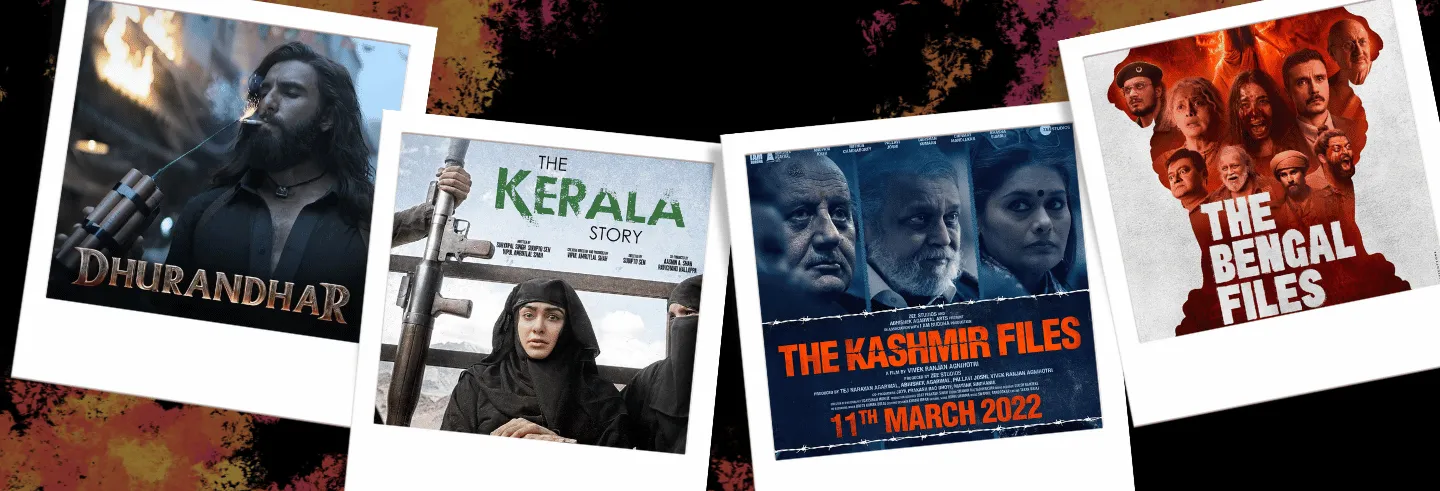
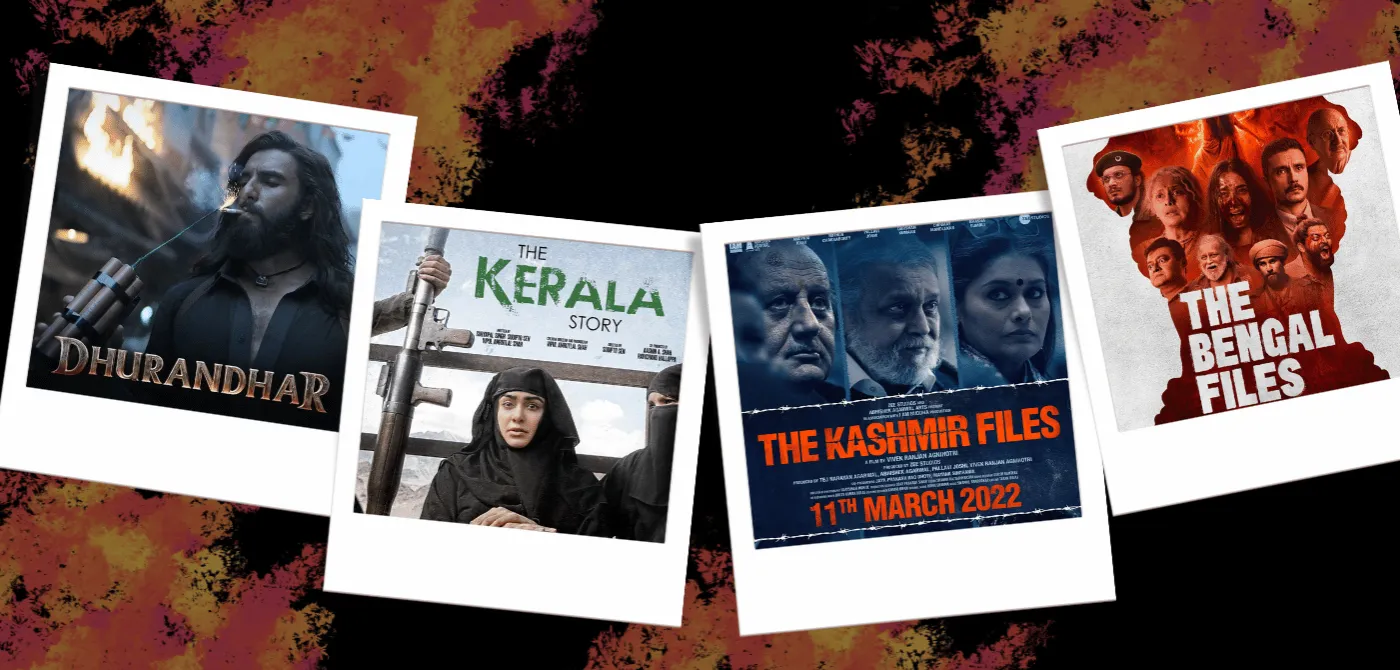
What is new about this phenomenon is that films propagating hatred have been consistently produced over the last decade, creating and expanding a market for hatred—with the support of the state and the ruling party. Dhurandhar, a Hindi spy action thriller released in theatres in December 2025, raises this pitch to a higher level—in terms of both technical excellence and spectacular violence, and as hate speech and outright political propaganda.
This new shift in politics and the entertainment industry demands serious attention, not only from film critics but also from anyone concerned about Indian democracy and cinema.
According to industry sources, Dhurandhar is the highest-grossing Indian film of 2025, the third highest-grossing Hindi film of all time, the fifth highest-grossing Indian film of all time, and the highest-grossing A-certified Indian film of all time.
Are we passing through a moment that will divide the history of commercial success in Indian cinema into before and after Dhurandhar? Is it going to be another landmark media moment, like the telecast of Ramayan and Mahabharat on Doordarshan that fuelled the majoritarian rath yatra of communal politics? Is it the final announcement of the arrival of the post-truth era, where majoritarian ideology can get away with anything?
Is there any point in critiquing a film that is blatant about its intentions, does not want to hide them, but in fact flaunts them?
Films that profess untruth, celebrate hatred, and propagate violence are nothing new. But films of that genre used to cover themselves with some semblance of balance and narrative justification. Dhurandhar has no such doubts or pretences. It knows it is propaganda and does not pretend otherwise—which is also what makes it difficult to deal with as a mere film text.
More than a film, it is a declaration, a war cry of sorts. How does one write about a movie that celebrates and professes hatred, and has no qualms about it? Should we ignore such films, avoid speaking about them so as not to give them further traction and discursive space? Is there any point in critiquing a film that is blatant about its intentions, does not want to hide them, but in fact flaunts them?
By writing about such films, do we not also somehow validate or legitimise their symbolic value, according them “mentionability” and, in turn, political presence? On the other hand, should one not be concerned and curious about the kind and scope of publicity and public appeal that such films command? Does that not say something crucial about our society, public life, and polity?
A film like Dhurandhar is a provocation—it fuels anger and despair in critics and viewers who consider art important, and who believe that art reflects and influences social perceptions. Hence the compulsion and urge to write about it.
But conventional approaches and tools become inadequate in the new situation, where the lines that are supposed to divide entertainment and power politics, industry and political system, film viewing and campaigning, are blurred. Traditionally, critics nurse the idea that they can analyse popular culture by dissecting, unpacking, and deconstructing it—revealing its inner meanings and innuendos, and gaining insightful glimpses into the mindset of the contemporary. Critics who uphold secular democratic values also feel morally bound to engage critically with such works. But here is a film that renders such efforts pointless through an overwhelming polemics that is upfront and in-your-face.
Take, for instance, the real incidents and events on which the film’s story is based. Many critics and social commentators—among them Anna Vetticad and Nissim Mannathukaren—have condemned the way it uses historical facts and real incidents as the warp and woof of lies and hatred to further majoritarian Hindutva ideology. But, ironically, it is a film that cares nothing for criticism and even thrives on it.
It knows fully well how the “liberal” intellectual community in the country—especially English-speaking urbanites—will respond to it. The film itself has a list of “internal enemies” who are said to undermine the nationalist project. Moreover, the readership for serious criticism in India has almost ceased to exist, both in terms of available platforms and the number of subscribers to such analysis. Within today’s highly polarised social media sphere, any criticism—for or against—is read and shared only inside the bubble; outside it, critics are trolled and rubbished by their respective opponents.
Accordingly, the film industry has recalibrated itself to invest in hatred, which has today become the most profitable investment opportunity in the country—whether in cinema or in politics.
True to post-truth times, audiences are not looking for critical evaluation but for validation and reassertion of what they already believe. They are “enjoying” and even celebrating the film knowing full well that it is a lie. Film-making and film-viewing have become exercises in self-indulgence—a shared act of pushing majoritarian biases and making any opposition or dissent look ridiculous or redundant.
Accordingly, the film industry has recalibrated itself to invest in hatred, which has today become the most profitable investment opportunity in the country—whether in cinema or in politics—heavily subsidised and supported by government agencies. It would be interesting to place the commercial strategy and success of the series of “hatred movies”—Kerala Story, The Kashmir Files, The Bengal Files, and the like—within the larger context of the economics of Hindi cinema, which in recent decades had found itself in virtual no man’s land.
Over the last two decades, with the resurgence of regional cinemas, the pan-Indian market across languages and states that Bollywood had commanded for decades—and taken for granted—has been fast eroding. It has been reported that Bollywood’s share of the Indian film market has been dipping, with the regional industries—Telugu, Tamil, and Malayalam—collectively outstripping it in both the number of box-office grossers and total collections. This radical shift in market leadership was evident in the overwhelming success of a series of pan-Indian films from the South: Baahubali, RRR, Pushpa, Kantara, and others.
Regional cinemas were capturing the national market hitherto monopolised by Bollywood—and doing so successfully and aggressively. Market observers point to the strength and diversity of content, upscaling strategies, and technical excellence as some of the reasons. This new crop of regional films draws its thematic energy from indigenous cultures and traditions—however imagined these may be—rendered with spectacular technical finesse. As these films turned into mega-hits across the country, Bollywood was forced to wake from its slumber and search for themes and genres that could compete with the core strengths of regional cinema.
In the new millennium, Bollywood had already lost its traditional footholds and was struggling to appeal to new audiences—especially the rising urban youth in cities and towns across the country. Avijit Ghosh, in his book on Bhojpuri cinema, has outlined the rise of that industry—virtually non-existent until the end of the last century—attributing it in large part to the transformation in Bollywood’s narratives. In the post-liberalisation era, Bollywood’s themes shifted to upper-class and upper-caste milieus and spectacular European landscapes. This led to a gradual estrangement of its traditional audiences—mainly migrant labourers from the Hindi hinterlands living in the metros—who found the non-resident Indian (NRI) milieu and exotic settings alien to their experience.
As a profit-seeking venture, the film industry is happy to create, nurture, and pander to changing market demands—moral or ethical considerations seldom figure in its motives.
The only way out of this bind for Bollywood was to recapture its pan-Indian audience base by falling in line with majoritarian ideology through extreme jingoism and violence. It did so by conjuring national enemies—real and imaginary, hidden and revealed, internal and external—stoking fear and demonising Muslims.
In this dispensation, extreme violence and hatred became the unique selling points (USPs) to mobilise, expand, and unify the pan-Indian market. Accompanying this was a dividing strategy: demonising those states—Kerala, Bengal, Kashmir—that do not share the majoritarian Hindutva ideology of hatred and Islamophobia. The marketing strategy of many of these films was not focused on box-office competition but on political campaigning, with the active help of the state and the Hindutva brigade in the form of tax exemptions and exhibition networks. To this were added the blessings of awards and festival placements by the central government.
In any democratic society, the vigour and vibrancy of mass media are determined by the dynamics between the triad: the state, capital and civil society or government, market and people. Capital provides content that the people need and demand, while the state acts as gatekeeper, controlling and surveilling the process. Both capital and state draw their legitimacy on behalf of the people—serving, servicing, and representing them. Capital justifies itself by claiming to produce and provide for consumers, while the state intervenes on behalf of “national interests” and morality.
As a profit-seeking venture, the film industry is happy to create, nurture, and pander to changing market demands—moral or ethical considerations seldom figure in its motives. If capital is primarily driven by profit, the state is supposed to be bound by constitutional principles. In the event of a conflict of interests between market and people, it is incumbent upon the state to stand by and protect the rights and interests of the people as citizens.
In any democratic society, media capital must essentially take into account and navigate between these three forces—state, capital, and civil society—to survive and thrive. For capital, the only consideration is profit: if violence and jingoism sell, it has no qualms producing and marketing them. But the state has larger obligations—among them, ensuring the democratic rights enshrined in the Constitution of every citizen, across religion, caste, gender, and class.
In all three moments of Indian media’s encounter with the state, global capital, and now with digital technology, the role and significance of each of the three players have undergone transformation. The balance of power within the triad is broken, with capital overpowering the other two.
If the first moment was the media’s encounter with the state, and the second its encounter with global capital, the third has been its encounter with technology.
With global finance and information capital becoming virtual and viral, the idea of the nation state—founded on boundaries and territories—has become marginal or merely mediatory. Such boundaries persist only for labour, not for capital, which has become fluid and mobile, moving instantaneously to points of least resistance in terms of state controls (trade barriers and tax regimes) and labour power (unions and bargaining power). All this has turned the nation state into a kind of broker, negotiating with global capital for access to the local market while claiming the allegiance and approval of civil society.
In the case of “hate films” too, we can see this partnership at work—between capital and state, between Bollywood and the BJP—laying siege to the public sphere to the benefit of both, and to the total neglect of civil society obligations.
If one looks at the post-Independence history of Indian media in relation to the triad of state, capital, and civil society, three key moments stand out. The first is the national Emergency (June 1975 to March 1977), when civil liberties were suspended and media freedom curtailed through censorship. The second came a quarter century later, with the New Economic Policy of 1991, which opened the market to global capital. In visual media, “the skies were opened” for foreign television channels, and foreign investment began to seep into the media industry. The third is the social media moment unfolding over the last decade—one that gave voice and form to the post-truth times we live in.
If the first moment was the media’s encounter with the state, and the second its encounter with global capital, the third has been its encounter with technology. Ironically, the clampdown on media during the Emergency gave rise to a surge in investigative journalism and the emergence of alternative media collectives and initiatives across the country, giving voice to civil society and finding the courage to talk back to power.
The second moment saw a recoil from political radicalism and a total shift towards a consumerist worldview. This era also witnessed the entry of television and its explosive popular appeal in India, driven by the telecast of the puranas. Just as “sant” films and mythologicals had marked the first decades of cinema’s arrival in India, television too spawned a bhakti wave whose far-reaching repercussions soon became evident.
If in the Emergency moment media confronted the state by standing for civil society, in the second moment it was profit motive all the way. Instead of being concerned with the rights and freedoms of citizens, it was all about the tastes, preferences, and demands of consumers. Over the next two decades, the tempo set by the rath yatra of puranic tele-serials marched into the citadels of real power.
The third moment—the digital and social media revolution—changed the media scene completely, with Hindutva ideology seeping into every nook and cranny of the mediascape, and consequently into the social fabric. It was a journey from citizen to consumer and then to fanatic Hindu—or, in other words, from rights to consumerism, and now to hatred.
For the post-globalisation generation that came of age in the digital era, born after the political moment of the Emergency and the economic moment of liberalisation, it is all about media.
All these shifts have also transformed media content, whether it be news, entertainment or criticism. When viewers only want to consume their own beliefs and biases, anything different, difficult, or dissenting is shunned and shut out—seen as a threat. In the post-truth times we live in, what audiences demand is self-validation rather than truth, facts, or analysis.
No one wants to be challenged or questioned, but reaffirmed and revalidated in their own beliefs and biases. Any attempt to disprove the lies that hate films spread is akin to an atheist trying to unravel the magic behind a holy man’s miracle. Such disproof, employing worldly rationality and reason, does not work within that self-propagating bubble of belief. Ironically, all kinds of fanaticism feed and thrive on opposition from non-believers.
Given this expanding market for violence and hatred, the Hindi film industry was only responding to demand. Given the financial and identity crisis it was mired in, this was a saffron business opportunity it sorely needed. Added to this was the unrelenting support of the central government and BJP-led state governments in promoting, distributing, and rewarding such films.
The saddest part is that the most crucial component in the triad—civil society—is also gradually becoming complicit in the whole process. For the post-globalisation generation that came of age in the digital era, born after the political moment of the Emergency and the economic moment of liberalisation, it is all about media.
In the social media-saturated public sphere they inhabit, there are no longer larger political narratives to frame their experience, nor any revolutionary ideal on the horizon against which to evaluate it. In the frenetic times they live through, genocides and pandemics are mere blips—suffering and trauma washed away and neutralised by imagined conspiracies and enemies. Films like Dhurandhar—in form, treatment, and content—perfectly match the fanatic mood and pace of our times.
That pace also has to do with our sense of time. Critics often mourn the erasure of history in films, and have critiqued it especially in the context of Dhurandhar, where real events and personalities are manipulated to suit a narrative of othering. Such butchering of timelines and facts gels with the spatio-temporal experience of our times.
Today, distances have shrunk and time is compressed by viral, instantaneous modes of communication. We navigate the virtual more than real, physical spaces. The linear, progressive sense of time is lost when everything has become instantaneous and virtual—time experienced as an endless present, with no past (as baggage or nostalgia) and no future (as hope or destination).
Contemporary narratives too, even while drawing from historical events, are not bound by historical time: memories from the past only flicker, and there are no dreams of a future. It is all about the impulses and compulsions of the present moment. For the hero of Dhurandhar, the violent events of the past are only an initial trigger; the present world he inhabits is over-saturated with dangers and thrills that are always imminent and immediate.
The very real and disastrous event of demonetisation, for instance, is recast as a well-thought-out plan to fight terrorism.
Fascism thrives in such temporal ecospheres, where one is forced to live in the immediate present—always threatened by invisible, imaginary, and omnipresent enemies who, in an atmosphere soaked in conspiracy, could take any shape and spring from anywhere at any time. There is never a moment to think or reflect, only to act and react; no time to mull over the past, only to fight for survival and victory in the present. This is the sense of time that fascism loves, and that Dhurandhar splurges in.
Every story told in this genre is “the story behind the story”: what appears on the surface, what we experience, is not true—truth lies hidden behind apparent facts. The very real and disastrous event of demonetisation, for instance, is recast as a well-thought-out plan to fight terrorism. Critics may debunk it, but the film unveils it—inviting you to see the unseen ‘truth’ behind. What you thought, or what critics of the system said, was not true. All the suffering and social costs become mere collateral damage for the larger good—the burden (dhura) that the heroes bore (dhar) on our behalf.
But who eventually bears the burden of all these lies?
C.S. Venkiteswaran is a film critic, curator, and translator based in Kerala.