






Tarluvada is one place to start.
Thirty kilometres to the north of Visakhapatnam, this village is an upcoming node in India’s data centre push. One of the three data centres Google is setting up near this coastal city will be sited here. The other two are sited to the south. Adavivaram lies just to the west of Visakhapatnam, or Vizag, as it is also known. As for Rambilli, it lies another 50 kilometres to the south, very close to the coast.
India is extending subsidies to a sector which will create few jobs, lesser tax revenues and do little to help India move up the ladder in AI.
Between them, these three data centres will house 2.5GW of computing capacity (Data centre capacity is measured in MW/GW because the sector considers power availability its ultimate constraint on operations). To put that number in perspective, India’s installed data centre capacity in 2025 was 2.2GW. Google, however, is just the start. Reliance is setting up a 1GW data centre at Polipalli village, 20 kilometres to the northeast of Tarluvada. At least two more data centres, one by RMZ-Colt Data Centres (1.25GW) and the other by Sify (50MW, expandable to 500MW), are coming up here.
In all, the land abutting Visakhapatnam might soon host as much as 6GW of data centre capacity. It’s not the only one. A clutch of other cities — some close to the coast like Mumbai and Chennai; and the others deeper inland, like Hyderabad, Bangalore, Naya Raipur, Greater Noida and Bhopal — are vying for them too.
As new data centres get announced seemingly every other day, projections of India’s data centre capacity are rising fast. Just last year, India was expected to touch an installed capacity of 4.5-6.5 GW by 2030. Firms like Wood MacKenzie now expect that number to cross 12 GW. Others peg this number higher yet. Take India’s Ministry of Power. Its estimates for power demand from data centres by 2031-32 go as high as 26.3GW.
What does one make of this expansion? Elsewhere in the world, countries have seen power costs spike once data centres took root. Ireland is one instance. India, however, is much larger. Given its installed power generation capacity of 520 GW — which is slated to rise to 777 GW by 2030 — do data centres constitute a strain on the grid?
And so, earlier this year, we decided to take a closer look at India’s data centre buildout. World over, data centres have faced much local opposition. Today, as India embarks on its own data centre push, is it protecting itself against the risks and externalities voiced by people in other countries?
Given the heterodox nature of concerns around data centres — power, water, heat island effects, sound, etc — we focused on power supply.
Here is what we found.
The entry of the gatekeepers
For starters, data centres are not new to India.
They have been around from the early nineties when firms like Rediff and VSNL began offering hosting services and the Reserve Bank of India began pushing core banking, forcing banks to create central servers with account holders’ information.
Global data centres will not only capture cheap land, power and water but also benefit from India’s low per capita emissions.
In recent years, though, the market has gotten hotter. As AI gathers users, hyperscalers, social media giants and AI firms are beefing up data centre capacities to meet demand and boost valuations. Given constraints like grid capacity, water availability and local opposition, they are expanding to developing countries where power is cheaper, and land/water can be more easily procured.
Within India too, a clutch of factors are boosting data centre growth. The push for data localisation is one reason. Another is the rising use of AI not just by companies but also by the country’s union and state governments. The war in the Persian gulf, which saw Iran bomb data centres in Bahrain and elsewhere, has helped as well — as have the financial incentives rolled out by India’s centre and state governments.
Along the way, though, India’s data centre market is seeing something odd.
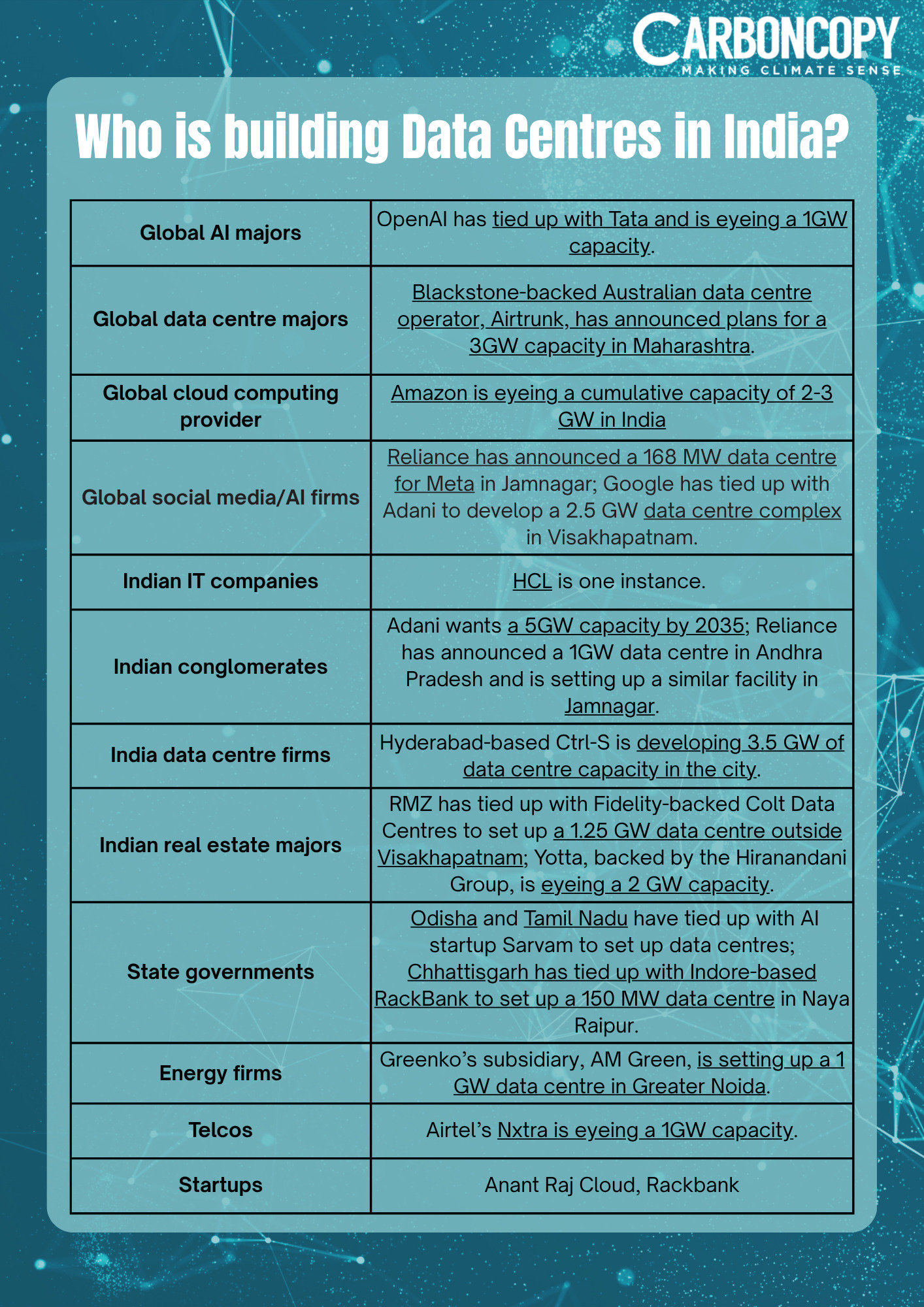
As the chart above shows, most firms coming in from overseas are neither setting up their own facilities nor tying up with local data centre operators. Instead, they are tying up with relative newcomers in the data centre trade. Google, for instance, has tied up with Adani; Meta with Reliance; and Colt with RMZ.
For anyone trying to understand how India’s data centre buildout will affect the country’s energy systems, these alliances are one place to start. The global data centre market is shifting towards larger scale. “(Facility sizes) are increasingly in the hundreds of megawatts, and in some cases approach gigawatt-scale campus formats,” said Anshuman Magazine of CBRE, a commercial real estate firm. With that, however, it gets harder to find enough land, water and power. And so, global firms are choosing local partners who can secure these.
This turn is significant for two reasons. First, it shows that, even with the global AI boom, India is little more than a raw input supplier. Second, as foreign firms tie up with influential local partners, India’s data centre market is splitting into two halves: Powerful newcomers who can secure land, power and water; and traditional operators with technical expertise. “Pureplays will have about 30% of the market,” said the head of a leading Bangalore-based data centre firm on the condition of anonymity. “There will be about a hundred of us. And then, there will be about ten large companies. They will tie up with hyperscalers like Amazon and Google.”
Of these, while the first camp builds GW-scale facilities, pureplays are sticking with smaller units, no more than 100 MW in size.
How both source power is very different.
Hundred MegaWatt vs One GigaWatt?
We asked the head of the Bangalore-based data centre firm how data centres like his source electricity. “India can easily host multiple 100MW data centres,” he said. “The grid can support these.”
Turn to GW-scale facilities and the question gets more complicated. “1GW is hard,” he said. “You will need to revamp the grid. Also, you will not get 1GW from a single generator. In addition, you are talking about something that needs 1 GWH all through the day. Which means that you need multiple GWs as capacity. If a data centre is running on just solar, it will need to set 5 GW to offset solar’s low efficiency. You will need storage as well.”
States are responding to this complexity in two ways.
Andhra Pradesh has allowed data centres to bypass the grid. It has, for instance, granted a discom license to the Adani-Google data centre at Vizag. “The licence will allow Google to directly procure and distribute electricity for its operations, marking a shift for the company from being a large power consumer to managing its own energy supply,” reported Economic Times. Similarly, Uttar Pradesh’s Data Centre Policy Draft 2026 contains a provision to extend licenses for power distribution to data centres.
Other states, like Telangana and Tamil Nadu, have taken a different tack. They have kept data centres within their discoms and offer dual power — power from two different locations/providers — to data centres as a hedge against power failure.
Both choices come with large trade-offs.
Discom vs Deemed Discom?
In the US too, once allowed to delink from power grids, data centres began sourcing their own power. Microsoft, famously, decided to source power for its data centres from the re-opened nuclear plant at Three Mile Island. Others, belying previous commitments about staying green, fell back on coal and natural gas. This includes Google, Meta, Amazon and Microsoft.
These are lessons India has not learnt. Data centres have high running costs — mostly due to their energy consumption for computing and cooling.
This is the first question. When a GW-scale data centre in India gets off the grid, who will it source power from? “The economics of renewables in India remain favourable compared to gas or nuclear at this stage,” said Magazine. “That said, as AI infrastructure scales to gigawatt levels, energy security and 24/7 reliability will become increasingly important considerations. The conversation around dispatchable power, whether gas, pumped hydro or eventually nuclear, will intensify in India as it has elsewhere.”
As things stand, India’s data centre boom is taking shape at a time when both renewable and fossil fuel generators are struggling with low capacity utilisation. “Power companies are happy with this boom because discoms were not signing PPAs,” a senior executive in the BESS space said on the condition of anonymity. “Data centres, on the other hand, are bankable customers.”
This, however, means data centres can choose between existing solar projects unable to sign PPAs, stranded gas projects, and thermal power plants with low capacity utilisation. With the latter two, India’s emissions will rise. Recent developments suggest the economic argument in favour of renewables is not emphatic enough. While Ctrl-S has tied up with NTPC Green Energy for renewable power, Maharashtra has reduced the clean energy requirement for data centres to 51 percent.
The other option, where data centres set up their own “behind-the-meter” power plants (as in the USA), comes with its own questions. To power its 933-MW data centre at Armstrong Country in Texas, Google opted for Natural Gas. “The power plant would emit as much as 4.5m tons of carbon dioxide,” The Guardian wrote. “For comparison, the entire city of San Francisco emits about 4m tons of carbon dioxide annually.”
In India, such arrangements will create an outcome where, as digital rights activist Srinivas Kodali said, global data centres will not only capture cheap land, power and water but also benefit from India’s low per capita emissions — a number India has used to defend its need to pollute for faster development.
The other approach — that of Telangana and Tamil Nadu — comes with its own questions. Telangana, for instance, has promised to exempt data centres from load-shedding. This, however, creates an outcome where power shortages will fall on other users.
In Ireland, data centres now consume 22% of its electricity. Given their rising demand for power, the island nation has had to fall back on costlier forms of power like gas. With that, as The Guardian wrote, data centres drained “€715m (£620m) from the Irish economy and increased household bills by a cumulative average of €360 between 2015 and 2023.” These numbers might rise further, says a report by Friends Of The Earth. “Depending on data centre growth, the average Irish household could pay a further €295 to €644 cumulatively from 2025 to 2034.”
In response, Ireland has told data centres to source their own power — and added a rider that 80% of their electricity must come from renewable sources.
These are lessons India has not learnt. Data centres have high running costs — mostly due to their energy consumption for computing and cooling. While wooing them, ergo, a clutch of state governments have offered exemptions on electricity duty, wheeling charges and transmission charges. Telangana promises electricity “at the cost of generation” and Odisha, “30% subsidy on power bills for 5 years”. Andhra has offered both Google and Reliance a discount of Rs 1/unit for 15 years. In the case of Reliance alone, this discount can be as much as Rs 3114 crore.
Large questions lie here. “Discoms will have to invest in new power lines,” said the senior official in the BESS space. These will also have to pay for their running costs, transmission charges and so on. “All those costs will get socialised,” he said.
Yet all these investments ultimately hinge on one unresolved question: how much computing capacity will India actually need?
Large Language Models vs Small Language Models?
The elephant in this room is market speculation. Not just in global AI valuations but also in India’s data centre announcements.
It shows up in hyperbole — like the one which says India will become a "global digital infrastructure hub" without specifying what this means. It shows up because neophytes are rushing in. It shows up, as the data centre head in Bangalore said, in projections by even established firms that are far higher than the GPUs they have. And it shows up in the mushrooming of data centres in the unlikeliest of places — like water-stressed and heat-prone Raipur. (One reason data centres flocked to Ireland was low temperatures).
With data centre majors aligning themselves with the country’s political economy, questions about ecology and equity are not getting considered.
And so, working on this report, we asked firms about actual demand for data centres.
This is partly about data and partly about AI.
The first of these doesn’t seem like much of a problem. “Ninety percent of the data Indians use is being serviced from outside the country,” said the Bangalore-based data centre head. “This includes social media and OTT. It’s more appropriate to service that demand locally.” In addition, Indian firms are re-shoring data to local servers. “All these companies have seen what happened to Nayara,” he said. “Microsoft just removed their IT access.” Also, as he said, US acts like FISA (Foreign Intelligence Surveillance Act) and the Cloud Act (Clarifying Lawful Overseas Use of Data Act) can also be used to claim Indian companies’ data. For this reason too, data is re-shoring.
More than data, though, AI is what will demand energy and computing capacities at data centres. “My cloud consumes 10 KW/rack,” the Bangalore-based data centre head told us that afternoon. “AI consumes 130 KW/rack.”
This is where things get complicated. On one hand, demand for AI is yet to meaningfully pick up in India. “We have not seen massive AI need so far,” said an IT sector observer on the condition of anonymity. “We have spoken so much about Smart Cities and Smart Grids but there is little demand yet.”
When asked about demand, the data centre head said the Indian government is the biggest user of AI data centres right now. “It’s using AI to update welfare beneficiary rolls, etc,” he said, and added this would change in a couple of years once local language models come up. “Imagine how easy ticket booking will be once travel portals can accept voice bookings in 22 languages! We have 140 crore people. Even if each calls once a day, that will consume 4-5 GW of capacity.”
The variable here is technology. Large Language Models (LLMs), like the ones developed by OpenAI and Anthropic, are tussling for dominance with smaller models like China’s DeepSeek and Kimi3 which need less computing power (and ergo, lesser energy). Between the Trump administration’s decision to restrict access to the country's latest AI models and Indian IT firms getting worried about runaway expenditure on AI tokens and switching, ergo, to smaller models, it remains to be seen how demand for compute will evolve.
For now, firms are staying cautious. “People might be announcing a 100MW capacity,” said the executive at the Delhi-based AI firm. “But what they are building is 10MW. Only when this demand is saturated will they build more.”
As in power, so with water
More than power, the constraint on data centres’ growth in India lies in water — new PPAs can always be signed; fresh feeder lines can always be laid.
Here too, aggregate numbers suggest there won’t be a problem. Water demand from data centres is dwarfed by what, say, Indian agriculture consumes.
Andhra has extended incentives worth Rs 22,000 crore to the Google-Adani data centres — and another Rs 19,000 crore to Reliance.
And yet, water availability varies per region and season. Every summer, Visakhapatnam faces water shortages. Even Mumbai, which has the biggest agglomeration of data centres in India, had a scare this June when water level in its lakes fell below 7% of reservoir capacity. A clutch of other processes — like climate change and rampant deforestation — are also changing India’s hydrology.
With data centre majors aligning themselves with the country’s political economy, questions about ecology and equity are not getting considered. Tarluvada and Adavivaram lie within touching distance of the Kambalakonda Wildlife Sanctuary, a home to leopards. Rambilli too, as Frontline reported, is surrounded by six reserve forests, the closest of these just 1.3 kilometres away.
Not only are these concerns getting ignored, India’s union and state governments are extending subsidies to a sector which will create few jobs, lesser tax revenues and do little to help India move up the ladder in AI.
The NDA has granted foreign cloud operators using India for global operations a tax holiday till 1947 — another illustration that India’s power and water will be used to solve AI queries elsewhere in the world – and state governments have doled out their own concessions. As for states, Andhra has extended incentives worth Rs 22,000 crore to the Google-Adani data centres — and another Rs 19,000 crore to Reliance. Apart from these, it has to invest in the Polavaram Left Bank Canal to get Godavari water to Visakhapatnam — and then to push this water to each of the data centres.
As with electricity, these costs will be socialised as well.
This is an edited and shorter version of the report titled “How should India Power its Data Centres”, first published in Carbon Copy.
M. Rajshekhar is an independent reporter who writes on energy, climate change and India's ongoing slide into right-wing authoritarianism. He is also the author of Despite The State: Why India Lets Its People Down and How They Cope.