



India wants waste recycling to pay for itself and to clean up after itself. For a solution, new policies were hurriedly implemented, mostly inspired by the West. On paper it looked good. Recyclers get paid for their work and producers are held accountable for making sure the end goods end up in the right hands.
When the raids come, the burning shifts to night. I have stood in these lanes at two in the morning during festival season and found them louder than at noon.
What India did not consider are the collectors. The E-Waste (Management) Rules, 2022 were meant to change where the waste physically goes. Leaving out the collectors turned them into a market in documentation instead. The certificate layer pays better than the physical work, so compliance and collection came apart.
The discussion becomes more pressing now because the new rules have widened the gap between what compliance pays and what collection pays. My prescriptions come from next door. China faced the same problem on a larger scale and paid for the unit dismantled. India pays for the certificate.
The following is the account of a practitioner who lost to the informal sector and decided to decode why he did so.
Introducing Seelampur
The first rule I learned in Seelampur is that nobody talks to people carrying notebooks. Everyone who comes here writes something down, and then the raids follow. So, I put mine away and said I was a small e-waste dealer from Calcutta facing prosecution, sent by a contact who told me the man running these lanes could help. That was half true. I had a plant on paper and no way to feed it.
Over months, across close to a thousand conversations in 21 unorganised units, I worked my way up to the man who controls raw material sourcing in one of these clusters. He told me, without lowering his voice, that he pays around Rs. 2 lakh a week to keep officials and local politicians comfortable. He treated it as a line item, which is what it is. He was willing to sell to me. The one thing he would not tell me, however often I circled the question, was where his own volumes came from.
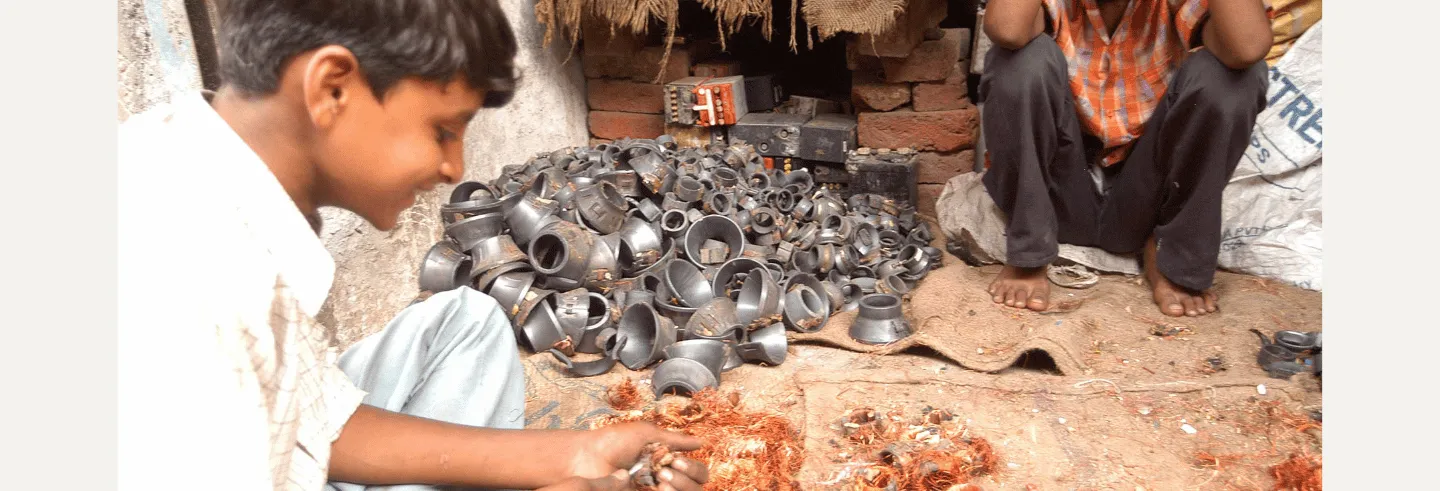
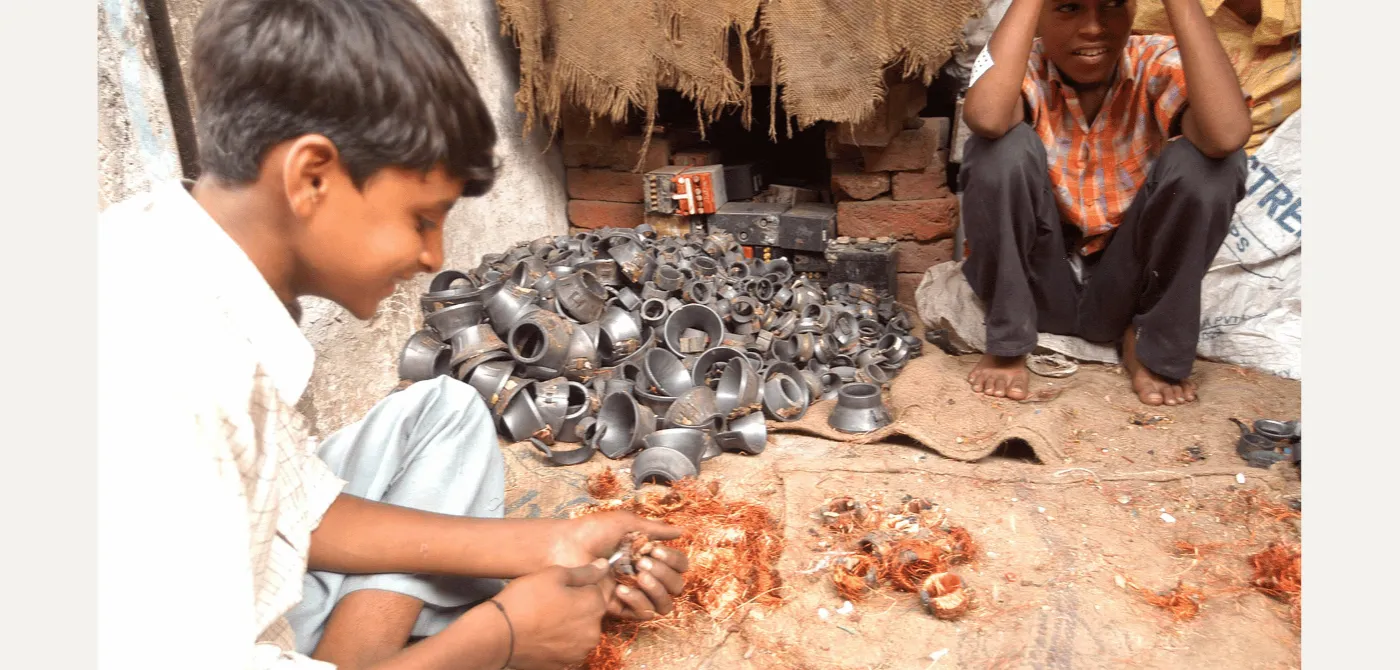
Below him works a man I will call Zaid, who strips a laptop motherboard faster than any machine on my equipment list. He said something I have not been able to forget—I have the skills and the material; I just cannot get ahead because of the power dynamics and the lack of funds. The skill is real. The capital is trapped.
When the raids come, the burning shifts to night. I have stood in these lanes at two in the morning during festival season and found them louder than at noon. Enforcement does not end the activity. It reschedules it.
The Plant That Pencilled Out
I went to Seelampur because I had already lost there, and losing taught me more than winning would have. My early interviews were attempts to source feedstock for a plant that only existed on paper, and the bulk of surveys came after I realised that the plant would never be built. What followed was close to a thousand interviews across 21 unorganised units, and 328 survey respondents across three states, with 183 of them being in Delhi National Capital Region.
Under a company I set up, Kolhan Upcyclers, with a project report costed alongside Respose India, I had a decent business on paper. It included a 500 tonne per year recycling plant, capital expenditure of about Rs. 65 lakh, working capital of about Rs. 36 lakh, collection cost assumed at Rs. 50 a kilogram, projected revenue of Rs. 5.15 crore, an earnings before interest, taxes, depreciation, and amortisation (EBITDA) margin of roughly 22%. Integrated circuits off printed circuit boards at around Rs. 1,000 a kilo, copper at Rs. 300, refurbished goods carrying resale margins of 50 to 100%. Every number survived scrutiny except one.
But he never needed to beat my price kilo for kilo. He needed only to make sure I could never assemble those tonnes at my assumed price.
The plant assumed I could buy waste at Rs. 50 a kilo. In Seelampur, the kingpin could pay more than that for the same kilo and still profit because his all-in cost of acquiring, moving, and processing it sat in a different category from mine.
What I had missed was the mechanism. On my own cost sheet, the plant broke even somewhere between 140 and 280 tonnes a year, a quarter to half of capacity, depending on how conservatively you treat overheads. Robust enough.
But he never needed to beat my price kilo for kilo. He needed only to make sure I could never assemble those tonnes at my assumed price. The supply curve I actually faced sloped upward and was enforced by a cartel—the first lots at 50, the next lot dearer once my buying became visible, and the lot after that simply unavailable. My spreadsheet assumed a market. What existed was a gate.
Other formal recyclers have run into the same wall. India now has 322 registered recyclers with a combined capacity of 22.08 lakh tonnes a year, and plant after plant operates far below it for want of material (Ministry of Environment, Forest and Climate Change 2025). Capacity has almost tripled since 2020. The feedstock has not moved with it. The industry term is feedstock starvation.
Why The Unorganised Sector Wins
The rules bind the producers and registered recyclers but do not touch the collectors. The registered recycler has consent to establish and operate, hazardous waste authorisation, a portal login, and audited accounts. But the collector has no registration, no invoice, and no bank trail, and about 90% of India's e-waste moves through them (Centre for Science and Environment 2020).
So, enforcement reaches where compliance is easiest to verify but never reaches the point where the acquisition price is set. My plant assumed Rs. 50 a kilo. The kingpin can pay more and still profit, because he carries no compliance, pays cash, and employs the neighbourhood. This is arithmetic rather than an enforcement failure. Inspection cannot close a price gap, and the advantages that produce it are structural, of which criminality is the least interesting.
Start with the cost of being legible. Ronald Coase (1937) observed that using a market is never free—searching, bargaining, contracting, monitoring and enforcing all cost something. Oliver Williamson (1985) built the apparatus for comparing those costs across institutional forms.
An Indian formal recycler carries the full weight of them—consents to establish and to operate, hazardous waste authorisation, audited invoices, labour compliance, and tax on every recorded sale. The kingpin carries almost none of it. Even his bribe is a transaction cost, and a cheaper one, since it buys invisibility instead of legitimacy.
The unorganised collector pays on the spot; no paperwork, no bank account. For a kabadiwala whose working capital turns over daily, that immediacy is the whole service.
The tax deserves its own paragraph, because it is the clearest case of policy handing the unorganised sector an advantage. India taxes recycled scrap at 18%, the same rate as virgin material. A registered recycler must charge it and an unregistered dealer does not, but the sharper problem is that the input credit chain snaps at the first mile, since a kabadiwala cannot issue an invoice. On my numbers, that is about Rs. 9 a kilo, which becomes roughly an 18% bidding disadvantage at the one point where the two sectors actually compete——the price paid to the person holding the waste.
Most of India's e-waste moves through untaxed channels, so the tax uncollected there exceeds what the formal sector pays (Centre for Science and Environment 2020).
Then there is cash. The unorganised collector pays on the spot; no paperwork, no bank account. For a kabadiwala whose working capital turns over daily, that immediacy is the whole service.
Reach and speed come together. The collection network in Delhi’s clusters was built over three generations and touches every lane by cycle and cart, which no formal logistics operation matches on cost. And hands that learned dismantling in childhood work at speeds a workforce trained last month cannot approach. Turnaround time is an economic weapon and nobody costs it.
The fourth advantage is the one policy keeps missing. The kingpin is an institution. Where the state is absent, he supplies employment to migrants without papers, credit at short notice, dispute resolution, and protection. Ostrom (1990) spent a career showing that arrangements outsiders read as chaos are often ordered self-governance, with rules and monitoring and sanctions that hold. That is Seelampur. Many workers there revere the man because he is the only institution in their economic lives that works.
The cost of this arrangement is best described by de Soto (2000). Zaid's skill and equipment are real capital, but dead capital—unpledgeable, uninsurable, and invisible to any lender because none of it is legally legible. He is productive and trapped at the same time, which is the harder problem to solve.
One more asymmetry, and my own data measures this one. Akerlof (1970) showed that where buyers cannot verify quality, good goods get driven out and prices collapse towards the worst case. The refurbished trade from these lanes to Chandni Chowk sits on exactly that asymmetry. In a survey I ran across 183 respondents in Delhi NCR, only a quarter said they would buy a second-hand electronic product, and when asked what would matter most in such a purchase, quality outranked price by roughly 10 to one.
That market is constrained by trust, not by price. The same survey found a third of households simply storing dead electronics at home, and fewer than one in five selling into the open scrap market. Dead capital does not begin in Seelampur. It begins in the cupboard.
The Paper Market
So, if the physical economy belongs to the kingpin, what does policy actually control? Paper.
The E-Waste (Management) Rules, 2022 run on extended producer responsibility or EPR (Ministry of Environment, Forest and Climate Change 2022). Producers meet rising collection targets by buying certificates from registered recyclers through a Central Pollution Control Board portal, each certificate attesting that a quantity of waste was processed. Producers buy the attestation. Recyclers sell it.
The flaw is in the design. A certificate market monetises documentation, not the physical movement of waste.
The flaw is in the design. A certificate market monetises documentation, not the physical movement of waste. It changes what producers must prove and leaves untouched the price a collector pays at the door. Two systems then run in parallel, a paper market above and a physical market below, and they barely touch.
Predictably, the paper market leaks. In 2023 the pollution control board found roughly 700,000 fake certificates in the plastic system alone—38 times what the recyclers issuing them could have processed (Down To Earth 2024). On the e-waste side, an investigation of 41 approved plants across four states found 31 that either did not exist or appeared to be running ghost operations, together authorised for 8.49 lakh tonnes and credits worth over Rs. 1,800 crore, sold on to major electronics brands (Newslaundry 2025). Traders in Seelampur put it plainly to reporters—the new companies keep just enough for certification, and the rest still comes to us (Rest of World 2025).
The strongest evidence is in the sector’s own accounts. Attero, the largest name in Indian e-waste, grew revenue to Rs. 961 crore in financial year (FY) 25 with material costs consuming close to nine tenths of its spending, and earned an EBITDA margin of 3.2% (Entrackr 2026). Namo eWaste, a listed volume recycler, earned about 12% (Namo eWaste 2025).
Eco Recycling earned 22.1% in FY23 under a conventional buy-and-recycle model, almost exactly what my own project report had promised. By FY25, its margin was 70.5%, built on certificate fee income and on material handed over by multinational clients at nominal cost, with the producer carrying collection and logistics as part of its own EPR obligation (Eco Recycling 2025). When material costs rose as a share of sales the following year, the margin fell about 10 points. Buy waste at market price and you earn 3 to 12%. Sell compliance and you earn 70%. The profit pool sits in the paper layer, and the audited accounts say so more clearly than I can
The Archipelago
The trade has adapted to enforcement by fragmenting across the city. Aggregation and first-stage dismantling have moved to Mustafabad in north-east Delhi, often behind front businesses—I documented one operating as a tarpaulin unit. Material travels from there to Seelampur for extraction, refurbished goods move on to the resale markets of Chandni Chowk, and stripped components are exported, much of it to China.
One seizure at Nhava Sheva in October 2025 opened four containers declared as aluminium scrap and found 17,760 used laptops inside.
Every node is deniable, and the chain survives losing any one of them. When police cleared a Mustafabad site in July 2025, researchers who had watched the area for two decades predicted what followed—a shutdown migrates the trade (Rest of World 2025).
India also imports the world’s e-waste, on the same arbitrage. The Basel Convention amendments in force now subject almost all e-waste to prior informed consent (Basel Convention 2025). Misdeclaration continues anyway. One seizure at Nhava Sheva in October 2025 opened four containers declared as aluminium scrap and found 17,760 used laptops inside (Directorate of Revenue Intelligence 2025). That stream feeds the same clusters, because they are the only operations that can process it at a cost the arbitrage supports.
What China Did Differently
China ran this experiment with the opposite design. Under its recycling fund, producers pay a fee per unit sold into a central pool and licensed dismantlers draw a subsidy per unit actually dismantled, audited against serial records. Revenue is welded to physical throughput, so a subsidised dismantler can outbid an informal buyer at the door and still make money.
The arithmetic is lopsided on purpose. A producer paid around 10 yuan for a computer put on the market and the licensed dismantler drew about 85 yuan for the same computer taken apart, with the fund covering the difference (Liu, Hui et al. 2018).
Guiyu is where that design met the ground. The town’s scattered workshops were consolidated into a circular economy industrial park. Zhao and Handwerker (2022) read the episode charitably, as inequality the park inherited rather than inequality it created. But the formalisation displaced most of the small operators rather than absorbing them, and the benefit concentrated (Schulz and Lora-Wainwright 2019).
The results are partial and it matters to say so. Formal collection stalled at around a fifth of the total and the fund ran up substantial arrears. But China changed the relative price at the point of acquisition and the physical flows moved with it, which India’s certificate market has not managed. India pays for the claim. China pays for the unit.
Then the irony completes itself. Our unorganised sector strips boards by hand, recovers perhaps a third of the metal, and ships the concentrate to Chinese refineries that recover upwards of 95%. We keep the harm and export the value.
What Would Actually Work
The reflex is to eliminate the unorganised sector, and the evidence argues against it as strongly as the ethics do. It holds the skills and the livelihoods of at least a million people, and Mustafabad showed what clearing a site achieves. You cannot seal your way out of a price problem.
Integration follows from the same microeconomics. Formal hubs should do the capital-intensive extraction that recovers over 95% of the metal, while collectors and dismantlers become licensed, equipped first-mile suppliers on a fair rate. Zaid becomes a supplier and his dead capital becomes collateral. The first-mile aggregation should be collector-owned on a cooperative or federated basis, which is how India solved an almost identical fragmented-supplier problem in dairy.
Certificate revenue should be redirected into a per-kilogram incentive that reaches that first mile, which is China’s fund logic translated into Indian institutions.
Certificate revenue should be redirected into a per-kilogram incentive that reaches that first mile, which is China’s fund logic translated into Indian institutions. The reverse charge on metal scrap needs extending to the appliance at the household door (Central Board of Indirect Taxes and Customs 2024). Enforcement should be predictable and paired with transition incentives, not arriving as raids that push the burning to two in the morning. And a digital chain of custody from door to hub is what would make the channel financeable.
A caution belongs with all of that. Pay the subsidy to too few licensed hubs and it gets pocketed as margin instead of reaching the door, which is part of why China’s formal collection share stalled, and which a 70% margin should make us wary of here. The incentive has to be conditioned on what reaches the first mile, and it needs a taper, since funding the gap on every tonne indefinitely is exactly what left the Chinese fund in arrears (Liu, Guangfu et al. 2023).
The pattern is bigger than e-waste. A compliance layer floating above an unchanged physical economy shows up wherever policy monetises documentation instead of altering unit economics at the margin, and plastic waste produced the identical certificate scandal. Physical flows follow relative prices. Change the price where the waste is acquired and the physical economy follows. Nothing else has ever moved it.
Aditya Jha is a Young India Fellow of Ashoka University who spent two years trying to build a formal e-waste recycling business in Delhi and has since researched why it could not compete.