



Amongst the Republic Day honours awarded in 2022 was a Padma Shri to Sosamma Iype. A veterinary scientist from Kerala, Iype is credited with the ‘rebirth’ of the Vechur cow, a rare breed of Indian cattle that was widely believed to be extinct.
The award for Iype could be seen as a reinvigoration of a nativist agricultural imaginary in India, especially at a historical moment when the cow has become a powerful object of political mobilisation (Parveen 2020). Equally, the award and the conservation campaign around the Vechur cow is a fertile illustration of the social underpinnings of scientific facts, the political negotiations that characterise scientific controversies, and the normative stakes involved in resolving the debates around them.
The “Rebirth” of the Vechur Cow
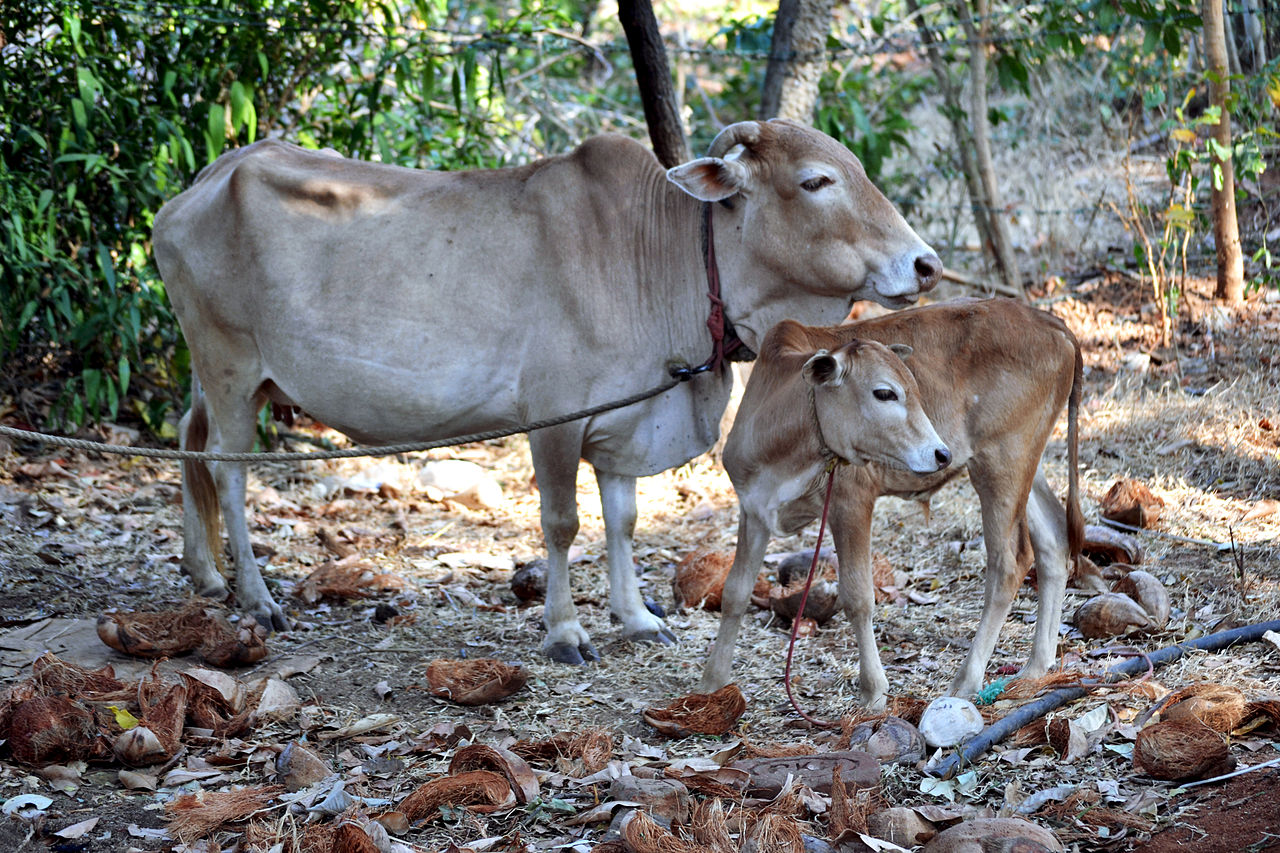
The Vechur cow, a breed of cattle known for its diminutive stature and ease of husbandry, was one among the many indigenous cattle breeds of Kerala, popular across the central districts of Kottayam, Ernakulam and Alappuzha for their hardiness. The Vechur bulls—relatively light and strong—were used to plough marshy paddy fields in low-lying agricultural tracts. By the 1980s, though, its population had dwindled; new dairy policies that favoured increased milk production, designated the low-yielding Vechur cow as “undesirable to propagate”.
These new policies were in response to a dairy crisis in the 1960s, when the milk-supply system lost a significant part of its high-yielding milch owing to a shortage of green fodder and concentrates, control of milk markets by private middlemen, and premature slaughter of milch animals. This “negative dairy development cycle” (Kurien 2001: 43) had led to milk supply falling behind demand (Kurien 2001; Atkins 1989). Shortages meant that the average per capita consumption of milk fell to 107 grams per day in 1970 from 124 grams in 1950-51 (Kurien 2001). To ramp up domestic milk production, the Indian government launched Operation Flood, an array of technical and economic interventions in milk production that aimed to place modern dairy farming at the centre of rural poverty alleviation (Kurien 2001).
In Kerala, Operation Flood took the form of the Livestock Improvement Act, 1961, which sought to replace indigenous cattle varieties with high-yielding cows birthed through artificial insemination. Animal husbandry officials forcibly neutered indigenous bulls and created unfavourable licensing requirements for owning them. This compelled dairy farmers in the state to propagate their cattle exclusively through the massive crossbreeding programmes sponsored by the government, leading to a near extinction of indigenous breeds like the Vechur cow.
Iype grew up in Niranam, a village in central Kerala, surrounded by Vechur cows and drinking their raw milk. In her autobiographical account of the conservation efforts, she viewed the state interventions as symptomatic of a breakdown in the harmonious relationship between farming communities and their domestic animals. Returning to Kerala after her doctoral training from the National Dairy Research Institute in Karnal, Haryana, Iype in 1989 put together a group at the Kerala Agricultural University to conserve the Vechur cow, well before any such measures were instituted by the Indian government.
The success of the conservation efforts depended on its passionate appeals to the patriotic duty of the farmers and pastoral idyllicism of the country.
As accounted retrospectively in her book, what motivated her to launch the conservation project was neither the ideal of disinterested scientific inquiry nor the calculative reason of maximising agricultural output. Rather, Iype was driven by a wistful longing for a bygone past in which Vechur cows were an indispensable part of Kerala’s rural landscape.
Iype’s team scouted villages and identified eight cattle that matched the phenotypical descriptions of the breed: diminutive size and relatively docile temperament. But many of the farmers who owned these cattle were unwilling to part with them. Unlike the central and state dairy policymakers, these farmers had quite different criteria for choosing cattle breeds. Even though the Vechur cow’s milk yields were lower than those of crossbred cattle, they required far less intensive management. The indigenous breed’s superior tolerance to disease and heat made it particularly well adapted to the subsistence needs of small-scale farmers and the climatic conditions of Kerala.
In an effort to persuade the farmers, Iype framed the act of giving up their cattle as one in service of the nation: the farmers were not selling their cattle to Iype, but were providing the “raw material” (Iype 2013: 107) for preserving and improving the nation’s indigenous biodiversity.
As farmers began cooperating with her, Iype worked the levers of state bureaucracy to obtain funding and institutional support for procuring the cattle and preserving their germplasm. But even as the conservation project grew and Iype’s team began celebrating their success, a controversy began to take shape. Iype’s professional rivals at her university accused her of fraud, alleging that the animals procured were in fact not Vechur cows.
What, after all, made a cow a Vechur cow?
What Makes a Cow?
There had been no prior studies that formally identified the distinctive properties of a Vechur cow. Nor were there scientific instruments available— either to Iype or her critics—to assess the genetic purity of an animal breed whose features were yet to be codified as usable information. Iype, as someone who grew up in a dairy farming community, had selected the nucleus herd based on how she remembered the Vechur cows from her childhood. The criteria of cattle selection were built on the tacit knowledge of local farming communities, which, for Iype’s critics, was incompatible with the modern conventions through which biological objects are taxonomised by scientists.
The Vechur project shows how social imperatives beyond Mertonian considerations of rational, disinterested inquiry can shape the workings of science.
By the mid-1990s, the effects of this unresolved dispute had assumed grotesque proportions. Several cows died in Iype’s facility; first by being poisoned with insecticide, and later in a fire. Iype plausibly believed that the killing of the cows was deliberately planned by her rivals to discredit her leadership of the Vechur project. Even though the investigations by the police were inconclusive, the public contestations around the death of the unclassifiable cows garnered considerable media attention. An article in Sasthragathi—the flagship science magazine published by a popular science movement in Kerala—gave credibility to the suspicion that there was a larger conspiracy at work within the university. Following the publication of the article, the state government constituted a committee to investigate the project. The committee invited members of the public to testify before it.
Iype describes several interactions between the committee and members of the public in her book, capturing an irresolvable tension between the demands of scientific expertise and the forms of lay knowledge that were at the heart of the Vechur controversy. As a debate staged in the “theatre of public reason” (Jasanoff 2019), the rhetorical resources deployed by those testifying before the committee were often not anchored in the verifiability or falsifiability of scientific claims. On being demanded by the committee to produce evidence to prove that the animals in the facility were indeed Vechur cows, one of the respondents from the Vechur region responded, “These are our cows. And we know that these are Vechur cows. Only we can ascertain this truth. There are things that cannot be proven. Some truths are truths, and that is that.”
The second roadblock in the way of the conservation efforts came as an allegation of gene piracy. In 1994, a local newspaper reported that the Roslin Institute in Scotland was in conversation with the Kerala Agricultural University to obtain the embryo of the Vechur cow. The report postulated that the institute would use the embryo to conduct transgenetic research around high-yield dairy cattle and sell the patented Vechur gene to its corporate collaborators. As the entity responsible for cloning Dolly—the first mammal from an adult somatic cell—the Roslin Institute was widely believed to be capable of such research as well as positioned to gain commercially from the Vechur genes.
The controversy was catapulted into a public debate in 1997 when the prominent environmental activist Vandana Shiva declared that the Roslin Institute had obtained Vechur embryo in order “to facilitate their patentable transgenic research”. In the days that followed, several attempts were made to verify this claim. The Roslin Institute vehemently denied its involvement in any research on Indian cattle breeds, and searches in patent databases returned no evidence to support the allegation. As the controversy was winding down, a reporter asked Shiva whether she had been “tricked” into making false allegations regarding gene piracy. “I have no connection with any scientist in the KAU”, Shiva responded, “I do not make myself available for petty personal politics meant to further personal agendas. My concern about biopiracy is not related to the KAU's internal politics; it is much larger than the issue of the KAU and the Vechur breed”.
The Vechur cow inhabits both material farmscapes and an imagined pastoral landscape, where it signifies a return to an ecologically harmonious rural order.
While it might be difficult to identify a moment that conclusively resolved the controversies around the Vechur project, Iype points to an article published in Nature Biotechnology as providing such a verdict to the debate. Interestingly, this article by Alan Dove—titled “Roslin Falsely Accused of Biopiracy”—is a sociological account of the Vechur debate rather than an article that makes any narrowly ‘scientific’ claims about it. The author of the article attributes the Vechur controversy to a misplaced suspicion that “indigenous groups” have towards biotechnology—an attitude that is not uncommon in regions affected by the exploitative effects of colonialism (Dove 1998: 904). By the turn of the century, the wider public acceptance of the initiative had transformed Vechur cattle conservation into the “prestige project” (Iype 2022: 211) of the Kerala Agricultural University, leading to a meteoric rise in the population of the Vechur cattle in the region.
If they were once on the verge of erasure, there are estimated to be around 6000 Vechur cows in the country today. In popular imagination, the Vechur cow is a “cultural icon” and an “ayurvedic powerhouse”, highly sought after for the medicinal properties ascribed to its milk. Today, the breed is often invoked as emblematic of sustainable, small-scale agriculture—its small body size and low input requirements framed as ideally suited to marginal farmers. In this sense, the Vechur cow inhabits both material farmscapes and an imagined pastoral landscape, where it signifies a return to an ecologically harmonious rural order that is continuous with certain ideals of civilisational authenticity.
What Scientific Controversies Teach Us
Science is commonsensically understood as a domain divorced from political contestations (Sismondo 2010: 180). Yet, instances such as the Vechur project show how social imperatives beyond Mertonian considerations of rational, disinterested inquiry can shape the workings of science. The roadblocks confronted by the conservation movement demonstrate the fecundity of scientific controversies as moments of crisis that reveal the inner workings of science. In spite of being a project located in an institutional setting that privileged dispassionate inquiry, the success of the conservation efforts depended on its passionate appeals to the patriotic duty of the farmers and pastoral idyllicism of the country.
The emergence and the (apparent) resolution of the controversy around the conservation efforts also illuminate how scientific facts are established through diverse social mobilisations. The contestations between scientific traditions and the lay knowledge, the availability of institutional and technical support (journals, patents, universities), as well as the “civic epistemologies” (Jasanoff 2005) that arose from the public engagement in scientific decision-making (newspapers, popular science magazines, and committee hearings) became vital to resolving the debates around the cow. This means that as various publics participate in settling a scientific controversy, contestations between interest groups and vicissitudes of institutional policy can profoundly shape how scientific knowledge is constructed, owned, and disseminated within scientific communities.
Thomson Chakramakkil is a PhD candidate in the Technology in Society research cluster at the Indian Institute of Technology, Delhi.