




Bacteriophages literally mean bacteria-eaters. These are viruses that infect bacteria. Some called the lytic phages kill bacteria quickly—within minutes or hours. Biologists have grown fascinated with these viruses. They are growing them in labs so that they can study their genomes as well as visualise how phages enter and infect bacterial cells. They want to understand which phage infects what bacterial cells and how. Such details are useful if we want to use phages as therapeutic tools against bacterial diseases.
Phages are now in the spotlight mainly because of the dwindling efficacy of antibiotics, our go-to-medicines to treat bacterial infections. Antibiotics are not working well against bacteria because bacterial populations constantly evolve to survive in undesirable living conditions. In antibiotic-rich landscapes, bacteria have evolved to have stronger cell walls that antibiotics cannot puncture; to have pumps to throw antibiotics out of their cells; or to produce chemicals that destroy antibiotics in their vicinity. These are called antibiotic resistant bacteria.
Developing new antibiotics against these resistant bacteria takes decades and is very expensive. Yet even after such investment, bacteria can quickly become resistant to the new medicines. So it is important to find solutions that can keep pace with bacterial evolution. Bacteriophages, which are viruses that can also evolve naturally and just as fast, are one potential solution that a growing number of scientists and clinicians are exploring.
History of Bacteriophages
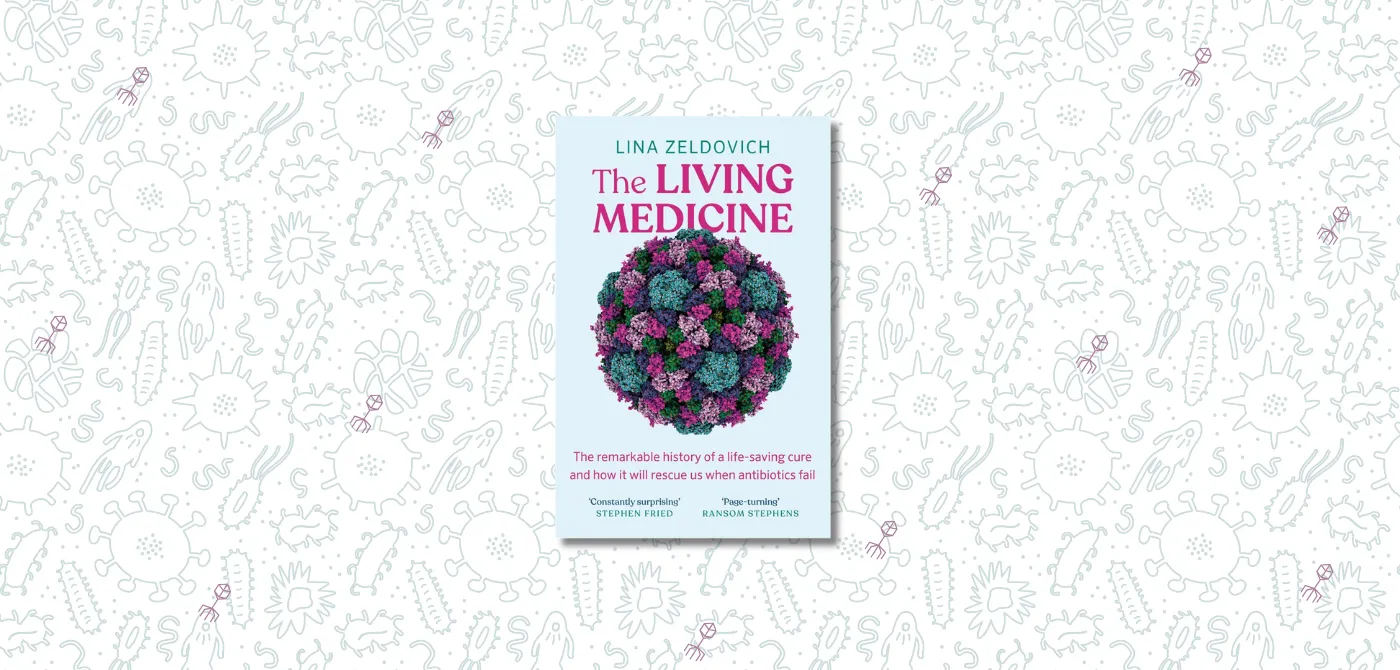
Lina Zeldovich’s book, The Living Medicine, takes us into the details of bacteriophages as therapeutics. It right away surprises us by showing how phages have been in use as medicines since a century. But their use had been largely restricted to one part of the world, the erstwhile Soviet Union.
Zeldovich is a science journalist who spent her childhood in the Soviet regime and then moved to the United States. The book contains stories of phages developed from old Soviet science publications, modern journals, newspapers, memoirs, handwritten notes, and oral histories as well as her memories. It feels as if Lina uses the book to make sense of a therapeutic that she read of and heard about since a kid (but possibly never used herself) and is now all the rage in Western science. In doing so, she tells us about how scientific communities work, what it takes for new ideas to be accepted, and how science is affected by those in power.
A quick glance at the Internet shows English bacteriologist Frederick Twort and French-Canadian microbiologist Félix d’Hérelle to be independent discoverers of bacteriophages around 1915–1917. Both of them found agents that were smaller than bacteria and were capable of killing bacteria, which d’Hérelle eventually named bacteriophages. But Zeldovich’s book brings Georgian medic Giorgi Eliava’s work to the fore. Around the same time as d’Hérelle, Eliava had discovered similar agents in the Mtkvari River in Tbilisi, the capital of Georgia.
Both d’Hérelle and Eliava’s discoveries were in the context of phages’ abilities to kill disease-causing bacteria, and the book details them vividly. d’Hérelle found them in the guts of soldiers who recovered from dysentery infection, and Eliava found them in the Mtkvari river water carrying cholera-causing bacteria in Tbilisi. Their careers started very differently, overlapped with each other’s, and went towards very different ends.
The book talks of how d’Hérelle‘s colleagues at the Institut Pasteur ridiculed his work, and how he found it difficult to even find a lab bench to continue working on phages.
Eliava became a hero in Georgia early in his career for his successful cholera-containing measures through cholera vaccines. He soon became the head of the Tiflis (Tbilisi’s old name) Central Laboratory. He was in charge of ramping up vaccine production capacities in a resource-deprived Georgia after World War I. These responsibilities and his personal life did not offer him much time to focus on phage activity.
d’Hérelle was much older than Eliava. He was a self-taught microbiologist with no formal degree. As a Canadian citizen, during World War I, he worked with the famed Institut Pasteur making antiseptics and vaccines to treat soldiers. It is not clear if it was the lack of formal degrees, his prickly character, or because his claims went against many existing theories of biology that d’Hérelle’s belief in phages did not find many takers. Many also found it difficult to replicate d’Hérelle’s findings.
The book talks of how d’Hérelle‘s colleagues at the Institut Pasteur ridiculed his work, and how he found it difficult to even find a lab bench to continue working on phages. But he still found opportunities to use phages to treat human as well as animal infections in other countries. And, to do so, he developed protocols of growing phages as necessary for different conditions in different places.
In the Soviet Union
Eliava went to Paris to learn about setting up mass production units of vaccines from the Institut Pasteur. On reaching there, when he heard of d’Hérelle’s findings, he noted how similar they were to his own observations. They went on to work together, published their findings for the wider scientific community, and the world took note of their work. The book provides examples of several countries, including India, benefitting from d’Hérelle’s work.
France was slow to embrace phages as therapeutic agents, but the book shows how Georgia, and the wider Soviet system, accepted them with relative ease. This contrast is especially striking given the turbulent political backdrop.
One possible reason for this easy acceptance is that bacteriophages were identified in the Mtkvari river, a waterway deeply woven into daily life and celebrated in local folklore for its wholesomeness. Phages also demand far fewer resources to cultivate than other anti-infective tools such as vaccines, which made them attractive in a resource-constrained setting.
All this scientific work unfolded amid World War I, the collapse of the Russian Empire, Georgia’s brief independence, its incorporation into the Soviet Union, and eventually the Soviet Union’s dissolution. In this climate of upheaval, even maintaining basic infrastructure, such as a steady electricity supply, was sometimes a challenge.
During the Winter War between the Soviet Union and Finland, and throughout World War II, microbiologists used phages to treat battlefield infections…
Under Josef Stalin, a bacteriophage institute was established in Georgia, his home republic. The book portrays Stalin as backing Eliava’s efforts to make Georgia more self-sufficient in healthcare, to the extent that d’Hérelle—by then well regarded in the US—considered Georgia better placed in terms of public health. With political support, they assembled teams of technicians able to isolate phages from nature, match them to their bacterial hosts, and classify them, and the institute became operational even as the government’s support for Eliava waned.
Eliava’s politics clashed with those of Lavrenti Beria, Stalin’s powerful lieutenant. The book recounts how Beria’s apparatus persecuted Eliava and his family, accusing them of espionage, detaining them, and ultimately executing Eliava, while also destroying his scientific reports and records. This purge occurred on the eve of World War II and kept d’Hérelle away from Georgia, as the Soviet state tightened controls on foreigners.
Even so, their colleagues continued to use bacteriophages. During the Winter War between the Soviet Union and Finland, and throughout World War II, microbiologists used phages to treat battlefield infections—wounds, fractures, and cholera outbreaks—and even employed them as preventive medicine.
Bacteriophages vs Antibiotics
Penicillin’s arrival as a chemically produced “miracle drug” pushed bacteriophage therapy to the margins because early phage preparations were often less potent and less safe by comparison. At the same time, Western medicine favoured tightly regulated, industrial antibiotic production, while Soviet medicine continued to use phages therapeutically. It was only much later that the West returned to them as antibiotics began to fail.
Penicillin, the first antibiotic derived from a fungus, soon gained a formidable reputation. Chemists learned to manufacture penicillin and other antibiotics on an industrial scale, while wartime bacteriophage preparations often remained variable in quality and safety. In this context, phages were at a disadvantage against reliable antibiotics such as penicillin.
Much of the early phage research was published in Russian, and Soviet scientists were reluctant to share their methods and data. Researchers outside the Soviet Union also found problems in this literature. Documentation was sometimes weak, as with many traditional medical practices, and the field was marred by exaggerated claims and even fabricated studies in the absence of strong regulatory oversight.
Western healthcare systems, built largely around private industry, embraced these mass-produced antibiotics, whereas Soviet public healthcare institutions continued to manufacture vaccines and bacteriophages for therapeutic use…
Chemical synthesis made antibiotic production far more controlled than cultivating living phage cultures. Pharmaceutical companies therefore found it easier to produce consistent batches of antibiotics than standardised phage preparations. Western healthcare systems, built largely around private industry, embraced these mass-produced antibiotics, whereas Soviet public healthcare institutions continued to manufacture vaccines and bacteriophages for therapeutic use and later added antibiotics alongside them.
In the West, bacteriophages were long viewed mainly as laboratory tools for identifying and classifying bacteria rather than as medicines. Attitudes began to shift only when antibiotics started to fail, and antibiotic-resistant infections rose from the 1950s onward. The book traces how the US slowly began to take phage therapy seriously, highlighting the contributions of Georgian scientists working both in Georgia and in the US, as well as investors interested in building a credible phage-therapy industry.
For such a therapy to gain legitimacy, it must pass through stringent manufacturing standards, clinical trials, and approvals from bodies like the Food and Drug Administration (FDA). Although Georgian scientists often played a key role in initiating collaborations, the deterioration of their research infrastructure in the 1990s cast doubt on their ability to meet FDA requirements, and this made investors wary.
Scientists in the US who wanted to develop phage therapies, whether of Georgian origin or not, faced many obstacles. These ranged from identifying phages for different variants of the same bacterium—the very problem behind antibiotic resistance—to controlling phage production even as the viruses kept evolving. They also had to purify phages to minimise side effects, determine safe and effective doses, and address fears about growing bacteria-eating viruses in facilities that also needed to culture bacteria for producing biomolecules such as insulin. The difference was that, unlike elsewhere, the US did not lack infrastructure.
The book describes how these scientists had to work over nearly two decades to address these concerns. Their efforts included building ever-expanding phage collections, cataloguing them, developing standardised methods for producing and purifying phages, formulating phage cocktails to target multiple bacterial variants, and even editing phage genes to increase their potency.
The book also follows two key episodes that triggered a paradigm shift for phage therapy in the US…
During these two decades, a small group of US scientists kept up a dialogue with the FDA. They started companies dedicated to advancing phage therapy; most shut down because of regulatory hurdles, but a few managed to persist. While rules for human medical treatments remain far more stringent, food regulations are comparatively lighter, so companies began developing phage products for chicken feed and to prevent infections in salmon destined for human consumption.
The book also follows two key episodes that triggered a paradigm shift for phage therapy in the US. One was the case of an infectious disease epidemiologist’s husband who became critically ill with an antibiotic resistant infection. The other was the US military’s effort to collect phages so they could be used to treat soldiers during the Iraq war.
Steffannie Strathdee, today a co-director of the Center for Innovative Phage Applications and Therapeutics, had all the right connections in place when her husband contracted the Acinetobacter baumanii infection and did not respond to antibiotics. Acinetobacter grows in soil and are considered one of the deadliest bacterial infections. Strathdee got the FDA to agree on a compassionate use of phages to treat her husband. But she had to still find phages that would work against the bacteria, which came from a source hitherto unknown to her—the US military.
During the Iraqi war, soldiers succumbed to or suffered life-long due to infections caused by explosion injuries. This meant that a lot of soil and pathogens growing in soil such as Acinetobacter would enter their bodies through these wounds. The US military had already started making a library of phages that work against soil bacteria when Srathdee was looking for phages against Acinetobacter.
Though the military had not used their libraries on the soldiers, they agreed to share it with Strathdee. The treatment worked successfully and paved the way for many other compassionate uses of phages in human medical treatments in the US. The book cites many successful examples of phage therapies as well as the initiation of a clinical trial to use phages against bacterial infections in Crohn’s disease.
Future of Phage Therapy
Phage therapies push medicine to be re-imagined. Traditionally, enormous effort goes into finding a single drug, testing it, and then manufacturing it so it can be used for decades. This model does not hold for phage therapy. There are an estimated 10³¹ phages in the world and tens of thousands of bacterial species, and both bacteria and viruses keep evolving. When the bacterial target changes, new phages must be found.
… [M]ore countries are now investing in phage libraries and training specialists to work with them.
For phage therapy to work in practice, large collections of phages need to be built and catalogued against different pathogens so that clinicians can quickly choose candidates for treatment. Once therapy begins, new phages may have to be added as the bacteria change, and each phage can require a different effective dose. As a result, a previous clinical trial might not remain relevant if the underlying phage mix has changed.
Despite these complications, more countries are now investing in phage libraries and training specialists to work with them. Governments are recognising that they must help build and maintain these resources, even as they look to the US model in which public institutes spin off companies that grow using their own profits. Policymakers and clinicians want to stay abreast of this emerging way of treating infections, and many are now willing to experiment with newer therapeutic approaches.
Somdatta Karak is Head - Science Communication and Public Outreach, CSIR-Centre for Cellular and Molecular Biology, Hyderabad.