





Over the past quarter of a century, much has changed in the Indian electricity sector. The electrification of villages and households is itself the most fundamental change. According to the census of 2001, 44% of Indian households lacked electricity access at the time. In the course of 15 years, half a billion people gained electricity access, and by 2020 the electrification effort was completed. This gargantuan effort is without parallel anywhere in the world.
As a sector advances over time, developments overtake the construct of laws, structures, operating frameworks, and prevalent practices. Nowhere does this hold truer than in the Indian electricity sector.
However, that is only one of the significant developments of the two decades during which the electricity sector came together and was integrated in every way. India transformed its balkanised regional grid system in 2004 into a completely integrated national grid over the following decade. Well-functioning power markets came into being despite constraints. A massive build-out and diversification of power generation sources ensured that the sector is no longer in crisis mode as far as supply is concerned. Modern energy access has become the norm, and its deprivation is no longer acceptable to citizens and voters.
Some challenges, however, have continued. Poorly functioning state-owned utilities remain a problem—even in urban India on the outskirts of the national capital, power supply is an on-and-off affair, with diesel generation frequently kicking in when it turns hot, cold, or rainy. Accumulated financial losses continue to pose massive burdens that are ultimately borne by the taxpayer, affecting poorer citizens disproportionately. Distribution losses, though lower than before, remain unacceptably high despite technological improvements to the networks. The political economy of electricity casts deep shadows on sector operations and regulation.
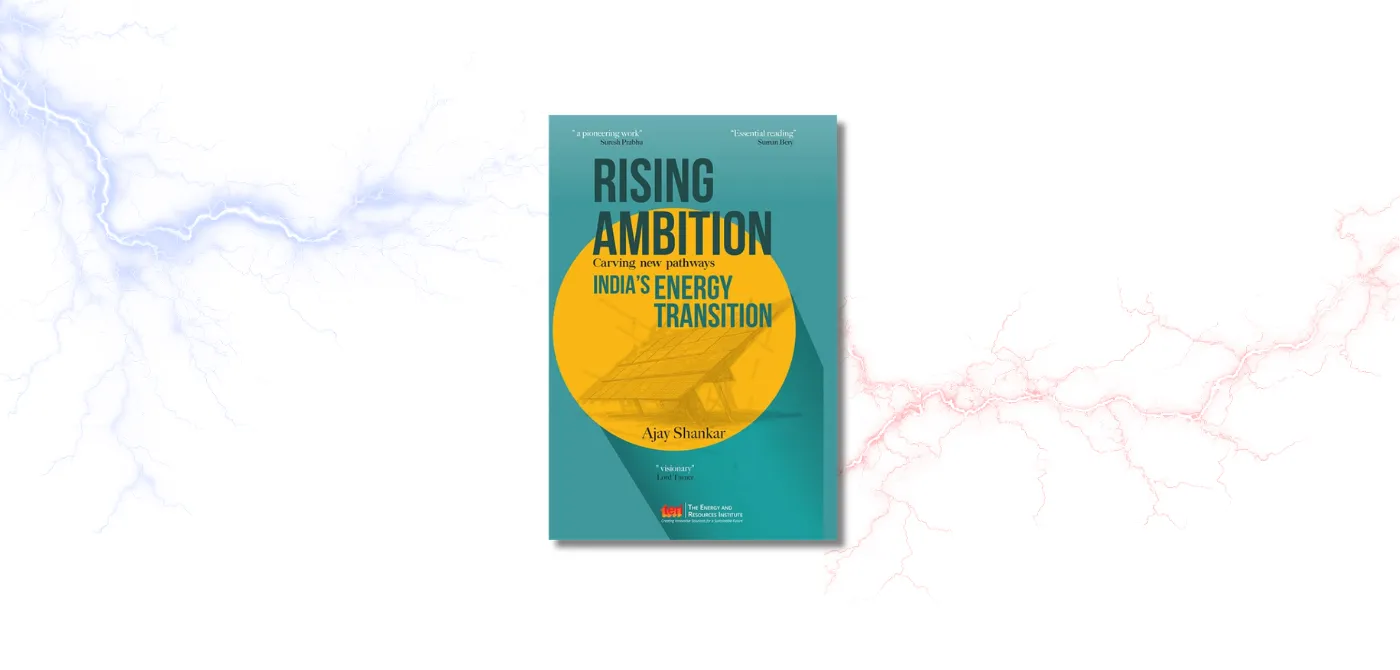
The improvements over two decades can be traced to the political economy, just as the continued failures and challenges can. Ajay Shankar has seen all of this from a unique vantage point—first as an administrator and policy maker, and then as an analyst and researcher. This volume of six chapters, organised around six distinct themes in the Indian electricity sector, is a distillation of those experiences, observations, and analyses. Tracing the recent history of reforms in the sector at the start of this century, it goes on to explore India’s Net Zero 2070 commitment.
As a sector advances over time, developments overtake the construct of laws, structures, operating frameworks, and prevalent practices. Nowhere does this hold truer than in the Indian electricity sector.
Renewables—previously expensive and sub-scale—have become mainstream and are now unconditionally competitive against conventional generation, even with the costs of storage and transmission included. Power markets have deepened and found a natural balance with long-term contracts. Net Zero is now formally in the policy frame, and the path to Net Zero runs through electricity for many reasons—the foremost being that the technology required demands electrifying everything possible. Shankar’s book devotes much-needed attention to pathways for end-use sector electrification as well as to the supply side—a balance that often goes missing in other narratives.
India’s rooftop solarisation programme, the switch to electricity as a cooking medium in preference to LPG, and a faster transition to electric vehicles have become national imperatives.
The book is a treasure trove of facts and details that are difficult to find in one place. The author’s deep experience and continued association with the sector has allowed for analysis that is hard to find elsewhere.
However, in the dynamic world we live in, even a recently written account can be overtaken by rapid and at times inexplicable developments. During the course of the book’s publication, the dynamics of the energy sector changed due to the war in the Persian Gulf and the blockage of the Straits of Hormuz.
This has only strengthened the case for faster electrification. For India and similarly placed nations, electrification is also the pathway to energy security. India’s rooftop solarisation programme, the switch to electricity as a cooking medium in preference to liquefied petroleum gas (LPG), and a faster transition to electric vehicles have therefore become national imperatives.
The transition critically depends on a robust electricity distribution sector. Distribution reforms to strengthen the network and improve its ability to serve the growing economy and consumer demand—all of which are highlighted in Shankar’s book—are timely actions. Indeed, the book is a timely call to action, not only on sustainability grounds but also for energy security, accessibility, and affordability.
The book does draw attention to this issue in the early chapters. However, Shankar does not dwell on it as an essential part of the Net Zero journey. For the author, Net Zero by 2070 is the north star, and renewables constitute the foremost means of achieving it. To that end, the book provides a great amount of detail on various clean energy technologies—wind and solar in their various forms and variants, but also biofuels and nuclear, with fair coverage of energy storage technologies as well.
What is perhaps missing is an in-depth analysis of transmission. The robust inter-state transmission system (ISTS) and the free ISTS access and market integration it has permitted have been key to renewable energy expansion. A more detailed account of transmission system development and the role of transmission in facilitating renewables would perhaps have been warranted.
Achieving Net Zero is obviously contingent on winding down coal-fired capacity. The book goes into detail on how this massive fleet can be downsized and eventually eliminated. On the basis of comparative costs coupled with climate ambitions, Shankar foresees the end of coal-fired generation in India. But is the age of coal really over, as the author claims?
It is hard to see that it is—and indeed a large fleet is under development and construction. Initially, new coal capacity was meant as a complement to renewables. Now, fuel security concerns have taken over. Coal is positioned as an essential means of achieving electrification and energy security goals. Perhaps the Net Zero goals and electrification goals no longer coincide in a post-Hormuz world as they did just a few months ago.
Sadly, collaborative and consensual approaches have become markedly absent today. Shankar obliquely points to this void by drawing reference to the past.
There are some insightful observations in the book that run contrary to contemporary practice in India. For example, the author rightly considers distribution companies (discoms) contracting and managing energy storage capacity as the best option. This is a reasonable premise, except for the reluctance of discoms to assume that responsibility. Instead, they prefer Firm and Dispatchable Renewable Energy (FDRE), which arguably does not offer the benefits of aggregated operations.
The challenge goes to the core of the ownership structure and operations of discoms—one of the greatest and continuing limitations of the Indian power sector. One wishes the author had dwelt more deeply on the questions of state ownership and political economy that continue to afflict the sector.
While much of the book is dedicated to the hard facts of energy systems, there is a softer side to the transformation that is no less important. It relates to building consensus on difficult legacy issues, deep-rooted industry structures, and the entitlement systems that accompany them. Perhaps the greatest achievement of the process that resulted in the Electricity Act 2003 was the building of consensus among the political class and citizens.
This is, as it should be, a matter of great pride for Shankar and others involved in the passage of the law and the further downstream reforms. The massive scale of the outreach activities, the dialogues within various committees and beyond them, and the stakeholder communication to ensure that intent was understood and genuine feedback taken through that process—all of this is a textbook example of how complex reforms should be conducted.
Sadly, collaborative and consensual approaches have become markedly absent today. Shankar obliquely points to this void by drawing reference to the past. While the challenge on this count is not particular to the electricity sector, the remarkable outcomes of the approach that—in Shankar’s words—“facilitated the evolution of legislation that suited Indian conditions and resulted in highly positive outcomes” are worthy of more detailed recall. Especially from Shankar, who saw it from closest quarters. Perhaps it will be the subject of his next book.
Anish De is global head of energy, natural resources and chemicals at KPMG International.