



I speak today of the pedagogic style shared by every traditional arts practice in India of the transmission of knowledge from guru to shagird in the seena ba seena style. ‘Seena-ba-seena’ translates literally as learning heart to heart. This way of imparting knowledge is sometimes idiosyncratic, often riddle-like. There are no syllabi, no exams, except internal ones. And it is a slow, often confusing process. But to my mind it is worth the long years of work for the insights we gain from this slow koan-like taleem.
‘Seena-ba-seena’ translates literally as learning heart to heart.
And so, in the next few conversations I would like to speak of this ‘slow-cooking’—literally called ‘pukhta’!-- style of teaching and learning in the arts. About extraordinary insights gained from such interactions with other gurus, and indeed now, as I grow older, from young friends who work with me as we learn and teach together.
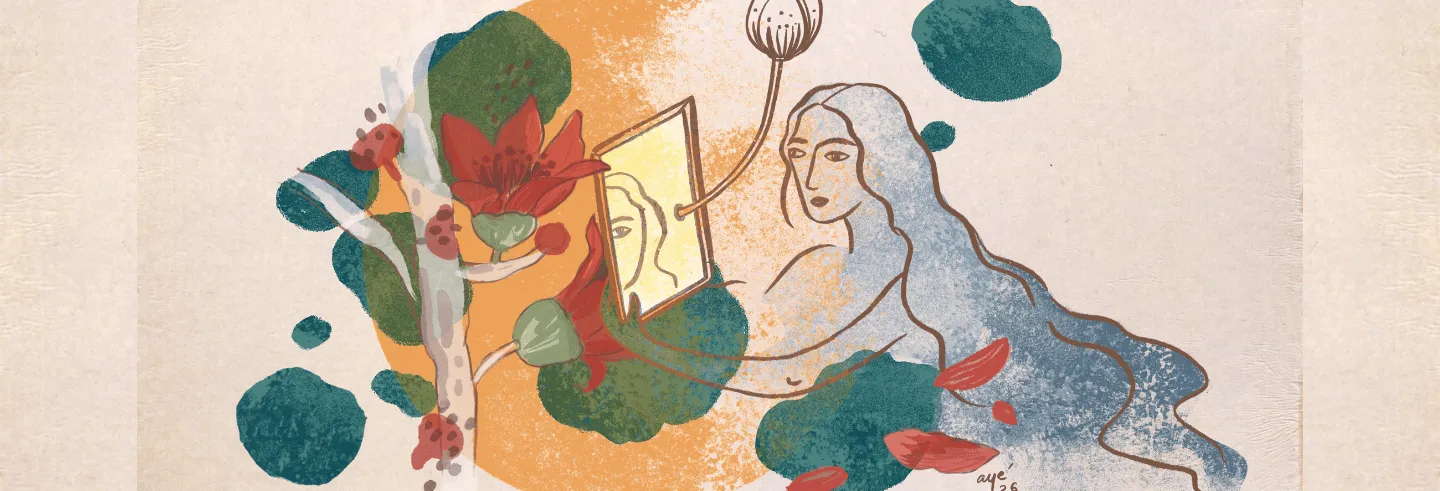
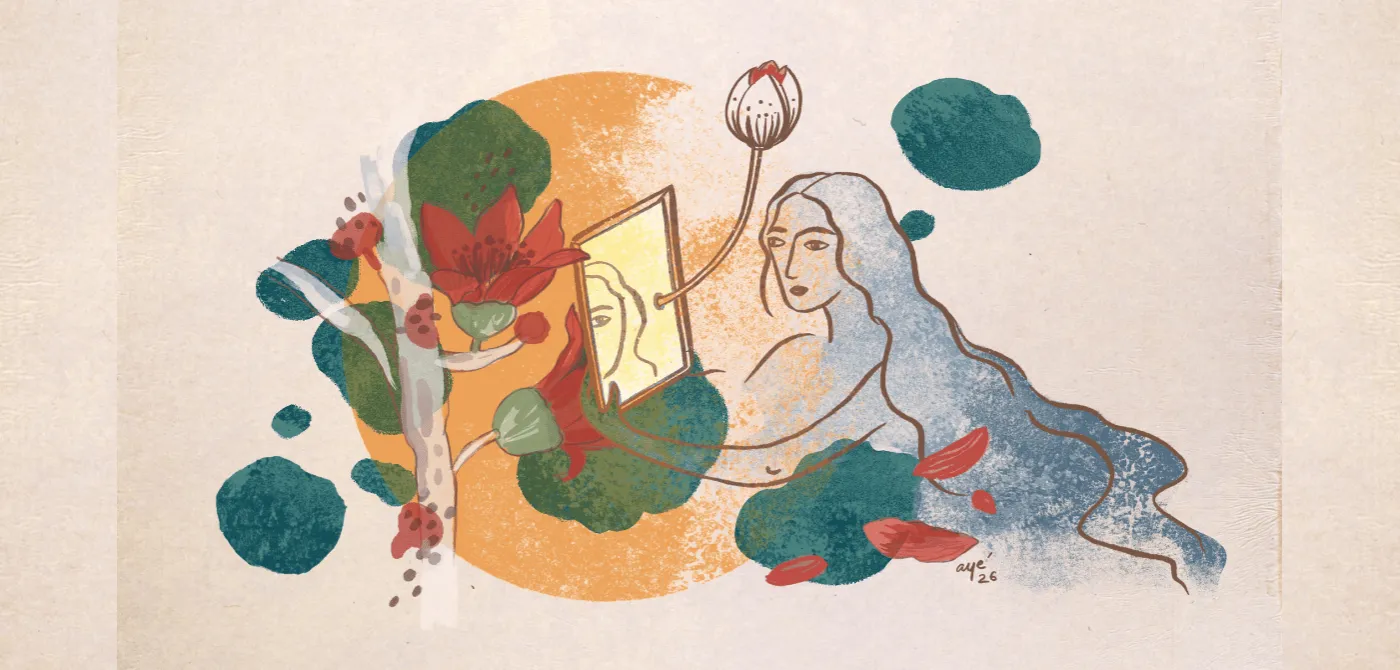
Today I share one such magical, riddle-like moment in my own taleem. Forgive me for speaking of my own experience. But I do believe this story is worth sharing in our rushed and busy world. And rather wonderfully, this story continues, in a fashion, the flow of the watery, reflective/reflexive chashma-e-hunar that now appears here as a small and somewhat nondescript mirror.
At the time of which I speak, I was fortunate to be studying under a tabla ustad, the amazing Ustad Dayam Ali Qadri. And no, I wasn’t studying tabla; I was receiving taleem from him in how exactly to converse with the tabla to create thumri’s will-o-the-wisp swiftly changing emotions, the bhav-batana, or expressing the emotion(s) of the text. During this period of my taleem, many wonderful insights presented themselves to me about how tabla and voice might together create ever-changing waves of bhav, not merely of virtuosity. I wish to speak here of one such moment, when, as I began singing, Khan Saheb placed before me a small mirror; he told me to look into it, and then sing to my reflection.
Why did Khan Saheb do this?
I was aware even at that time that this was a deep teaching that went far beyond the technical ability to sing well, or even to sing with bhav. And so I started thinking, reading, remembering, connecting various dots….And now, so many years later, I try to find the words to speak of Khan Saheb’s mirror and the great teaching he gave me.
Khan Saheb’s mirror instantly brought to mind a memory of watching theatre director Anuradha Kapur preparing actors for work on a play. She had made them do what is called the mirroring exercise, whereby actors face one and other and mirror each other’s gestures, speech, and as they move deeper into the exercise, even thoughts, and then, moving deeper still to a space where one does not know any more who is it who acts, who it is that mirrors that action! This theatre exercise, developed by Viola Spolin and Jerzy Grotowski (in very different ways, no doubt), is the bedrock of much contemporary theatre work. But such techniques and the theories that inform them have been present in older non-western and traditional art practices as well. Indeed, these are foundational theories/words to live by in Shakta/Tantra, Bhakti, Sufi and Zen thought. So do allow me to speak a bit of this extraordinary concept of the ‘mirror’ and of the act of mirroring, and how, as I understand it, all these classic techniques of the theatre and all these philosophical understandings connect with that simple, small, yet so wonderful act of Khan Saheb’s placing a mirror before me and asking me to look at my reflection and sing!
In contemporary theatre and dance work, the physical mirror serves to align the actor’s/dancer’s body perfectly. Traditionally too, mirrors were important in performance/practice spaces.
In theatre and performance work, apart from the exercise of mirroring, the physical mirror has also often been an important part of the rehearsal space. In contemporary theatre and dance work, the physical mirror serves to align the actor’s/dancer’s body perfectly. Traditionally too, mirrors were important in performance/practice spaces. I recall my guru Naina Devi ji describing to me the mirrors in the kothas of tawaifs. Indeed many other accounts, written and oral, also speak of the beautiful mirrors in the performance space of the kotha. Mujra, the performance style of the kotha, was a form that was simultaneously sung and danced. It was both aural and visual. The kotha's mirror would therefore have had a significance and necessary role to play in the unfolding of the performance. So when Khan Saheb handed me that mirror, was he harking back to and honouring the original space and style of thumri’s performance (the kotha’s mujra) and also reminding me of that old ‘multi-disciplinary’ style —music, dance, poetry, story-telling—and dare I say, flirtation too—all rolled into one!
Also read: Chashma-e-Hunar by Vidya Rao
An aside—Naina ji had once told me that the large mirrors in the kotha’s performance space served as a separate set of eyes for the kotha’s Chaudhrain/’Madam’ and indeed for the performer herself: Kaun aa raha hai, kaun jaa raha hai; kaun kaisa bartav kar raha hai-- sab kuch dikh jaata tha, she had said. The Chaudhrain, and the performing tawaif herself too, were able to see every movement in the kotha, who came, who went, how each person was behaving….It helped performers to avoid ‘problem’ persons and spaces within the hall (if at all they could help it) and it helped the Chaudhrain keep an eye out for and deal—as only they knew how-- with ‘problem’ behaviour on the part of the audience. Equally, it also gave the Chaudhrain and the ustads/teachers, an ability to see every gesture and movement, so that, especially in the case of younger, less experienced tawaifs, the ‘performance’ itself also became, not so much a finished product as a kind of extension of riaz , which could be critiqued later and thus improved upon.
Thinking of all this, might one say then, that into the traditional style of thumri performance was built the absolute importance of its visual-ness in addition to its musicality. Khan Saheb’s little shaving mirror, incongruous, with its aluminium frame, its slightly wobbly stand, the small blotches and stains that age had marked like wrinkles on its otherwise glossy surface—was this little mirror telling me something very important about thumri gayaki? Something that I needed to recognise and live by? That the performance style of thumri, required me to be aware that this was a heard form, of course it was, but it was also a visual form. And that I must never forget that! And that this little mirror was reminding me that I now had to learn to bring a certain quality of the visual—the dancerly, the painterly even, into the singing. Without this visual-ness it would just not be thumri.
This act of looking into the nookodi signals to the actor, the make-up artist, the world, that the ritual of creating the character is now complete.
When Khan Saheb gave me the mirror I also remembered the nookodi mirror of the Kathakali performer. At the ‘completion’ of their hours-long make up ritual (and indeed that act of doing the make-up takes hours and is, moreover, highly ritualised), Kathakali performers, again, in most formal a fashion, pick up and gaze at their own reflection in a small, exquisitely worked hand-held mirror called nookodi. This act of looking into the nookodi signals to the actor, the make-up artist, the world, that the ritual of creating the character is now complete. It is at this exact moment that the actors empty themselves of their ego and invite the deity/character to inhabit their body/soul-receptacle, the patra (which means both role/character and receptacle). Nookodi literally means ‘the Vision’--the vision of the character, the deity, the actor, the universe….Was Khan Saheb encouraging me to shed my ordinary persona and allow my body and soul to be inhabited by the nayika of the thumri? Was I being encouraged to see actor, character(s) and beyond as all present in the tiny mirror-text of the bandish?
Theatre practitioners like Viola Spolin, and following from her work, others too, like my own dear friend Anuradha Kapur, used the technique of mirroring to enable actors to enter deeply into their characters, and also (I think importantly) to create a sense of rapport, trust and support in rehearsal and on stage. But this notion of the mirror also finds a place in philosophical thinking of various traditions.
For the great Andalusian sufi and scholar Ibn-al Arabi, the universe is a polished mirror created by god, so he could witness his own beauty. (I have to use the gendered noun—he-- here, being aware always that this is but a linguistic function of the Arabic where nouns are invariably either masculine or feminine. This gendered use of the pronoun in Ibn-al Arabi’s work has to be heard alongside the understanding that in both the Sufic and mainstream Islamic traditions, god is beyond gender.) And now, I also think of Khwaja Mir Dard’s exquisite verse that overturns even this idea of the polished mirror and the reflection, seeing even this, mirror and reflection, as a duality that just cannot be possible, given the Oneness of god. Dard says:
Wahdat me teri harf dui ka na aa sake
Aaina kya majaal tujhe muh dikha sake
The perfection, the Oneness that is you—even a syllable of duality cannot impeach this
Would the mirror dare to show you your face!
And then, there is the exquisite image of Devi, looking at her own reflection in a mirror as she creates the universe through self-reflection; she looks in the mirror and the universe is born; she is the universe that she creates. Devi needs no external material to create the universe. She is both mirror and the reflection in that mirror of her own playful awareness. She is One and she is also the vastness, the many-ness of her reflection as worlds, galaxies….What a great teaching!
Devi needs no external material to create the universe. She is both mirror and the reflection in that mirror of her own playful awareness.
And how can I not mention Nandikeshwara’s text on dance, Abhinaya Darpana—the Mirror of Gesture/Expression. The word abhinaya comes from abhi (towards, for instance, towards the rasa, even towards the audience) and the root ni (to guide, to lead). Dance therefore is abhinaya—that which leads the viewer towards rasa. For Nandikeshwara, an actor/singer/dancer’s gestures and bhava expressions must reflect perfectly the eternal truth about human emotion—bhava and rasa—and communicate this to a sahridayi—an empathetic, appreciative, open-hearted—audience. The dancer/actor/singer (even painter too, surely) must guide, lead the rasika towards the eternal truth about emotion and life by her/his enacting/dancing/singing the text. For Nandikeshwara this means that the actor’s body-heart must be a flawless, polished mirror that reflects Life itself to the audience.
And then there’s the mirror of Zen Buddhism—this is but a metaphor for the mind, for pure awareness, that reflects all things without judgment, distortion, choice, preference, ego; it reflects without grasping, without attachment or aversion. But it is also a ‘no-mirror’, as Huineng would have us understand. Thus, Shenxiu tells us that the body is a Bodhi tree and the mind is the mirror of pure reflection; this mirror, he tells us must be kept clean of dust at all times. But then, Huineng takes this understanding a step further to the ultimate understanding of ‘no-mind’ by reminding us that given the essential emptiness of all phenomena, there is neither body-tree, nor mirror-mind and so where is the question of dust alighting and on what surface!
How many teachings, how much to understand—and all of these and more (I have mentioned but a few here) held in that small mottled mirror that Dayam Ali Qadri held up to my face one afternoon and asked me to look at my reflection and sing. This teaching—I am still trying to understand it fully. Perhaps I never will. And perhaps that is the point of taleem—your guru gives you a small something—a jadiya, as Kabir would remind us—to think about, and then you have to unravel its ever-flowing river of meaning.
Vidya Rao is a singer of thumri-dadra and ghazal, and also an independent researcher, teacher and writer.