

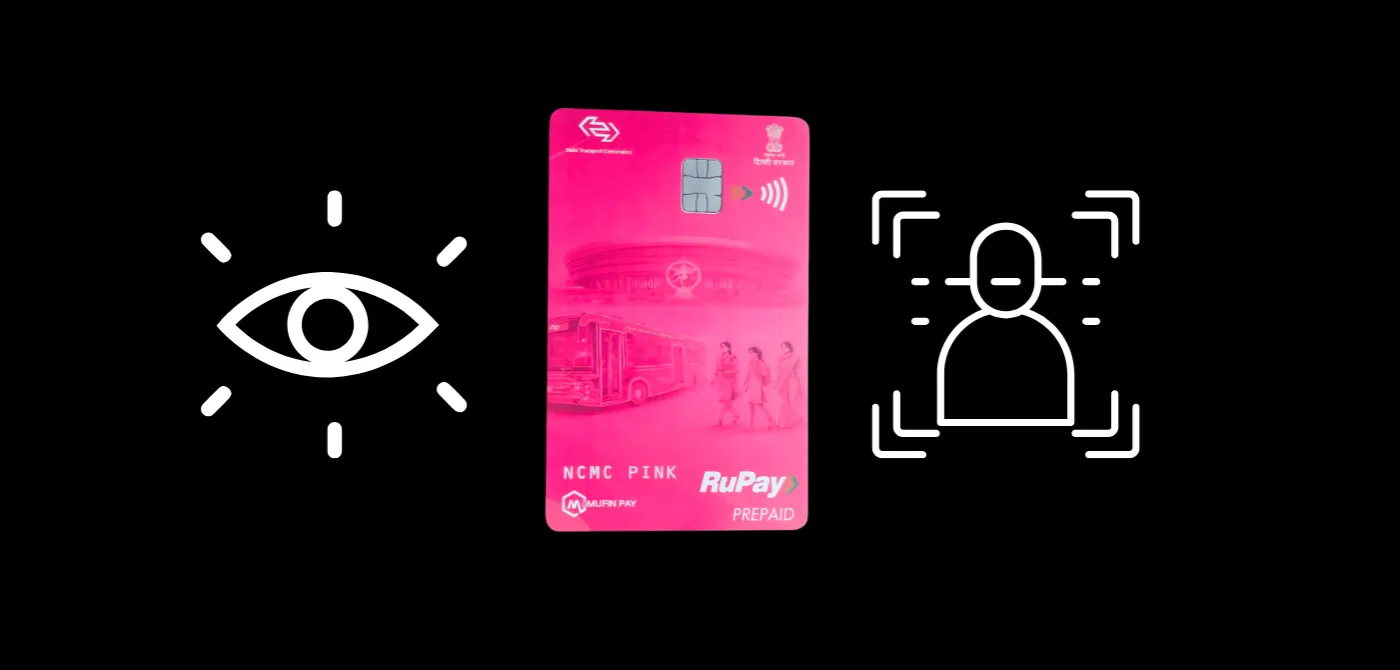



The Delhi government’s plan to replace the long-running pink ticket system for women’s free bus travel with the Saheli smart card is being promoted by it as a modern upgrade. Official statements have communicated that it will make the scheme more efficient and reduce misuse. Yet, there is no solid public evidence that such a change is needed, or that it will actually make buses more accessible for women.
Were men obtaining pink tickets? Were conductors pocketing reimbursements? Were fake tickets being printed? The government has not said.
The justification offered for this overhaul is “misuse” of the pink ticket system. Chief Minister Rekha Gupta has referred to a “pink ticket scam” on multiple occasions, linking it to the Comptroller and Auditor General’s (CAG’s) report on the Delhi Transport Corporation’s (DTC’s) Rs. 14,000 crore losses. But the CAG report addresses the DTC’s overall financial situation (most notably the sharp decline in the bus fleet) and does not mention any scam related to pink tickets (Comptroller and Auditor General of India 2024).
No specific mechanism of fraud has been publicly described. Were men obtaining pink tickets? Were conductors pocketing reimbursements? Were fake tickets being printed? The government has not said. In our community interactions with bus users across Delhi, we found no evidence of such practices. The tender documents cite no data either.
The pink ticket scheme, introduced in 2019, was simple. Women and transgender passengers could board a bus, take a pink ticket, and travel for free. Multiple independent studies and the government itself have credited the policy with boosting women’s share of ridership and encouraging greater mobility.
Now there are claims of “scams” and “leakages” but no data showing what proportion of riders are wrongly availing themselves of the benefit. Without such numbers, the case for a complete redesign rests on suspicion rather than demonstrated need. If the problem is small-scale misuse, it can be tackled through proportionate measures such as better on-bus checks and ticket validation. Instead, the government is proposing a bank-linked, document-heavy system that will introduce hurdles, raise administrative costs, and exclude legitimate users. That is a large leap in complexity for a scheme that worked well in its current form.
No Evidence of Scam
The DTC’s own Expression of Interest (EOI) for the Saheli rollout reveals the scale and complexity of the change (Delhi Transport Corporation 2025). It states that only bona fide female or transgender residents of Delhi are eligible, and that every applicant must undergo full bank-level Know Your Customer (KYC) verification. This means submitting Aadhaar (the national biometric identity number), a Permanent Account Number (PAN), proof of residence, and a photograph.
For many women, especially those in informal work, recent migrants, or those living away from their official residence, the new requirements will be significant barriers.
The bank will then dispatch the card to the applicant’s residential address, and the DTC will activate it through its Automatic Fare Collection system. This is already more complicated than the pink ticket process, but the tender goes further—it requires validating the address of each applicant to confirm that they live in Delhi.
This sounds like a simple check. In reality, it will be an enormous administrative exercise. Address validation for lakhs of potential beneficiaries means checking documents, matching them to databases, ensuring pin code alignment, and in some cases conducting field verification. Such work demands personnel training, coordination between banks and the DTC, reliable information technology systems, and a process for appeals when genuine applicants are rejected.
This is not something that the DTC or the banks are currently resourced to do at scale. The tender does not explain how many staff will be needed, what technology will be deployed, or what the cost of these operations will be, but it will certainly entail extraordinary investment.
For many women, especially those in informal work, recent migrants, or those living away from their official residence, the new requirements will be significant barriers. Some may have Aadhaar or a PAN but no matching Delhi address on record. Others may lack a bank account entirely. For many women, the time and effort may outweigh the small but vital savings that the scheme provides.
The logic of involving banks in a free bus travel scheme is questionable on its own. Under the pink ticket scheme, the government directly reimbursed operators based on the number of pink tickets used. There was no need to put every rider into a banking database.
Linking bank accounts and Aadhaar to this benefit raises privacy concerns and reflects a wider policy trend—making access to public services conditional on being fully documented in centralised systems.
Creeping Conditionality
Delhi is not alone in offering free bus travel for women, but it stood out because it did not require documentation. Karnataka’s Shakti scheme, launched in June 2023, reported a 30% increase in bus ridership almost immediately, even though eligibility was restricted to Karnataka residents and women were required to show proof of domicile.
This is how entitlements are being hollowed out in other spheres of welfare—not by abolishing schemes and programmes, but by making entitlements harder to access.
Telangana’s Mahalakshmi scheme, introduced in December 2023, similarly limits benefits to women domiciled in the state and restricts free travel to certain categories of buses. Tamil Nadu’s scheme, operating since 2021, is a comparatively positive case—it requires no proof of domicile and no registration. Women simply board and receive a zero-fare ticket, though free travel is restricted to “ordinary” buses, not express and air-conditioned ones. 1For an assessment of the scheme’s impact, see Sumana Narayanan, "Freebie or Freedom? Tamil Nadu's Free Bus Travel Scheme for Women," The India Forum, 22 November 2023.
Across several Indian states, free bus travel schemes that began as trust-based entitlements have gradually been layered with documentation requirements. The usual trajectory is somewhat like this. Schemes are often announced during elections with political fanfare and with unclear, but implicitly universal, eligibility. They are then narrowed in scope at the time of launch and further tightened through administrative mechanisms, with little public accountability.
Delhi’s pink ticket scheme stood out precisely because it avoided these traps. Unlike Karnataka and Telangana, it imposed no domicile restriction, no distance limits, and no eligibility criteria beyond gender. Any woman or transgender person could board any DTC or cluster bus and travel free. This universality was not an oversight; it was central to the design of the scheme, and it worked well. More than 100 crore pink tickets were issued, and women’s share of bus ridership increased substantially, with studies estimating the rise at between 20% and 33% (Singh and Nishant 2024; Jamba et al. 2025).
The Saheli card now proposes to bring Delhi in line with the more restrictive models that the scheme had originally avoided—and with success. The new conditionality arrives through a tender document, through the machinery of procurement. This is how entitlements are being hollowed out in other spheres of welfare—not by abolishing schemes and programmes, but by making entitlements harder to access.
Long Shadow of Aadhaar
The Saheli card belongs to a broader policy architecture in which access to public services is increasingly mediated through centralised identity systems. Ashish Rajadhyaksha has described this process as “creep”—the gradual widening of a technology beyond the purpose for which it was originally intended, arriving not through legislation or public debate but through tender documents and operational guidelines (2020). Understanding this architecture requires engaging with the “Aadhaar experiment” in Indian welfare.
The administrative logic is always the same—the state assumes that the cost of inclusion without verification is greater than the cost of exclusion through verification. The evidence consistently suggests otherwise.
Aadhaar began as a voluntary identity number. It is now required for food rations under the public distribution system, for pensions, for Mahatma Gandhi National Rural Employment Guarantee Act (MGNREGA) wages, for cooking gas subsidies, and for school admissions. The justification has been consistent—Aadhaar-based verification will eliminate “ghost beneficiaries” and reduce leakage.
But as Jean Drèze and Reetika Khera have argued, this framing conceals a political choice. Every verification system involves a trade-off between two types of error—inclusion errors (benefits reaching the ineligible) and exclusion errors (eligible people being denied). Recent welfare policy in India has systematically prioritised the elimination of inclusion errors, treating the exclusion of genuine beneficiaries as an acceptable cost of preventing fraud (Drèze et al. 2017).
The consequences of this choice are well documented. Studies of the public distribution system in states that implemented Aadhaar-based biometric authentication found significant exclusion due to authentication failures, connectivity problems, and mismatches between Aadhaar data and ration card records. In Jharkhand alone, multiple starvation deaths have been linked to the denial of rations following Aadhaar-related failures (Right to Food Campaign 2018).
The administrative logic is always the same—the state assumes that the cost of inclusion without verification is greater than the cost of exclusion through verification. The evidence consistently suggests otherwise. As Reetika Khera’s research on Aadhaar in welfare programmes has shown, the promised savings from reduced leakage often fail to materialise while the costs of exclusion fall disproportionately on the most vulnerable (2017).
There is a further irony. Aadhaar was promoted as a freedom from paperwork, red tape, and unaccountable middlemen. In practice, it has created a new layer of bureaucracy. A recent survey of nearly 300 people at Aadhaar correction centres in Delhi found that 40% of respondents had visited such centres more than once, and 56% reported that they or a family member had been denied a government service due to Aadhaar-related issues (Khera and Moharil 2024).
If the aim is to encourage women to use buses, the focus should be on making them safer, more reliable, and easier to access. Adding layers of paperwork achieves the opposite.
The costs are not trivial—each trip to a correction centre costs on average more than Rs. 100, and there is no guarantee of success. Drawing on Daniel Solove’s concept of “digital red tape”, the authors observe that databases intended to streamline welfare have instead become sites of disempowerment, where people have little control over the information that determines their access to public services.
The Saheli card extends this logic to urban mobility. To save Rs. 10 or Rs. 20 per ride, a woman must agree to link her identity, bank account, and address to a government-monitored system. This turns what was a universal entitlement into a conditional benefit that must be earned through paperwork and approvals. The people most likely to be excluded—migrant women, domestic workers, those living in informal settlements, and women whose official address does not match their current residence—are precisely those for whom the scheme matters most.
There is a deeper issue here. When every interaction with a public service requires documentary proof of identity, residence, and financial linkage, the state is no longer providing a public good. It is administering a targeted benefit.
The distinction matters. Public goods are available by default; targeted benefits must be applied for, verified, and approved. The woman who once walked onto a bus and took a pink ticket exercised a right. The woman who must first apply for a Saheli card, submit documents, pass KYC, and wait for address validation is petitioning for a favour.
The financial justification is equally weak. The government has not published a cost-benefit analysis. The pink ticket scheme reimbursed operators directly through a simple fiscal transfer. The Saheli system requires entirely new infrastructure—creating and maintaining databases, producing and distributing smart cards through banks, running helpdesks, and processing appeals.
In welfare policy, the administrative cost of identifying and excluding the “undeserving” frequently exceeds the fiscal cost of the leakage it claims to prevent. When the scale of misuse has not even been quantified, this inversion is almost guaranteed.
Curbing Women’s Mobility
Women’s ability to travel freely and affordably is a cornerstone of participation in work, education, and public life, not just a minor welfare handout. The pink ticket scheme recognised this and delivered it with minimal friction.
An independent study looking closely at the impact of the pink ticket scheme found that 88% of women felt that the scheme helped them use buses more (Nishant and Singh 2025). For 67% of women bus users, the monthly spend on travel dropped to under Rs. 1,000. The money saved was used in many ways—more than half of respondents used it for household essentials, nearly one in two respondents kept it aside for emergencies, one-third of them made personal purchases, and a significant share of respondents spent it on healthcare or education.
Until the government publishes clear data on misuse, demonstrates a strong cost-benefit case, and explains how the new process will be resourced without slowing down access, replacing pink tickets with the Saheli card remains unconvincing.
The Saheli rollout, with its bank linkage and address validation, risks excluding precisely those women who benefit most from affordable transport. This is why the unease among bus users is justified. The issue is not swapping paper tickets for plastic cards but whether governments choose inclusive, trust-based systems or more conditional, bureaucratic ones that ration benefits through procedural hurdles.
If the aim is to encourage women to use buses, the focus should be on making them safer, more reliable, and easier to access. Adding layers of paperwork achieves the opposite. If the government believes there is misuse, it should quantify it. If the scale of misuse justifies intervention, it should choose proportionate measures such as better on-bus checks, random audits, and improved conductor training.
A wholesale redesign that burdens every legitimate user to catch an unspecified number of illegitimate ones is not helpful. And if the government is unwilling to publish its evidence, citizens are entitled to conclude that the evidence does not support the narrative.
Until the government publishes clear data on misuse, demonstrates a strong cost-benefit case, and explains how the new process will be resourced without slowing down access, replacing pink tickets with the Saheli card remains unconvincing. In its current form, it risks harming women's mobility and undermining the very idea of public transport as a public good.