
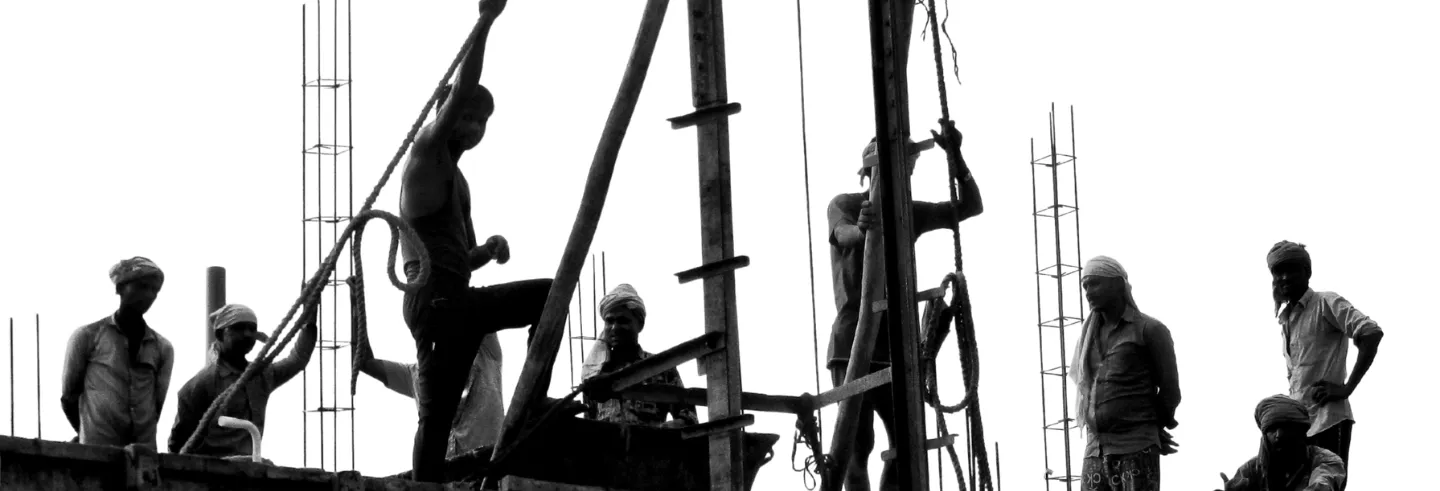
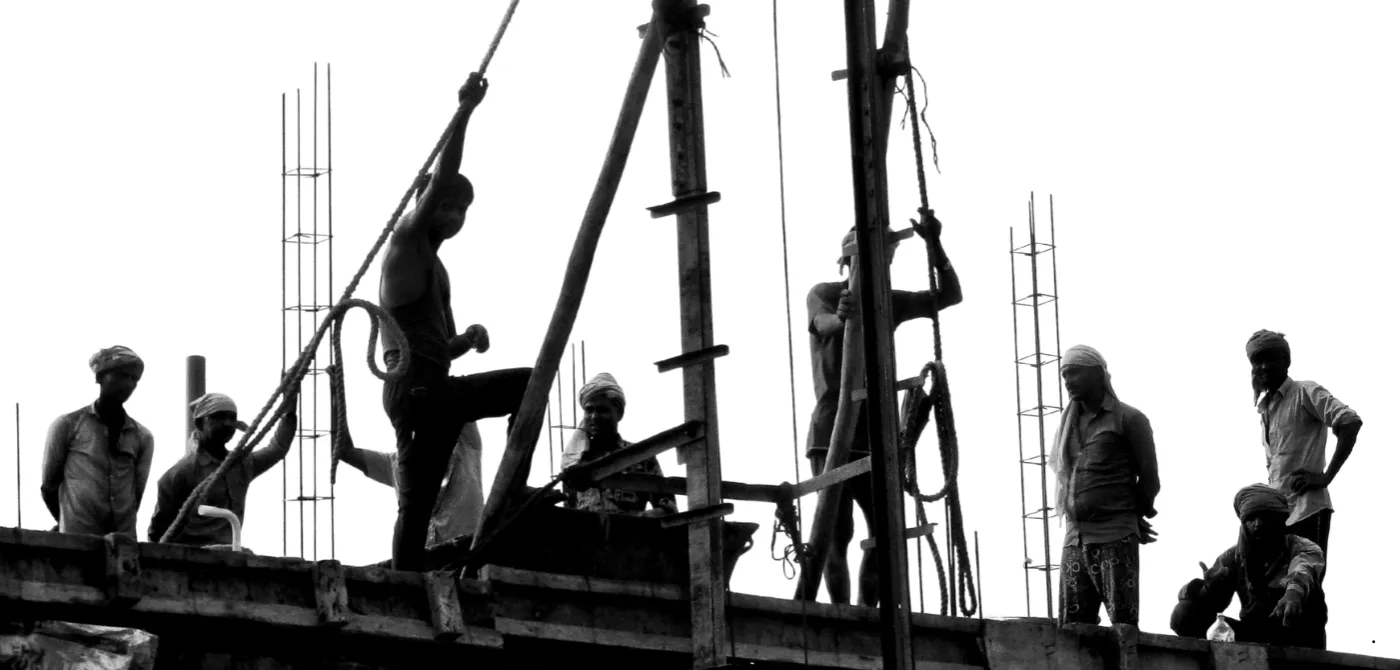



Construction workers in India occupy an unusual position within the informal economy. They are one of the few informal sector groups covered by a dedicated central welfare law—a law that should, on paper, give them stronger social security protections that most of their peers. But the reality tells a different story.
Millions of these workers cannot access even the most basic entitlements the law promises them. Today, India’s construction sector employs 71 million people. It recently overtook manufacturing to become the country’s second largest employer after agriculture and by 2030, that figure is expected to cross 100 million.
These workers build India’s highways, airports, and metros. They work on industrial corridors, smart cities, and mass housing projects. The government’s National Infrastructure Pipeline alone envisions Rs. 100 lakh crore in investment, positioning construction as central to both economic growth and job creation.
New Act and Outcomes
In 1996, Parliament passed the Building and Other Construction Workers (Regulation of Employment and Conditions of Service) Act, recognising that construction labour was hazardous, irregular, and mostly migrant.
The act requires state governments to set up welfare boards funded by a cess on construction activity (now between 1% and 2%). The boards are meant to provide medical assistance, accidental insurance, children’s education support, maternity benefits, pensions, and housing assistance.
Three decades later, the numbers tell a troubling story. Only 5.65 crore workers are registered under the act, against 7.1 crore working in the sector. At the same time, the informal nature of construction makes it hard to count workers accurately. Employment is seasonal and irregular, which makes it difficult to track who’s actually working in the sector at any given time and even harder to keep registrations and renewals up to date.
So, the question is—why does a well-funded, carefully designed welfare law fail to reach the very people it is supposed to protect?
In Jharkhand, for instance, the board failed to prepare annual budgets for several years and spent only half the funds allocated between 2017-2018 and 2021-22.
The answer is not about money or legislative intent. It is about systemic invisibility, poor administrative design, and a welfare system that does not match the reality of how construction work actually happens.
The act came in the mid-1990s, during rapid economic liberalisation and urbanisation. Construction had always sat outside the formal labour protection, unlike industrial or railway work, which has clearer regulatory frameworks dating back century or so.
States were meant to create Building and Other Construction Workers Boards as tripartite bodies with representatives from government employers and workers. These boards would design welfare schemes tailored to workers specific vulnerabilities. Maharashtra’s board, for example, covers roughly 1.75 million workers (up from 1.4 million in 2020) and distributes education scholarships, medical insurance, and accident compensation.
The Covid-19 pandemic briefly showed what the system could do. Between 2020 and 2021, welfare boards distributed Rs. 7,413 crore in emergency cash transfers to about 30.6 million registered workers. On paper, the act addresses the most urgent problems construction workers face—high accident rates, financial instability, intergenerational poverty, and lack of access to healthcare and education.
Wealth without Welfare
Despite its potential, the system based on the Building and Other Construction Workers Act is chronically underutilised. Cess collections now total more than Rs 1.17 lakh crore, of which Rs 48,000 crore remains unspent.
The Comptroller and Auditor General (CAG) flagged this in audits of multiple state boards. In Jharkhand, for instance, the board failed to prepare annual budgets for several years and spent only half the funds allocated between 2017-2018 and 2021-22.
Further there were certain other basic benefits promised under the Act, which did not materialise on the ground. This was not just inefficiency, but a failure of institutional accountability.
Invisibility by Design
Most construction workers are not denied welfare benefits outright. Instead, they are locked out of bureaucratic processes that demand documentation few can provide. Registrations with a welfare board requires extensive paperwork, birth certificates, employment proof, and residence documents. For migrant workers moving between states and sites, this becomes an impossible barrier.
The problem deepens when employers and contractors refuse to provide employment certificates or papers, especially in informal arrangements, which is what most construction work is. Given how frequently workers move between construction sites, contractors also have little incentive to inform them about welfare boards or to help with registration. Short-term employment reduces accountability and means that information about available rights rarely reaches workers.
Women construction workers, who make up about 12% of the workforce, face an even more severe form of exclusion. Most work as helpers or head-loaders in roles that are intermittent, underpaid, and poorly documented. Even though there are legal entitlements to maternity benefits and children’s education scholarships, the lack of formal proof keeps most of them deprived of these rights.
Digitisation and Intermediaries
When welfare boards went online, they were supposed to make registrations easier. Instead, they have locked more workers out. The portals work on the basic assumption that everyone owns a smartphone, knows how to use it, has steady Internet access, and can read the interface language. For most construction workers, none of this is true.
Walk on to any construction site and you will find workers who have never filled out an online form. Many do not have smartphones and they share basic feature phones among family members. Those who do own a phone often cannot afford reliable data plans. And even when they have access, the forms are in English or Hindi, not the languages a significant chunk of workers speak or are able to write.
Scheduled Caste and Scheduled Tribe workers struggle with documentation, employer verification, and institutional access.
The gap has spawned a whole network of agents who help with registrations and renewals. These intermediaries exploit workers, sometimes charging Rs. 1,000 to Rs. 2,000 for basic form filling and renewals, which should not cost more than Rs. 200.
The problem runs even deeper. Many portals require Aadhaar-based verification through fingerprint scanning, something that repeatedly fails for workers whose prints have worn away from years of handling cement bricks and tools. Getting help over the phone is next to impossible.
Caste discrimination does not disappear online. Scheduled Caste and Scheduled Tribe workers struggle with documentation, employer verification, and institutional access. Digital systems have not levelled these playing fields but rather shifted the barriers from offline to online.
What Welfare Means
It helps to look at what this exclusion actually costs workers in monetary terms. For people living on irregular, precarious incomes, even modest assistance makes a real difference.
Take the Mahatma Gandhi National Rural Employment Guarantee Act (MGNREGA), which guaranteed 100 days of work per household annually. In Rajasthan, where the scheme’s wage hovered around Rs. 200 a day, a worker earned Rs. 20,000 a year if she or he had work on all 100 days, something that was rare.
Under the Building and Other Construction Workers Act, a registered construction worker with two children can receive Rs. 15,000 to Rs. 20,000 annually just in education assistance. That alone can match or exceed a year’s MGNREGA earnings and significantly supplement a household’s precarious income.
Add medical aid, maternity assistance, and pension, and the welfare system’s potential to stabilise workers’ lives becomes clear. That these benefits remain out of reach for so many is not just an administrative failure. It is a missed opportunity to meaningfully improve livelihoods in one of India’s most vulnerable sectors.
Workers are left in an impossible bind. They know the benefits exist. They just cannot access them.
Accessibility fundamentally transforms this situation. The MGNREGA operated through panchayats, job cards, and a local, demand-based registration system. It also provided for community monitoring on a regular basis, which helped keep a check on the work throughout the year.
By contrast, Building and Other Construction Workers boards function at a distance—a distance that workers can rarely bridge. The board remains largely beyond public scrutiny and accountability, and examples of it being held to account are rare.
In Madhya Pradesh, Rs 416 crore—37% of the 2021–22 budget—was diverted to unrelated programmes, with no tangible outcome for workers. Unfortunately, this problem plagues more than a single state or board.
Awareness Not the Problem
There is a common explanation for why construction workers do not access welfare—they simply do not know about it. Officials blame poor awareness. Non-governmental organisations (NGOs) run information campaigns. But this misses the real issue.
A significant chunk of construction workers know welfare boards exist. They have heard about the benefits and support that they can receive through it. The issue lies with the system, which is not built for how they actually work and live.
Construction work means constantly moving from site to site, sometimes across districts and states. It means employment that is irregular, an address that is not fixed, and, more often than not, no single employer who will vouch for you.
So, workers are left in an impossible bind. They know the benefits exist. They just cannot access them.
Migrant workers face the worst of it. The system is not just difficult for them but is designed in ways that actively work against how migration happens.
This invisibility is not just accidental or an oversight. It is built into the design. Welfare systems assume people stay put in one place, work for recognised employers, maintain stable employment, and can produce complete documents whenever required.
Rethinking Welfare
Fixing this requires more than tweaks. It demands rethinking how welfare is designed so that it matches how informal and migrant workers actually live and work.
First, registration processes must be simplified. Reducing rigid documentation requirements and limiting dependence on employer certification would significantly lower barriers to entry. In several states, workers are formally allowed to self-certify for registration, but in practice officials often demand verification from contractors or employers, citing concerns about possible misuse.
This defeats the purpose, as it brings back the very employer-dependent system that was meant to be reduced and reinforces the power imbalance that already exists in the sector. Alternative forms of verification, such as self-declaration supported by worker collectives or unions, should be explored.
In this context, invisibility is not the absence of policy. It is the outcome of a welfare system that only sees workers when they are stable and stationary.
Second, portability has to become central to welfare architecture. Benefits should follow workers across state lines, especially in sectors marked by high mobility. State welfare boards need better coordination and convergence to ensure continuity of access.
Third, accountability mechanisms must be strengthened. Welfare boards should face regular audits, public disclosure of fund utilisation, and legislative oversight. The social audit framework used under the MGNREGA—a legally mandated, participatory community review—offers a model for greater transparency and public scrutiny.
Finally, civil society organisations and labour unions need to be more involved. These groups help facilitate registrations, spread information, and guide workers through bureaucratic processes. Their involvement can bridge the gap between policy intent and on-the-ground implementation.
The e-Shram portal, a Ministry of Labour and Employment initiative that aims to centralise the database for all informal workers in the country so that social security schemes can be better tailored, is one positive step towards tackling and solving the portability issue.
The Welfare Paradox
Few welfare frameworks in India are as well funded, legally grounded, or expansive in promise as the Building and Other Construction Workers Act. Yet, nearly three decades after its passage, the law remains stuck in a paradox—the boards have ample resources but struggle with limited reach. The schemes are wide-ranging, but implementation remains poor.
It is not just administrative gaps that make it hard to extend welfare in this sector. It is also that jobs in construction are rarely permanent or tied to one employer. Workers frequently move between sites and often across districts or states, shifting in and out of construction depending on demand, season, and the availability of other forms of daily wage work.
Such fluidity makes it difficult to determine what someone’s actual occupation is. This further complicates registration, renewal, and data collection, particularly because welfare systems are designed around fixed categories and identifiable employers.
In this context, invisibility is not the absence of policy. It is the outcome of a welfare system that only sees workers when they are stable and stationary. Welfare stays tied to state boundaries in an economy that runs on circular migration. Re-imagining social protection for these workers begins by imagining them as right-holding citizens of the country, and not just as a group to whom the government keeps giving freebies.
Portability of welfare, simplified access, genuine worker representation in boards, and strict accountability for cess utilisation are democratic necessities today. Steps such as the e-Shram portal are in the right direction.
Until these issues are addressed, India’s construction workers will remain in an uneasy position: indispensable to growth yet peripheral to policy. A nation that aspires to be a global leader must first reckon with the lives and labour of those who literally build it.
Utkarsh Mishra is a journalist focusing on labour, migration, and informal economies.