






A person born in rural India today encounters the state first through a digital identifier. Her birth is recorded, and an Aadhaar number is issued, most likely a Bal Aadhaar. A student identity card follows. Scholarships are delivered through Aadhaar. A health identity number is generated. Land and credit are further mapped through additional registries. Old-age pensions for rural individuals are based on demographic details as recorded in Aadhaar.
The expansion of datafication is reshaping not only administrative processes but also the architecture of citizenship.
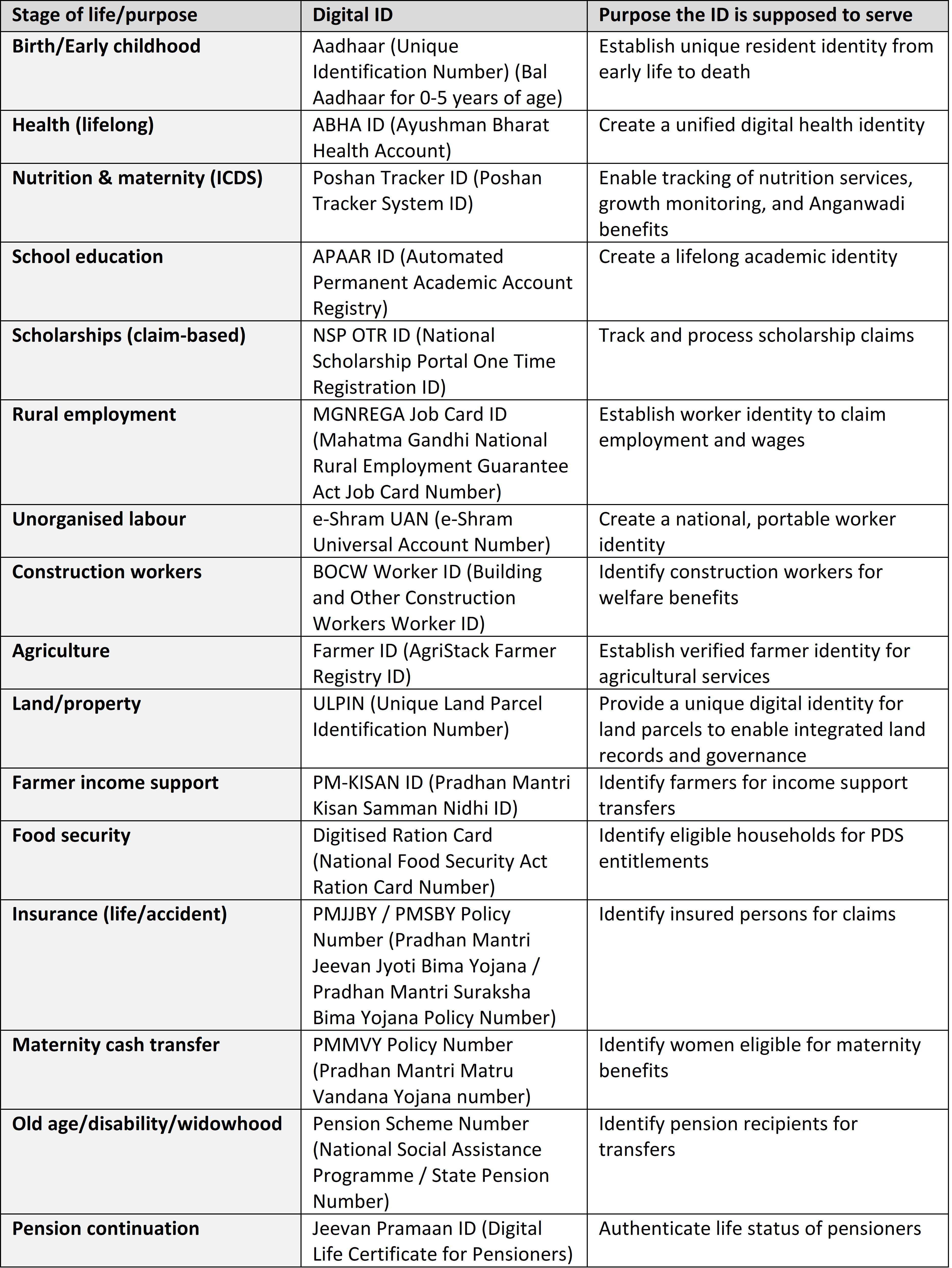
From cradle to old age, recognition and access to services and welfare rely on digital identities and database systems (see Table 1 below for a partial list of digital identities in welfare). By doing so, the digital infrastructure has become the curator, arbitrator, and primary interpreter of granting legitimacy to people’s lives (Siba Yahana and Nyamwire 2024).
This steady entrenchment of the “digital state” reflects a broader shift towards what is often described as the “datafication” of individuals: the rendering of social life into digital data that can be stored, analysed, and acted upon at each stage of life (Mayer-Schönberger and Cukier 2013). While the case for datafication rests on promises of efficiency, cost savings, and seamless delivery of benefits, experience and studies suggest that the process is not always seamless and that calculations of efficiency seldom account for the human costs borne by citizens navigating these systems.
The expansion of datafication is reshaping not only administrative processes but also the architecture of citizenship.
One ID to Rule Them All
Identification, registration, and classification of people are as old as the conception of the state itself. In India, as a constitutional democracy, these practices have been shaped by a commitment to social justice. Welfare policies are designed to address entrenched inequalities of caste, class, and gender and to translate constitutional ideals into practice.
However, the outcomes of these policies have depended critically on the institutions through which they are implemented. Institutions, as Douglass North argues, are created to establish order and reduce uncertainty in exchange (North 1991). These institutions extend beyond formal rules to include informal constraints such as customs, norms, and social hierarchies embedded along lines of land, caste, class and gender.
It is in this messy architecture of institutions, power structures, and social hierarchies that most welfare policies play out. Yet, contemporary policymaking has increasingly come to be governed by an “economic style of reasoning”, in which questions of power, hierarchies, justice and equality are recast as problems of efficiency, optimisation, and resource allocation (Popp-Berman 2022). Within this framework, the central question becomes not how welfare policies transform unequal social relations, but whether they deliver benefits “efficiently”.
Targeting the delivery of welfare emerged as a central tool in this pursuit of efficiency. However, it is inherently prone to two well-known types of errors: exclusion and inclusion. Exclusion errors occur when eligible individuals are denied rights and entitlements, often resulting in severe deprivation. Inclusion errors, on the other hand, involve the wrongful allocation of entitlements to ineligible individuals.
While both have long been recognised as administrative challenges, the 1990s marked a shift in their interpretation. International development agencies increasingly prioritised inclusion errors as indicators of corruption and poor governance, tying development assistance to the demonstration of “good governance”. Consequently, technological fixes/solutions appeared attractive, particularly for their promise of bypassing intermediaries and tightening “beneficiary” identification. These approaches aligned with broader neoliberal shifts associated with structural adjustment.
Mapping individuals numerically became central to this project, translating the “thick” social identities of persons into “thin” standardised data categories.
At the same time, rapid advances in information and communication technologies (ICT) made large-scale digital databases administratively feasible. As governance became more ossified in its obstinate quest to minimise inclusion errors, advances in ICT were too tempting for the bureaucracy to let go.
Electronic governance, or e-governance, became the new buzzword in the corridors of power, and one’s intent in the pursuit of development became synonymous with whether they aligned themselves with using digital technologies for governance or not. It was in such an electronically intoxicated milieu that the Indian state began to receive a digital facelift.
Mapping individuals numerically became central to this project, translating the “thick” social identities of persons into “thin” standardised data categories (Bowker and Leigh Star 1999). The idea of a unique identification system gained traction, culminating in the launch of Aadhaar in 2009. Although early discussions around a unique identification number were tied to national security concerns, the convergence of structural adjustment with a technocratic zeal in welfare delivery reframed it as a necessary instrument for good governance (Ramkumar 2010).
Underscoring the need for Aadhaar in reducing corruption through efficient targeting, its architect Nandan Nilekani said in his acceptance speech at the 22nd Nikkei Asia Prize in 2017, “As India built a welfare state with pensions, employment guarantees, scholarships, etc., it was deploying a large part of its budget to such social benefits. However, the lack of a proper ID system meant that in every welfare scheme, there were lots of ghost and duplicate beneficiaries.” 1Quoted in the PhD thesis of Ranjit Singh (pp1-2) and can be found here.
Corruption and leakage were framed primarily as technical problems requiring technological solutions in this narrative. Aadhaar thus became the foundation for a broader digital transformation of the Indian state, layered atop pre-existing hierarchies of power, offering a “new approach to governing Indian citizens through their data” (Singh 2020).
Five Dimensions
Drawing on the preceding discussion of welfare delivery in India, we posit an expanded notion of datafication that can be understood along five interrelated dimensions. These are: (a) the subordination of persons to digital identifiers; (b) the selective reliance on dashboard metrics to construct narratives of efficiency and good governance; (c) shifting the burden of accountability from the state to citizens; (d) governance regimes that deprioritise consent creating a channel for surveillance; and (e) the growing primacy of scale over accuracy.
Subordination of persons to digital identifiers: Digital identifiers have begun to assume a significance greater than the person they are meant to represent. We present two instances, at opposite ends of the age spectrum, to illustrate the subordination of persons to digital identifiers.
Consider the case of the Automated Permanent Academic Account Registry (APAAR) identifiers for education. The generation of an APAAR identifier itself depends on the seamless integration of three distinct data systems: handwritten school registers, the Unified District Information System for Education Plus (UDISE+) portal, and Aadhaar. Minor inconsistencies—such as improvised birthdates, spelling variations, and typographical mistakes, which are widely common in rural India—can cascade across systems, making it difficult, if not impossible, to generate the APAAR identifier.
The entire ordeal took a day, cost her more than Rs 700, and involved climbing several flights of stairs, which was difficult for an octogenarian with arthritis.
Although the government claimed that the APAAR identifier is optional, the Central Board of Secondary Education (CBSE) recently made it mandatory for Class 10 and Class 12 board examinations. Such conditionalities for students have had implications for children from vulnerable communities, such as those belonging to rural areas, migrant populations, and low-income households, and have led to students being blocked from registering for board exams.
Worryingly, the idea of the APAAR identifier indicates how, in a datafied governance regime, administrative recognition increasingly relies not on lived reality (in this case, of genuine students) but on coherence and consistency across digital systems—on what can be stabilised across databases. In effect, the digital identifier begins to carry more weight than the person it is meant to represent.
Table 1: Partial List of Digital IDs in Welfare
At the other end of the age spectrum is Lalitha, an octogenarian retired schoolteacher from Kolkata living in Bangalore, who is the mother of one of the authors of this article. To continue receiving her monthly pension, she must submit an annual life certificate to prove that she is alive. Before 2015, this certificate could be obtained directly from the bank by visiting the branch.
In late 2014, however, the government introduced Jeevan Pramaan, a digital life certificate system requiring pensioners’ demographic details and biometric information to be uploaded to the Central Identities Data Repository and verified through biometric authentication. Authentication is deemed successful when the fingerprints match the records in the database; if repeated attempts fail, iris scans are used, and failing that, the pensioner must approach a state office for manual verification.
A government press release on Jeevan Pramaan said, “The proposed digital certification will do away with the requirement of a pensioner having to submit a physical Life Certificate in November each year, in order to ensure continuity of pension being credited into his account.”
The incident thus produced two competing versions of truth: one derived from dashboard metrics and another from ground investigation.
A few years after digital life certificates became mandatory, Lalitha’s biometric authentication repeatedly failed at Canara Bank. She was directed to several digital seva centres, where her biometrics again failed, before finally obtaining a life certificate at the Employees’ Provident Fund Organisation (EPFO) office. The entire ordeal took a day, cost her more than Rs 700, and involved climbing several flights of stairs, which was difficult for an octogenarian with arthritis.
In exasperation, she said to the authorities, “When I am here in flesh and blood, why is it that you fail to trust me but rely on my fingerprints to prove who I am? My fingerprints are not my identity. Is my presence not proof that I am alive?”
The main thrust of this case is the steady shift from the authentic to authenticating: a technocratic reconfiguration of citizens with rights into “datafied beneficiaries” subordinate to a digital state (Narayanan and Sinha 2025). Lalitha’s sustenance was not dependent on pensions, and she had the agency of the English language, but such challenges are multiplied in the case of a person without formal literacy in a rural setting (Yadav 2026).
For lakhs of rural women pensioners, pensions are not a form of supplementary income but are their only source of sustenance. Lalitha’s case underscores how the digital state can cut across class lines when it comes to people’s interface with the state.
The Rashomon effect of data: The second aspect of datafication is a pervasive reliance on metrics collected on data dashboards to construct narratives of good governance, which are often at odds with ground realities. What is important to note here is the selective use of indicators and dashboards that shapes what counts as evidence. For many administrators, dashboards appear to be a single source of truth, while reality presents a Rashomon effect. 2The Rashomon effect implies how the same event can be perceived, experienced, and remembered by different people in different ways. The principle is based on the Japanese film Rashomon, directed by Akira Kurosawa, where the same crime is described differently by different characters. The main premise is that truth need not be singular but can have different perspectives.
We present two examples to illustrate this: one from the Unique Identification Authority of India (UIDAI) and one from the Mahatma Gandhi National Rural Employment Guarantee Act (MGNREGA).
Premni Kunwar, a single woman, was a resident of Korta village in Garhwa, Jharkhand. She used to receive a monthly pension in her Aadhaar-linked bank account. However, from October 2017, she stopped receiving it because her pension was diverted to some other account. Around the same time, access to food grains at ration shops was made contingent on Aadhaar-based biometric authentication with the ration dealer. By the end of November, Kunwar had also run out of food grains at home.
She reached out to her ration dealer to withdraw rations. But the dealer was out of stock and suggested she complete her Aadhaar-based biometric authentication so that he could disburse rations on priority when he received the next stock in December. It was common practice to make multiple visits, a few times for biometric authentication and one time for collecting rations. She completed her biometric authentication in November 2017, but before she could receive the rations, she died on 1 December 2017.
In its fact-finding report, the Right to Food Campaign found that diversion of pensions and denial of rations led to starvation death. In contrast, the UIDAI’s report and the official narrative had a different conclusion. Relying solely on dashboard data, it noted that the timestamp of Kunwar’s biometric authentication was recorded at the end of November, and that pensions were indeed deposited -- albeit diverted to a different account -- and so ruled out starvation as the cause of death. Thus, the incident produced two competing versions of truth (Rashomon effect): one derived from dashboard metrics and another from ground investigation.
A Comptroller and Auditor General (CAG) report on the UIDAI raised serious concerns about the veracity of its dashboard metrics (CAG, 2021). Specifically, we highlight three such concerns. First, the CAG noted that nearly three out of four of the total biometric updates were voluntary updates by residents “for faulty biometrics after payment of charges”. Questioning the very purpose of the UIDAI, the CAG observed that this “huge volume of voluntary updates indicated that the quality of data captured to issue initial Aadhaar was not good enough to establish uniqueness of identity”.
Second, the CAG flagged that the UIDAI did not have a system to “analyse the factors leading to authentication errors”. As a result, while the overall number of biometric authentications was reported, the number of attempts remained unknown. Third, in breach of its own regulations, the UIDAI provided authentication services to banks, mobile operators, and other agencies free of charge.
Take another example: the all-famous management information system (MIS). MIS has become the de facto implementation engine for most welfare programmes in India. Numerous cash transfer programmes have been grouped under the umbrella of Direct Benefit Transfer (DBT). There are a total of 328 schemes across 56 ministries that are listed as part of various DBT programmes, with “estimated gains of Rs. 4,31,138.05 crore” 3Accessed on March 8, 2026 .
Within one year of the Aadhaar-based Payment System becoming mandatory, more than five crore workers were deleted, reflecting a 247% increase in worker deletions.
The estimated savings from the Mahatma Gandhi National Rural Employment Guarantee Act (MGNREGA) between April 2023 and March 2024 are given as “Rs. 15,524.84 crore”, with the stated reason being the “deletion of 1.26 crore fake and duplicate job cards”. Since each job card has multiple workers, the number of deleted workers would be much more. On the face of it, the dashboard presented this as an achievement; but closer scrutiny revealed something else.
Till recently, the Aadhaar-based Payment System (ABPS) for wage payments in the MGNREGA existed as an option alongside the traditional, well-understood payment mode known as the account-based system. However, in 2023, the union government made the ABPS mandatory. For this system to work, at least two conditions had to be met: a worker’s job card had to be linked to her Aadhaar number, and her bank account had to be linked to her Aadhaar number.
In practice, this transition was carried out in haste, and no clear protocols were issued to officials on how to deal with spelling mismatches between records. Consequently, when demographic details differed across documents, officials resorted to deleting workers from the MGNREGA database. The union government, for its part, claimed that these were “fake” or “duplicate” workers and described the deletions as a “routine exercise”. It also claimed that no workers were deleted due to the ABPS. However, several ground reports showed otherwise.
Even a difference of a single letter between the two documents led to worker deletions (Nair 2023). Within one year of the ABPS becoming mandatory, more than five crore workers were deleted, reflecting a 247% increase in worker deletions (Buddha and Tamang 2023). Further, in a work in progress by Nanditha Ajith, Chakradhar Buddha, and Rajendran Narayanan, the authors provide a statistical estimate that, nationally, nearly two-thirds of all workers deleted were removed on the grounds of being “unwilling to work”.
Under the MGNREGA, such grounds cannot legally justify worker deletions, and the very presence of this option in the information system raises serious concerns. By combining large-scale data analysis with Right to Information (RTI) responses and immersive fieldwork, researchers have debunked the government’s efficiency claims about the ABPS that were based solely on dashboard numbers (Bheemarasetti et al. 2025).
Taken together, these illustrate how the politics of data play out in the digital state. The ruling political class repeatedly cites savings claims from dashboards, even though there is no transparency about the methodologies used to generate these figures. As these claims become part of the popular narrative, they come to function as a single source of truth, while the subversion of legal rights is relegated to a footnote.
Shifting accountability from state to citizens: The third and one of the most insidious aspects of datafication is the shifting of the burden of accountability from the state to citizens. Building on social movements concerning socio-economic rights, and aided by an 'activist judiciary', the United Progressive Alliance (UPA) government promulgated several rights-based legislations concerning information, education, employment, and food, among others, between 2005 and 2013. In 2014, there was a change of guard when the National Democratic Alliance (NDA) took charge on the promise of 'vikas' (development).
Their prophecy has come largely true … as we have entered a new era of welfare in which direct cash transfers to people’s bank accounts have become the new norm.
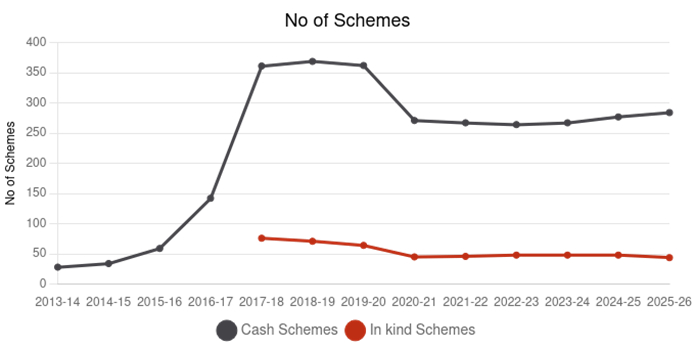
The blueprint for this next phase could be seen in the third chapter of the 2014-15 Economic Survey. Modestly titled “Wiping every tear from every eye”, it proposed the JAM trinity: Jan-Dhan, Aadhaar, and Mobile. As quoted in (Drèze, 2015), its proponents argued that the premise was to roll out “all subsidies into a single lump-sum cash transfer to households” (Subramanian and George 2015). Their prophecy has come largely true, as indicated in Figure 1, which shows we have entered a new era of welfare in which direct cash transfers to people’s bank accounts have become the new norm.
Figure 1: Schemes Over Time
Several of these cash transfer schemes in recent years have been introduced with Prime Minister Narendra Modi’s name and/or face prominently advertised in each of them. This has, in turn, laid the foundations for a seismic shift in the role of the state in welfare. Increasingly, the prime minister, rather than simply being the head of a democratically elected government, has started being portrayed as a benefactor, and citizens with constitutional rights have begun to be reconfigured as labharthis, or 'beneficiaries'.
This, as Yamini Aiyar argues, has involved a “careful positioning of welfare as the individualistic pursuit of a duty-bound citizen rather than state responsibility toward rights-bearing citizens”. The promise of Direct Benefits Transfers (DBT) lies in the direct emotional connection it has created between the “benefactor” and the “beneficiary” through a digital channel (Aiyar 2023).
Earlier modes of delivery had multiple intermediaries who acted as the citizen’s interface with the state. Responsiveness, however patchy, at least had a face. DBT has invisibilised this responsiveness by outsourcing accountability to an opaque system—and, ironically, has done so without reducing the number of intermediaries (Vivek S. et al. 2018).
Access to welfare schemes is now, in many ways, contingent on Aadhaar-based system requirements. Consider maternity entitlements under the Pradhan Mantri Matru Vandana Yojana (PMMVY), which itself is a whittled-down version of the rights as per the National Food Security Act. A successful transfer requires Aadhaar authentication, correct bank linkage, and accurate data entry in online portals. When any of these go wrong, the burden of correction falls entirely on the rights holder.
This burden is particularly pronounced in rural contexts. Among newly married women, individuals often do not independently control their documents or mobile-linked bank accounts. Correcting errors such as name mismatches requires visiting Aadhaar enrolment or update centres, often located far from their villages, involving multiple visits and biometric re-verification. More importantly, for women in late pregnancy—the very group PMMVY seeks to support—travelling long distances or standing in queues can be especially difficult. Kuruva Venkatesh of LibTech India pertinently observes that officials often fail to explain the technical reasons for rejection, leaving many such women unsure of whether the issue lies in Aadhaar linkage, portal entry, or account status. As a result, many depend on intermediaries to navigate this digital maze, defeating the supposed purpose of DBTs.
This tendency to recast systemic issues as mere “technical errors” weakens the grounds on which citizens can hold the state accountable and narrows the channels available for redress.
Mechanisms for correcting details in Aadhaar often involve disproportionate requirements, such as obtaining a gazette notification, which can be a major hurdle for rural citizens. Although local digital access points exist in some villages, blocks, and districts to rectify DBT-related errors, citizens frequently have to rely on centralised Aadhaar Seva Kendras (ASKs).
Ongoing ethnographic research on Aadhaar enrolment and update centres by Devahuti Sarkar and B.D.S. Kishore of LibTech India highlights several challenges. Many local centres are either closed or not authorised to process all applications, while inadequate training of operators often compels individuals to travel from villages to city-based centres. Even when applications are processed locally, they face disproportionately high rejection rates. Compounding these issues, weak mechanisms for tracking correction requests render grievance redressal largely ineffective. As a result, applicants are pushed into making repeated visits to already overcrowded Aadhaar Seva Kendra offices – a situation further exacerbated by vague technical messages (Figure 2) that even officials struggle to interpret or are simply dismissed as “technical errors in the backend process”.
Figure 2: Vague Technical Messages

Needless to say, this tendency to recast systemic issues as mere “technical errors” weakens the grounds on which citizens can hold the state accountable and narrows the channels available for redress. It is symptomatic of the character of the datafied welfare regime, and, in addition, it places the burden of correction on citizens.
Deprioritising consent creating a channel for surveillance: The fourth dimension involves governance operating through regimes that deprioritise consent, as data about citizens is increasingly being observed rather than actively provided or volunteered. In his work, Seeing Like a State, James Scott argues that evolving technologies have aided in the creation of the “high modernist” state, whose goal is to make people “legible” to the state (Scott 1998). Scott’s idea of legibility refers to the fundamental tendency of modern states to make society legible—simplified, readable, and understandable—so that it can be monitored, administered, taxed, and controlled. States need to turn complex social realities into standardised categories they can see and manage to govern.
Most significantly, data are being observed, not volunteered: they are derived as a by-product of technology use rather than collected by authorities through surveys or census methods.
The digital state is different in that it operates through the power to make things “visible” rather than merely “legible”. While legibility increases governability in Scott’s formulation, visibility operates through the power to “influence and intervene”. Unlike the data that provide legibility, these new forms of data are often of unknown reliability and tend to reflect not populations but “users and markets” (Taylor and Broeders 2015).
In the current trend of datafication, data is derived as a by-product of technology use rather than collected by authorities through surveys or census methods.
Take the case of the recent Sanchar Saathi app directive. On 28 November 2025, India’s telecom ministry privately asked all smartphone manufacturers to preload their new devices with the app, stating that it must be “visible, functional, and enabled” upon first setup. Although the stated purpose to users was to block and track lost or stolen mobile phones using the device’s International Mobile Equipment Identity (IMEI) number, the app was allowed to make and manage phone calls, send messages, access call and message logs, phones and files, as well as the phone camera. After widespread resistance from civil society organisations and the political opposition, the government had to roll back its directive.
Similar concerns were raised for other interfaces such as the CoWIN platform for vaccination. This shift from episodic data collection to continuous observation alters the terms of engagement between citizens and the state, producing a form of “digital behaviourism”, where individuals are rendered knowable through continuous data capture and algorithmic interpretation rather than through explicit participation (Issar and Aneesh 2021).
This form of digital behaviourism also opens the floodgates to ambient, embedded and routine surveillance, blurring the boundary between service provision and a panopticon state, tilting the already skewed citizen-state balance further towards the state and against the citizen. In this rapidly evolving remapping of the citizen-state relationship, as William Shakespeare described the stabbing of Julius Caesar by Brutus, the “most unkindest cut of all” is the Digital Personal Data Protection (DPDP) Act, 2025. Rule 23 of the DPDP Act gives unconditional powers to the Union government to demand any information about individuals from digital platforms and telecom companies without the consent of the concerned individuals. This potentially includes metadata (data about data) of individuals such as call logs, browsing history, photos, and locations of individuals (Yadav 2025). Through such a disproportionate datafication drive, the government has given itself unrestricted powers to profile anyone. Some critics have raised legitimate concerns that the state might abuse its powers through such a digital leash paving the way for digital authoritarianism (Gupta 2025). In particular, minorities and dissenters face a heightened risk of being targeted which are likely to have a chilling effect on anyone exercising their freedom of speech.
In such light the push to use Face Recognition Technologies, be it in welfare as in Angwandi centres or by the police in some places, presents intersecting concerns of automated exclusions, manufacturing consent, violating privacy and shifting the burden of accountability from the state to citizens.
Scale over accuracy: The final dimension of datafication concerns the growing primacy accorded to scale over accuracy. The emphasis on large volumes of data enables a discourse that privileges reach and coverage, often sidelining concerns about data quality and ground-level realities. A useful way to understand this is the widely cited example of cancelled ration cards in Jharkhand due to “failures” in linking these cards to Aadhaar, even though they belonged to genuine households.
While the government claimed that most of these were “ghost beneficiaries”, a J-PAL study found that 88% of the cancelled ration cards belonged to genuine households. In this case, what became more important was the ability to claim savings and efficiency on the grounds of scale, regardless of how accurate the process was.
The black box of the state
Taken together, these five aspects of datafication represent a new normal – one which has implications for the growing, centralised institutional capacity of the state to move contestable socio-political issues into a space of reduced negotiation. Datafication has become symptomatic of a governance assemblage in which the “space for immediate negotiability has been reduced in algorithmically managed input-output systems”, provoking a deeper inquiry into how citizens engage with a digital state and what forms of mediation, contestation, and collective action remain possible (Issar and Aneesh 2021).
In this redrawn architecture of datafied governance, the centralised state has effectively granted itself quasi‑omniscient powers to decide who can be recognised within state systems and on what terms. If metrics shape narratives of performance and efficiency, and continuous observation expands administrative reach, then digital identifiers provide the basic infrastructure through which individuals are rendered “visible”, reshaping contours and meaning of citizenship.
Claims are now increasingly routed through digital systems, where errors are often hidden within opaque “backend processes” and redress requires navigating multiple portals, operators, and offices.
Citizenship rights, following T.H. Marshall’s foundational typology encompasses civil rights (which allow for personal freedom), political rights (to participate in the exercise of power), and social rights (to economic welfare and human well-being) (Marshall 1950). It is these rights—and the means through which citizens claim them—that constitute the practice of active citizenship.
Claim-making is an essential element of active citizenship. It involves ordinary practices—such as filing an application, attending a meeting, or approaching a local official—the everyday acts through which social rights are activated and citizenship is practised (Kruks-Wisner 2018). Crucially, these are also the acts through which the relationship between citizen and state is negotiated, contested, and realised. Against this backdrop, datafication can be seen as reshaping these everyday practices of claim-making by altering both the channels through which citizens access the state and the information they have about it. Claims are now increasingly routed through digital systems, where errors are often hidden within opaque 'backend processes' and redress requires navigating multiple portals, operators, and offices.
Worryingly, the shifting burden of accountability from the state to citizens has now entered the very domain of establishing citizenship itself through the Special Intensive Revision (SIR) exercise. Drawing from the technocratic playbook honed in the digital state’s welfare architecture, the ongoing revision of electoral rolls by the Election Commission of India reflects a similar logic (Buddha and Narayanan 2025). In both domains, individuals are required to repeatedly verify, authenticate, and prove their eligibility, transforming entitlements into claims that must be continuously performed and defended in a datafied regime. Finally, contentious laws like the DPDP Act, 2025 legalise opacity, erode structures meant to hold the state accountable and make citizen surveillance easy (Bharadwaj and Johri, 2026).
Over time, these institutional shifts across all domains are likely to and, in many ways, already have shaped how citizens engage with the state. This is because the institutional architecture of the datafied regime—spanning welfare systems, legal frameworks, and regulatory bodies—constitutes the everyday terrain through which state–citizen relations are experienced and understood. Each time a citizen struggles to claim her rights, she learns what claims are possible and whether speaking up will make a difference in her or others’ lives. The challenge, therefore, is not simply to make digital systems 'more efficient' but to ensure that they are in alignment with democratic accountability and remain cognisant of the power structures they operate in.
Rajendran Narayanan teaches at Azim Premji University, Bengaluru, and is affiliated with LibTech India. Padmini Ramesh is a PhD student at Johns Hopkins University, Baltimore. The views expressed are personal.