




1. Introduction
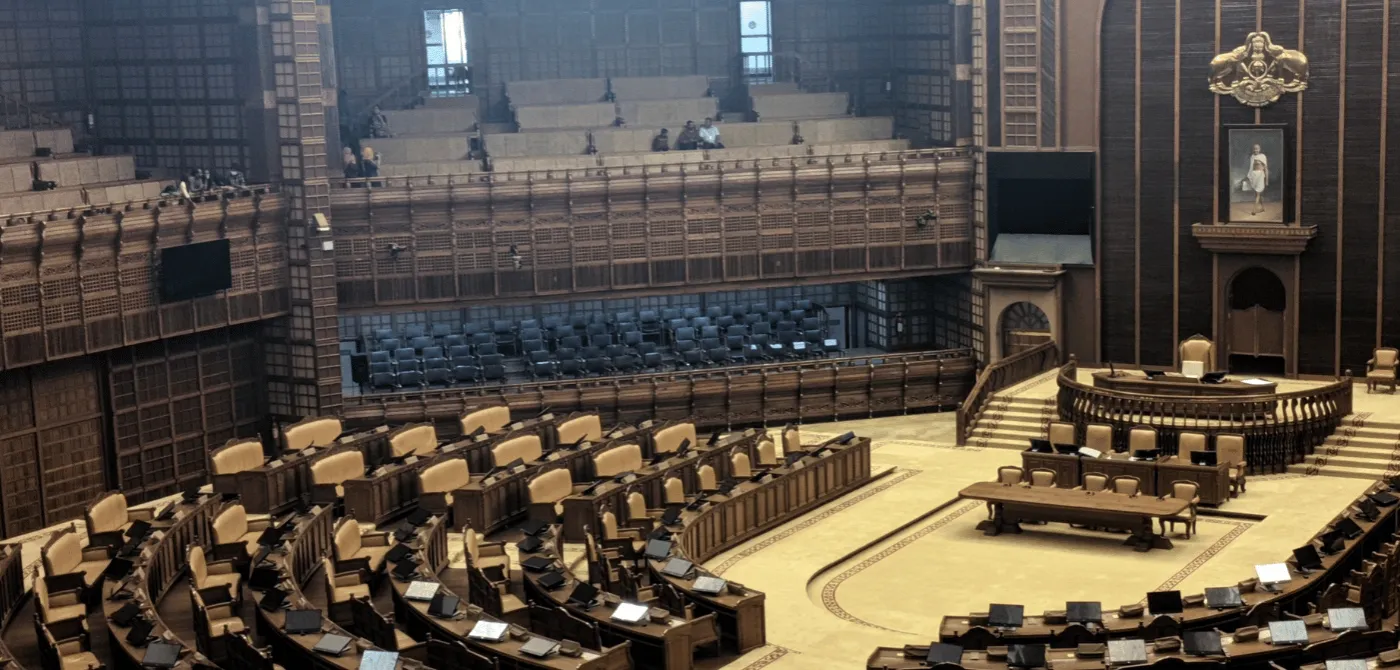
It is well known that the two Constitutional Amendment Acts of 1976 and 2002 (the 42nd and 84th Amendment Acts respectively) have, between them, left unaltered the allocation of Lok Sabha seats across India’s States and Union Territories over the last half-century. The number of Lok Sabha seats, at 543, and their States-wise distribution, were frozen after the 1971 decennial Census, and the exercise of delimitation 1Various facets of the issue of ‘delimitation’ have been discussed in many commentaries, both quasi-academic and scholarly, that have appeared in various outlets in recent times. For a small sample of this literature, the reader is referred to, among others, the essays by Mohammed Sanjeer Alam (2024), R. Rangarajan (2024), Jeetendra Vishwakarma (2024), P. D. T. Acharya (2025), Tamilarasan Meppuleyselvam and Remya Iyyappan (2025), Sudha Pai (2025), Santosh Mehrotra (2026); and Louise Tillin, Milan Vaishnav and Andy Robaina (2026). was deferred to the first Census after 2026. With the expected release of the 2021 Census population figures, the nation is faced with an imminent unfreezing of the extant allocational pattern of Lok Sabha seats.
The national political environment is increasingly turning out to be one in which the South feels aggrieved by what it perceives to be unfair treatment.
By and large, the system of allocation which prevails in India, and as laid out in the Constitution (Articles 81, 82 and 170), is that of Proportional Representation (PR), whereby legislative seats are apportioned among the country’s States according to their respective population shares. PR takes an essentially individualistic view of the political organization of society, and arguably takes insufficient stock of the compelling politics of coalitions of States, whereby decisive political power is exercised not so much by the individual as by coalitions of States wrought by within-region homogeneities and between-region heterogeneities. The phenomenon is most clearly manifested in India’s North-South divide, a partitioning of the population according to a number of features of politics, economics, culture, language and human development which has been widely acknowledged by social scientists. This theme will be stressed in the present essay.
Contributing to the theme just mentioned is the differential performance of the North and the South with respect to a number of human development indicators, as reflected, significantly, in the differential growth rates of population in the two regions. It is pertinent, in this context, to point out that the 84th Amendment Act is quite explicit, in its Statement of Objects and Reasons, about the justification for not undertaking a fresh delimitation exercise: ‘Keeping in view the progress of family planning programmes in different parts of the country, the Government, as part of the National Population Policy strategy, recently decided to extend the current freeze on undertaking fresh delimitation up to the year 2026 as a motivational measure to enable the State Government to pursue the agenda for population stabilisation.’ Compatible with this sentiment would be the examination of a pattern of Lok Sabha seats apportionment which takes account of the differential North-South performance with respect to population stabilisation, as reflected in what, in this essay, is called a ‘Fertility Adjusted Formula’.
But first, a brief review of some normative issues underlying alternative apportionment schemes, and which have a bearing on the political and ethical appeal of these schemes.
2. Some Underlying Conceptual Issues
The worry over the freeze on the allocation of seats over the last 50 years, and the perceived urgency of correcting the ‘under-representation’ of the North and the ‘over-representation’ of the South, is founded in some deep conviction regarding the unimpeachable rightness of a system of PR and its endorsement of the ‘one person – one vote – one value’ principle. At the bottom of this is deference to what in Social Choice Theory is called the Anonymity (or Symmetry) Axiom, which comes into play at the level of the individual voter in a scheme of PR. According to this axiom, personal identities do not matter, arising from which all individuals must be treated identically and interchangeably: if each person’s political salience in the scheme of things is to carry equal weight, then the only principle of representation compatible with this is PR. The economist Glenn Loury (2000) criticizes the Anonymity Axiom for what he calls its stance of ‘liberal neutrality’, which loses much of its appeal when group identity is a pervasive aspect of the reality of the world we inhabit.
The appeal of the Anonymity Axiom is implicitly tied to some notion of the ‘homogeneity’ of a population. In the context of a national federation of States, an aspect of homogeneity might reside in the requirement that all States in the Union should share a similar distribution of voter preference and political ideology. This is simply not the case of Northern States vis-à-vis Southern States. Each of the North and the South may be separately homogeneous to a degree, but the two are heterogeneous with respect to each other. An important part of this reality is the sway of Hindutva ideology and the accompanying pattern of affiliation to political parties in the two regions. As Sudha Pai (2025) puts it: ‘An additional source of tension is the ideological gap between northern and southern States. The ideology of Hindutva, for example, faces “regional limits” and is less accepted in the South…’.
The exclusive preoccupation with Proportional Representaition and its underlying Principle of Anonymity … is partly based on some blanket adherence to an abstract principle of fair representation, without much regard for the context at hand.
Briefly, the principle of Anonymity denies the possibility of group identity being forged by coalitions based on affiliation to a common ideology. In the present context, the coalitions in question have a geographical—North-South—aspect to them. This is no mere matter of regional chauvinism. The national political environment is increasingly turning out to be one in which the South feels aggrieved by what it perceives to be unfair treatment. This perception obtains in the matter of the South’s disproportionately large contributions to national progress and disproportionately small shares in central government taxes in the horizontal devolution formulae of various Finance Commissions. It arises in the sense of being subjected to a sort of ‘levelling down’ under the pretext of an ethics of equity by which Northern States are rewarded for mis-governance, mis-prioritization of social objectives, and slothfulness in the pursuit of human development while Southern States are expected to ‘subsidize’ the North for its leaders’ failures. It finds reflection in the view that the South’s efforts at achieving a measure of competence in governance are systematically frustrated by the imposition of unsuitable central schemes of education (such as the National Eligibility-cum-Entrance Test [NEET]), as also by unfriendly State Governors refusing to grant routine approval to bills passed in the State Assembly.
The exclusive preoccupation with PR and its underlying Principle of Anonymity, I would argue, is partly based on some blanket adherence to an abstract principle of fair representation, without much regard for the context at hand. This is an example of what Amartya Sen (1970; p.178) has referred to as …the sever[ity] of the problem of postulating absolute principles…that are supposed to hold in every situation.’ When group identity is an integral fact of the context at hand, insistence on ‘liberal neutrality’ is at least a little misplaced. As Lester Thurow (1981; pp. 180, 182) puts it: ‘…do groups have a role to play in …justice?... Individuals have to be judged based on group data… A concern for groups is unavoidable.’ While Thurow was speaking of economic justice, the spirit of his contention carries over to questions of fair political representation. A concern for ‘balanced federalism’ divorced from a single-minded concentration on the principle of PR is inevitable, such as in the context of India’s North-South divide, as argued by commentators such as Acharya (2025).
This is why I would push the case for something like the Fertility Adjusted Formula advanced in this essay. It does, as will be seen, defer partly to PR, in terms of its respecting the 1971 Stateswise-distribution of population, on the basis of which population growth rates are computed. But it also defers to a system of positive and negative incentives by inflating or deflating 2026 States-specific populations according to whether the State in question has or has not been successful in securing a measure of population stabilisation. The net result is a 2026 distribution of Lok Sabha seats which (to anticipate) does, to a degree, reduce the extent of concentration currently enjoyed by the North.
3. Allocational Changes in 2026 Under PR and Under a Fertility Adjusted Formula
3.1 Assumed Size of the Lok Sabha and 2026 Population Numbers
In the ensuing seats projection exercises, I shall cap the number of Lok Sabha seats at the present number of 543. There is a well-known case for legislative representation to be a roughly constant fraction of total population, that is, for the overall number of legislative seats to rise in proportion with the rise in population. This would make sense in a situation where the status quo seats-to-population ratio is some reasonably ‘robust’ fraction, but altogether less so when it is already an absurdly small number. The all-India population in 1971 was around 540 million, and might be expected to rise to about 1415 million in 2026. The seats-to-population ratio, when the number of seats is confined to 543, will then decline from 0.000001006 in 1971 to 0.000000384 in 2026: taking serious account of the change might not amount to much more than registering a distinction without a difference. Additionally, if North-South inequality in the distribution of seats is of any concern at all, then even an equi-proportionate rise in every State’s allocation would leave only the proportionate shares of the North and the South unchanged, whereas the difference in the numbers of seats allocated to the two regions would increase. Finally, a House of 543 members is large enough for one to view with disquiet the problem of having to manage the potential chaos that could be triggered by a larger House.
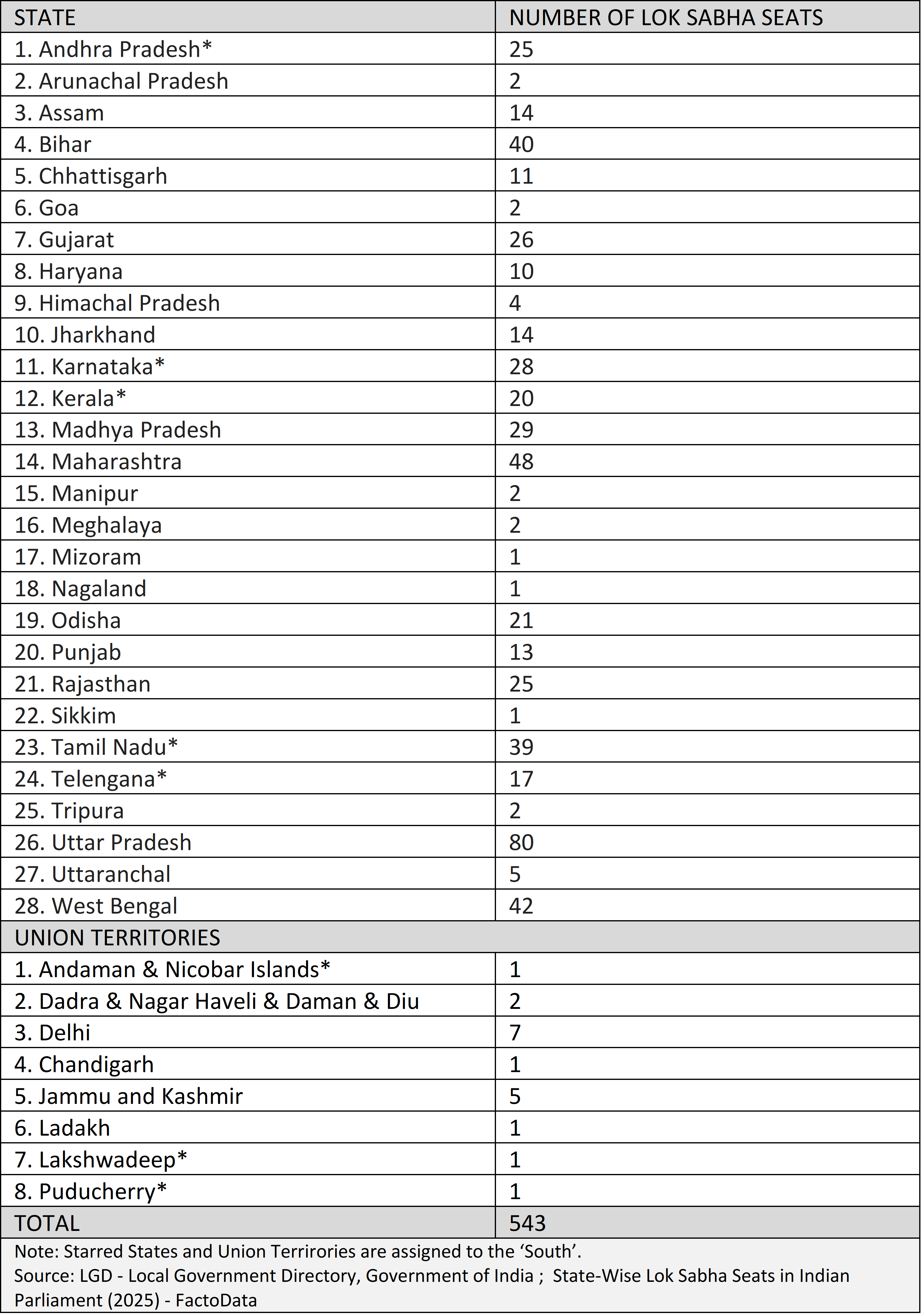
In considering alternative patterns of seat allocation in 2026, one would require data on State-wise population projections for 2026. I shall rely for this on the projections (based on a ‘medium’ or ‘moderate’ projection of fertility status) available in the report Unravelling India’s Demographic Future brought out jointly by the International Institute of Migration & Development and Population Foundation of India (2025). The population figures for 1971 will be based on the 1971 Census. Separate population figures will be considered only for the ‘major’ States and Union Territories (UTs) for which the allocation of Lok Sabha seats in 1971 was based on PR. The remaining set of 13 States and Union Territories are the smaller ones, each of which was allocated at most 2 seats. Table 1 sets out the status quo allocation of Lok Sabha seats. For the exercises undertaken in this essay, the Union Territories of Jammu and Kashmir, and Ladakh will be merged together.
Table 1: The Status Quo Allocation of Lok Sabha Seats Across States and Union Territories
3.2 Population Growth and Human Development
It is instructive to recall that the 84th Constitutional Amendment Act of 2002 justifies the freezing of the 1971 seats allocation pattern until 2026 quite directly in terms of ‘… a motivational measure to enable the State Government to pursue the agenda for population stabilisation.’ A properly construed ‘motivational measure’ should, presumably, be concerned with incentives for States that have made an effort in pursuing population stabilisation policies, and disincentives for States which have not. This would entail some system of rewards for ‘low fertility’ States and of penalties for ‘high fertility’ States. One way of securing such an outcome would be to directly reward (respectively, penalize) low fertility (respectively, high fertility) States, employing population growth rates for the purpose. That population growth rates may be a reasonable proxy for human development is suggested by the direct correlation between population growth and multidimensional deprivation, as discussed briefly below.
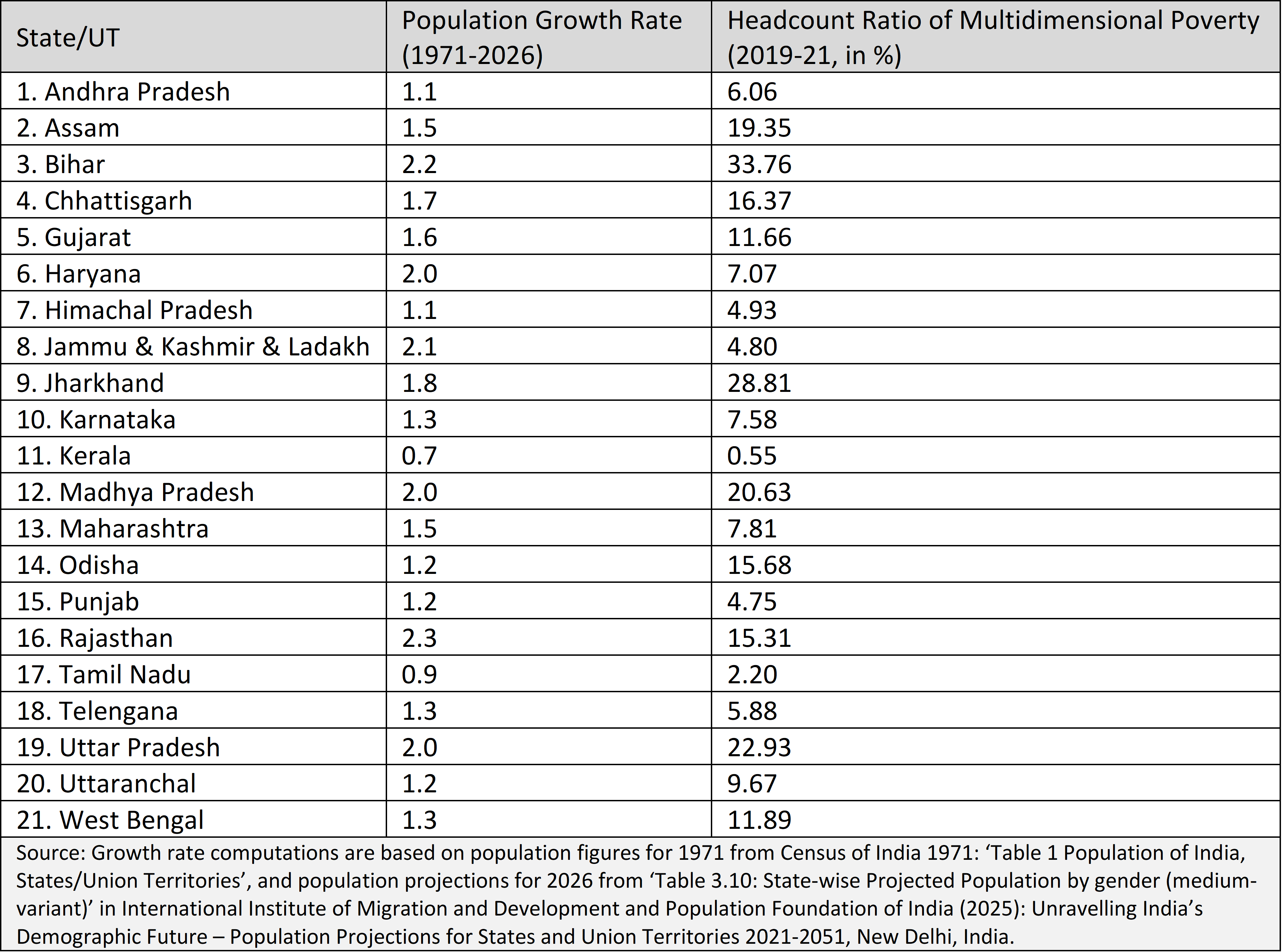
For 21 of the 22 major States and UTs, Table 2 presents information on the growth rate of population between 1971 and 2026 and the headcount ratio (or proportion of population) in multidimensional poverty over the period 2019-21. Population growth rates are derived from the 1971 Census and projected 2026 population figures referenced earlier, and headcount ratios of multidimensional deprivation, computed for twelve indicators covering three dimensions of human development—health, education and standard of living—are from the Niti Aaayog’s (2023) publication National Multidimensional Poverty Index, brought out in collaboration with the United Nations Development Programme (UNDP) and the Oxford Human Development Institute (OPHI). Table 2 does not feature the Union Territory of Delhi which is something of an outlier, being a special case with special features. 2Among other things, over the five decades from 1971, Delhi has been transformed from a virtually completely rural to a virtually completely urban area. For the 21 States and UTs considered in Table 2, Pearson’s Coefficient for the correlation between population growth rates and multidimensional poverty turns out to be 0.635 (p-value: 0.001982; 95% confidence interval: [0.2802, 0.8372]). This suggests a fairly robust correlation between the two variables, making population growth rate a plausible proxy for human development (or rather the lack of it). This enables one to employ the rate of growth in population as a convenient indicator for deriving a simple reward/penalty measure of a State’s development performance, as shown in the following sub-section.
Table 2: State-wise Population Growth Rates (1971-2026) and Headcount Ratios of Multidimensional Poverty (2019-21) for 21 Major States and Union Territories
3.3 ‘Adjusting’ for Population Growth
Suppose we wish to reward a State for its relatively good human development performance, as reflected in a relatively low rate of population growth, and similarly penalize a States for its relatively poor human development performance, as reflected in a relatively high rate of population growth. There are no doubt many ways of doing this, and in what follows I propose one particular, simple method. A necessary requirement for the method to work is that all State-specific population growth rates should be strictly positive (a requirement that is met in the Indian case when we consider population changes between 1971 and 2026).
The method I propose is this. Take the ratio of the aggregate rate of growth of the nation’s population over the 1971-2026 period to any given State’s rate of growth of population over the same period, and multiply this ratio by the projected 2026 population for the State: this is the State’s ‘fertility adjusted’ 2026 population, which will be less (respectively, more) than the actual 2026 population for a ‘high growth’ (respectively, ‘low growth’) State, where a ‘high growth’ (respectively, ‘low growth’) State is one with a population growth rate higher (respectively lower) than the national growth rate. Apportionment can then be in proportion to the 2026 shares of ‘adjusted’ State populations in total ‘adjusted’ population. This is the ‘Fertility Adjusted Formula’.
3.4 Changes in Seats Allocation
Employing the 1971 and 2026 population figures referenced earlier, and the State-specific rates of population growth provided in Table 2, a simple application of the ‘Proportional Representation Formula’ and the ‘Fertility Adjusted Formula’ (as discussed in the preceding sub-section) yields Table 3, which projects the 1971 and 2026 seat allocation patterns under the two respective formulae, and indicates how these patterns deviate from the status quo pattern.
Table 3: The Allocation of Seats Under The ‘Proportional representation’ and the ‘Fertility Adjusted’ Formula: The Status Quo and 2026 Patterns
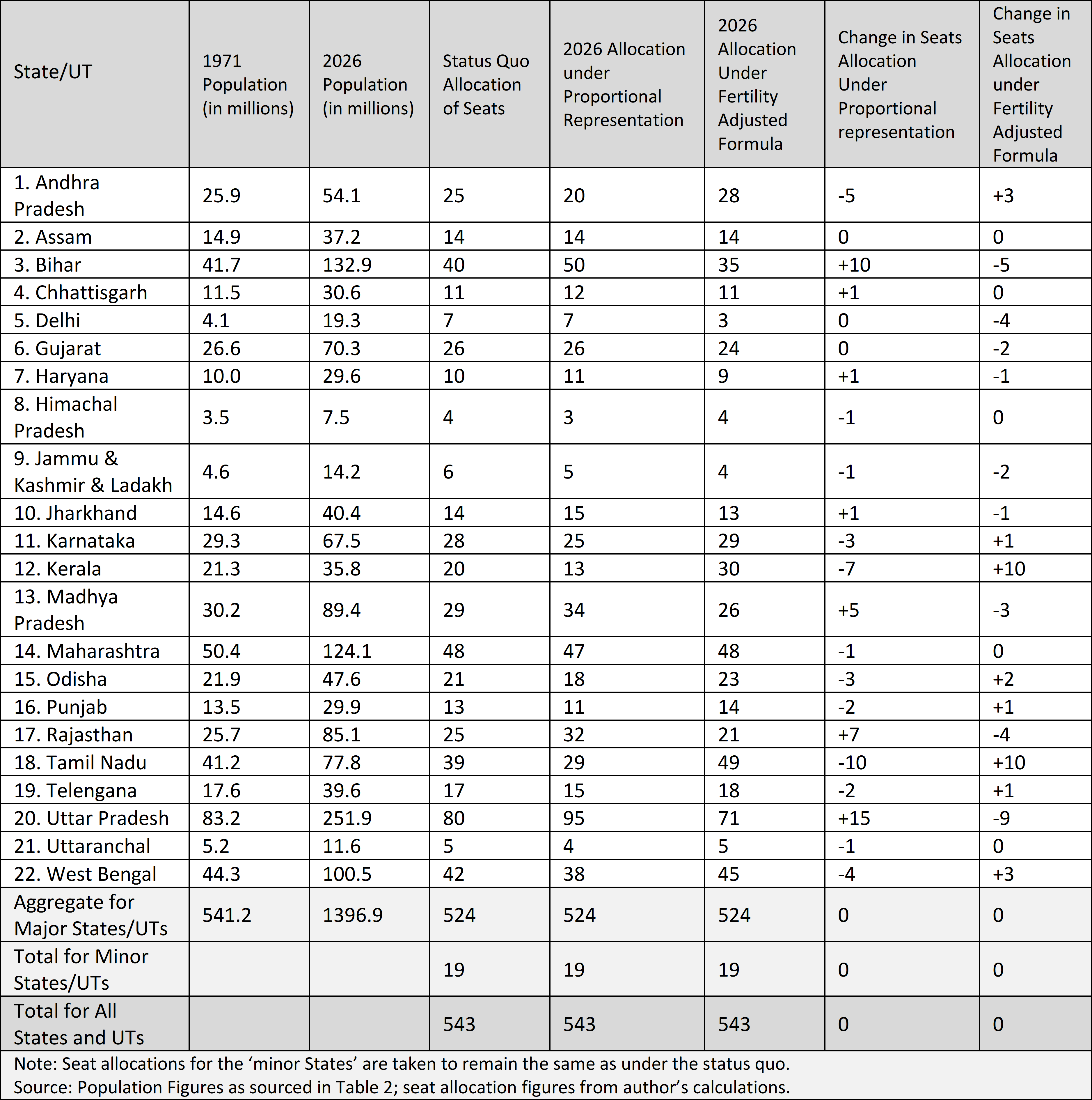
Consider first the changes in allocation under PR. Table 3 confirms the expectation of an increase in overall between-States inequality in the apportionment of seats, and a widening in the North-South rift. Given the high population growth rates of some of the Northern States, superimposed on their already larger base population, it should come as no surprise that these States, in 2026 vis-à-vis the status quo pattern, should have further swelled their representation, while all of the five major Southern States should suffer losses in their present level of representation. Among themselves, Bihar (+10), Madhya Pradesh (+5), Rajasthan (+7) and Uttar Pradesh (+15) raise their collective tally by 37 seats from 174 to 211, while Andhra Pradesh (-5), Karnataka (-3), Kerala (-7), Tamil Nadu (-10) and Telangana (-2) together lose 27 seats to bring their tally down from 129 to 102. The gap between Bihar and Andhra Pradesh doubles from 15 to 30, that between Rajasthan and Kerala nearly quadruples from 5 to 19, and that between Uttar Pradesh and Tamil Nadu rises from 41 to 66. These are some of the consequential changes in legislative seat apportionment between the present pattern and the likely 2026 pattern that would be entailed by implementation of the Constitutionally mandated delimitation procedure embodied in the principle of Proportional Representation.
…The North-South distribution of Lok Sabha seats in 2026 under the Fertility Adjusted Formula is amenable to principled rationalization (which, additionally, is sympathetic to the rationale underlying two earlier constitutional amendments).
Consider next the 2026 seats allocation pattern that would emerge from an application of the ‘Fertility Adjusted Formula’. Table 3 indicates that of the 22 major States and UTs, 10 are ‘high growth’ entities and 12, ‘low growth’ entities. All 10 of the high growth entities—Bihar, Chhatisgarh, Delhi, Gujarat, Haryana, Jammu-Kashmir/Ladakh, Jharkhand, Madhya Pradesh, Rajasthan and Uttar Pradesh are from the North. None of these States gains a Lok Sabha seat from the ‘fertility adjusted formula’: 8 lose seats and 2 retain their present number. Of the 12 ‘low growth’ States, there are 5 relatively smaller States (Assam, Himachal Pradesh, Odisha, Punjab and Uttaranchal) and 2 relatively larger States (Maharashtra and West Bengal) from the North, while the remaining 5 States are all accounted for by the South. The relatively large losses in seats are experienced by five States in the North: Uttar Pradesh (-9), Bihar (-5), Delhi and Rajasthan (-4 each), and Madhya Pradesh (-3), which among themselves account for a decline of 25 seats. All the Southern States gain: Kerala and Tamil Nadu (+10 each), Andhra Pradesh (+3), and Karnataka and Telangana (+1 each), which together account for an increment of 25 seats. Some Northern States also gain, notably West Bengal (+3) and Odisha (+2). The North-South gap is bridged considerably because of the large losses suffered by Uttar Pradesh and Bihar and the large gains experienced by Kerala and Tamil Nadu.
4. The North-South Divide under Alternative Allocation Formulae
Thus far, we have mainly looked at the changes in the pattern of seats allocation entailed by alternative distributional criteria at the disaggregated level of individual States and UTs. Here, we take a more aggregative view of the matter, by considering the two blocs of the North and the South.
From Table 3, and from the classification of States and UTs into their Northern and Southern components as featured in Table 1, it is possible to assess changes between the status quo and the two alternative 2026 seat allocation patterns we have considered, and how these affect the North-South distribution of legislative representation. Table 4 presents a summary picture of some basic numbers in this regard.
Table 4: Division of Lok Sabha Seats Between Northern and Southern States and Union Territories Under Two Alternative Allocation Formulae
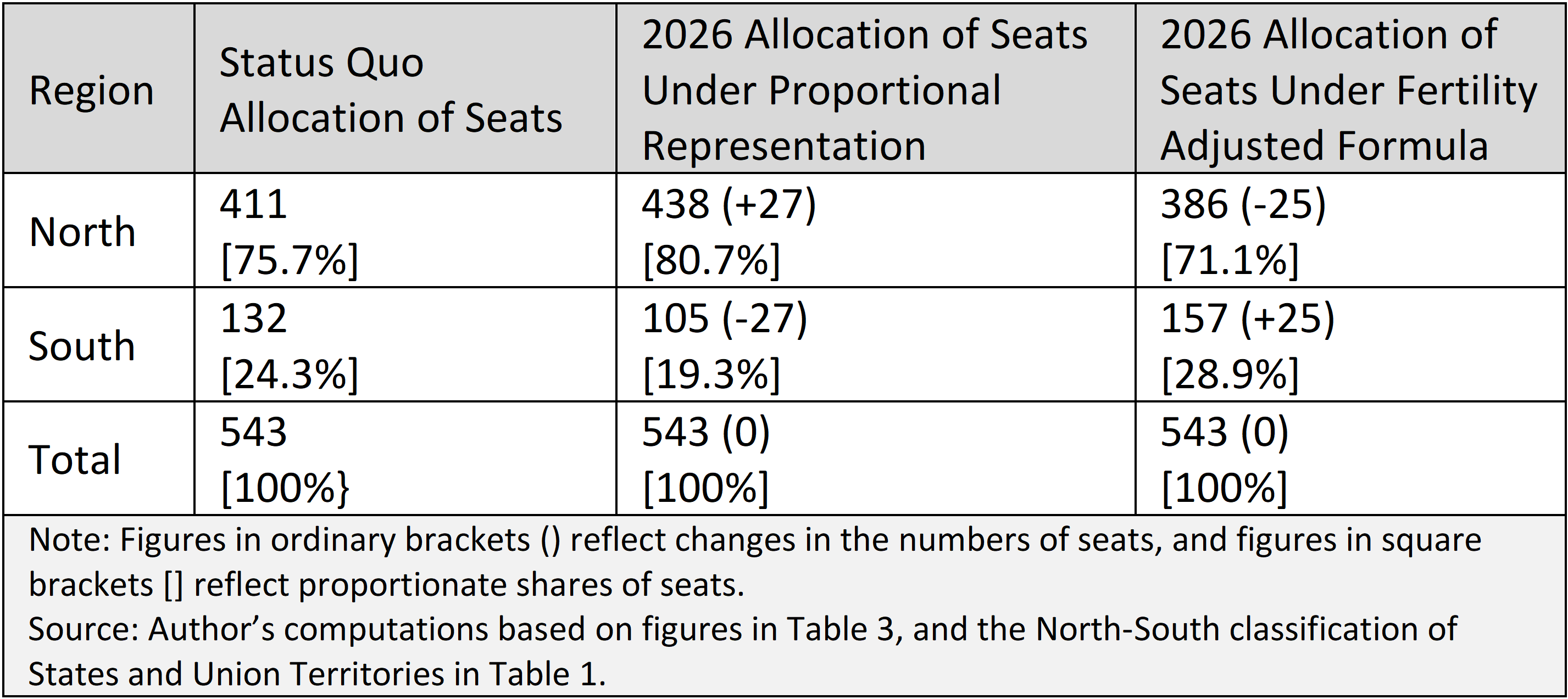
The Table suggests that under the present dispensation, the North accounts for 75.7 per cent of all Lok Sabha seats; in 2026, under PR, the North’s share would rise to 80.7 per cent, while under the Fertility Adjusted Formula, which prescribes a decline (of 25) in the number of seats allocated to the North (with a corresponding increase of 25 seats for the South), the share of the North in all seats would decline to 71.1 per cent. As observed earlier, the second of the two formulae just mentioned is by no means incompatible with the spirit underlying the justification—in terms of its serving as a motivational measure for population stabilisation—of the 84th Constitutional Amendment Act of 2002. That is to say, the North-South distribution of Lok Sabha seats in 2026 under the Fertility Adjusted Formula is amenable to principled rationalization (which, additionally, is sympathetic to the rationale underlying two earlier constitutional amendments). It seems worthwhile to state this despite—or perhaps because—of the fact that the Fertility Adjusted Formula will find no favour with the majoritarian will of India’s present political orientation.
5. Concluding Observations
I shall keep the conclusion very brief. In this essay I have been concerned to examine a small set of issues relating to the allocation of legislative (Lok Sabha) seats across the States and Union Territories of the Indian Union. In doing so, I have attempted to deal both with facts relevant to the Indian situation, and with abstract principles of political representation and their translation into the actual arithmetic of apportionment. I have contended—as other, but by no means all, commentators have done—that insisting on the strict constitutional mandate of PR would considerably exacerbate the already (arguably) large North-South divide further in favour of the North. To this end, I have suggested a scheme of allocation encompassed in what is called a Fertility Adjusted Formula, by which States with low population growth are rewarded and those with high growth are penalized. This has entailed a reduction in the seats allocated to some large and high-growth States in the North like Uttar Pradesh, and an increase in the seats allocated to some low-growth States in the South, such as Tamil Nadu and Kerala. The net result is a dilution in the North’s share of seats, compared to the status quo. I believe that the basis for the formula employed to secure this outcome has intrinsic normative merit, not least given the political environment that now obtains in the country. That is why I advance it—and not at all because there is the least expectation that the proposal will meet with anything but wide rejection. This being the case, one has a reason for push-back—at least for the record.
I would like to thank Venkatesh Athreya for an instructive preliminary discussion of the subject of this article, Sudha Pai for helpful comments on an earlier version of the essay, and above all, Rammanohar Reddy for detailed and valuable advice on the writing of the article.
The author is an economist who lives and works in Chennai.