



From India to France, Belgium to the Netherlands, Germany to Switzerland, Albania, Portugal, Spain, Italy, and Argentina, the world witnesses an intercontinental wave of young people revolting against their governments. In Serbia, a students’ movement defeated an authoritarian government in the national elections. While the Serbian students’ movement began two years ago, the youth protests sweeping the world have more or less all come at the same time.
Supreme Court Chief Justice Surya Kant will be remembered as the unwitting trigger of the protests with his callous remarks comparing unemployed youth to “cockroaches” and “parasites”.
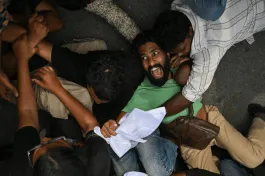
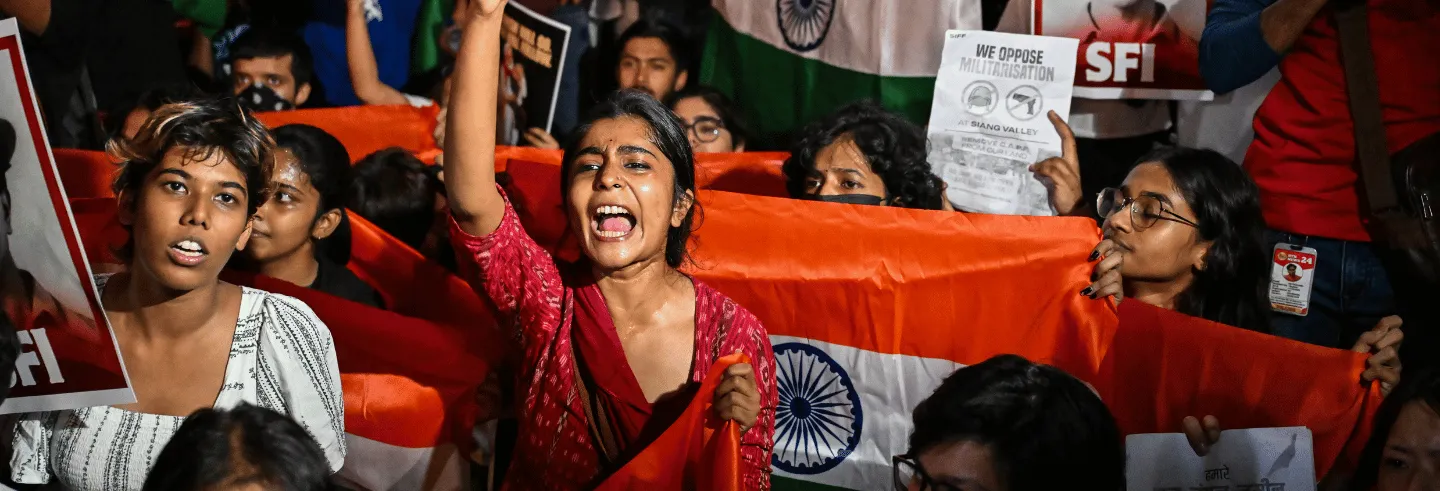
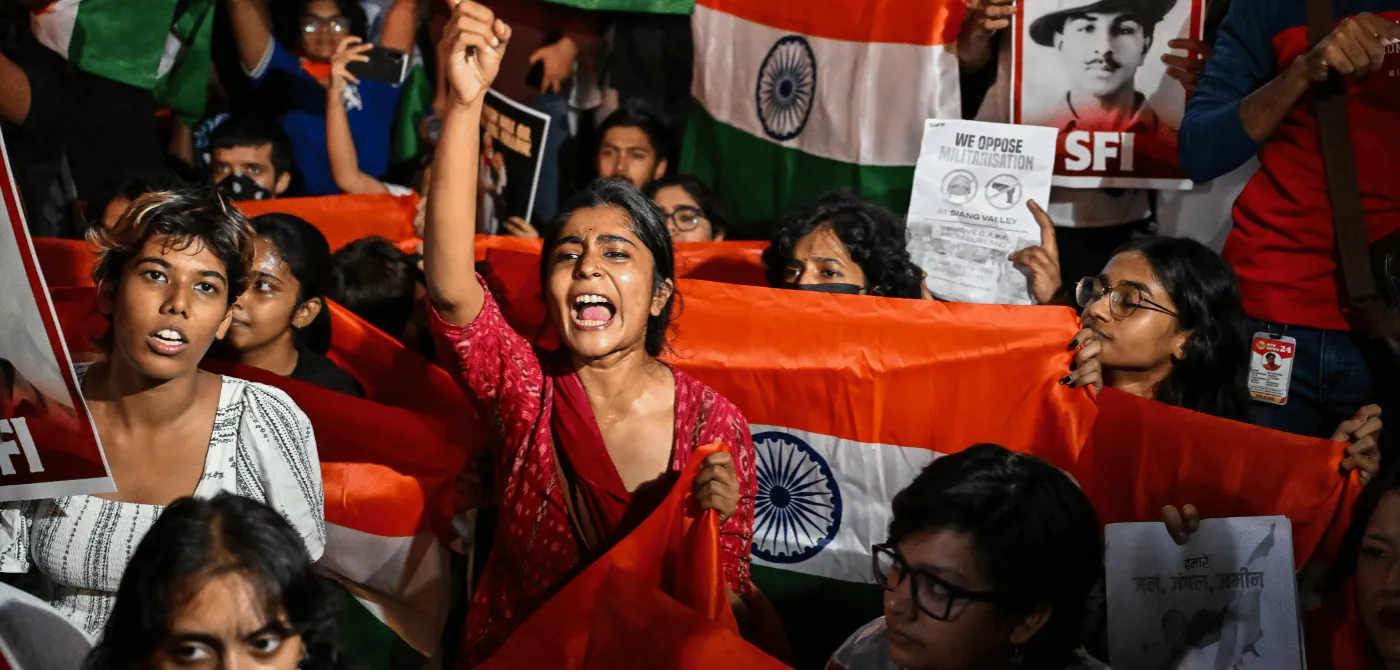
India’s Gen Z uprising began as a protest against a corrupted public examination system for entry into medical colleges, and then rallied once more against the mass deletions of voters from electoral rolls. The protests in France started with high school children drawing attention to the poor state of their schools, and segued into a larger uprising against unemployment and the high cost of living. The rioting in Paris and other cities in France in the third week of October came after a month of peaceful protests. Six months ahead of a presidential election, these protests are certain to affect voter sentiment.
In Belgium, high school and university students took to the streets against budget cuts to education. In Spain and Portugal, a housing crisis was the immediate trigger. In Albania, public opposition to an investment in a luxury resort on the Adriatic coast, which had been simmering since last year, turned into a country-wide agitation against corruption, the cost of living, and the poor state of the country’s universities. In Argentina, a decision by the government to cut funding for universities brought out 600,000 people in protest across the country.
The eruption of anger among young people across the globe had separate and specific causes. Supreme Court Chief Justice Surya Kant will be remembered as the unwitting trigger of the protests with his callous remarks comparing unemployed youth to “cockroaches” and “parasites”. The Cockroach Janata Party (CJP) began as a roast of the chief justice and the “system” that he wanted to protect from the vermin he dismissed so contemptuously. But it quickly turned into a serious platform for an issue affecting India’s young people: the credibility of India’s public examinations. From humorous ownership of a humiliating label, the CJP morphed into the most serious political challenge that Prime Minister Narendra Modi has faced in over a decade of leading India. In France, on the other hand, it was a cruel summer that brought irate schoolchildren out of their airless classrooms.
But almost everywhere the underlying causes are near identical. They include a broken education system that does not guarantee a meaningful future, a bleak job market that is now further exposed to the onslaught of artificial intelligence (AI), and the uncertainties inflicted on the world by three long wars: one of them now commonly described as genocidal, and the two others patently illegal. Add to this the increasingly felt impact of climate change, and a leadership vacuum so dire that it makes former US President George W. Bush seem inspirational.
Even so, painting all these protests as one big blob of global 'youth unrest' runs the risk of treating them generically as 'angst'. That makes it easier to blame the young themselves as an 'entitled' generation who have everything but want more, or blame other entities such as the tech giants who brought AI into this world. Either way, the leadership and governance failure in each case goes unseen.
India’s Gen Z Moment
In India, the Modi gerontocracy’s failures have been of the 'in your face' kind. Demonetisation is an example. Its response to the country’s jobless growth—' go fry pakoras'—is another. But unlike the Western democracies currently wracked by protests, where a ruling party, however terrible its record, continues to remain answerable and accountable to the public, the Modi government takes pride in its unaccountability, emboldened by its electoral successes year after year since being voted into office in 2014. Modi’s style of one-way communication takes no questions, except of the scripted kind.
The government’s authoritarian bearing, the hollowing out of institutions of state such as the Election Commission of India and the judiciary, the squashing of dissent, and the conversion of mainstream media into a handmaiden, all began many years ago. The response of the Bharatiya Janata Party (BJP) to all criticism has been to lean more on Hindutva. It has also subverted the few opposition electoral victories, either by breaking up parties or by setting investigation agencies on opposition politicians for real or foisted charges of wrongdoing.
The “demographic dividend” that Modi spoke about glowingly is now a ticking time bomb for the BJP.
Amidst all this, Modi always talked up India’s youth bulge as the “demographic dividend” that would lead the country to great heights. At the 11th Governing Council Meeting in June, he said: “India’s demographic dividend is a historic opportunity that we cannot afford to lose. Creating the right ecosystem for our youth through quality education, demand-driven skilling and employment opportunities must remain a priority. Empowered youth will be the driving force behind our journey towards Viksit Bharat”.
It is another matter that under India’s headline gross domestic product (GDP) numbers, job creation has never kept pace with the number of graduates that the education system produces every year. Of approximately five million graduates added every year to the workforce between 2004–05 and 2023, only slightly over half found employment, with only a small fraction entering salaried employment, according to a report by the Azim Premji University’s Centre for Sustainable Employment.
As evident from his ill-advised Instagram posts, Modi’s vision of India’s youth is one of obedient “children”, who do not question “elders”, especially if those are elderly men running the government. The government knows best; everyone else just needs to follow orders—that is the attitude.
Anecdotal evidence about Hindutva’s reach among the young supported the view that the generation that came of age during Modi’s prime ministership had joined at least two preceding generations of Indians before them in the blind worship of a strongman leader. The jibes of 'pappu' at the Leader of the Opposition Rahul Gandhi, and 'Maunmohan' at Modi’s predecessor, the late Manmohan Singh, had caught on.
The young even reinvented clubbing into worshipful 'bhakti' evenings. Modi played the tambourine at one such bhajan clubbing event in the capital. Close by was another gathering of young people, protesting the alleged violation of the electoral rolls, and others demanding the resignation of the Chief Election Commissioner. They were being hauled off in buses to be detained at remote police stations. The contrasting scenes conveyed the kind of demographic dividend Modi wants—unquestioning, deferential foot soldiers of the regime, high on Hindutva rock, not well-informed citizens demanding their rights.
Also read: India’s Young Protesters are Reclaiming the Republic by Asim Ali
In this, Modi is no different from authoritarian leaders in other parts of the world aiming to discipline the young. From the Brown Shirts to the Red Guards, history is littered with examples of how dictators co-opted the youth for total control.
One of the Modi government's first actions after it was voted into office was to tame universities where students were seen as having a mind of their own. But some student leaders of the time stayed outside the grasp of the Modi establishment. Umar Khalid, who remains incarcerated since 2020, was first arrested in 2016, two years after Modi took office, and accused of sedition during a protest at Jawaharlal Nehru University (JNU). This was on the basis of doctored videos aired by some willing TV channels. His rearrest under the draconian UAPA years later was meant to be a message to both Muslims and the young. Cross the line, and see what happens. But if the government intended to make an example out of Khalid, the young have shown they are not intimidated.
With information flowing faster than at any other time in modern history, brainwashing young minds is not as easy as it used to be. In India, the bubble was waiting to burst, with unemployment as high as 40% in the 15 to 25 age group and 30% in the 25 to 29 one. The demographic dividend that Modi spoke about glowingly is now a ticking time bomb for the BJP.
After the BJP moved swiftly to fulfil its anti-Muslim ideological commitments to avenge the 'humiliations' of the past—downsizing Kashmir, criminalising triple talaq, and building a temple over a demolished mosque—it was natural for even its people in its Hindutva constituency to ask if the government they had elected would now pay attention to the present and future. The first explosions were heard this summer.
If those who turned up to protest despite the government’s all-out effort to stop them are truly representative, large sections of Gen Z are no more impressed by Hindutva, if they ever were. Instagram is awash with youngsters saying they once supported the BJP in the past, and some of its decisions, such as draconian measures imposed in Kashmir in 2019, but they now realise their error of judgement. Some have even managed to convert their BJP-supporting parents to see it their way. They are asking questions that the Modi government never expected to hear from a demographic dividend which was thought to be an obedient saffronised army of about half a billion Indians.
It is Modi and the BJP who are now consumed by fear of a demographic they once sought to control.
Modi and Home Minister Amit Shah have no answers to the sharp questions raised by the likes of Neha Bora of the All India Students’ Association (AISA) and her comrades, or Abhijit Dipke, Ashutosh Ranka, and Saurav Das of the CJP.
Why indeed is a peaceful protest a threat to law and order? Why is Amit Shah telling us to fry pakoras for living when he has wangled cricket’s most lucrative and prestigious position for his embarrassingly unqualified son? Why is the BJP going all out to protect Chief Election Commissioner (CEC) Gyanesh Kumar? Why is it wrong to assert that fiddling with the electoral list violates a constitutional right and is a punishable crime? Why does the government refuse to be accountable? Since when is holding the tricolour a crime, let alone one that attracts imprisonment?
With its merciless send-ups of the main targets—the Prime Minister, Home Minister, and the CEC—Gen Z’s social media game is notches above the BJP’s information technology (IT) cell. What makes these memes more powerful is that they are posted by real people, and not 'two-rupee' trolls hiding behind anonymous handles. When Bora or Dipke post something on Instagram, it garners more views than Modi’s desperate attempts to make 'friends' with a rebellious Gen Z. They know they have committed no crime, and they remain fearless in their public utterances.
On the other hand, it is Modi and the BJP who are now consumed by fear of a demographic they once sought to control. The protestors on the streets, mostly Hindu, can no longer be labelled and delegitimised as dangerous jihadis. Modi did coin another label, dimagi Naxals, but young people have embraced it and wear it as a badge of honour, much as they did with the cockroach label. The government’s fear showed in the extreme measures that the state machinery has used to prevent people from gathering to protest near the seat of power. These included the denotification of the protest site, cancelling trains on 10 October (the day of the protest called by the CJP), closing down Metro stations, internet suspensions, violence against protestors on 20 July, and detentions and imprisonments.
Finit or Interlude?
After such a severe clampdown, there is also no denying that the energy that drove young people to protest sites in defiance of these measures has receded from its highs of July and October.
Have Modi and Shah won out, or should this be seen as an interlude in a longer fight?
With the caveat that comparisons are useful only to a point: history, or even contemporaneous events, offer mixed lessons. Serbia may be inspirational, but youth movements have risen in moments of national crisis, only to be crushed with extraordinary cruelty, co-opted, or replaced by governments no better, perhaps even worse, than the ones they ousted.
Tiananmen Square is a recent example of the merciless deployment of state power to crush a nascent youth movement that was challenging the authority of the Chinese state. The Arab Spring revolt, particularly the one in Egypt, led to a more repressive regime than the one it replaced. Even in Western democracies, peaceful youth movements have been 'well handled' before they could realise their full potential for ushering in political change.
At this point, when Serbia is high in the new Indian imagination, it is good to remember that its “regime change” came through elections.
In France, the 1968 student uprising was ended forcibly after Charles de Gaulle won a landslide victory after calling a snap election. The violence in the ongoing protests in France could strengthen the hands of Marine Le Pen, an extreme right-wing leader, in the April 2027 presidential elections. The jury is out in Bangladesh and Nepal, where youth uprisings swept out governments and brought in new ones.
India’s Gen Z revolt has been compared by establishmentarians to protests that forced 'regime change' in those two last-named neighbours, as well as in Sri Lanka. It is something of a confession when a government calls itself a regime, a term commonly used by opponents or observers to describe totalitarian, authoritarian dispensations. Those who make these comparisons only reveal their own insecurity. Further, those who declare they are protesting for 'regime change' also do themselves no favour, as this implies the replacement of one authoritarian with another. In any case, the Indian state is far too powerful to permit an ousting of an elected government by protestors at the gates.
Following the Modi government’s repressive measures, many have already pronounced that the CJP has been 'controlled'. They overlook the government’s fear, not just of physical gatherings by the young, but of the narrative that has taken hold in the minds of the young—that the Election Commission of India and judiciary have sold out; that the Modi government is not the solution to its problems; and that it needs to make way for something else.
This narrative, playing out on one-minute reels on Instagram, is clearly powerful. Or else, why would the Ministry of Electronics and Information Technology have moved so swiftly to direct Meta to pull down thousands of Instagram posts, so indiscriminately that even a post on the ECI’s submission to the Supreme Court was taken down? But consider too that the administrators of two central universities, Jamia Millia Islamia and Aligarh Muslim University, bowed swiftly to the demand of striking students at both institutions, for elected student unions. The protests by the students at the universities were separate from what was happening on the streets of Delhi. But could it have been just coincidence that the students picked up the courage to set out their demands at the same time as the youth ferment in the capital and in other cities?
At this point, when Serbia is high in the new Indian imagination, it is good to remember that 'regime change' in that country came through elections. A roof collapse at a train station that killed 14 people was big enough to mobilise students throughout the country immediately. Even so, it took two years of a sustained campaign to force the authoritarian Aleksander Vucic to call last month’s snap election, which he lost decisively. His early political career and rise to office were steeped in ultranationalism and anti-Muslim rhetoric.
As the demands widen, the movement needs to widen and make alliances countrywide with political parties and civil society.
Or consider Thailand, where a students’ protest was perhaps the first ever to attract the Gen Z label. In 2018, a new party called the Future Forward Party disrupted the political duopoly held by the royalist, pro-military Palang Pracharath Party (PPRP), known as the yellow shirts, and the populist Red Shirts or the Pheu Thai Party. There were several setbacks. The FFP and its successor, the Move Forward Party, were dissolved for challenging Thailand’s powerful monarchy. Another edition of the FFP, called the People’s Party, did well enough in this year’s snap election to emerge as the main opposition in the Thai parliament. Their struggle to displace the established political parties has partially succeeded, and will no doubt continue.
India’s youth may have something to learn from these two movements. First, calling for political change and accountability cannot be seen as 'apolitical'. It requires an honest reckoning about what is the politics, if not ideology, of the movement that forced the resignation of Dharmendra Pradhan, the then education minister, and now wants the CEC to resign and, even more, demands accountability for his actions from even higher up.
As its demands have widened, expectedly, the CJP has lost some of its early traction. Sections of youth who turned out in July stayed away from the “political” call for the CEC’s resignation in October. The CJP supported the Congress call for a rally at Ram Lila Maidan on 1 November, but it was evident that the mammoth gathering was in large part due to political mobilisation of party workers and supporters from neighbouring states. But if the movement’s goal is indeed to bring about substantive changes in the way India is governed, it needs to be widened. For this, there is no alternative other than to make alliances countrywide with like-minded political forces and civil society.
What India’s Gen Z movement has already achieved, though, is what no opposition party could manage to do in the last dozen years. It has introduced a new narrative about the Modi government that has crossed its immediate support base and permeated into far corners of the country. It has also made the government fearful of the people in whom it once instilled fear. Can the opposition political parties turn this narrative to their advantage? Can SIR turn into as much of a catchphrase for all the Modi government’s failures and wrongdoings as Bofors once did for the Rajiv Gandhi government? Political change does not come easily. It demands both persistence and patience.
Nirupama Subramanian is an independent journalist.