
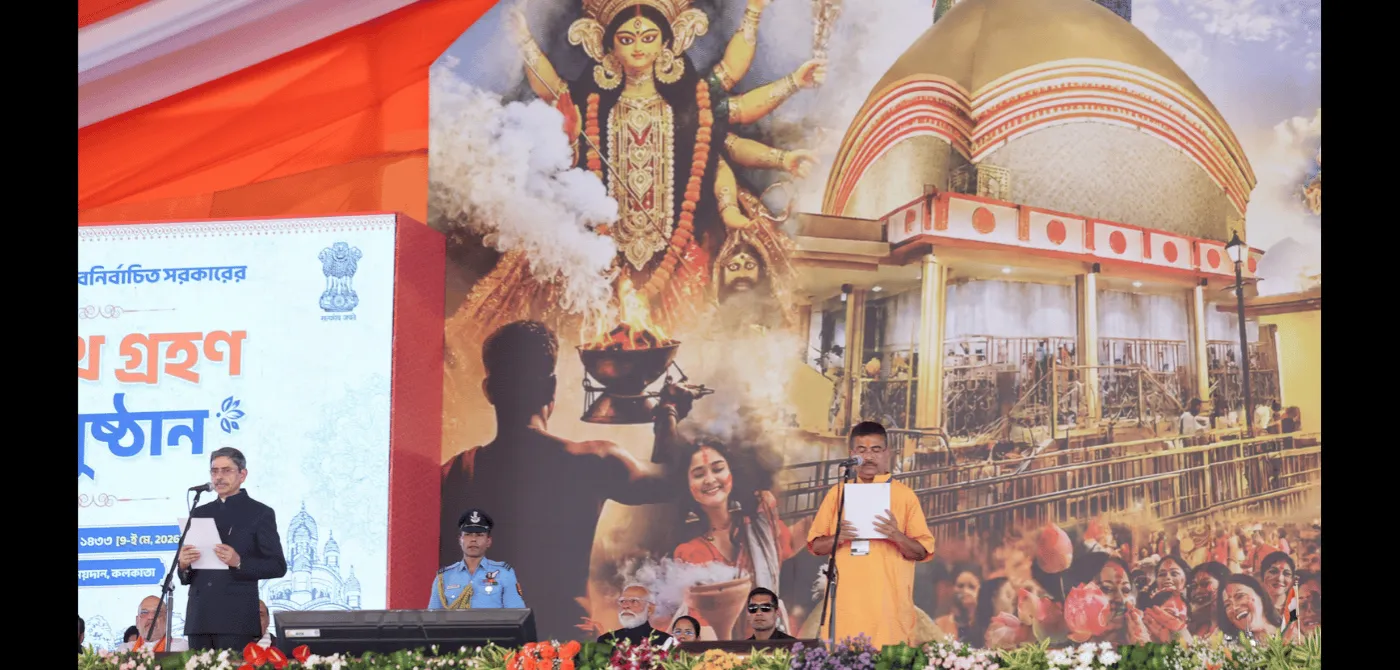



West Bengal has entered a distinctly new political moment. For the first time since independence, the state has elected a government that makes little effort to accommodate its nearly 30% Muslim population and has moved swiftly against the informal livelihoods of the poor.
If one looks at the larger political canvas, an atmosphere of fear is unmistakably being cultivated among the Muslim and Christian minorities in the state.
Within days of the Bharatiya Janata Party’s (BJP’s) emphatic victory in the assembly election in April, bulldozers flattened hawkers’ stalls around major railway stations and cleared “illegal settlements”, many of them in predominantly Muslim neighbourhoods. These early actions signalled a targeted and anti-poor administrative direction the kind of which until now was inconceivable in the state.
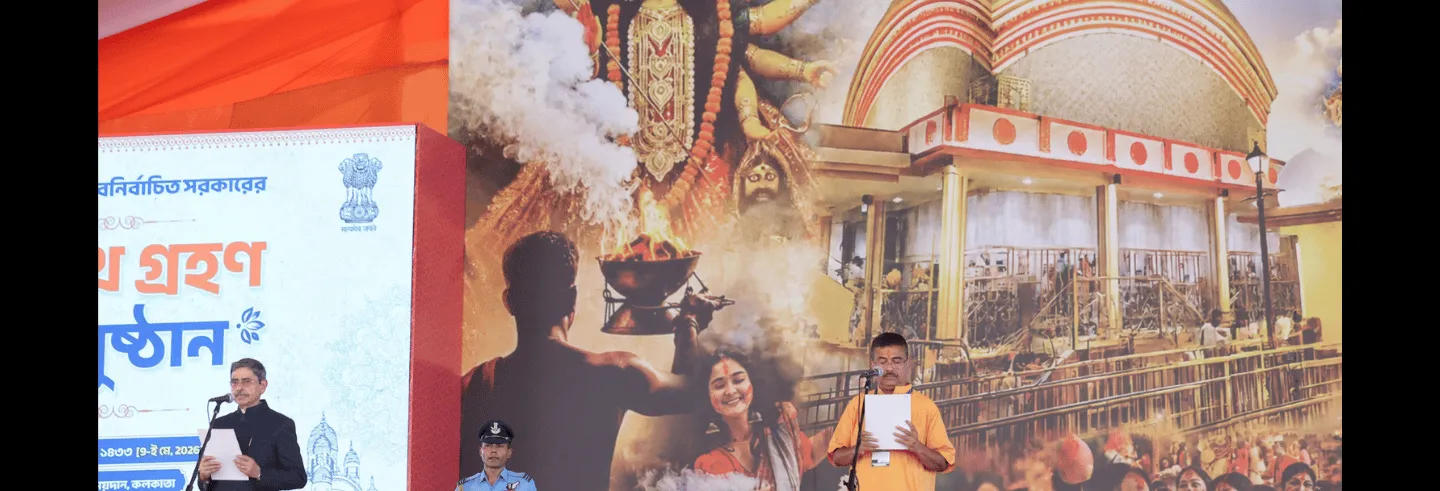
The new dispensation preceded such action by an unambiguous rhetoric. Well before the election, Suvendu Adhikari, then the leader of the opposition in the West Bengal assembly, had publicly dismissed the slogan Sabka Saath, Sabka Vikas and questioned the need for the party’s Minority Morcha. After winning Nandigram, he declared on television: “Hindus have made me win … I will work only for the Hindus.” The party’s post-election conduct has matched this language with force. 1Adhikari later moderated his stance and sought to sound more inclusive. This subsequent shift, however, does not erase from public memory his polarising campaign speeches or the categorical statement he made immediately after the results were declared.
Changes
On the heels of the election, the legislative wing of the Trinamool Congress, the principal opposition party, has virtually collapsed. Of the party’s 80 members of the legislative assembly (MLAs), 58 moved to align with a renegade faction pliant to the BJP. Large numbers of Lok Sabha and Rajya Sabha members of parliament (MPs) also defected, almost all under the implicit threat of investigative agencies.
Such makeover has few parallels in scale. The BJP has long practised “washing machine” politics all over the country. In West Bengal, it has taken on an industrial form of “political recycling”—absorbing almost the entire Trinamool Congress (TMC) legislative party while retaining corruption cases as instruments of future leverage. The result: Mamata Banerjee is left with only a handful of loyalists and a sharply diminished party organisation.
If one looks at the larger political canvas, an atmosphere of fear is unmistakably being cultivated among the Muslim and Christian minorities in the state. Within weeks of the change in power, restrictions were imposed on public namaz and tighter controls enacted on cattle slaughter, heightening anxieties among Muslims. Reports of attacks on religious minorities multiplied. Mosques were attacked (one defender killed), Muslim-owned hotels demolished, meat shops and cattle markets forcibly closed, and female students intimidated for wearing the hijab.
Christians faced parallel hostility. In Murshidabad, a Christian widow’s home was vandalised by a mob demanding that she renounce her faith; and in Bankura, a pastor’s prayer meeting was disrupted, Bibles seized, and worshippers briefly detained. Churches in Sonarpur and Subhashgram were attacked by mobs shouting “Jai Shri Ram”, their altars desecrated, and property damaged. Similar assaults occurred in Paschim Bardhaman district. Even some Hindu families were publicly humiliated for allegedly failing to observe prescribed religious practices. 2The following reports document these incidents: Matters India, “Anti-minority incidents escalate in West Bengal under new government,” July 2026, https://mattersindia.com/2026/07/anti-minority-incidents-escalate-in-west-bengal-under-new-government/; Matters India, “West Bengal’s pluralist legacy under siege,” May 2026, https://mattersindia.com/2026/05/west-bengals-pluralist-legacy-under-siege/; Christian Today, “Christians in West Bengal report fresh wave of attacks,” https://www.christiantoday.co.in/news/christians-in-west-bengal-report-fresh-wave-of-attacks.html; Subhasish Chaudhuri, “Vandals reach Bengal churches; Christian body flags ‘pattern’ in attacks, police ‘harassment’,” The Telegraph, 11 July 2026, https://www.telegraphindia.com/west-bengal/vandals-reach-bengal-churches-pattern-in-attacks-police-harassment-prnt/cid/2169524; Madhyamam Online, “APCR report shows 34 incidents of violence, mosque attacks in Bengal after BJP win,” https://madhyamamonline.com/india/apcr-report-shows-34-incidents-of-violence-mosque-attacks-in-bengal-after-bjp-win-1518696; Manish Roy, “‘Anti-India Teachings’: Bengal Launches Crackdown On Khariji Madrassas; BJP Leaders Back Move,” News 18, 12 July 2026, https://www.news18.com/india/anti-india-teachings-bengal-launches-crackdown-on-khariji-madrassas-bjp-leaders-back-move-ws-l-10207199.html; and Aparna Bhattacharya, “Eid Crackdown and a Temple Sacrifice Expose Contrasts in Bengal’s Selective Animal Welfare,” The Wire, 1 July 2026, https://thewire.in/rights/bakri-eid-crackdown-and-a-temple-sacrifice-exposes-contrasts-in-bengals-selective-animal-welfare.
The BJP, it seems, is out to reorder the pattern of linkage between state, economy, and society in West Bengal.
Taken individually, these incidents may appear to be scattered. Together, they point to the emergence of a broader climate in which fear, public vigilance, and majoritarian policing increasingly shape everyday life of the state. What is at stake is not merely the insecurity they produce, but an attempt to reorder the moral and institutional environment within which people work, trade, worship or negotiate with each other and with the structures of power. In sum, the emergent atmosphere is likely to disrupt and eventually undermine the network of cross-community exchange which—despite its many flaws—maintained a pluralist cultural fabric in West Bengal for decades.
The BJP enters office with an ambition fundamentally different from that of the TMC. It seeks to reorganise the institutional mechanisms through which access to the state, economic opportunity, and political protection are distributed. Its project cannot be understood as a simple change of government. While it is too early to predict the precise form of change it can unleash, an informed speculation about its direction is perhaps possible.
Also read: Love and Power in Kolkata
The party, it seems, is out to reorder the pattern of linkage between state, economy, and society in West Bengal. A thumbnail description of how these linkages were formed in the last several decades will not be out of place here.
West Bengal stands out in India on four counts. First, while both Punjab and Bengal experienced partition, Bengal was divided twice—in 1905 and 1947. Unlike Punjab’s one-time exchange of population, it continued to absorb fluctuating streams of migrants from East Pakistan and later Bangladesh.
Second, land reforms here was more thorough than most other states: strict ceilings, redistribution of surplus land, and tenancy reforms produced a predominantly small-peasant economy largely free of the rich-farmer dominance. Third, the state underwent a dramatic economic reversal, declining from one of India’s premier industrial destinations for labour to one of its largest labour-exporting regions. The flight of large capital in the 1960s and 1970s left small-scale informal units or Micro, Small and Medium Enterprises (MSMEs) with low per capita investment as the backbone of the state’s employment sector.
Unlike other regions, the state lacked strong caste associations, rich farmers’ unions, or dominant religious and linguistic organisations.
Fourth, the precarity of the majority workforce and the consequent need for collective action turned West Bengal into one of India’s most intensely politicised states, marked by high levels of partisan violence and fierce electoral competition with huge voter turnouts. These structural features form the essential backdrop against which the BJP’s rise must be understood.
Three conceptual tools have shaped the interpretation of West Bengal politics from the Left Front era through the final years of TMC rule—“political society”, “party society”, and “franchisee politics”. Each captures a distinct mode of governmental practice mediating relations between the state, the economy, and different population groups.
Of these, political society, developed in Partha Chatterjee’s work (2004), is the most encompassing. It refers to the site of collective action through which large sections of the poor negotiate with authorities for survival. Unable to claim basic necessities—such as the occupation of public land for work or habitation, or relief from loan repayment—as rights, these groups demand them as exceptions.
The pressures of electoral democracy have often compelled ruling parties to yield. Such politics of negotiation flourished under the Left Front and continued under the TMC. The BJP’s early assaults on hawkers and slum dwellers may therefore be read as signs of a deliberate project to dismantle political society as a central axis of democratic life in the state.
Departing from the logic of political society carries profound implications for West Bengal. Whatever limited voice the poor, marginal groups, Adivasis, Dalits, small traders, and micro-entrepreneurs could exercise was possible precisely because authorities were compelled to engage in negotiation, adjustment, and settlement. Local leaders functioned as the managers of this mechanism of collective dialogue and bargaining. The new government’s frontal attacks on hawkers and residents of “illegal” settlements signal a clear intent to reject this mode of politics and replace it with a new one: command politics, in which coercion takes the place of persuasion.
For various historical reasons, political parties occupied the central space in West Bengal’s political society, a phenomenon I have termed “party society” (Bhattacharya 2009, 2016). Unlike other regions, the state lacked strong caste associations, rich farmers’ unions, or dominant religious and linguistic organisations. Partition and refugee rehabilitation, Left-led peasant movements, the distribution of khas land, and the localisation of governance through the panchayats together made the role of the political parties central.
During my fieldwork in rural Bengal in the late 1990s and early 2000s, the ruling Communist Party of India (Marxist) (CPI[M]) was deeply embedded in decision-making across peasant organisations, the bureaucracy, and panchayats, extending even into the private lives of citizens. The communists organised people primarily along class rather than caste or religious lines. Even today the phrase “party kore” (“does party”) is commonly used to describe social identity.
Framed within party society, and mapped onto West Bengal’s MSME economy, franchisee politics blended political power and financial interest to produce what I called “non-corporate cronyism”.
The party thus became not merely one actor within political society but the principal organ for mediating with society and accessing state resources. With its not yet developed organisational spread in the state—and with the eager influx of the TMC workers at the grassroots—the BJP’s first challenge is to turn its legislative superiority into a dominance over West Bengal’s party society without replicating the operative norms of its predecessor.
What made such norms? Unlike the Left, and somewhat like the present BJP, the TMC came to power with a weak party organisation. It was Mamata Banerjee’s personal charisma that allowed her to hold rival factions together. Despite the political rupture of 2011, the foundation of West Bengal politics marked a continuity from the late Left Front years as the local leadership of the CPI(M) began to change since the 1990s.
The earlier crop of salaried middle-class leaders was slowly getting replaced by a new group of local entrepreneurs—builders, contractors, transporters, rice millers, fishery owners, goods suppliers, and the like—as cash started substituting party ideology for traction. The CPI(M) tended to keep these actors within a disciplinary regime.
Once the TMC assumed power, the party’s porous organisation enabled them to switch sides and assert autonomy. Mamata treated them as her extended arms, granting police protection for legal and illegal activities in return for unquestioned loyalty. This arrangement—what I have termed “franchisee politics”—positioned her as franchisor, serving as the party’s core brand, while local entrepreneurs functioned as franchisees (Bhattacharya 2023, 2026 forthcoming). She supplied the moral-popular legitimacy that held the party together, they channelled a share of rent income upward.
Also read: How the Invisible Maths of Electoral Roll Revision Altered West Bengal’s Election
Framed within party society, and mapped onto West Bengal’s MSME economy, franchisee politics blended political power and financial interest to produce what I called “non-corporate cronyism”. The institutional form of such cronyism was a “syndicate”, as it indulged in various forms of “corruption”.
Corruption was the fuel of franchisee politics. Profit made from illegal business often remained tied to legitimate investments in productive informal enterprises, turning it into a liminal economic zone. Although serious allegations against senior TMC leaders were longstanding, they rarely damaged the party at the polls. At the popular level, what was or was not attributed as “corruption” rested on a fine balance between moral disapproval of few getting rich and the advantage of tangible benefits procured by many. This balance rendered it a “participatory” phenomenon, drawing in large sections of the population despite the highly skewed nature of the accumulation.
Only when the accumulative dimension of corruption began to overwhelm its distributive aspect did a strong sense of moral reproach outweigh its participatory approval. This change in mood explains why earlier corruption charges against the TMC failed to stick, yet in 2026 they not only contributed to the TMC’s defeat but—with the protective shield of the police removed—also left the party virtually incapable of functioning as an effective opposition.
The early actions of the new government, particularly its demolition drives and limited regard for the poor, suggest that a push in this direction is already under way, though its durability remains an open question.
The emerging mode of power in West Bengal may be understood as a shift from franchisee politics toward what can be called command politics. Where franchisee politics still operated within the inherited terrain of party society—relying on local intermediaries, negotiated settlements, and the selective distribution of protection and rents—command politics seeks to reassert hierarchical control from above.
In this mode, the party, increasingly aligned with the organisational and ideological disciplines of the Rashtriya Swayamsevak Sangh (RSS) (which expanded significantly in the state during the latter half of TMC rule), attempts to regulate political mediation, economic activity, and public conduct through directive authority rather than bargaining. When sustained over time, such command politics risks producing what may be termed a “command society”. This is a social and political order in which the democratic logic of political society—negotiation, exception and the pressure of popular claims—is progressively displaced by the logic of hierarchical direction, corporatised investment and coercive enforcement.
The success of any such command society would depend both on the intensity of opposition and confrontation it encounters, and on the BJP’s ability to stabilise itself beyond its internal factional divisions within West Bengal’s party society—a process that remains incomplete. The early actions of the new government, particularly its demolition drives and limited regard for the poor, suggest that a push in this direction is already under way, though its durability remains an open question.
Challenges
On the face of it, with no formal opposition in sight, the BJP gets an open field after its first victory in West Bengal. Yet, the party confronts serious and, in some respects, unprecedented challenges. Although it fought the election on a strident Hindutva platform and secured the support of a large majority of Hindu voters, not all of these voters are necessarily committed to its ideological project. The BJP also benefited from strong anti-incumbency sentiment and from the hardening of anti-Muslim feeling after the political shift in Bangladesh, where Jamaat-e-Islami and allied forces made significant headway.
Hindutva is not merely a cultural ideology but a distinct mode of politics that weaponises the moral capital of religion in pursuit of material ends. For the BJP, a central challenge in West Bengal will be to realise this moral-political project if its new order is to prove durable. It remains to be seen how Bengali Hindu voters will respond in the coming years to a more regimented form of Hindutva. Its religious pantheon and political diction often sit uneasily with the state’s long tradition of cohabitation and syncretism, a tradition that has persisted despite periodic communal ruptures.
That tradition has also resonated with Bengal’s cultural mooring, itself shaped by a historical lineage that rendered the everyday coexistence of different sects and communities culturally meaningful. Despite many contradictions, such reciprocal ecumenism tended to float above religious exclusivism. From 19th-century social reformers like Ram Mohan Roy and Ishwar Chandra Vidyasagar to Rabindranath Tagore’s humanism, Swami Vivekananda’s reinterpretation of Hinduism, Kazi Nazrul Islam’s syncretic imagination, and later the various hues of Left’s sustained emphasis on economic rather than religious differences, the dominant socio-cultural vocabulary of Bengal rarely celebrated communal division.
In any case, punitive governmentality has never sat comfortably in a region marked by an enduring spirit of defiance: from the Sannyasi Rebellion to Singur, from Naxalbari to Nandigram.
No one should romanticise this history—communal violence has never been absent—yet a strong current in the state’s literary and cultural practices created a normative horizon within which peaceful relations across communities acquired legitimacy. It remains an open question how far, and in what ways, the present political dispensation can unsettle this moral common sense.
This brings us to a further challenge that the BJP is likely to face in West Bengal: its top-down, hyper-masculine style of operation. In his body language, intonation, diction, and choice of words, new Chief Minister Adhikari appears to be cultivating the image of a no-nonsense embodiment of force and resolute action. Or an elected dabang (a tough, dominant strongman) intent on projecting an audacious and indomitable mode of governance.
This impulse is already visible in one of his first legislative initiatives: the West Bengal Public Safety and Control of Anti-Social Activities Act, 2026 (popularly known as the Goonda Daman Ayin). The law permits the preventive detention of suspected “goondas” for up to 12 months without trial, along with the confiscation of their property. The state is also establishing a Special Investigation Agency (SIA), modelled on the National Investigation Agency, to handle terrorism-related cases and matters under the Unlawful Activities (Prevention) Act.
Such a punitive governmental style is broadly consistent with the BJP’s operative logic elsewhere in the country. In West Bengal, however, it is being introduced at a moment when the party finds itself under a form of mental siege elsewhere, precipitated by the extraordinary success of the youth-led movement under the Cockroach Janata Party (CJP). This setback has occurred despite the BJP’s successive electoral triumphs in Haryana, Maharashtra, Delhi, Bihar, Assam, and now West Bengal, following its loss of parliamentary majority in 2024. In any case, punitive governmentality has never sat comfortably in a region marked by an enduring spirit of defiance: from the Sannyasi Rebellion to Singur, from Naxalbari to Nandigram.
In such a setting, the currency of fear risks rapid devaluation. Moreover, the BJP’s hyper-masculinity and traditional gender norms may encounter unexpected resistance among Bengali women. As Lokniti/ Centre for the Study of Developing Societies (CSDS) surveys have repeatedly shown, women in the state have often demonstrated an independent political will, with their electoral preferences diverging from those of the men in their households. For a party that still has only a thin presence in West Bengal’s social history, these challenges could prove formidable.
More than a question of political style, a deeper difficulty confronting the BJP is the task of turning itself into a distinct and coherent party within West Bengal’s party society. Before the election, the party had sharpened its attack on the TMC’s alleged “Muslim appeasement” and “corruption.” In the aftermath, however, the extensive political recycling and rapid admission —both direct and indirect—of former TMC leaders into its ranks have fuelled accusations of a swift “Trinamoolisation” of the BJP.
Beyond every other challenge and uncertainty surrounding the present moment, the most critical issue for the BJP remains the fulfilment of its promise to generate employment and stem out-migration.
State president Samik Bhattacharya repeatedly argued that the party should not indiscriminately absorb Trinamool defectors, even as the continuing influx of former TMC leaders exposed the gap between the state unit’s stated position and the political dynamics unfolding after the election. What followed has been extraordinary.
The scale of induction even at the local level has been so extensive that an influential BJP MLA recently complained that the “new” workers in his party are more brazen and aggressive in “extortion, corruption, intimidation and the harassment of ordinary people” than their TMC predecessors. If such apprehensions are already being voiced so early, it may prove difficult for the BJP to carve out a distinct identity in the public eye beyond appearing as little more than “a TMC with a fiercely communal bend”.
Perhaps more than the BJP’s perceived metamorphosis, it is the weakness of the formal opposition in the Vidhan Sabha that renders the terrain of political contestation unpredictable. It remains to be seen whether Banerjee, still the most popular individual leader in the state, can restore her faction of the TMC to anything resembling its former strength. What is clearer is that the communists and the Congress—both reduced to a bare toehold in the legislature—will seek to reclaim space in the opposition now that the TMC has largely ceased to function as an effective force.
Also read: The Boy-Man Who Beat the Dravidian Model
Together with the Indian Secular Front in southern Bengal, these formations have room to expand into the organisational void created by the mass defection from Banerjee’s camp. Unlike the TMC, which has suffered a severe depletion of moral capital due to sustained charges of corruption over the past decade and a half, these parties—formally weak but potentially resilient—may offer a different mode of opposition, one more reliant on extra-parliamentary street protest and agitation. The precise forms and patterns such opposition will take remain, for now, unknown.
Beyond every other challenge and uncertainty surrounding the present moment, the most critical issue for the BJP remains the fulfilment of its promise to generate employment and stem out-migration. West Bengal’s economy rests on a low-equilibrium base of MSMEs in manufacturing, trade and services, together with small-holding agriculture, which together sustain the livelihoods of millions. MSMEs create jobs at far lower capital cost than large corporations and constitute the country’s second-largest source of employment after agriculture—more than 90% of these jobs are generated by micro-enterprises.
The BJP’s project appears directed instead toward the creation of a hierarchical “command society,” in which the party—guided by the ideological authority of the RSS—seeks to reorder both political mediation and economic life.
The BJP has pledged an economic turnaround that will require both filling thousands of vacant government positions and attracting substantial private investment. While aggregate capital expenditure in India has risen sharply over the past decade, this growth has been driven largely by public infrastructure spending rather than private corporate investment. It remains to be seen how successfully a “double engine sarkar” burdened with steep public debt can expand public employment, draw private capital into the state, and politically manage the existing informal economy. If the early demolition of hawkers’ stalls and poor people’s settlements without any rehabilitation is taken as a policy signal, the state risks serious social and economic disruption even in the short run.
Whither West Bengal? The BJP’s current strategy shows little interest in the politics of persuasion or in building cross-community support. Its project appears directed instead toward the creation of a hierarchical “command society,” in which the party—guided by the ideological authority of the RSS—seeks to reorder both political mediation and economic life. Efforts to corporatise and regulate the MSME sector further threaten the decentralised informal arrangements that once linked the livelihood of the poor to local political power.
Where the Left and the TMC, despite their differences, tended to operate within the grain of political society, the present turn has from the beginning privileged moral policing over negotiation, and conformity over dissent. The likely consequence is not stability but confrontation. Indian politics has repeatedly shown that electorates tend to rally behind the opposition force most capable of resisting a dominant and coercive power. The decisive question, therefore, is not simply who will occupy the opposition space now left dangerously vacant: Mamata Banerjee, the Left, the Congress, or some broader anti-Hindutva coalition yet to emerge. More fundamentally, the issue is whether any such formation can rebuild the democratic capabilities of political society while acquiring the organisational strength and moral legitimacy required to upend the BJP’s project of establishing a command society in West Bengal.
Acknowledgement: An earlier version of this was presented in Bangla before Muktadhara, a collective of concerned citizens in Kolkata, on 19 June 2026. I am grateful to the participants for their thoughtful questions and criticisms, which greatly helped refine the essay.
Dwaipayan Bhattacharyya is Professor, Centre for Political Studies, Jawaharlal Nehru University, Delhi.