
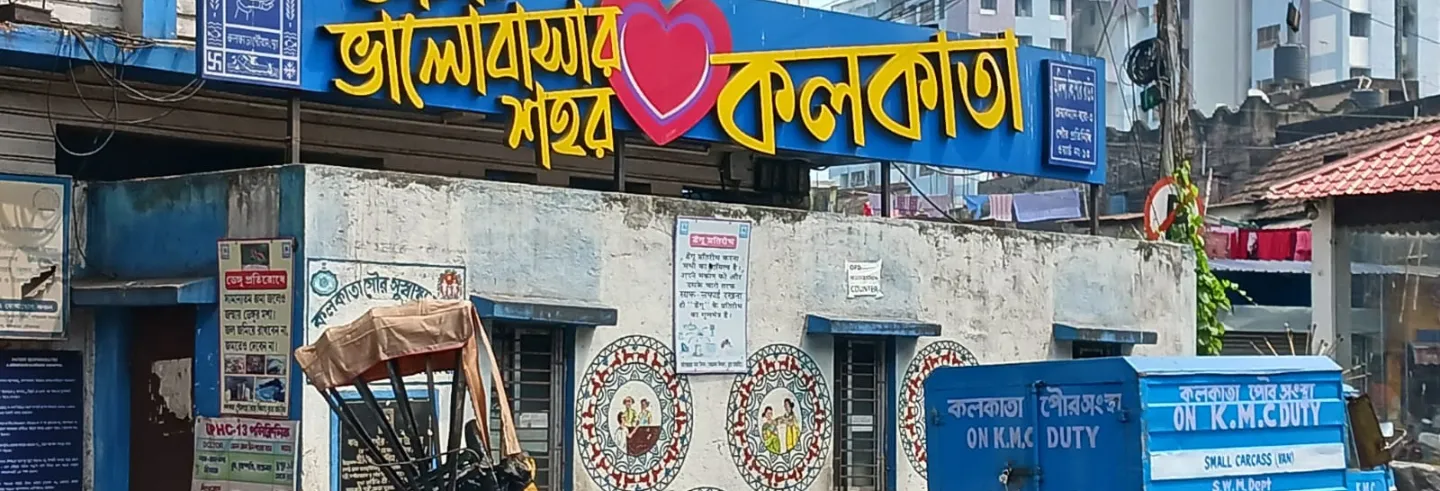
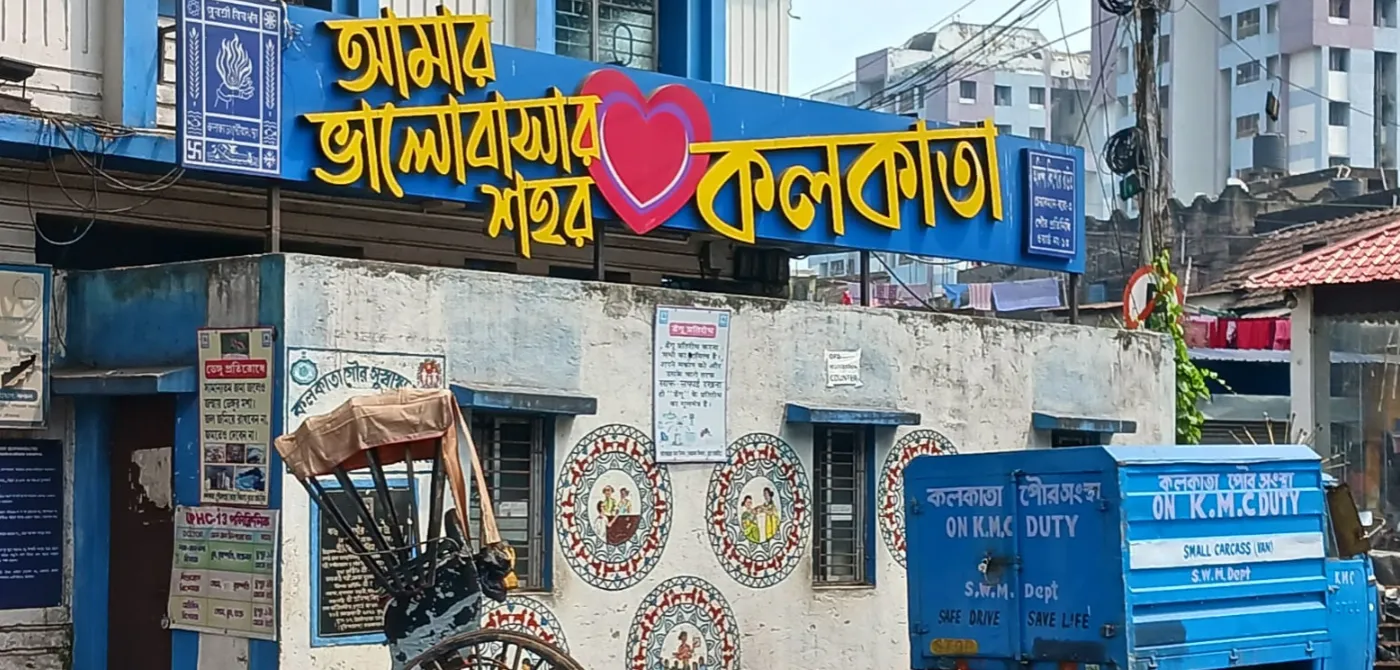



Kolkata is a visually dense city: each wall a palimpsest of posters, banners and hoardings announcing political rallies, events, festivals, greetings from politicians big and small, social and cultural initiatives by the city’s diverse ethnic organisations. Amidst this forest of visual materials, huge declarative glow signs of I LOVE, followed by the name of the ward, and its many variations stand out for their spectacular scale and relative permanence. Like other posters, these signs too have been deploying a vernacular idiom, depending on the space and context. Installed primarily during the last term of the Trinamool Congress (TMC) government (2021-2026), these signs are unmissable, as ubiquitous as the blue-yellow buses or the iconic yellow taxis on the city’s roads.
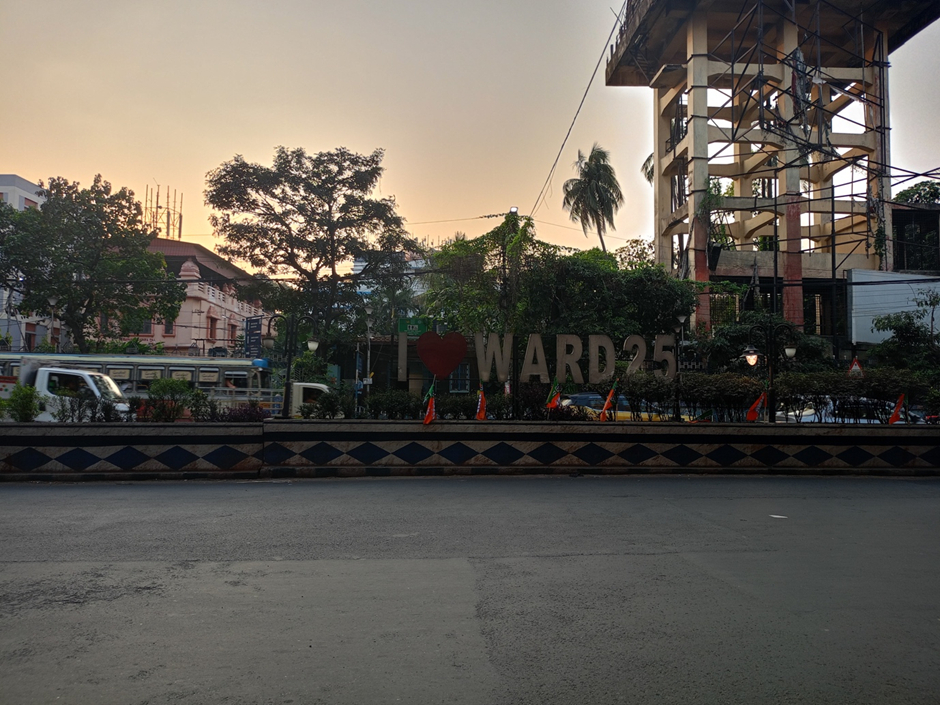
Initiated by the Kolkata Municipal Corporation in 2022 as “a campaign aimed at evoking a sense of belonging among citizens for their neighbourhoods”, the signs do much more than that. They became a projection of political patronage at the municipal level under the TMC government. North Kolkata, with a greater density of mixed neighbourhoods, has much more of such signs than the leafy posh neighbourhoods of the south. Even when the municipal campaign of love started with the southern part of the city, the signs here are minimal, with the mention of the ward number alone, in contrast to the north, where they assume a maximalist mirroring of the space itself: dense with text, at times even poetry and quotes, iconic figures, and very visible names of the political patrons of that sign—mostly a councillor or a former legislator.
Branding the City
Such signs are part of a growing infrastructure of urban branding that we see across Indian and overseas cities, by foregrounding the neighbourhoods where they are installed. The history of the I LOVE signage is closely intertwined with a changing economy. With the neoliberal push and shrinking public expenditure in the late 20th century, city branding became an entrepreneurial way to attract private investors. The first I LOVE sign came up in New York in 1977, transforming a crayon sketch by graphic designer Milton Glaser into an advertising campaign to promote tourism. The sign was reproduced on mementos, T-shirts, keychains, fridge magnets and other tourist merchandise re-branding the city amidst a growing financial crisis and shrinking public expenditure. In that vein, Sanjay Srivastava (2009) reads urban spectacles in Indian cities as a symptom of growing neoliberalism, that generated inter-city competition and commodified urban spaces. And, if the newest Urban Challenges Fund (2026) at the national level that proposes a market-driven model of urban development funding is any indication, such city branding is only going to intensify.
In Kolkata, a regional idiom of urban branding was created by the TMC government in 2013 in the form of Biswa Bangla symbol. Mired in political contestation, this symbol included a generic globe superimposed with the Bangla letter ‘B’ underwritten by the logo ‘Bengal meets the world’. This symbolised Bengal’s aspirational interface with the world, albeit through the conduits of party politics. The Biswa Bangla symbolism was a staple of beautification under the TMC regime, especially used as the official branding of the state. An eponymous gate, convention centre and an arterial road leading to the swanky New Town township reinforced this branding further. The other fixture is the clock towers or ‘Big Ben’-replicas in various sizes constructed in several parts of the city since 2015.
Some of this had met with resistance, and have been razed since the formation of the new BJP government in May 2026. For instance, a clock tower installed in 2023 in Garia, on the southern periphery of Kolkata was resisted by a local club on grounds of "illegal occupation" of the club’s playground in Calcutta High Court. Despite orders from the court, the tower remained unscathed till recently, when there was a municipal action for its demolition. The Biswa Bangla logo has also been replaced by the national Ashoka emblem on all government websites.
‘Beautification’ of the city under TMC government had become a mode of garnering political legitimacy- targeted especially towards the urban poor or lower middle class. As narratives of urban stagnation amassed and Kolkata’s trajectory of urban development became a matter of debate, neighbourhood-level beautification aided populism. As Dasgupta (2020) argues, beautification under TMC government became a way to make the urban poor "included" in the development dream without the state having to deliver on substantial economic or infrastructural counts. While the aesthetic appeal of accoutrements of beautification remains contested, especially among the Bengali bhadralok (middle class), their installation symbolised the territory and power of local party functionaries. The density of installations became a marker of political power.
Marking Political Territory
City-wide declarations of love are also seen in other cities across India and West Bengal. This mode of beautification can be observed in the hill towns of Darjeeling region. The Gorkhaland Territorial Administration has put up such signs in tourists hubs like Kurseong, Mirik, Darjeeling chowrasta and Batasia Loop and in two spots in Kalimpong, reportedly spending 50 lakh rupees in the process.
‘Beautification’ of the city under TMC government had become a mode of garnering political legitimacy- targeted especially towards the urban poor or lower middle class.
But few have it as dense as in Kolkata, with its ward-level signage often evolving into intra-party competition between councillors. Primarily installed on the main thoroughfares, rather than inner streets, these signs seem to create symbolic boundaries of the municipal wards too. Along the busy BT road, connecting Kolkata with its northern suburbs of Baranagar and Barrackpore, the signs flank the path where the boundaries of two wards or municipal areas merge, or where the local political functionaries seek to outdo each other, as if they were marking symbolic entry points to the competing political territories.
This is even more visible at key junctions of the city. At the busy Sovabazar junction in north Kolkata, close to the gates of the Sovabazar Sutanuti metro station, four massive signs flank each corner, each sponsored by a different ward councillor. Each direction is symbolically claimed by a political patron. Sovabazar stands at the confluence of multiple local economic networks: several 19th century palaces of zamindars on one side, Sonagachi, the much-studied colonial sex-workers’ enclave on the other, the prime real estate of Central Avenue, owned primarily by Marwari businessmen on the third, and at the fourth, the artisanal neighbourhood of Kumartuli, the centre of the Durga Puja economy. Though some wards have quietened over the years, parts of Shovabazar have remained volatile through the years, due to splintering of party organisations and periodic violence between various factions of the TMC there.
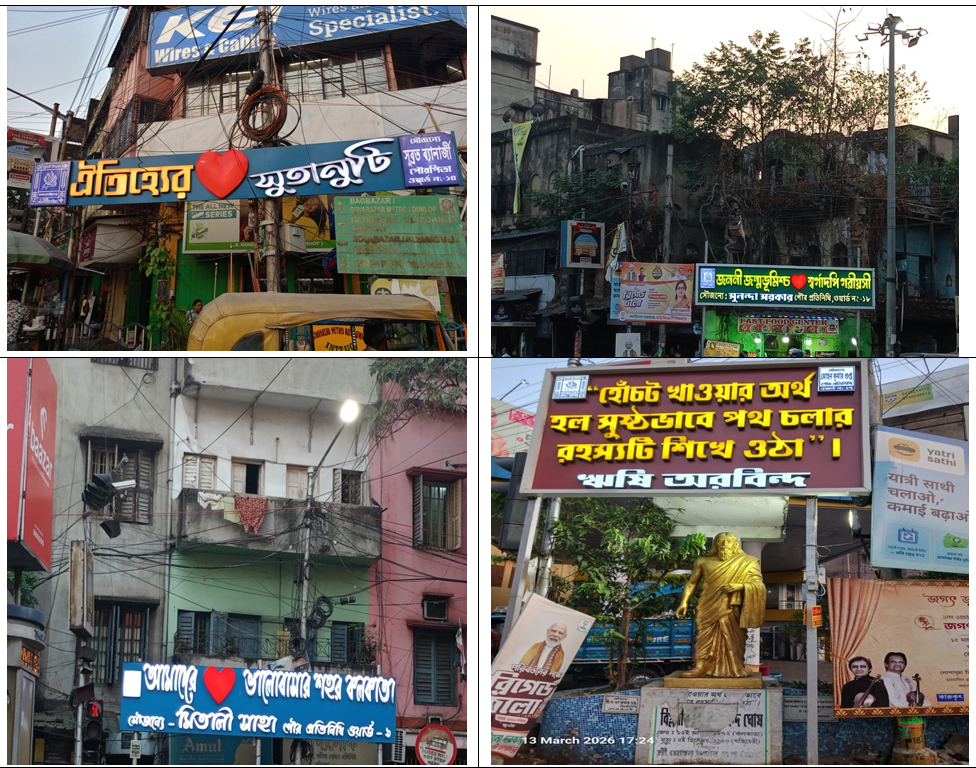
In this place, dense with memory and laden with power, the four glow signs are aesthetic accomplices of the local political contestations. They mark the boundaries of political territories of their respective councillors. Mohan Kumar Gupta, one of the councillors, chose a quote from Rishi Aurobindo—an icon of spiritual nationalism-on the installation patronised by him. Sunanda Sarkar of Ward 18 uses a Sanskrit shloka comparing the motherland to heaven, while Subrata Banerjee of Ward 10 calls the area as ‘aithijyer sutanuti’ (historic Sutanuti) indicating the heritage value of the area. Two kilometres later on Shyambazar crossing, the same councillor shifts to a nationalist tenor with an ‘I love Netaji’ signboard. The councillor of Ward 9, Mitali Saha, covering Kumartuli potters’ colony, the beating heart of Durga Puja economy in the city, chose a more generic ‘amar bhalobashar shohor’ or ‘the city of my love’ for the signboard patronized by her.
Vernacular Variations
These signs reflect idiomatic localisations of municipal power of councillors in the city’s political culture concretising the ‘party apparatus’. During the assembly elections’ campaign in 2026, the names of the political patrons on the signs were covered, perhaps to comply with the ‘model code of conduct’ during elections. The signs were clearly interpreted as symbols of political advertising more than anything else.
Caught in the cross- currents of neoliberal city-making and regional political idioms, Kolkata is no longer the city above pretence.
With the red heart as the constant, over time the signs have become much more stylised and striking, morphing into different scripts and fonts across diverse geographies of middle-class enclaves, declining industrial belts and zones of redevelopment. At the Chiria Mor junction on the northern fringes of Kolkata, where new middle-class gated complexes impose over the remains of the colonial industrial belt of Cossipore, a spectacular bi-lingual glow appears. The part facing the main road is in Bangla, while the immediately adjacent sign is in Hindi - declares Kolkata as "sapnon ka sheher" (city of dreams). The sign in Bangla faces primarily Hindu Bangali thika bustees (state recognised slums in former zamindari estates); the sign in Hindi faces the settlements of Hindi and Urdu speaking ‘upcountry’ workers, descendants of the migrants who were drawn to the industrial hinterland of the city in the 19th century.
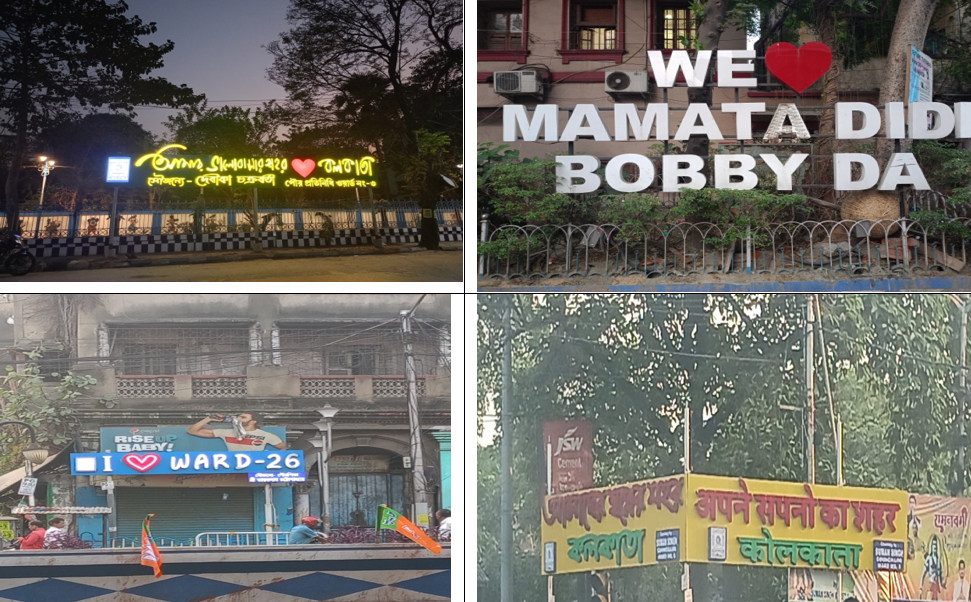
In other neighbourhoods, the text of the sign is supplemented by poetry or quotes of famous cultural, religious and political figures. In others, they also invoke historic legacies of the neighbourhoods. Near Shaymabazar five-point crossing, the erstwhile public square of the ‘black town’, love for Ward 10 has been supplemented with love for Netaji, whose horse-mounted statue is a relic of 20th century nationalisation of urban spaces. In the Paikpara neighbourhood of North Kolkata, in ward number 3, the ‘immortal eleven’ of Mohun Bagan, the first native football team to beat white players, are commemorated on a panel, alongside a bust dedicated to the nationalist sporting hero, footballer Goshto Pal.
The aesthetics, language and script are also sensitive to political changes. In 2023, Trinamool Congress (TMC) councillors in two wards on the southern fringes of the city, populated primarily by middle-class Partition refugees put up the I LOVE signs in Bangla. This was in the context of TMC’s heightened invocation of regional identity or “Bangali Asmita” (Bengali pride) in its electoral campaign during the run up to the 2021 assembly elections. In areas such as Kidderpore, with a large population of Urdu-speaking Muslim working class, the love for wards is superseded by love for political patrons.
Conclusion
Kolkata’s aesthetic regime under the former TMC government—its blues and whites, the Biswa Bangla globes, the small fibre glass replicas of Big Ben, the Durga installations and the I LOVE signs—were embedded in an urban economy fuelled by competitive city branding on the one hand, and in municipal populism on the other. The names of local councillors or the then MLAs as patrons on each signage added a political edge to these otherwise homogeneous ensembles. Beautification with performative signs of ‘love’ for one’s ward often clashed with the everyday lived realities of Kolkata and its suburbs: an illusory symbolism of ‘all is well’ above potholed roads, waterlogged streets and informalities spilling on the pavements. Caught in the cross- currents of neoliberal city-making and regional political idioms, Kolkata is no longer the city above pretence.
Garima Dhabhai teaches political science at Presidency University, Kolkata. Himadri Chatterjee teaches political science at University of Calcutta, Kolkata. They both are urban researchers, interested in questions of urban heritage, refugee rehabilitation, political economy and cultural life of cities.