


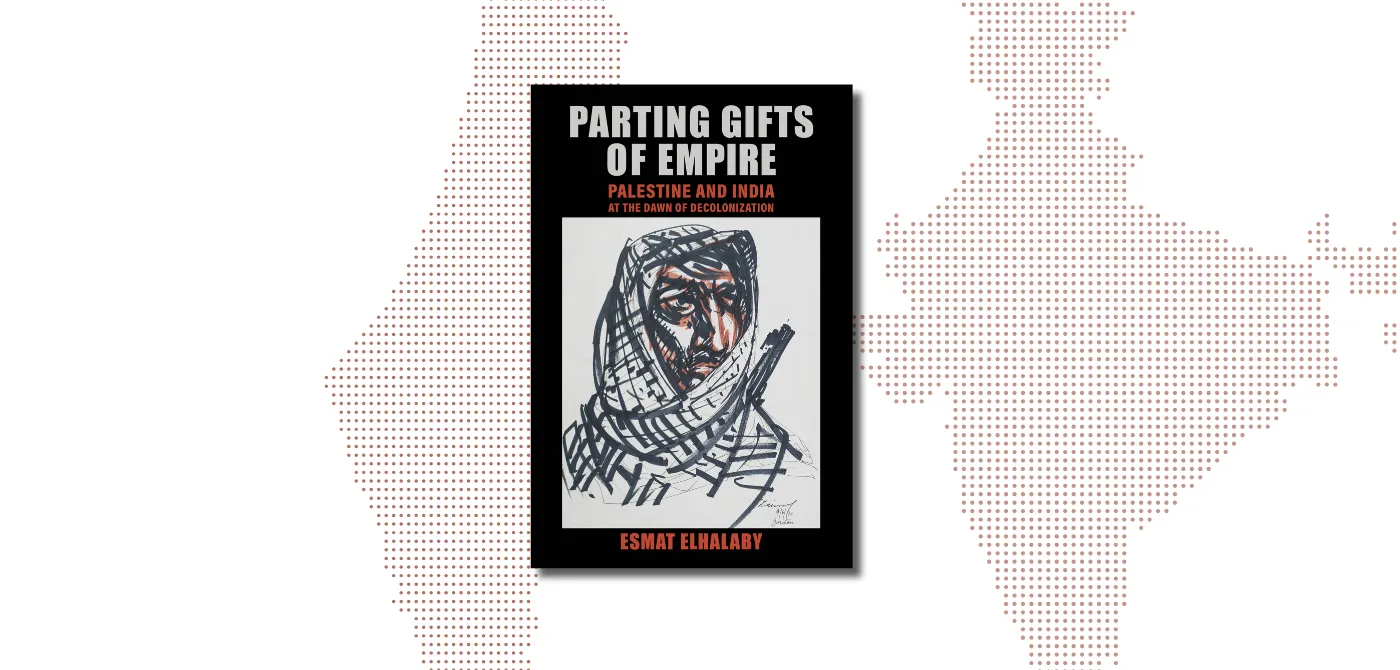



Although the title might suggest otherwise, Parting Gifts of Empire mainly focuses on a group of scholars and activists in the Indo-Arab region. These individuals challenged the colonial discourse and narratives promoted by Western intellectuals and institutions—first during the early 20th century, and then again from 1945 to the mid-1970s. Their efforts and contestations have largely been neglected. Esmat Elhalaby explores how an anti-imperialist way of thinking began to take shape from the perspective of those who suffered under Empire.
Nevertheless, as Elhalaby notes, the title remains appropriate. Palestine’s ongoing reality as a settler colony means that the struggle against imperialist approaches to knowledge and practice is still urgently relevant.
Conferences and other cross-border intellectual meetings—whether held in India or elsewhere—are highlighted as important sites for exchanges on religion, literature, and anti- or post-colonial political projects.
The Introduction lays out the basic plan of the book and identifies the three key elements in this construction of anti-colonial thought. First, the rejection of lies and distortions purveyed by colonisers or imperialists and their ideological apologists, howsoever sophisticated. Second, the building of anti-imperialist intellectual institutions and networks to develop truer knowledge. Finally, such scholarly enterprise must (and did in some measure) connect to progressive projects beyond national liberation such as anti-imperialism, Pan-Africanism, non-alignment, and even to communist ideals.
Between the Introduction and Epilogue, Parting Gifts of Empire presents five chapters titled: “Empire,” “Islam,” “Asia,” “Nonalignment,” and “Area”. The last refers to the establishment of broad academic studies about West and South Asia.
Each chapter illustrates the early attempts by selected individuals to actively challenge the Orientalist nature of Western scholarship. This kind of scholarship often served to advance the post-World War II geopolitical interests of Western countries, especially the United States, across the formerly colonised world.
Elhalaby provides detailed accounts of the travels and intellectual development of specific Arab figures who were dedicated to anti-colonialism. These individuals also sought engagement with India to foster cultural and political unity within the region.
Conferences and other cross-border intellectual meetings—whether held in India or elsewhere—are highlighted as important sites for exchanges on religion, literature, and anti- or post-colonial political projects. Such gatherings played a key role in building networks for reimagining and reconstructing knowledge.
The “Empire” chapter tells the story of Wadi’ al-Bustani (1886–1954), a Lebanese Arab Christian who worked for the British colonial administration and was sent to different colonies. His intellectual life was most profoundly shaped by his years in India (1912–16), while his political views were most influenced by his later time in Palestine (1917–53). After spending a few years in Palestine, Bustani resigned from the British government.
During its time, British India had the largest Muslim population of any country. This made it a focal point for both Christian missionary efforts to convert Muslims and for the development of Pan-Islamism.
He went on to translate the Ramayana, Mahabharata, and Shakuntala into Arabic. He also translated the writings and plays of Rabindranath Tagore—whom he met and who, by the late 1930s and early 1940s, was perhaps the most translated foreign writer in Arabic newspapers and journals.
While in Palestine, Bustani reassessed his earlier views on Orientalist thought. He became an activist for the liberation of Palestine, advocating for stronger Muslim-Christian solidarities. Bustani also became a supporter of broader Arab nationalism and closer collaboration with India. He dedicated his translation of the Gita to the “soul of the Mahatma in the name of the Arabs of Palestine”.
In his other works, he sought to reveal an ecumenical unity underlying Eastern philosophies and values. Unlike Western Orientalist studies—which have often imposed a sense of superiority—Bustani’s work was, in the words of the Sanskrit scholar Sheldon Pollock, “comparison without hegemony”.
During its time, British India had the largest Muslim population of any country. This made it a focal point for both Christian missionary efforts to convert Muslims and for the development of Pan-Islamism. Chapter 2 examines how racist prejudices and attitudes undermined both Pan-Christian and Pan-Islamic initiatives. For example, the Cairo Christian Centre, which operated during the Ottoman period, trained missionaries in Arabic—believing it would help them understand Urdu and thus improve their ability to convert Indian Muslims.
It was thought that, due to the historic ties of Islam to the Arab world, a Syrian Arab Christian priest named Paul Dimishky, who arrived in India in 1906, would have greater success converting Indian Muslims than Indian-origin Christian missionaries. However, this was not the case. At the Bombay-based Society for the Propagation of the Gospel, Indian missionaries—who easily accepted proselytising advice from their European counterparts—resented the authority granted to Dimishky. Frustrated by this and by the mission’s limited success in converting Indian Muslims, he left after four years.
Al Azhar, Egypt’s leading seminary and mosque founded centuries earlier, sought to promote broader Islamic unity—uniting Shias and Sunnis and advancing the cause of Egypt’s King Fuad as a possible new Caliph after the fall of the Ottoman Caliphate. In 1936, it sent a delegation of scholars and students, led by Ibrahim al-Jibali, to assess the situation in India and gauge potential support for their efforts.
The delegation spent 100 days in India, visiting 50 educational centres and meeting leaders such as M.K. Gandhi, Maulana Abul Kalam Azad, Zakir Husain, and Muhammad Iqbal. However, upon returning to Egypt, they issued a critical report, blaming the deep sectarianism among Indian Muslims for the failure to convert the lower castes—including B.R. Ambedkar, who had previously declared that he and the untouchables should leave Hinduism for more egalitarian religions. Here again, racial and ethnic prejudices were evident among the main advocates of Pan-Islamism.
A revelation in the text—new to this reviewer and perhaps to other readers—is that the pan-Arab women’s movement that included these Egyptian representatives had its origins in the Palestinian national struggle of 1936–39.
The next three chapters survey the steady process of decolonisation after World War II, with the exception of Palestine. Chapter 3, to its credit, highlights how feminist groups in the Indo-Arab world—whose representatives frequently met throughout the 1940s—reached a collective agreement to pursue both gender equality and anti-colonial goals. These groups often took more principled positions than their male colleagues at transnational conferences.
The Asian Relations Conference held in Delhi in March 1947 lasted 10 days and was attended by representatives from countries such as Indonesia, Afghanistan, and even Turkey. However, most Arab countries boycotted it because the Muslim League opposed what it saw as a Congress initiative. Two members of the Egyptian feminist movement, Hawa’ Idris and Karimaali-Said—both of whom already had ties to Indian feminists—attended the conference, along with Abd al-Azzam, an observer from the Arab League who had studied Islamic literature in India and written about it back in Egypt.
Also present was a Zionist Jewish delegation from the Hebrew University, who considered themselves part of the West but claimed that Jews were an ancient Asian people returning to their ancestral homeland. The Egyptian feminists most forcefully challenged their arguments at the conference and later rebutted Israeli claims in the Indian press.
A revelation in the text—new to this reviewer and perhaps to other readers—is that the pan-Arab women’s movement that included these Egyptian representatives had its origins in the Palestinian national struggle of 1936–39. As for Azzam, his intellectual trajectory largely reflected the broader shifts during the Cold War, with most Arab governments moving away from their earlier support for Asian-ism, Afro-Asian solidarity, anti-imperialism, and socialism, claiming these positions as expressions of true Islam.
This spirit, though already waning, was still evident in speeches at the African-Asian Islamic Conference in Bandung in 1965. By 1969, at the founding of the Organization of Islamic Cooperation in Morocco, the shift was clear. Final collective pronouncements no longer referenced imperialism, Afro-Asian solidarity, or Asian identity, but instead called on the great powers—the UK, USSR, US, and France—to maintain international peace. The anti-Israel stance persisted, but Islam became the primary lens through which support for Palestinian freedom was expressed.
Concerned that non-alignment was a greater challenge for the Arab states than for India, Maksoud wanted them to strengthen ties with India and learn from its political behaviour.
The intellectual and diplomatic commitment to non-alignment, reflected in the institutions and networks established to promote it, followed a similar trajectory of change over time. Here too, Chapter 4 offers a fresh insight. Leaders such as Jawaharlal Nehru, Sukarno, Gamal Abdel Nasser, and Kwame Nkrumah are generally regarded as the original exponents and architects of the non-alignment project. But even before Bandung in 1955, Arab thinkers like al-Azzam, and the Algerian philosopher Malek Bennabi were stressing the need to go beyond simple anti-colonialism as the common thread between Africa and Asia.
Left-wing thinking in and around communist and socialist parties gravitated in this direction. Elhalaby says that in the Arab region it was the Lebanese theorist Clovis Maksoud, closely associated with that country’s Progressive Socialist Party, who most forcefully elaborated the idea of positive neutrality, non-alignment, and of the “third force”, which he was to identify with India. World socialism and Arab nationalism were his key intellectual reference points. In 1958, he joined Delhi’s Indian School of International Studies as a Visiting Professor for a few months, and some years later was made the Arab League’s first permanent representative to India.
Concerned that non-alignment was a greater challenge for the Arab states than for India, Maksoud wanted them to strengthen ties with India and learn from its political behaviour. Under him, the League became a key centre for Indo-Arab cultural exchanges. It was not Islam, but three other ideals—socialism, secularism, and non-alignment—that served as the glue bringing Indians and Arabs together. Indians and Arabs did not form two entirely separate nations; in reality, they were connected by many cultural, linguistic, racial, and political bonds.
By the 1970s, talk of non-alignment, Third World-ism, and Afro-Asia had become increasingly empty of meaning as countries went their own way. Hopes for Arab unity crashed. Though Elhalaby does not mention it, in 1971, in the context of the Bangladesh liberation struggle, India, supposedly the most non-aligned of the non-aligned, violated a basic principle of membership in the non-aligned bloc when it signed a mutual security pact with the USSR.
Chapter 5 is devoted mainly to surveying the rise of Islamic and West and South Asian studies departments in India after Independence. Aligarh Muslim University only established an Institute for Islamic Studies in 1955, and that too at the initiative of the central government. This made it possible to study modern Arabic, and the learning of Persian and Turkish was also encouraged. There was Jamia Millia Islamia, the West Asian department of Jawaharlal Nehru University (JNU), and a few other such departments supported by the government.
In the early decades after Independence, the intellectual energy and output from these area studies offered a progressive alternative to what was taught in the West and provided rationales for the Indian state’s diplomatic flexibility.
However, such support remained limited because there was a widespread belief among bureaucrats and politicians that, in a majority-Hindu country, the government should not appear to favour studies related to any particular religion. Unlike in the US, Indian private capital did not follow the example set by funders such as John D. Rockefeller, Andrew Carnegie, and Henry Ford, whose support for university departments and think tanks readily served US foreign ambitions. Although the majority of faculty members recruited to teach these subjects in India were mainly Muslims, most of their students—including many who later joined the government—were not.
In the early decades after Independence, the intellectual energy and output from these area studies offered a progressive alternative to what was taught in the West and provided rationales for the Indian state’s diplomatic flexibility. That is no longer the case. Today, Hindutva has come to exercise unprecedented control over curricula and the selection of teachers.
Parting Gifts of Empire reminds us of a past that is gone and will not return. Today’s India has abandoned not just Palestine but replaced past beliefs in Afro-Asian solidarity, Third World-ism and non-alignment with supposedly “decolonial” knowledge forms that aim to rationalise Hindutva supremacism and serve its own sub-imperialist ambitions.
Achin Vanaik was professor of international relations and global politics at the University of Delhi.