

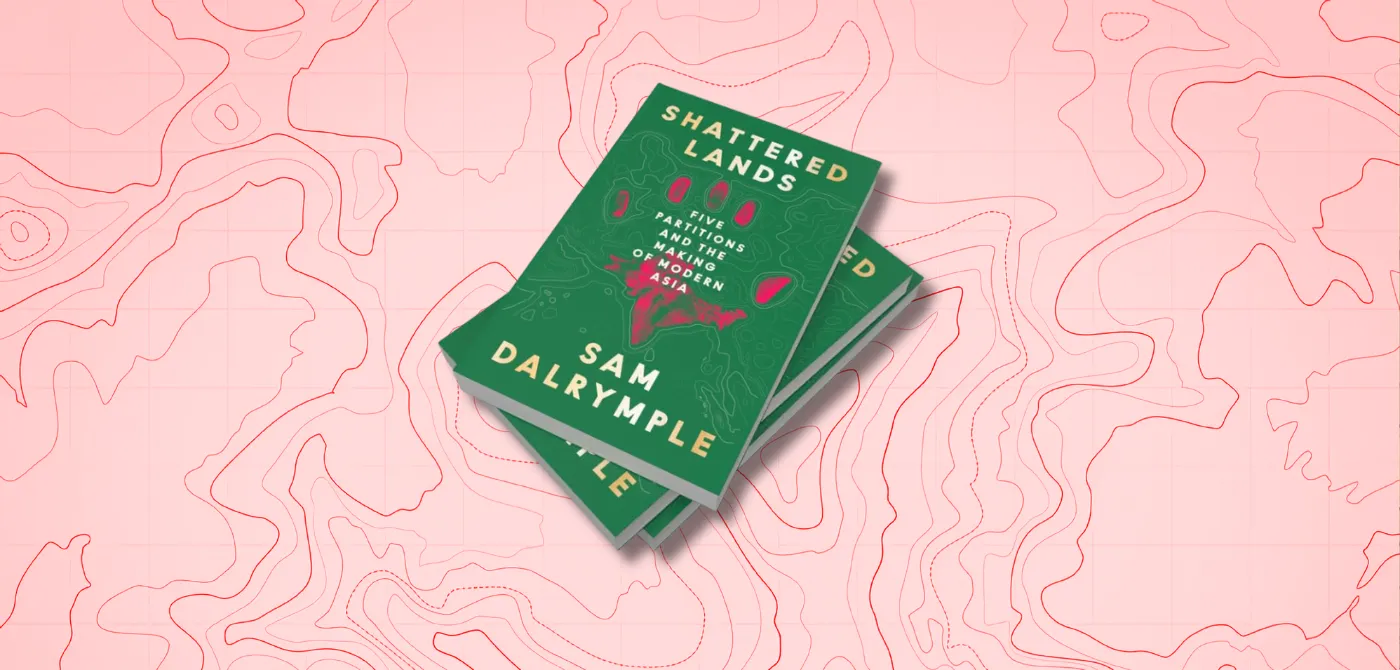



Shattered Lands is the debut book of Sam Dalrymple, a remarkably accomplished historian and filmmaker who is only 29 years old, and it is an impressive achievement. Coverage in Indian newspapers and journals has, unfortunately, been surprisingly limited. Brief notices have appeared in Scroll, The Week, Hindustan Times, and The Telegraph, while international publications have devoted far more in depth attention to the book.
The narrative traces this disintegration year by year, beginning in 1928 the last year the “Indian Empire” still existed in anything like its undivided form, and extending to the emergence of Bangladesh in 1971.
It is hard not to wonder whether this disparity has something to do with the colour of the author’s skin, and not with the work’s merits. A similar pattern marked the reception of Perry Anderson’s sharp critique, The Indian Ideology (Three Essays Collective, 2012), which received very little notice from Indian reviewers. Professional historians also seem to have ignored Shattered Lands completely. Perhaps this is our way of paying back the colonialists in their own coin, but the book is, after all, about our history.
What makes Shattered Lands distinctive is its rarity—it is a substantial, densely researched work of history that unfolds with the pace and narrative drive of a novel. At 540 pages in hardcover, it is difficult to put aside once you begin reading.
For me, much of the book’s pull came from confronting gaps in my knowledge about the true scope of “India” before 1947. In the 1920s and 1930s, the entity called India was not simply the present-day Republic of India plus Pakistan and Bangladesh. It also included Burma (now Myanmar), Nepal, Bhutan, Aden (in what is now Yemen), and virtually every sheikhdom along the Persian Gulf, from Oman to Kuwait.
People living in these territories used Indian rupees as their currency, carried passports labelled “Indian”, and fell, at least nominally, under the protection of the Indian Army. Then, over roughly half a century, from around 1925 to 1975, one of history’s largest empires fragmented into more than a dozen sovereign states. Throughout the book, Dalrymple emphasises that these divisions, and the borders that followed, were deliberate constructions rather than inevitable or natural features of the landscape.
The narrative traces this disintegration year by year, beginning in 1928 the last year the “Indian Empire” still existed in anything like its undivided form, and extending to the emergence of Bangladesh in 1971. Guiding readers through the upheavals of the 1947 Partition, the annexation of Hyderabad in 1948, and the wars of 1962, 1965, and 1971, while still maintaining momentum and clarity, is an impressive accomplishment.
Along the way, Dalrymple quietly dismantles several entrenched assumptions. I knew that Burma was separated from India in 1937. I was also aware of the close links between Burma and Telugu‑speaking regions, particularly the thousands of families—many of them Dalit—who migrated there in search of opportunity and later returned to Andhra, helping to spark new social awareness. What I had not realised was that pressure for separation also came from Hindu nationalist circles and even some Gandhian ones, which argued that Burma lay outside the sacred boundaries of “Bharat”.
There was, however, opposition within Burma itself. Candidates opposed to separation won a resounding victory in the 1932 Legislative Council elections (a body that Dalrymple mistakenly calls the Legislative Assembly). The Government of Burma Act of 1935 then took effect, formalising the separation on 1 April 1937.
Dalrymple provides ample detail on Partition era violence across regions and remains measured in his judgments, though he sharply criticises the British for their inadequate planning and for washing their hands of the chaos that followed.
Indians in Burma faced widespread resentment, much like Indian communities in parts of Africa. Dalrymple quotes a Burmese headmaster who complains: “The Indians have taken away all government jobs from us … The Chettis are buying our land and houses, the Bengali Muslims have occupied all navigational jobs. The foreigners are now … everywhere in the country and we are now fast becoming extinct.”
Tensions erupted into anti‑Indian riots across major cities. These riots claimed hundreds of lives, injured thousands, and destroyed property worth nearly Rs. 24 lakh. As World War II intensified and Japanese forces advanced, the situation became disastrous for Indians. Around 600,000 of them—Tamils, Telugus, and others—were expelled in what amounted to an ethnic cleansing, and 80,000 perished during the gruelling overland trek back to India.
The evacuation process was starkly discriminatory. Airplane seats and ship berths were reserved for Europeans and Anglo‑Indians, while wealthy Indians bribed their way aboard. Everyone else had to walk. Those who stayed behind often met violent deaths, and the killings only halted after the Japanese occupation in 1942.
Dalrymple provides ample detail on Partition era violence across regions and remains measured in his judgments, though he sharply criticises the British for their inadequate planning and for washing their hands of the chaos that followed. Much of this material comes from eyewitness testimonies, probably gathered through his involvement in Project Dastaan, a peace‑building initiative that uses digital tools to reconnect refugees displaced by Partition with their ancestral homes.
As he notes, “Seventy‑five years on, it is common to think of the Great Partition of India and Pakistan as causing the mass violence that would soon become associated with its name. But in June 1947, Partition was seen as a way to stop the violence. ‘We were tired men and we were getting on in years,’ Jawaharlal Nehru later admitted. ‘The plan for Partition offered a way out and we took it’.”
Elsewhere, roughly one fifth of the Naga population found themselves on the Burmese side of an arbitrarily imposed border. Sikkim and Bhutan remained independent, but Nagaland joined the Indian Union despite its tradition of tribal self‑governance without centralised kings. Naga leader Zapu Phizo rallied his people in one of modern India’s most sustained rebellions. When Nehru and Burmese premier U Nu visited the Naga Hills in 1953 for a public address, locals simply walked away, some baring their bottoms in defiance.
The Indian state later crushed the uprising with extreme force—often more harshly than the British had—by imposing the Armed Forces (Special Powers) Act in 1958, which remains in force today. As Phizo’s family reflected, “The Naga revolt against India was due to the accident of geography whereby an ethnic community was slashed into various bits by artificial frontier lines.”
V.P. Menon’s rebellious youth did not make him any less obdurate when dealing with recalcitrant maharajahs and minor princes. He was the iron hand of the iron man Vallabhbhai Patel.
The book is filled with vivid, memorable episodes that break through the historical narrative and hold the reader’s attention. One example: what pushed Jawaharlal Nehru decisively toward politics in 1919? Travelling by train from Amritsar to Delhi, he overheard General Reginald Dyer boasting in a nearby berth that he had wanted to raze Amritsar to ashes but had shown mercy by holding back. The raw cruelty of imperial rule crystallised for the young Nehru in that moment.
Another example: in 1939, Phizo arrived to enlist in the British Army and was asked to choose Indian or Burmese nationality, since Burma’s separation had split Naga lands. He stormed out, insisting he was “a Naga first, a Naga second, and a Naga last”—a declaration that foreshadowed his leadership in the post‑Independence insurgency.
Fans of Saadat Hasan Manto will recognise the tale of him carrying two caps—one Muslim, one Hindu—to switch as he moved through Lahore’s divided neighbourhoods. “Previously religion used to be in one’s heart,” he observed; now it demanded outward display. To the cries of “Long Live Pakistan” and “Long Live India”, he replied with his own slogan: “Long Live Caps”.
Vappala Pangunni Menon, as Secretary of the Ministry of States, was instrumental both in Partition and in the integration of the princely states. His early life was rebellious—he fled home after setting his school ablaze in Malabar Hills and spent five years as an indentured gold miner, with a steel ring clamped on his arm. His rebellious youth did not make him any less obdurate when dealing with recalcitrant maharajahs and minor princes. He was the iron hand of the iron man Vallabhbhai Patel.
Mohammed Ali Jinnah’s premature death in 1948 ended the Nizam of Hyderabad’s hopes of using him to secure Hyderabad’s independence. It later emerged that Jinnah had battled severe lung cancer and tuberculosis for years. Lord Mountbatten would write that if he had known “the seriousness of … Jinnah’s illness, he might have delayed independence and there may have been no partition”. History, it seems, often turns on such contingencies.
Hyderabad’s fall in 1948 reverberated across the Arab Gulf, where many Hadhrami and Hyderabadi traders identified as Indian. For nearly two centuries, the Qu’aiti state—the third largest on the Arabian Peninsula—had effectively been governed from Hyderabad. By 1967, that state and 19 others had disappeared, replaced by South Yemen. Indian and Pakistani residents were exiled or forced to hide their origins, in an echo of the fate of Hyderabad’s Muslims after the Indian “police action” and annexation in 1948.
While school textbooks fixate on the Radcliffe Line, Dalrymple directs our attention to lines first sketched in London offices, Rangoon camps, Muscat courts, and Naga villages.
The Rohingya appear not as a marginal group in Myanmar’s history but as a community with deep, centuries long connections to Chittagong and Bengal. In 1942, violence displaced between 20,000 and 100,000 Rohingya. By the 1950s, they had launched the first armed challenge to the Partition borders, seeking union with East Pakistan. Burmese authorities consistently treated them as outsiders who belonged in Bengal. The border itself was the core problem; yet once drawn, it became immovable.
The 1971 break‑up of West and East Pakistan, which created Bangladesh, receives detailed treatment. Drawing heavily on Anam Zakaria’s excellent book 1971: A People’s History from Bangladesh, Pakistan and India (Penguin Random House India, 2019) and on other accounts, Dalrymple evokes a mix of shared dreams, cultural and linguistic divides, misunderstandings, and horrific violence—rape, slaughter, and chaos.
He places the birth of Bangladesh in its Cold War setting, with the Soviet Union, the United States of America, and the People’s Republic of China all manoeuvring. He quotes Richard Nixon telling Henry Kissinger, “It’s better not to have Pakistan come apart…. And of course, the Bengalis have been extremely difficult to govern throughout their history.” As Tariq Ali put it, “Jinnah’s Pakistan died on March 26, 1971 with East Pakistan drowned in blood.”
Dalrymple does not merely recount these events; he immerses the reader in them. Some readers may question his occasional nostalgic nods to the princely states—his maharajahs often appear as cultured patrons and guardians of wildlife—and his severe view of Subhas Chandra Bose, which can seem uncharitable. But these are small quibbles.
What endures is the scholarship. I rarely chase endnotes, yet here I kept turning to more than 52 dense pages of them. Together they form a rich archive of unpublished diaries, multilingual memoirs (in English, Hindi, Urdu, Bengali, Punjabi, Konyak, Arabic, and Burmese), private correspondence, and, for 1971, the author’s own interviews. Custom drawn maps clarify borders that have long since vanished.
Ultimately, Dalrymple compels us to see the map of South Asia as it truly is—a modern, contingent, and often violent creation. While school textbooks fixate on the Radcliffe Line, he directs our attention to lines first sketched in London offices, Rangoon camps, Muscat courts, and Naga villages. Borders arise from power; they can also erode under the pressure of defiance, grief, and time.
This is vital, urgent history, written with the intensity of someone who understands how quickly we forget that, not long ago, much of this was one realm.
This is vital, urgent history, written with the intensity of someone who understands how quickly we forget that, not long ago, much of this was one realm. Across South Asia, governments in every country have systematically minimised or erased the deep historical and cultural connections that once linked communities across what are now rigid frontiers, connections that long predate today’s states. The motive is straightforward—the insurgencies and uprisings of the post‑colonial era showed that cross‑border loyalties could undermine national control, turning those who felt them into inherent risks in the eyes of the state.
Remarkably, the dominant national identities we now take for granted—strict and often exclusionary—mostly crystallised only after the 1930s, rather than flowing from timeless origins. Today, questions of citizenship, inclusion, and belonging remain deeply contested across the region.
No comprehensive truth and reconciliation process has ever addressed the lasting traumas carried by roughly one fifth of the world’s population, whose daily lives still bear the imprint of these vast upheavals. The divisions are deepening further.
Politicians continue to fan these flames for their own gain, as nuclear‑armed India and Pakistan repeatedly edge towards full‑scale conflict. In Myanmar, the military’s campaign against the Rohingya continues without let up. Meanwhile, India is moving ahead with plans to fence its largely open border with Myanmar, one of the region’s last such frontiers.
Gita Ramaswamy is an activist, writer, and publisher.