




When they attain a certain age, many Indian policymakers, academics, and bureaucrats develop an urge to write a book describing India’s development transformation. These include hagiographic or polemical works by technocrats-turned-politicians, tired retreads of free market economists, and bitter indictments of Indian policymaking by academics whose professional lifetimes have long passed their sell by date, and policy manuals or “roadmaps” to “unshackle” India by rising and retired policy wonks.
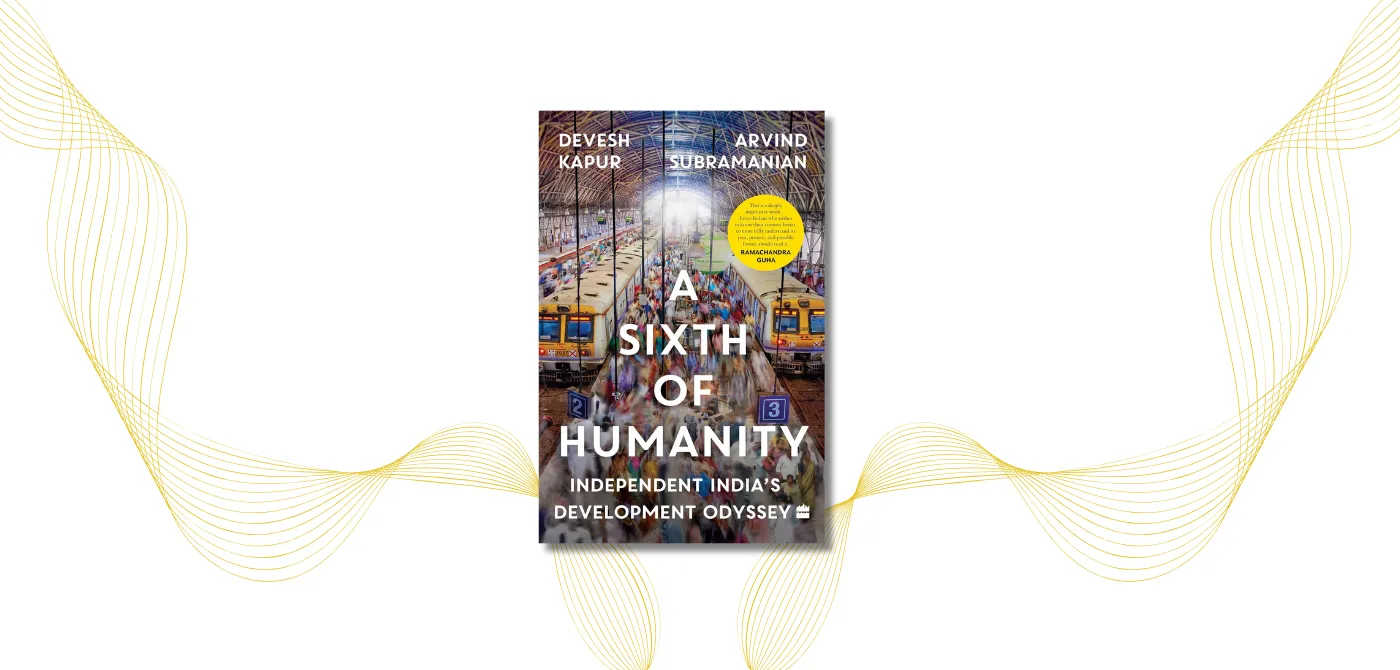
“A Sixth of Humanity” is co-authored by the same professional demographic but, mercifully, does not fall within any of these categories. It is an interdisciplinary venture between Devesh Kapur, a political scientist who has written perceptively and authoritatively about the practicalities of the administrative and institutional processes that have underpinned India’s development journey, and Arvind Subramanian, a policy economist with a distinguished international career, and a stint as Chief Economic Advisor in the Ministry of Finance.
This book is not a work in political economy like Pranab Bardhan’s masterpiece of compression “The Political Economy of Development in India” (Bardhan, 1984). Nor is it a history of the course of post-Independence development in India. That is yet to be written. This book provides what is perhaps an intermediate step to that history, which is a political and economic geography of India’s development journey since Independence.
The methodology is a mix of cross-country empirics of the sort favoured by the International Monetary Fund and the World Bank, and the framing of stylised facts using administrative and economic data. It is an empirical work with no a priori theoretical or analytical postulates. It escapes being empiricist only because the narratives that the authors posit are grounded in political and economic propositions that have everyday acceptance, even if not universal concurrence.
Precociousness
For instance, the book, very early on, takes as a given the idea that economic development must precede sophisticated political and social progress. They proceed to argue that India did not follow this path, and do so by correlating per capita incomes and the attainment of universal adult franchise, terming India a “universal franchise outlier”. The counterfactual—whether an alternative was possible for a democracy established in 1950 as opposed to a hundred or more years before that date—is not discussed. There is no need to do so as the core proposition— economic prosperity before democratic progress—is already a respectable given, and all that is required is some empirical work to show that India was “precocious” in this respect.
The identifying of several “precocities” is a central endeavour of this book. India is not just a politically precocious democracy which dares to universalise voting before attaining a respectable per capita income. It also precociously did not complete the laid down sequence of economic transition—first from agriculture to manufacturing, and then from manufacturing to services. Again, this is a well-accepted (if not universally accepted) proposition in both economics and development studies. So the empirical work that goes on to validate the postulating of this precocity—cros- country comparisons of similar development journeys of three other Asian countries—would be accepted without quibble as affirming evidence.
The identifying of several “precocities” is a central endeavour of this book.
The question, of course, is why. Here the authors are on a somewhat weaker wicket unless they have ideological priors that they do not reveal. An important reason why the share of agriculture in GDP remained high (other than the fact that GDP growth, itself, was sluggish) was that India, since the late 1960s, was undertaking a stupendous transition, from a food importing, food scarce nation to a food surplus country. Here it was access rather than availability that was the binding constraint to alleviating hunger and starvation. This had little to do with the lack of development of formal manufacturing. The green revolution was marked by an increase in agricultural productivity not the increased application of inputs, so the stickiness of agriculture’s share in GDP was not a driver inhibiting the release of surplus labour for manufacturing. Nor was there any trade-off between the growth of manufacturing and the precocious growth in the share of high skilled services. But posited as a structural precocity, these analytical questions do not arise. They cannot. As the Mercator projection illustrates, geography defines analytical terrain and is therefore not neutral simply because it is empirically descriptive.
Each of the precocities in the book is defined using the same strategy. Thus, the State precociously invests in the public sector “before” investing in public infrastructure. But if the task was to transform a feudal economy into one that was capable of both defining its existence and protecting its sovereign independence—so avoiding the fate of Manchu China or several South American countries—then the imperative would be to quickly acquire the necessary materiel de guerre and place it at the disposal of the State. For this, it would make sense to develop industries that would foster a military-industrial complex and develop high-end skills in a relatively small cohort to administer that complex, rather than pursue the “traditional” development aims that are accepted without question as the objectives of national transformation today.
This process, which Toye (1976) terms “mimetic nationalism”, has in fact been an objective of development in many emerging economies from Ataturk’s Turkey to Mao’s China. It is therefore that the first significant mentions of poverty and inequality in Indian government discourse come only in the 1970s after three wars and successful resistance to attempts to get India to come to heel within the then extant international balance of power.
The Surprises
Moving on from the precocities, the authors identify a number of “surprises.” Many of these are plausible and interesting. The most striking and innovative for this reviewer were:
1. The per capita income of an Indian (or Pakistani) who emigrated to the USA in 2022 jumped by 30 times as opposed to less than 5 times for a Brazilian or Cuban. This is because the per capita income of India and Pakistan was very low, but also because the per capita income of high skilled immigrants at home was much lower than what they got when emigrating to a rich country. Conversely, India’s ability in 2018 to export things that absorbed low-skilled labour was much lower than most other countries. Thus, India was not utilising its relatively abundant low skilled capital but exporting its scarce human capital!
2. India was pretty good at avoiding death by crime. Criminal fatalities as a percentage of population were the lowest in the world in India. Much lower than China or Vietnam. Yet the number of people in jail without trial rose from 30%(of the total number jailed) in 1961 to a scary 76%in 2022, meaning most people in jail in India were not convicted of any crime
3. Since 1980 one third of India—the southern and western states—have grown as fast as China. India’s growth has been dragged down by the (majority) North and East
But there are other surprises which arise as a result of conclusions drawn from selectively presented data.
For example, the authors show that India has a higher fiscal deficit/GDP ratio than Brazil or Turkey in most years between 1991 and 2022. But they do not point out that India’s revenue-GDP ratio is also much lower than these countries, so the size of the Indian state (measured by total expenditure as % of GDP) is actually smaller than in both these countries. The authors report the latter for India but do not present a cross-country comparison. In addition, India’s fiscal deficit is entirely internally financed unlike the other countries compared.
These three facts taken together would counter the authors contention that the “Kamadhenu” Indian fiscal state speaking comparatively validated and accommodated every manner of vested interest. Note I am not contesting the conclusion but merely the deployment of data on which this premise is based. I have myself argued that the Indian state has transformed in its political fiscal journey from being a development to a compensatory State (Roy, 2019).
I am also puzzled by the authors’ harsh treatment of the state governments. Their contention that “whatever the Central government did badly the States do worse” is a very Delhi-centric one. States have implemented mid-day meal schemes, fostered flagship private universities, efficiently targeted subsidies and collectively displayed much better fiscal discipline than the central government. The point about the small size of local (panchayat and urban municipal) government is well taken but I would have expected at least the political scientist to offer an analytical explanation for why this is so. There are several attempts to explain this which have been ignored (see, for example, Roy and Raja 2026).
Caste and Inequality Missing
I expected an interdisciplinary collaborative effort to address two questions that attract much attention in contemporary Indian public policy debates—caste, and inequality—of consumption, income and assets. But these do not even find a pace in the book’s index! Caste is dismissed by curiously stating (and reinforced in book launches where this question was raised) that (1) things are not as bad as they used to be (and that public employment of Scheduled Castes and Tribes has risen across the board in the public sector) and (2) focusing on caste obfuscates gender discrimination. I am not persuaded by either statement. In a development transformation, affirmative action continuing to result, after 70 years, in 5 per cent of the population dominating 80 plus per cent of positions in the government, military, academia, the media and the private sector surely deserves more attention. This is a dominance by a hereditary exclusionary social group that beats anything comparable in contemporary times including apartheid.
Even the bread and butter methodology of the book—cross-country comparisons—is not invoked to assess the comparative evolution of these inequalities...
Even if the inquiry is not about annihilating caste, it would have been interesting to see how the reproduction of caste inequalities, oppressive extraction by newly dominant caste groups, and the re-affirmation of caste identities in urban spaces impacted some of the precocities ( e.g. the rise of high skilled services before manufacturing), surprises (e.g. the lack of attention to mass quality school reduction), and trends (e.g. the “Kamadhenu” state and “mai baap” government). I also see no trade-off between policy attention to gender on the one side and caste and ethnic phenomena on the other. It is puzzling that the authors seem to think there is one.
The question of income, asset and consumption inequality receives cursory treatment. Even the bread and butter methodology of the book—cross-country comparisons—is not invoked to assess the comparative evolution of these inequalities in India over time and space, and to investigate whether there is any intersect between the sharp rise in these inequalities across the lifetime of the authors and the precocities and surprises they identify.
Thought-Provoking Read
This reviewer’s critical analysis required a careful reading of this book. When done, I felt this was intellectually time well spent. The great merit of this joint effort is that it is refreshingly free of rhetorical polemic, unsolicited preaching, or disciplinary narrowness that afflicts most other recent attempts to talk about the complex canvas of India's development transformation. It does not attempt to prophesy or provide prescriptive solutions for the future based on a narrow technocratic reading of what is to be done, based on silly revivalist propositioning, or appeal to long-discredited political ideologies.
The book is written for the curious and the critical, and presents points of comment and departure on a canvas that describes the inheritance that Indias development journey offers to what is, today, the largest number of young citizens that this country will ever see. For the rest of us, it offers an opportunity to reflect on the development history of our times. Therefore, for those of us who care about these things, it is an interesting and thought-provoking read.
Rathin Roy is a political economist. When being technocratic he specialises in macroeconomics and public finance.