




I am writing this review the day the results of Bihar election have started coming in, indicating a resounding triumph for the Bharatiya Janata Party (BJP) in alliance with a regional party, the Janata Dal (United) (JD[U]), defeating its challenger, a coalition of the Rashtriya Janata Dal (RJD), the Congress, and the Left Front parties. In its political ideology and direction, the BJP has never shied away from its determination to dominate every state, cannibalising every regional formation, and imposing an ideological uniformity over the Indian nation-state. It has done this by riding on Hindutva majoritarianism, which weaponises Hinduism against Islam and every pluralist tradition of the country.
Instead of a seamless, singular identity, the book celebrates the many ideas of unity that shine through the imaginings of India’s regions, as seen in its myriad mother tongues.
Over little more than a decade, Prime Minister Narendra Modi has been projected not just as the leader of the union government, but as Hindu-hriday-samrat, the king of the Hindu hearts. In carrying a Sengol from Tamil Nadu, inaugurating the Ram temple on the site of a demolished monument in Ayodhya, and placing himself at the centre of a choreographed opening ceremony of the new parliament house surrounded by the seers, he has doubtless found great success in attaining a monarchical aura. This is despite his party’s unexpected failure to reach the majority mark in the last parliamentary election, and the limited footprint of the party outside the Hindi heartland and Gujarat.
Cultural Plurality of People of India
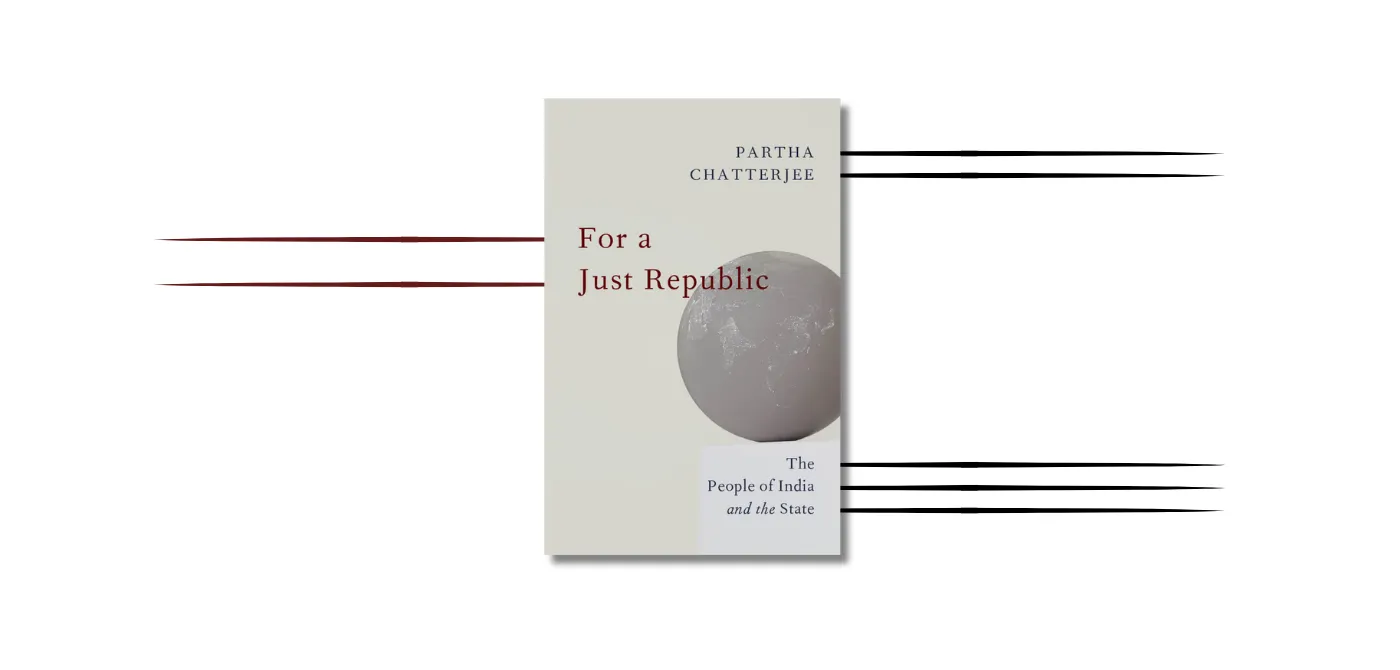
Against this backdrop, For a Just Republic offers a historically grounded and theoretically incisive analysis that interrogates, deciphers, and contextualises India’s contemporary political moment. Drawing on a magisterial command of empirical detail and almost all relevant scholarship, the book not only illuminates the present impasse, but also, perhaps, intimates a subtle direction for democratic renewal.
Spread well over 400 pages, the book is divided into two parts: the nation-state and the people-nation. These two concepts, which first found expression in Chatterjee’s I am the People: Reflections on Popular Sovereignty Today (Columbia University Press, 2019), are the two arms of its theoretical arc that holds a third major idea: “a relativist view of the Indian nation”. Together, the three potentially upend not just the unitary vision of Hindu nationalism but also destabilise the mainstream version of secular nationalism, which discovers the “idea of India” in its “unity in diversity”.
Instead of a singular identity, the book celebrates the many ideas of unity that shine through the imaginings of India’s regions, as seen in its myriad mother tongues. When viewed from the vantage of the regions and the world of the vernacular, the notion of a seamless nation-state, born of an unbroken civilisational unity, begins to crack. In its place appears a collage of cultural traditions, held together by a delicate balance of negotiations and negations, differences and accommodations. At its heart is the people’s cultural plurality, which envelops and sustains this unity. This book tells the story of power from the standpoint of the people.
The ’People-Nation’
Indian independence emerges in this account as a carefully negotiated transfer of power that retained many imperial structures of governance. The Constituent Assembly’s work, while often invoking the “people” and rarely the “nation”, entrenched state structures that reified the administrative and territorial logic of British India. This overlooked the lived multiplicity of its citizens.
The “people-nation” is a plural, contested, and inherently relative formation—radically different from the centralised, juridical notion of the nation-state.
Drawing extensively from the Constituent Assembly’s debates, the book presents the most influential voices as those of realist strategists. These figures prioritised administrative functionality over participatory democracy, and viewed “constitutional morality” as an elite virtue with pedagogic potential rather than as a mass disposition. According to this perspective, the Indian state preceded the nation, both historically and conceptually. It emerged as a continuation of the colonial administrative apparatus: centralised and hierarchical. This claim overturns conventional assumptions that invoke Indian nationhood as a culmination of civilisational virtues stretching back to ancient times.
The project of nationalism in India has mostly drawn upon the colonial legacy of centralisation and privileged English as the language of administration, higher education, and elite political discourse. In contrast, the “people-nation” has evolved through vernacular print cultures, devotional and sectarian movements, caste-based histories, and localised struggles—none of which are adequately captured in the narrative of a singular nation.
Drawing from a range of literary, performative, and historiographical sources, the book shows how the “people-nation” is imagined differently in various linguistic and cultural contexts. These include the militant masculinity of Maharashtra’s Shivaji, the mother-goddess imagery of Bengal, the anti-Brahmin rationalism of Tamil Nadu, the fractured linguistic politics of Punjab, and the Sanskritised Hindi nationalism of the United Provinces.
This kaleidoscopic view reveals that the Indian nation-state does not mark a moment of arrival. It is not a homogenous unity of diverse imaginations, but rather a site of different and competing vernacular imaginations. These imaginations seek recognition and equality as the precondition for a just republic.
The “people-nation” is a plural, contested, and inherently relative formation—radically different from the centralised, juridical notion of the nation-state. The book examines Indian federalism not simply as a constitutional arrangement, but as a political response to the many imaginations of nationhood that resonate with a relativist view of the nation.
The author argues convincingly that the history of the state and the history of the people have diverged, and continue to do so. From this divergence emerges a relativist view: “India” is not a fixed object with a single cultural meaning. Rather, the Indian nation appears differently from the vantage point of each major regional-linguistic formation—Tamil, Telugu, Marathi, Bengali, Punjabi, Assamese, and others. There is no neutral, transcendental standpoint from which an invariant Indian national identity can be constructed. In this sense, the Indian nation is necessarily plural, perspectival, and relational.
Dominance without Hegemony
Having framed the constitutional debate, the book shifts focus to India’s liberal governmentality. This governmentality frequently deviates from strict laws to accommodate the democratic demands of different population groups spread over diverse regions.
Despite its authoritarian brinkmanship, the regime’s heady mix of crony capitalism and Hindutva-based citizenship laws conceals major vulnerabilities.
Governmental techniques in post-colonial India carry traces of both pre-colonial and colonial rules. These are embodied in the normative idioms of the dharma texts, the instrumental use of danda from the artha texts, and the selective application of the “pastoral” care found in European liberal techniques.
Together, these elements produced a unique blend of “dominance without hegemony”, to paraphrase historian Ranajit Guha. In this blend, dominance also carries an element of hegemony, allowing for the accommodation of differences and exceptions. Such strategic flexibility enabled India to maintain unity despite popular demands for linguistic states, while authoritarian rigidity led to the break-up of Pakistan when it attempted to impose Urdu on the Bengali-speaking people in the east.
While the streak of danda in the people’s imagination may prompt them to seek quick redemption from poverty and deprivation by turning to an elected autocrat, any unitary excess—such as forcing Hindi upon non-Hindi speakers—is likely to wreck the country’s delicately crafted unity.
Despite its authoritarian brinkmanship, the present regime’s heady mix of crony capitalism and Hindutva-based citizenship laws conceals major vulnerabilities. From the economy’s dirigiste phase to the pro-business turn, Indian policymakers tried to combine the competing demands of powerful classes within a coalition of interests, aiming to maintain a certain passivity in the country’s capitalist transformation. These adjustments were primarily political and arose from capital’s lack of hegemony among all social classes.
Now, this balance stands at risk due to the acute concentration of wealth at the top and the shrinking of the middle classes, dangerously stretching the bottom of the pyramid.
Erosion of Inclusive Framework
Under Modi, despite the fusion of centralised authority, targeted cash transfers, subsidised delivery of food and utilities, aggressive Hindutva rhetoric, and leadership charisma, the regime of capitalist accumulation remains fragile. It remains susceptible to the demands of global capital, domestic negotiations, and popular resistance. Far from being autonomous, India’s capitalism continues to depend on political management—making the present regime’s reckless proximity with a few business houses risky.
The tension between these principles is frequently managed by political leadership, connecting the messy world of popular movements with the pristine world of the juridical state.
Similar gaps have now been created in the country’s citizenship laws. The Constituent Assembly settled for Anglo-American jus soli (right of the soil) instead of Continental jus sanguinis (right of blood), and did so for a reason. Vallabhbhai Patel’s articulation of a democratic yet minimalist vision—that anyone born or naturalised in the Union under its laws would be a citizen—was sensitive to the requirements of a republic born under the shadow of mass migration and Partition.
However, this inclusive foundation has been eroded by successive governments. The last nail in the coffin for jus soli was struck by the 2019 Citizenship Amendment Act, which made religion the principal criterion for naturalisation of immigrants from neighbouring countries. Chatterjee graphically shows the vulnerability of such laws in a country where borders—artificially drawn by the Radcliffe Line—are blurred, and where the idea of stable, unmarked citizenship is hopelessly unattainable.
Nothing illustrates this better than the fiasco of the National Register of Citizens (NRC) in Assam, meant to target Muslims but ultimately excluding roughly 500,000 Bengali Hindus. The current agitation of the Matuas in West Bengal, whom Home Minister Amit Shah desperately tried to persuade by urging, “Aap chronology samajhiye!” adds to this.
Test to Human Dignity
India’s plurality and diversity make it difficult, if not impossible, for any rigid, disciplinary policy to be accepted as just. Chatterjee argues that any universalist principle of justice—liberal or illiberal—faces roadblocks. He prefers a blending of Jeremy Bentham’s utilitarianism and Amartya Sen’s capability approach, extending them to India’s post-colonial conditions. Here, equality before the law co-exists with demands for legal exceptions that deliver tangible benefits to the marginalised; democracy’s procedural fairness overlaps with demands for authoritarian arbitrariness that promises swift justice.
… [T]here is a need to foster region-specific struggles against all forms of socio-economic dominance.
The tension between these principles is frequently managed by political leadership, connecting the messy world of popular movements with the pristine world of the juridical state. This makes justice appear attainable within a collective, contingent, and evolving framework, rather than one that is perfect or absolute. Against the threat of authoritarian excess, the real test lies in how well shared human dignity is upheld, amid deep economic inequality, social hierarchy, and cultural diversity.
Evidently, the most resolute attack of authoritarianism is on minority rights. B.R. Ambedkar defined minorities not simply by numbers, but by their socio-economic vulnerability in the face of majority domination. He argued that minorities must collectively counter this domination to achieve autonomy and self-representation.
The fight for genuine equality, then, requires strong constitutional safeguards—such as reserved seats or separate electorates chosen by minorities themselves—in addition to state action to abolish untouchability and other oppressive practices. For Ambedkar, economic democracy was essential to abolish class exploitation intertwined with caste, making political power, rather than slow reform, the real key to emancipation.
Coalition beyond Caste and Religious Identitites
Chatterjee, while taking us through Ambedkar’s thesis on minority rights, also points to its limits. Formal rights alone are not enough to eliminate caste or class hierarchies. Instead, there is a need to foster region-specific struggles against all forms of socio-economic dominance. The goal is to protect the dignity and rights of minorities through empathy, self-rule, and shared prosperity.
Chatterjee’s book reminds us that justice in India will never descend from the summit of a centralised state; it must be made and remade in the tumult of popular vernacular worlds that refuse to be erased.
The push must be for broadening the base—for forming a larger coalition of minorities that goes beyond narrow caste or religious identities. Recent elections in several north Indian states show that if minority mobilisation focuses exclusively on reservations or representation—without wider reforms or redistribution—it becomes vulnerable to divisive appropriation by Hindutva forces.
While celebrating vernacular plurality has many virtues, regional excesses remain common in India. Movements for linguistic and cultural autonomy have, more than once, devolved into chauvinistic assaults on marginal and minority groups within a state. The targeting of Bengalis in Assam, Biharis in Maharashtra, and Gorkhas in West Bengal are illustrative examples.
A relativist understanding of the Indian nation must therefore remain vigilant against the dangers of ethno-nationalist relativism. Such forms replace inter-group solidarities grounded in dignity and equality with inward-looking cohesion, sustained by spurious claims to supremacy and exclusivity. Even federalism has sometimes served as a pretext for states like Uttar Pradesh, Madhya Pradesh, Gujarat, Haryana, and Karnataka to enact anti-labour ordinances—suspending industrial welfare provisions, diluting dispute-resolution mechanisms, extending working hours to 12, and curtailing union rights.
Meanwhile, it remains uncertain how the poor and minority communities of the Hindi heartland, who contend daily with forms of “bulldozer justice”, can reclaim the democratic space for negotiation that once characterised political society. Moreover, the ideology of unitary nationalism repeatedly recalibrates its demands to suit the electoral pitch: it selectively co-opts ati-Dalits (the most oppressed among Dalits), extends calculated overtures to Christian communities, and even normalises food practices that openly contradict the very principles it claims to uphold.
Tumult of the Popular Vernacular
In the end, For a Just Republic insists that India’s future cannot be secured by the authority of a single leader, the power of a single party, or the myth of a single nation. Instead, it lies in the unresolved and ever-alive creative friction between India’s many peoples, languages, and histories. If a single leader or party could resolve all problems from the top, demonetisation would have killed corruption, farmers would have eagerly accepted the new agricultural laws, and the National Register of Citizens would have been immediately implemented across the country.
Chatterjee’s book reminds us that justice in India will never descend from the summit of a centralised state; it must be made and remade in the tumult of popular vernacular worlds that refuse to be erased.
At a moment when authoritarian certainty masquerades as national destiny, Hindutva majoritarianism casts a political shadow far greater than its share of popular support. This dominance is aided by a compliant media, weak opposition, an intriguing Election Commission, and unlimited resources. Against this backdrop, Chatterjee’s work shows that India’s destiny has always belonged to its plural, disputatious, and self-respecting “people-nation”. The real battle for the republic, it argues, has only just begun.
Dwaipayan Bhattacharyya is Professor, Centre for Political Studies, Jawaharlal Nehru University.