






1. Introduction
One of the challenges India faces today is the pace of urbanisation. Between 2001 and 2011, India’s urbanisation rate increased from 27.8% to 31.2%. The pace of urbanisation is to continue and the rate of urbanisation is projected to increase to 39.2% in 2036 (MoHFW 2019)—increasing the urban population from 380 million in 2011 to 597 million in 2036.
Over the past decade, municipal bonds have emerged as a vital tool for expanding urban revenue streams, and financing infrastructure in countries such as South Africa, the United States, and Russia.
To cater to the needs of the growing urban population, infrastructure and basic services such as solid waste management, sanitation, transport, water supply, and the like need to be expanded significantly. The investment required to meet this challenge is huge because traditional sources of finance in the form of grants from the union and state governments and existing own sources of revenues are not adequate (Gupta et al. 2025, Athar et al. 2022). 1Athar et al. (2022) estimate that India will require $840 billion (Rs.68.9 trillion; $1 = Rs.82), or 1.18 % of projected gross domestic product (GDP), in capital investment for urban infrastructure and municipal services over FY 2022-36—an average of $56 billion (Rs.4.59 trillion) annually. In contrast, between 2011 and 2018, average annual investment was $10.6 billion (Rs.0.85 trillion; 0.6 % of GDP), indicating the steep gap between needs and current spending.
There is, therefore, a need to explore new and innovative ways to raise resources for financing the infrastructure gap in Indian cities. One such option is municipal bonds. Municipal bonds are debt instruments issued by local governments to raise money from the capital market for meeting their capital expenditure requirements. They are issued with a promise to repay a fixed principal amount along with the coupon (the interest payable on the bond), which can be paid at fixed intervals, typically semi-annually, or at the end of the tenure.
In effect, municipal bonds are loans from investors to the local governments. Over the past decade, municipal bonds have emerged as a vital tool for expanding urban revenue streams, and financing infrastructure in countries such as South Africa, the United States, and Russia (Samal 2021).
Following the liberalisation policies of the early 1990s, with inadequate infrastructure posing a significant obstacle, the Ministry of Finance set up an expert group on Commercialisation of Infrastructure Projects (known as the Rakesh Mohan Committee) to create a framework for increasing private investment and commercial viability in India’s infrastructure sector.
The expert group highlighted the need to explore developing a municipal bond system. Such a system would support market borrowings that could meet state and urban infrastructure investment requirements. This set the stage for the emergence of a municipal bond market in India, allowing organisations involved in the provision of urban civic services to secure funds through commercial borrowings.
Bengaluru was the first municipal corporation (MC) in India to float municipal bonds in 1997, backed by a state government guarantee. It was followed by Ahmedabad MC in 1998, without a state guarantee. Between the mid-1990s and 2005, there was a healthy growth in bond issuance, with nine MCs raising around Rs 1,200 crore. The average issue size was Rs 130 crore per corporation (RBI 2022) .
Between 1997 and 2015, around Rs 1,747 crore was raised through municipal bonds. However, since 2017, we see a spurt in municipal bond issuances.
After 2005, there was a slowdown in bond issuance. Municipal bond issuance was muted during the 2006–2015 period. The fall in bond activity during this period was attributed to the launch of the Jawaharlal Nehru National Urban Renewal Mission (JnNURM) in 2005. Under the JnNURM, Rs. 1 lakh crore of central government grants were allocated to qualifying MCs (RBI 2022), which was a more attractive option for them compared to the effort of issuing and servicing municipal bonds.
Further, the lull in bond issuance during this period can also be explained by its declining appeal to investors. The demand for taxable municipal bonds declined after 2005 in the face of high levels of taxation and competition from fixed and small-scale deposits in the market. After 2007, non-taxable municipal bonds also lost their sheen with the rise of equity markets and the illiquidity of municipal bonds (Nallathiga 2015). Between 1997 and 2015, around Rs 1,747 crore was raised through municipal bonds (Mehta and Mehta 2026).
However, since 2017, we have seen a spurt in municipal bond issuances. This can be can be attributed to a number of factors.
1. Issue and Listing of Debt Securities by Municipalities) Regulations, 2015: To encourage more municipal bond offerings in India, in July 2015 the Security and Exchange Board of India (SEBI) issued the Securities and Exchange Board of India (Issue and Listing of Debt Securities by Municipalities) Regulations, 2015 (SEBI-ILDS regulations). These regulations laid out the eligibility criteria, disclosure requirements, and listing standards that local governments had to follow to raise capital for urban infrastructure development. Over the years, they have been amended to facilitate bond issuances and to also boost investor participation.
Further, in 2019, the RBI and SEBI permitted foreign portfolio investors (FPIs) to invest in municipal bonds. In 2024, the SEBI reduced the face value of bonds to Rs. 10,000 from Rs. 1 lakh to boost retail participation.
2. Smart Cities Mission: This Centrally-Sponsored Scheme was launched in 2015 and pushed for projects to be funded through private financing and rekindled interest in municipal bonds in public discourse.
3. Government incentive under Atal Mission: Cities or urban local bodies (ULBs) have been encouraged to mobilise resources since 2018-19 by issuing municipal bonds under the Atal Mission for Rejuvenation and Urban Transformation (AMRUT) scheme.
For their first issuance, ULBs were provided an incentive of Rs.13 crore for every Rs.100 crore of bonds issued, with the total incentive not exceeding Rs.26 crore per ULB. For subsequent bond issuances, ULBs can claim the incentive if the bonds fulfil the criteria for green bonds specified by SEBI (they have to be for projects on water supply, sanitation, renewable energy, and urban resilience). An incentive of Rs. 10 crore was provided for every Rs. 100 crore raised, capped at Rs. 20 crore. The incentive for issuance of municipal bonds was continued under the AMRUT 2.0, which was launched in October 2021.
These initiatives resulted in an increase in the number of MCs issuing bonds compared to those between 1997 and 2017. However, both the number of MCs accessing capital markets and the quantum of borrowings through municipal bonds continue to remain small. Since 2017, only Rs. 4,540.34 crore have been raised through 31 issuances by 22 MCs.
2. Recent Bonds Issuances
An examination of bond issuances since 2017 by 22 MCs shows they are limited to seven states—Andhra Pradesh (1 MC), Gujarat (6 MCs), Madhya Pradesh (2 MCs), Maharashtra (3 MCs), Tamil Nadu (4 MCs), Telangana (1 MC), and Uttar Pradesh (5 MCs).
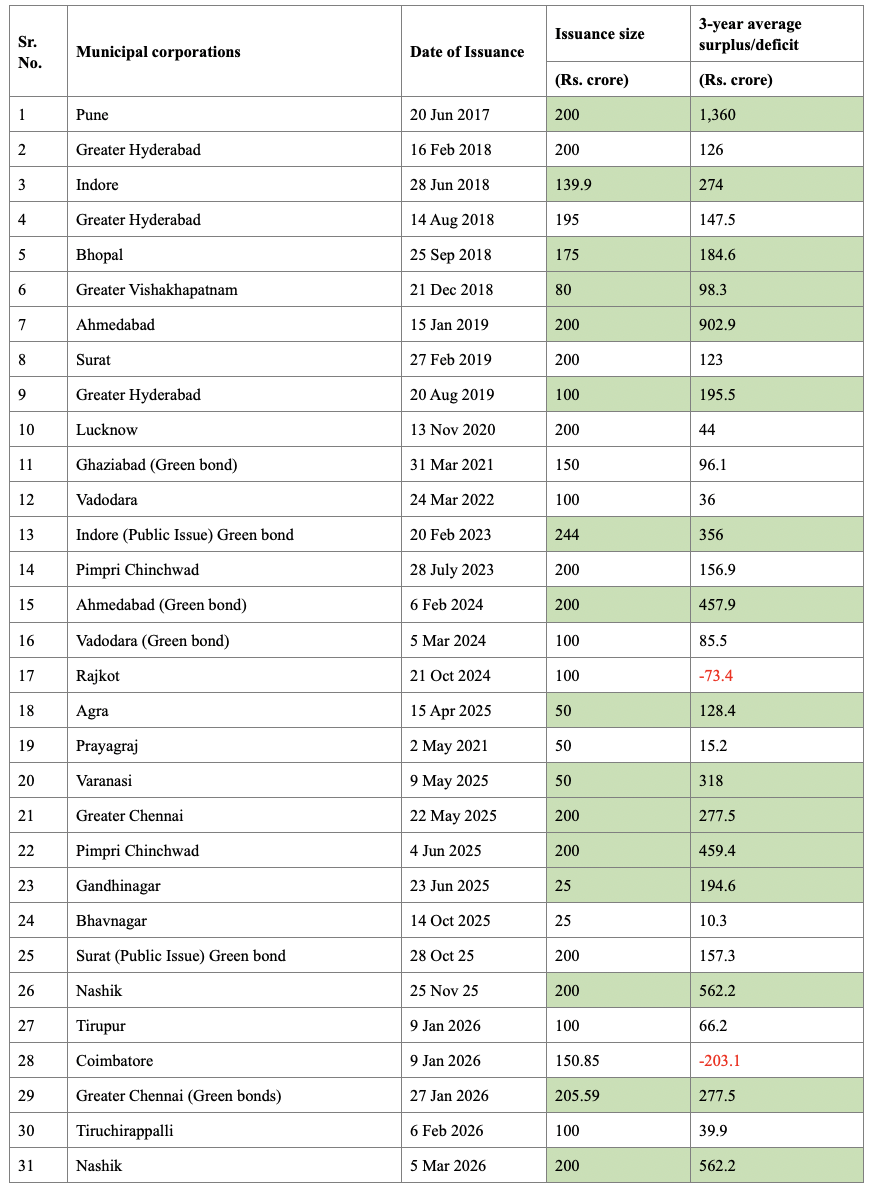
The issuance size ranges between Rs 25 crore and Rs 244 crore, which is similar to the amount eligible for the government’s incentive—a maximum of Rs 26 crore or Rs 20 crore, as the case may be, for an issuance size of Rs 200 crore (Table 1). Further, the financial information in the placement memorandum (or offer document, in the case of a public issue) shows that in 16 issuances the three-year average revenue surplus preceding the date of bond issuance was considerably higher than the issuance size.
This means that the recent bond activity was primarily fuelled by the government incentive. Whether this momentum can be sustained once the government withdraws the financial incentive remains to be seen.
Further, of the 31 bond issuances, only three were public issues—Indore (February 2023), Surat (October 2025), and Nasik (January 2026)—while the remaining 28 were on a private placement basis. When an issue or offer of municipal debt securities is made to investors or the public through an offer document, it is called a public issue. However, when an issuer offers municipal debt securities to a select group of persons through a placement memorandum, it is called a private placement (SEBI 2022). The select group cannot exceed 200 persons in a financial year, excluding qualified institutional buyers.
…[T]he recent bond activity was primarily fuelled by the government incentive. Whether this momentum can be sustained once the government withdraws the financial incentive remains to be seen.
In other words, a private placement of municipal securities is the non-public sale of municipal bonds or debt to a limited group of sophisticated or institutional investors. It is governed by regulatory bodies like the SEBI and allows municipal bodies or local authorities to raise capital without a broad public offering. It offers faster execution and streamlined regulatory compliance and is, therefore, the most preferred municipal bond issuance method in India.
Table 1: Issuance Size Versus Surplus/Deficit of Issuing Corporation
Given that private placement is the preferred method of municipal bond issuance in India, the question is: who are these select group of investors? Or, who invests in municipal bonds in India?
Information on the investors/subscribers of municipal bonds is not available in the public domain. However, an MC issuing bonds—either through public issue or private placement—is required to provide details of outstanding liabilities in the offer document or placement memorandum, as the case may be. This includes details of secured and unsecured loan facilities as also details of non-convertible debentures (NCDs) or bonds.
In case an MC has issued a municipal bond before the current issue and any outstanding bond liabilities remain to be serviced, it is required to report the names of debenture holders. It must also report the value of the total debentures held by them. The placement memorandum or offer document gives this information for the top 10 debenture holders
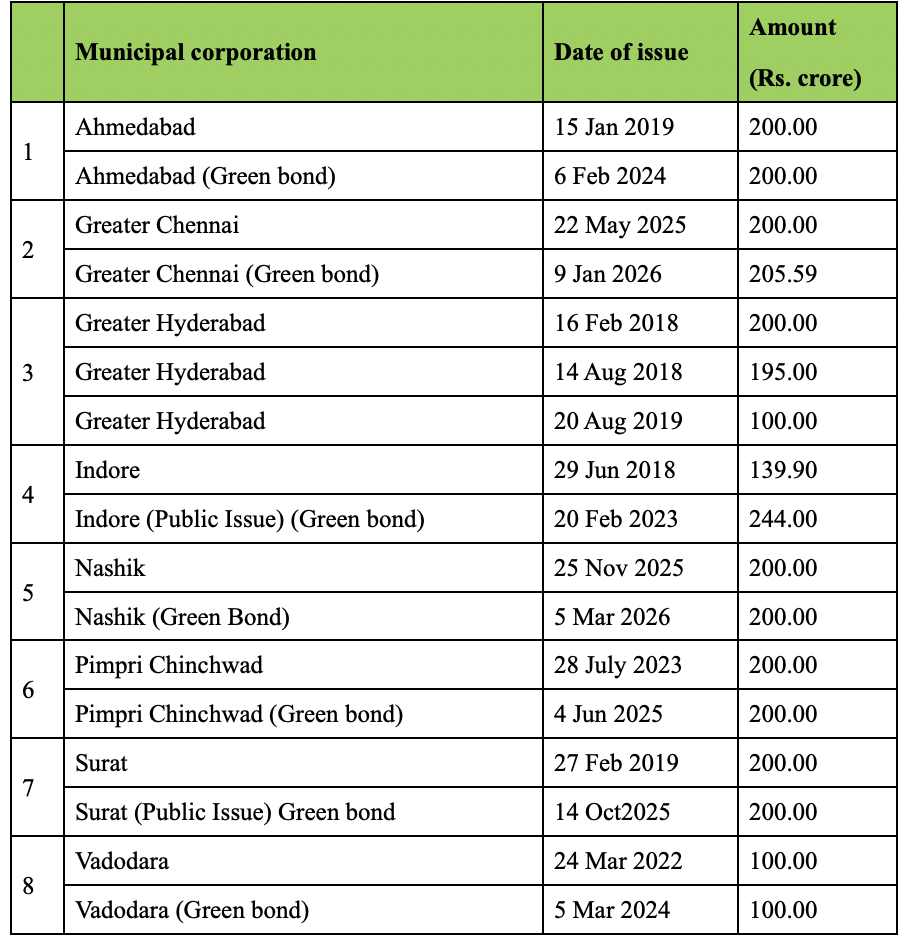
Of the 22 MCs that have issued municipal bonds, only eight have more than one issuance (Table 2). Of these eight, the offer document of Surat’s second issuance did not provide details of bond holders for its first issuance, as the corporation had serviced this debt before it went for the second issuance. This leaves us with seven MCs (with eight issuances) for which the names of the top 10 debenture or bond holders and the value of bonds held by them are available. A sum of Rs 1,434.9 crore has been raised by these seven MCs through their second and third issuances.
Table 2: Municipal Corporations with Multiple Bond Issuances
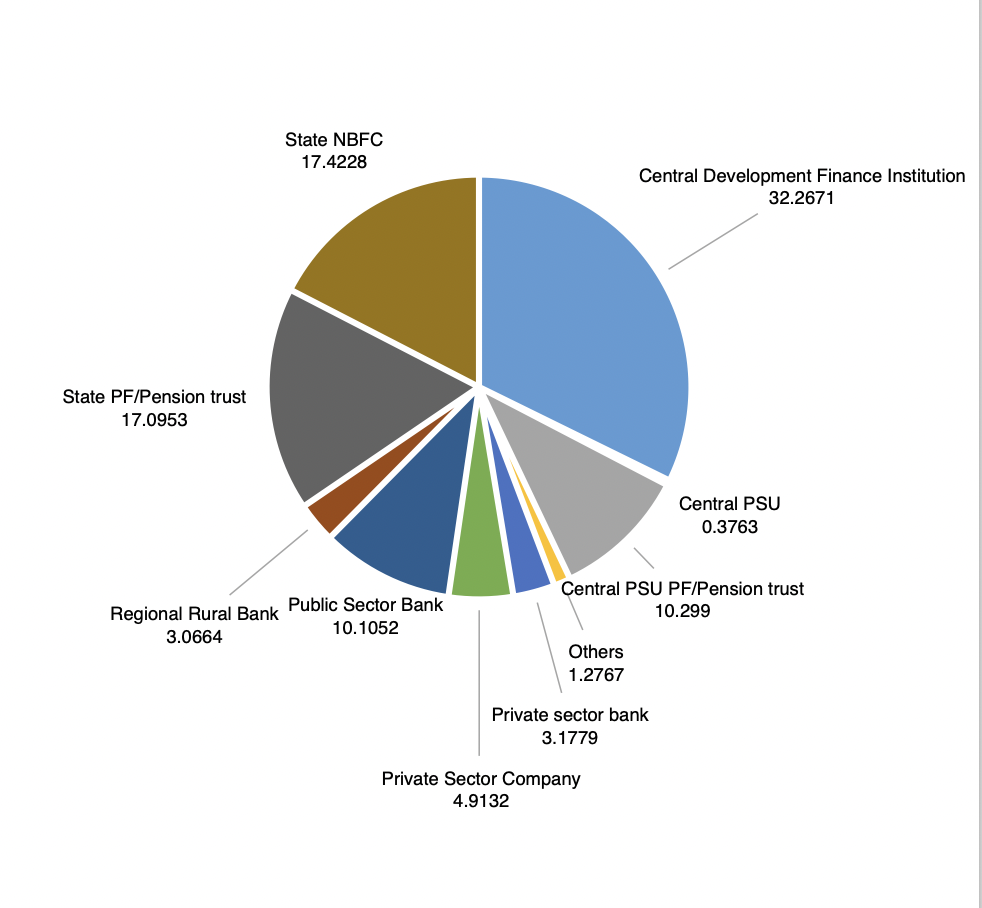
From an examination of the placement memorandum or offer document of these MCs, we find that the National Bank for Financing Infrastructure and Development (NaBFID), a central government-owned development financial institution, has invested around Rs 463 crore. It holds around 32.3% of the bonds issued by these seven MCs (Figure 1). The other major investors include a state government-owned non-banking financial company (Rs 250 crore; 17.4%), state government provident fund (PF) or pension trusts (Rs 245.3 crore; 17.1%), PF or pension trusts of central public sector undertakings (Rs 147.78 crore; 10.3%), public sector banks (Rs 145 crore; 10.1%), and regional rural banks (Rs 44 crore; 3.1%).
The privately placed bonds are largely held by the public sector, comprising central and state financial institutions, public sector undertakings, public sector banks, state and central PF or pension trusts, and regional rural banks.
These entities, either central or state owned, together own more than 90% of the bonds issued by these MCs through private placement. The share of the private sector, meaning private companies (mainly insurance companies) and private banks, is a mere 8.1%. This amounts to a total investment of only Rs 116.1 crore.
Thus, we see that most municipal bond issuance in India is on a private placement basis. The privately placed bonds are largely held by the public sector, comprising central and state financial institutions, public sector undertakings, public sector banks, state and central PF or pension trusts, and regional rural banks. The private sector holding is negligible.
Figure 1: Investor-wise Holding of Municipal Bonds through Private Placement (%)
3. Way Forward
As India works towards building cities that are sustainable and financially strong, municipal bonds have the potential to become a central part of urban finance, not just a small component of it. They are a viable alternative for financing urban infrastructure requirements.
India has made considerable progress in rejuvenating its municipal bond market through AMRUT-linked incentives, the framing of regulations for issuing and listing municipal debt securities, and subsequent modifications and amendments widening the scope for both issuers and investors. However, overall municipal borrowing continues to remain minuscule. The post-2015 regulatory environment has reduced entry barriers, expanded eligible issuers, and enhanced transparency and listing standards.
Additionally, the government extended the incentive for issuing bonds. Despite these initiatives, we find that the number as well as the volume of bond issuance continues to remain low. The small number and size of issuances and the overwhelming dominance of private placements highlight the prevalence of structural bottlenecks from the perspective of both issuers and investors.
The development of a municipal bond market is essential for financing urban infrastructure. Realising the full potential of municipal debt requires strengthening fiscal autonomy for ULBs, enforcing modern accounting and disclosure practices, implementing rule-based borrowing frameworks, and diversifying investor participation, particularly among retail and long-term institutional investors.
While the state municipal acts allow municipal corporations to borrow, the absence of a comprehensive debt limitation policy is a hindrance for investors. Such a policy would clearly specify rules and limits on municipal borrowing to keep public money safe. Further, there is a need for a bankruptcy framework for local governments if a corporation fails to repay its obligations.
Without such reforms, municipal bonds will continue to be seen as a risky option by investors and remain a specialised, incentive-driven financing vehicle rather than a strong pillar of urban infrastructure development in India.
Manish Gupta and Atrayee Choudhury are with the National Institute of Public Finance and Policy, New Delhi.