







On 21 June 2026, more than two million young people will appear for the medical entrance examination for the second time in seven weeks. The first attempt, on 3 May 2026, was cancelled 11 days later after a question bank circulating on WhatsApp and Telegram in Sikar, Rajasthan, turned out to match scores of questions in the live paper.
The Central Bureau of Investigation has since arrested more than a dozen people, including a translator the National Testing Agency (NTA) had hired to convert the physics paper into another language. Some students who sat the May attempt have committed suicide. The country has watched all of this closely because a paper leak is easy to see and easy to be angry about.
...[A] single test fixed to a single syllabus also raises the return on a particular kind of preparation: intensive, repetitive drilling on terrain that often sits some distance from what a school actually teaches.
There is another story that the National Eligibility cum Entrance Test (NEET) tells every year, even when nothing leaks, and it draws far less attention. It determines who gets to become a doctor in India through a single, syllabus-bound examination. Those who clear it are not a random cross-section of able students.
The leak is the scandal; the sorting is the system. The problem is that we still do not know, with any real confidence, how that sorting works across the country. The agency that conducts the exam is under no obligation to disclose that information, and so far, it has not.
Single National Test
Before 2016, a student could reach a medical seat by more than one route. States ran their own examinations, school-leaving marks counted in several of them, and the all-India pre-medical test sat alongside both. None of this was free of coaching. An industry already surrounded the older entrance exams and money already bought advantage.
What the NEET changed was not the existence of coaching but its reach. One paper, one syllabus, and one ranking for the whole country meant that the same narrow body of preparation became the target for every aspirant everywhere, with no local alternative to fall back on.
At the margin where ranks are close and seats are actually allocated, sustained paid coaching is the factor most reliably available for purchase…
Standardisation has real merits, and they should not be waved away. A common test undercuts the old racket of management quotas dressed up as merit, and it lets a student in one state compete for a seat anywhere. But a single test fixed to a single syllabus also raises the return on a particular kind of preparation: intensive, repetitive drilling on terrain that often sits some distance from what a school actually teaches. That gap has to be closed by someone. For the serious aspirant it is closed by coaching.
It would be a bold claim that coaching alone decides outcomes. Ability, school quality, the education of a candidate’s parents, and sheer persistence all matter, and a good student without coaching still sometimes wins a seat. The narrower and more defensible claim is this. At the margin where ranks are close and seats are actually allocated, sustained paid coaching is the factor most reliably available for purchase, and the one that most dependably converts a near miss into a place.
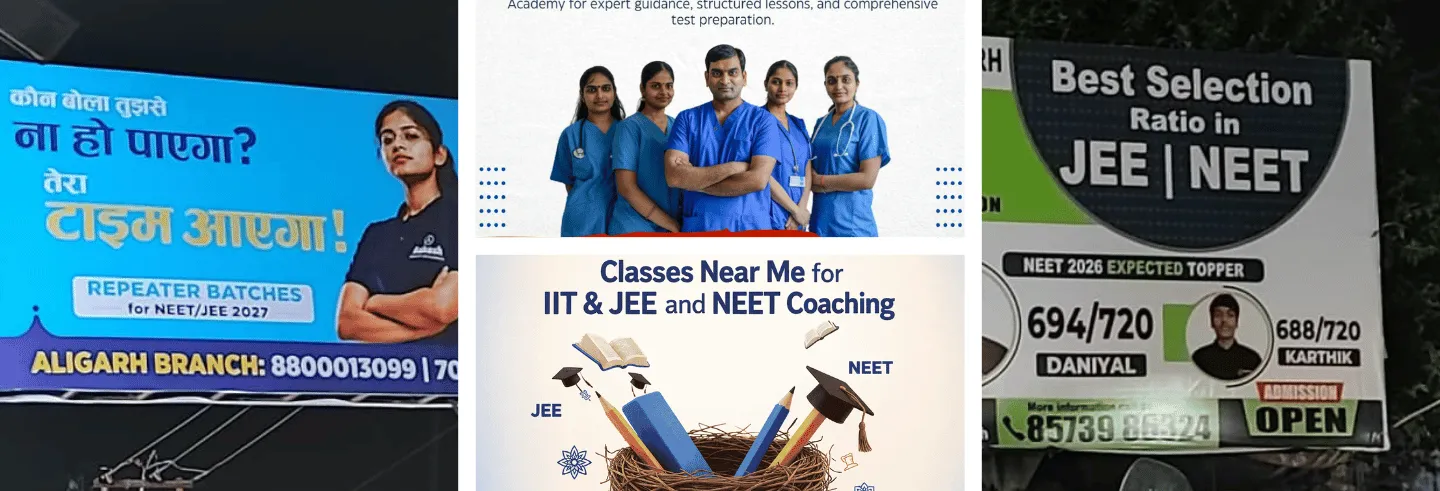
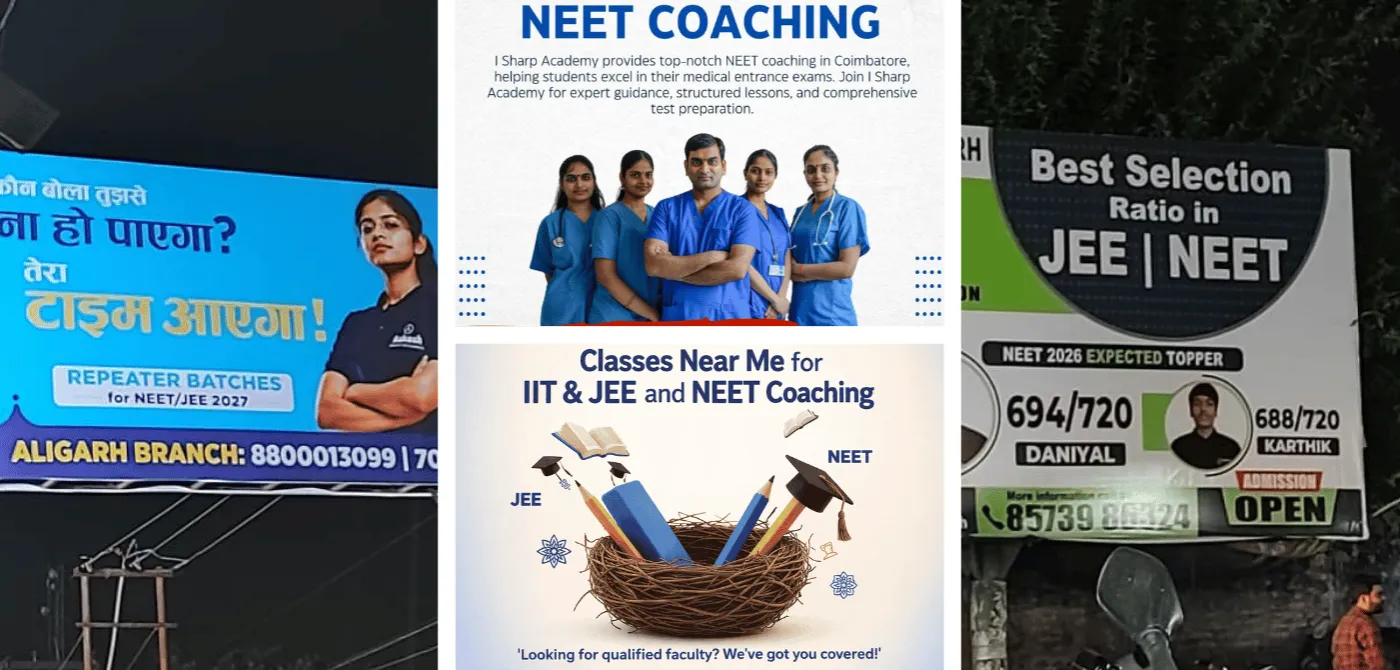
The Justice A.K. Rajan committee, set up by the Tamil Nadu government in 2021 to study the NEET’s effects in that state, put the annual size of the state’s NEET coaching business at roughly Rs 5,750 crore and noted that for many families the amount spent on coaching exceeds the fee for the medical course itself (Sivapriyan 2021). A market of that scale is hard to explain unless families believe coaching buys a real advantage in securing a seat.
No Figures Published
Coaching of that intensity is not spread evenly across the country. It clusters in cities and in a handful of towns that have built reputations for it. It assumes a parent who can fund years of fees, a household that can spare a teenager from earning, and often a child already schooled in English on a curriculum close to the test’s. Each of those conditions tracks income, location, and the kind of school a family could reach in the first place. If preparation of this kind shapes who succeeds, then who succeeds will tend to track those same advantages.
The Rajan committee tried to measure the result in Tamil Nadu and found a marked shift. The share of medical seats going to students from rural areas fell from about 65% in the year before the NEET to roughly 50% by 2020-21. Over the same period, the share going to students educated in Tamil rather than English shrank to a small fraction of its earlier level (Jayarajan 2021). The committee read this as evidence that the NEET was disadvantaging the very students a public health system most needs—the ones likeliest to return and serve where doctors are scarce.
No public dataset breaks down NEET qualifiers and seat-winners by income, rural or urban origin, school board, or medium of instruction, year on year, for the country as a whole.
That report cannot carry a national conclusion, and it is worth saying plainly why. It was commissioned by a state government already committed to abolishing the NEET, and some of its inferences ran ahead of its figures (Pawariya 2021). A single state study, contested on its own terms, tells us about Tamil Nadu and not about India. So, the right conclusion is not that the Tamil Nadu pattern holds everywhere. It is that we have no way to know whether it does.
No public dataset breaks down NEET qualifiers and seat-winners by income, rural or urban origin, school board, or medium of instruction, year on year, for the country as a whole. The concern is serious and the evidence for it is suggestive, yet it remains permanently at the level of suspicion. Not because the effect is too subtle to measure, but because the figures that would settle the question are held by a body that does not publish them.
Wrong Legal Box
That silence traces back to a decision made when the NTA was established. The government had a choice about the body’s legal form. A committee of the Indian Institutes of Technology had recommended years earlier that a national testing body be set up through legislation so that it would carry the autonomy and accountability a statute brings (Sharma 2024). The government did not legislate. In 2017, it registered the NTA as a society under the Societies Registration Act of 1860, the same 19th-century law used to register clubs and charitable associations.
The form is not a technicality. A body created by an Act of Parliament derives its powers and duties from statute and operates within a framework of legislative oversight. A registered society is governed by its own memorandum and rules, and Parliament does not routinely supervise it because Parliament did not create it. Yet, the NTA conducts the examinations that determine admission to medicine, engineering, and much of higher education for tens of lakhs of students every year.
The difference should not be overstated: Parliament can scrutinise non-statutory bodies when it chooses, statutory status is no guarantee of transparency, and a law creating the NTA could itself remain silent on demographic disclosure. What statutory status reliably adds is more built-in channels of accountability, including duties written into law and obligations that do not depend on a citizen first asking for them. The society form forecloses none of this. It simply makes accountability a matter of choice rather than design.
Whatever the reason, the data that would let the public see how the NEET sorts students is subject to no routine disclosure requirement, and so it remains largely unseen.
The agency is not beyond reach. It falls under the Right to Information Act, and citizens can seek records from it. But the right to ask, one application at a time, is a poor substitute for a standing duty to publish. A paper leak becomes visible through investigations, arrests, and headlines. The social profile of who clears NEET and who secures seats is different. It surfaces only when someone undertakes the work of assembling and analysing the data, and little pressure exists to do so because the harm is diffuse and accumulates without any single moment that demands attention.
None of this requires an assumption of deliberate secrecy. The reasons for the chosen form may well have been mundane: administrative convenience, flexibility, or continuity with other government-created societies. The point is about consequence, not motive. Whatever the reason, the data that would let the public see how the NEET sorts students is subject to no routine disclosure requirement, and so it remains largely unseen.
It is tempting to say the same institutional choice explains both the leaks and the missing data, but that asks more of the evidence than it can bear. A security failure and a disclosure gap are different things: one is operational, the other concerns what an agency must reveal. What links them is narrower. Both are the kinds of failures that can persist when no outside body is obliged to hold the agency to account. The leak persists until it erupts into view; the opacity persists indefinitely, because it never does.
Fixing the Form
After the 2026 cancellation, several petitions reached the Supreme Court. One, by the Federation of All India Medical Association, asks the Court to replace or rebuild the NTA and to run the re-examination under judicial supervision. Another, by the United Doctors Front, goes at the legal structure directly and seeks the agency’s dissolution in its present form (LawBeat 2026). On 25 May, hearing the matter, Justices P.S. Narasimha and Alok Aradhe told the agency it was sad that it had not learnt its lessons, recalling that a committee had been formed after the last leak and its recommendations accepted. It asked the NTA to file an affidavit on what it had actually done (Business Standard 2026).
Should a single centralised examination remain the sole gateway to a licensed profession when success in it turns so heavily on what a family can pay for preparation?
Placing the NTA on a statutory footing would help, and it is worth doing. A statute could impose duties the society form leaves optional: publishing disaggregated outcome data on a fixed schedule, answering to a parliamentary committee, and meeting security standards that carry consequences when they fail.
That would make the missing picture harder to keep missing. It would not, on its own, touch the deeper pressure, and the accountability case is more credible for admitting so. The reason paid coaching has become the real entrance to medicine is that a single high-stakes test is the only gate, and a gate of that kind is opened most easily by those with the greatest resources.
Changing the agency’s legal form changes who watches it and what it must disclose. It does not change the fact that one paper on one day on a syllabus most schools do not teach decides everything. A better-governed gatekeeper is still a gatekeeper.
Harder Question
This is the question none of the present petitions will open, because it is harder than replacing an agency. Should a single centralised examination remain the sole gateway to a licensed profession when success in it turns so heavily on what a family can pay for preparation? Before reaching for an answer, it is worth being clear about why the single gate exists, because it was not an accident. It was a remedy.
The NEET became compulsory through amendments to the Indian Medical Council Act in 2016, and the Supreme Court upheld that scheme in 2020 in Christian Medical College Vellore Association v. Union of India, holding the common examination valid even against the claims of private and minority institutions (Supreme Court Observer 2024). The court treated the single test as a cure for a real disease.
The decentralised system it replaced was where the worst abuses lived: capitation fees running into crores, management quotas sold to the highest bidder, dozens of private institutional exams whose only consistent feature was that wealth cleared them. A common test pulled admission out of that market and set one transparent rank in its place. That is the case for the gate, and it is serious.
The difficulty is that the gate solved one inequality by creating another. The old system favoured families who could pay a college directly. The new one favours families who can pay a coaching industry instead. The money did not leave the process; it moved one step upstream, from the institution to the preparation.
This is why the choice is not simply one exam against many. Going back to separate state and institutional exams would reopen the door the NEET was built to shut. The honest question is narrower and harder: can a single gate be kept—for the corruption it genuinely suppresses—without it selecting so sharply for wealth?
The agency must be placed in the right legal framework and required to disclose its workings.
The serious answers all work within the gate rather than tearing it down. School-leaving performance could be given real weight alongside the entrance rank, rewarding 12 years of consistent work that no crash course can manufacture, though it runs into the difficulty of comparing marks across more than 30 school boards of uneven standards.
Reserved shares for government-school students, of the kind Tamil Nadu already operates, could be widened and, more importantly, studied, so their effect on who eventually practises medicine is known rather than assumed. The syllabus could be brought closer to what ordinary schools teach, shrinking the gap that coaching exists to fill. None is costless, and each carries its own risk of fresh distortion. The argument here does not choose among them.
Data First
What it insists on is the order of operations. Every one of those reforms requires evidence the country does not currently have, because the body that holds it is free to keep it. We cannot weight board marks sensibly without knowing how the present system distributes seats. We cannot judge a government school quota without measuring who it actually helps reach the profession. We cannot tell whether the syllabus gap is widening or narrowing without the data to track it.
The reform that looks like a side issue—placing the NTA on a statutory footing with a hard, recurring duty to publish who qualifies and who is admitted, broken down by income, region, school system, and language—is the precondition for every other reform worth debating.
Tamil Nadu had to commission its own committee to see what was happening inside its own results—and even that told it only about Tamil Nadu. A country that cannot see how its single most consequential examination sorts its children is in no position to decide whether to keep the examination, fix it, or replace it. The agency must be placed in the right legal framework and required to disclose its workings. Only then can the harder question be asked with the evidence it deserves, and only then will the answer be worth anything.
Kshitij Saruparia is graduate from the National Academy of Legal Studies and Research (NALSAR), University of Law, Hyderabad; Apeksha Kachhawaha is a graduate from Maharashtra National Law University (MNLU), Nagpur.
Please see Comments on this article.




NEET: A Signal Failure