






In the vast mangrove delta of the Sundarbans, where the Bengal coast dissolves into tidal rivers and dense forest, survival depends on more than a boat and a net. Before entering the forest to collect honey or cut wood, fishermen and wood-gatherers stop at small shrines along the treeline to invoke Bonbibi, a figure one 19th traveller called a ‘strange goddess’, believed to be the keeper of the forest.
The relationship between Islam and the Indian landscape has a much longer and more intimate history than either side of that argument usually allows.
Bonbibi is, by origin, a Muslim figure. Her legend, interwoven with the tiger god Dakshin Ray and the mediating saint Ghazi Miyan, forms the cosmological grammar of an entire ecosystem: a shared sacred world in which tigers, humans, forest spirits, and Muslim saints negotiate the boundary between the wild and the habitable.
What, exactly, makes this a Muslim ecology? Not the presence of Muslims as such. Hindu, animist, and tribal communities too invoke Bonbibi. What makes it Muslim is that an Islamic idiom—a saint, a sacred genealogy, a moral vocabulary of protection and transgression drawn from Islamic devotional practice—has become one of the registers through which an entire regional community, across religious lines, understands and regulates its relationship with a dangerous and necessary landscape.
This essay is about Muslim ecologies: not environmental knowledge that happens to be held by Muslims, but ecological practice and ethical reasoning in which an Islamic vocabulary does identifiable work: dividing the forest, sanctifying a pond, regulating a water channel, restricting a tree. The claim here is not that Muslims have a special relationship with nature. It is that, across several regions of India, the vernacular life of Islam—its saints, its legal concepts, its devotional geography—has shaped how land, water and animals are managed. This history has gone almost entirely unrecognised in how India thinks about its environmental past and present.
The Bengal Delta: A Compact Between Saint and Tiger
The story of Bonbibi is best understood not as folklore decoration but as a working cosmology for an unworkable landscape. The Sundarbans are a tidal forest where the line between land and water shifts with every monsoon, where the Bengal tiger is a constant and lethal presence, and where any human entry into the forest interior is, in a quite literal sense, a negotiation with death. According to the ‘Bonbibi Johuranama’, a narrative poem that has circulated among fishing and forest-dwelling communities for generations, Bonbibi is sent by God to protect the poor of the forest. She defeats Dakshin Ray, the tiger god and lord of the wild, but does not destroy him: she negotiates. The forest is divided - the deep interior remains the tiger’s domain, while humans may use the margins, provided they enter with humility and seek her blessing first. Ghazi Miyan, the Muslim warrior-saint, witnesses and seals this compact.
This is, in effect, a zoning law expressed as theology. It tells honey-collectors and woodcutters where they may go, on what terms, and what ritual obligations attach to entry - and it does so by fusing an Islamic figure of sainthood with a pre-existing, non-Islamic tiger-deity and forest-spirit complex that long predates the arrival of Islam in Bengal.
Sufi shrines functioned as nodes of a ‘moral ecology’—a cognitive map in which the authority to clear land, the authority to mediate with dangerous animals, and the authority to bless or curse were all held by the same sacred figure.
The historian Richard Eaton’s account of how Islam became local in Bengal helps explain why this fusion occurred where and how it did. Eaton describes the eastward expansion of Bengali agriculture into forested, sparsely settled tracts of the delta from the sixteenth century, often led by pirs, Sufi pioneers, who arrived not as conquerors but as forest-clearers. They were granted land by Mughal authorities precisely because they could mobilise local labour and command local legitimacy. These pirs became, in local memory, figures who could ride tigers, command crocodiles, and negotiate with the spirits already understood to inhabit the forest. Sufi shrines functioned, in Eaton’s phrase, as nodes of a ‘moral ecology’—a cognitive map in which the authority to clear land, the authority to mediate with dangerous animals, and the authority to bless or curse were all held by the same sacred figure.
This is the specific historical mechanism by which an Islamic idiom became a vernacular ecological expression: not through doctrine imposed from above, but through the practical role Sufi pioneers played in the agrarian and ecological frontier of premodern Bengal. The legendary Zindah Ghazi, said to ride tigers, and Khan Jahan, credited with clearing the forests of what is now southwestern Bangladesh by mediating between settlers and the animals and spirits of the land, belong to this same genealogy. Bonbibi is its most enduring popular form—still invoked today by Hindu and Muslim forest-goers alike, in a region where the practical business of staying alive in the mangrove has outlasted, and absorbed, the religious categories that produced it.
The Shrine Pond: Sanctity as Conservation
A second, more widely distributed pattern concerns the role of Sufi shrines as informal sanctuaries for endangered wildlife. Here the mechanism is different again, and worth spelling out carefully.
The animals are understood to be in some sense the shrine’s own, connected to the saint’s baraka, his spiritual charge, in ways that vary from place to place but that consistently mark the pond and its inhabitants as off-limits to ordinary use.
At the shrine of Bayazid Bistami in Chittagong, the sacred pond harbours the black soft-shell turtle, among the rarest turtles in the world. Across present-day Bangladesh and Pakistan, researchers have documented similar shrine ponds inhabited by protected fish and crocodiles, which devotees feed and will not harm. The animals are understood to be in some sense the shrine’s own, connected to the saint’s baraka, his spiritual charge, in ways that vary from place to place but that consistently mark the pond and its inhabitants as off-limits to ordinary use.
The mechanism here is not an abstract Islamic teaching about animals in general. It is the specific, local logic of shrine sanctity: a saint’s tomb radiates a kind of protection outward into its immediate environment, and the pond, being physically continuous with the shrine, falls within that radius. Catching the fish or harming the turtle would be to violate the sanctity of the place itself; a transgression against the shrine, which only secondarily, and almost incidentally, has the effect of protecting the species.
The result, in ecological terms, is nonetheless real. Centuries before the language of conservation biology existed, a religious geography of sanctity was functioning as a de facto protected-area network, scattered across the subcontinent wherever Sufi shrines stood near water. The turtle in the shrine pond is not a religious symbol pressed into ecological service. Its survival has depended on the specific local belief that this pond belongs to this saint: a belief that is simultaneously about Islam, and about this place.
Kargil: Islamic Law as Resource Law
A third pattern, in the high-altitude cold desert of Kargil in Ladakh, shows the same Islamic idiom doing different ecological work: not zoning a forest or sanctifying a pond, but regulating water and timber in a landscape where both are catastrophically scarce.
Participants explicitly describe these norms in the vocabulary of Islamic stewardship: the idea that resources are held in trust and that wasteful or excessive use is a kind of wrongdoing for which one is accountable.
Field studies of Muslim communities in Kargil describe how the cutting of juniper— a slow-growing tree that is ecologically critical for soil stability and fuel in this fragile environment—is restricted through community norms. Participants explicitly describe these norms in the vocabulary of Islamic stewardship: the idea that resources are held in trust and that wasteful or excessive use is a kind of wrongdoing for which one is accountable. Water in Kargil is distributed through collective irrigation arrangements that draw on a specific principle of Islamic law , that flowing water (as distinct from water that has been collected or stored) cannot be privately owned and access to it is a shared right that no individual can foreclose. This is not a vague spiritual orientation toward nature. This legal concept, drawn from the fiqh tradition, performs a distributive function in the irrigation system: determining who may take water, in what order, and on what basis a dispute over a channel is resolved.
What is striking about Kargil is how precisely the Islamic vocabulary maps onto the ecological problem. A cold desert’s two scarcest resources—wood and water—are governed by, respectively, an ethic of accountable stewardship and a legal doctrine about the non-ownability of flowing water. Neither of these is a generic ‘Islam is green’ claim. Both are specific doctrinal resources, selected and emphasised because they happen to fit the ecological problem at hand. This is exactly what one would expect when religious vocabulary is used as a regulation by people living with scarcity, rather than being read into their practices after the fact by an outside observer.
Vernacular Architecture: Building With, Not Against, the Land
A fourth, more diffuse pattern is visible in the way mosques across India took on entirely different built forms depending on region. The multi-pitched terracotta roofs of rural Bengal echo the thatched bamboo-and-mud houses of the delta and shed the region’s heavy monsoon rain. The sloping tiled roofs of the Malabar coast in Kerala, which use locally available materials, are suited to its different but equally intense rainfall. The tiered wooden forms of Kashmir are built for snow load and for a climate where wood, not stone, was the available building material.
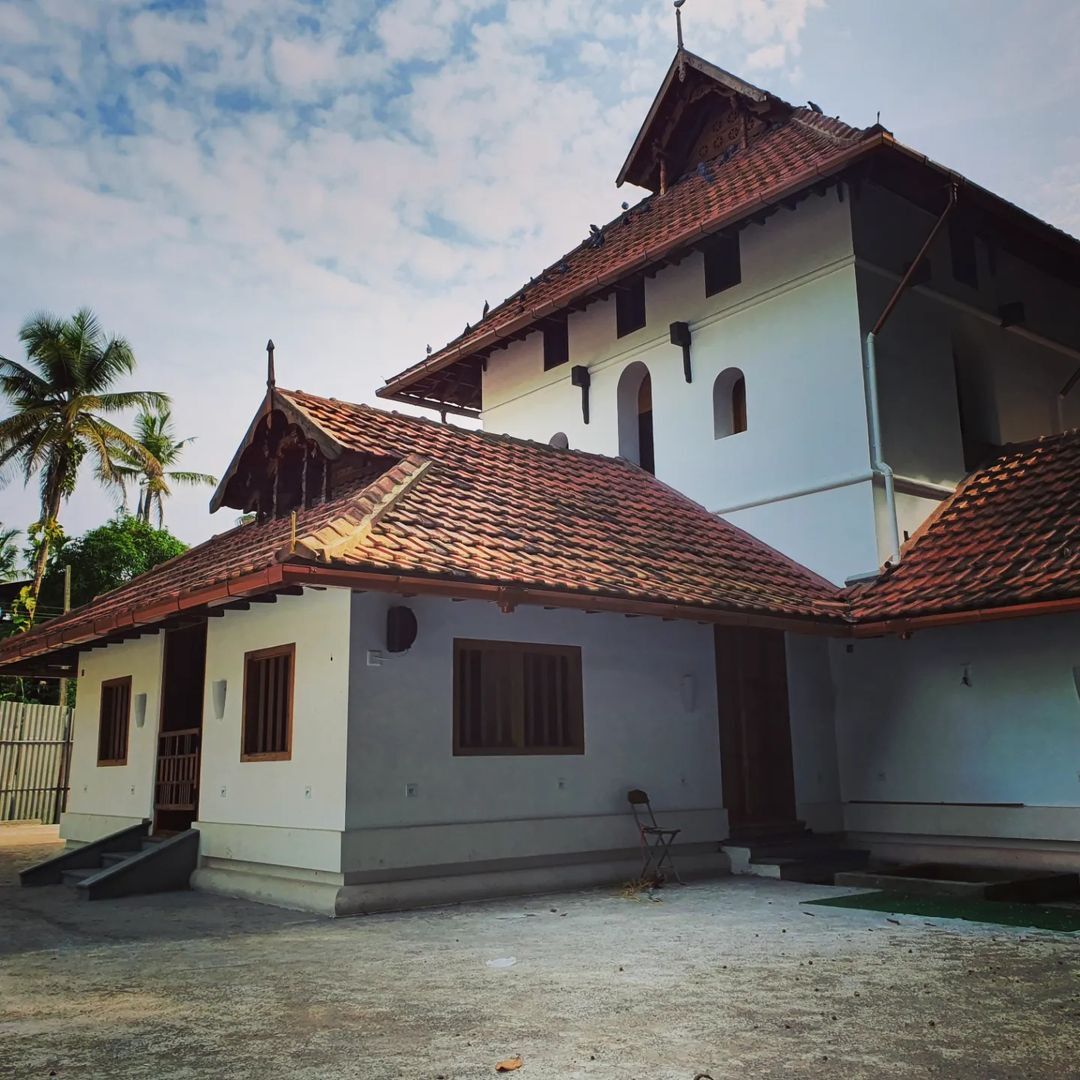
These adaptations are sometimes described simply as evidence of Islam’s capacity to absorb local aesthetic traditions. This is true but understates the point. A roof pitched to shed monsoon rain or built from the timber a forested hill region produces, is a building in working relationship with its climate and its materials. It is, in a modest but real sense, an ecological adaptation arrived at by communities who needed their houses of worship to survive the same weather as their houses of living. That this adaptation happened differently in Bengal, Kerala and Kashmir—producing three quite different built vocabularies, all recognisably Islamic and local—is itself evidence against any singular ‘Muslim’ relationship to the environment.
What Is Muslim About This?
What is Muslim here is a set of practices that took shape differently in each place, in dialogue with each place’s ecology. In each of the four cases described—a forest cosmology in Bengal, shrine ponds across the subcontinent, water and timber law in Kargil, and mosque architecture in three regions—what makes the practice ‘Muslim’ is different and specific.
Islam in India has also been local and environmental. It arrived in, and took shape within, specific ecological and social landscapes, via specific historical agents
In the Sundarbans, it is a saint-figure and a sacred narrative, of Islamic provenance, that organises a cosmology shared across religious communities. It is Muslim in origin and idiom, but not Muslim in exclusive ownership or practice. In the shrine-ponds, it is the specific logic of Sufi sanctity—the baraka of a tomb extending into its surroundings—that produces a conservation effect as a side-consequence of devotional geography. In Kargil, it is Islamic legal doctrine that supplies the rules of a resource-management system. In mosque architecture, it is the way Islamic religious building, as a category, take on the specific ecological grammar of each region it arrived in.
What unites these cases is not a shared ‘Islamic environmental ethic’ that exists prior to and independent of local context, waiting to be applied. It is rather that Islam in India has also been local and environmental. It arrived in, and took shape within, specific ecological and social landscapes, via specific historical agents: Sufi pioneers in Bengal’s forest frontier, jurists and irrigation communities in Ladakh’s cold desert, builders working with regional materials and climates. In becoming local, it became, in these instances, ecological. Islamic vocabulary did not arrive as an abstract doctrine and get ‘applied’ to nature in general; it arrived embedded in specific practices of settlement, sanctity, law and building, each of which had to come to terms with a specific landscape.
This also clarifies what this essay is not claiming. It is not claiming that anything done by a person who happens to be Muslim—a Muslim farmer, a Muslim scientist, a Muslim novelist—constitutes ‘Muslim ecology’ simply by virtue of the practitioner’s identity. That would make the category so broad as to be analytically empty and would risk exactly the kind of forced or essentialising move that this framing wants to avoid. The cases above are different in kind. In each, an identifiably Islamic vocabulary, narrative, legal concept or institutional form is doing identifiable work in how land, water, trees, or animals are actually treated.
Faith as Vocabulary
None of these amounts to a singular claim that Islam determines ecological outcomes, or that Muslim communities are inherently more conservation-minded than others. Region, caste, livelihood and local political economy all matter - often more, in any given instance, than religious identity. The Kargil irrigation system would not function on doctrine alone; it depends on local enforcement, kinship obligation, and the practical fact that everyone in a watershed needs the system to work. The Bonbibi cosmology did not, in itself, prevent the colonial-era and postcolonial destruction of large parts of the Sundarbans mangrove. A cosmology is not a conservation policy, and treating it as a substitute for one would be its own kind of error.
Concepts like khalifah, hima, and fasaad are available, across the Muslim world, as a moral vocabulary for ecological argument.
What religious identity does provide, in each of these cases, is a vocabulary: a set of terms—stewardship, sanctity, the non-ownability of flowing water, the moral geography of a saint’s protection—through which ecological relationships can be named, argued about, and handed down. Concepts like khalifah (often glossed as stewardship), hima (a pre-Islamic and early Islamic institution of protected land, adapted in various local forms), and fasaad (corruption or disorder on the earth, a Quranic term) are available, across the Muslim world, as a moral vocabulary for ecological argument. Whether, and how, that vocabulary gets taken up in any given place depends also on local circumstance. The vocabulary is portable; its ecological uptake is complex and also local.
Seen this way, what is distinctive about this material is not that it represents a separate or parallel ‘Muslim environmentalism’, set apart from other Indian environmental traditions. It is that it is irreducibly syncretic and transregional in a way that other, better-recognised strands of Indian environmental thought—indigenous forest-rights traditions rooted in specific territorial claims, or Dalit ecological politics rooted in the specific experience of caste and pollution—are not, or not in the same way.
The Bonbibi cosmology is simultaneously Islamic, animist, and Hindu, crossing all three registers in a single narrative shared by communities who do not share a single religious identity. The shrine-pond pattern recurs, with local variation, from Chittagong to the Sindh—the same logic of saintly sanctity producing parallel conservation effects across very different ecologies and political boundaries. Kargil’s water law draws on a legal tradition that is simultaneously rooted in this specific Ladakhi watershed and connected to a body of jurisprudence shared across the Muslim world. This trans-regional portability, combined with deep local specificity, is most distinguished feature. It is also, not incidentally, a direct rebuttal to the idea, current in some political discourse, that Muslim presence in a landscape is inherently foreign to it, or stands outside its ecological history. The opposite is closer to the truth: in these cases, an originally extra-regional religious vocabulary became one of the idioms through which intensely local ecological relationships were—and in places still are—organised.
Recovering the Frame
Indian environmental scholarship has, over several decades, expanded its sense of who counts as an environmental subject. Indigenous communities are recognised as ecological stewards with territorial claims. Women are recognised as primary managers of household and agrarian resources. Dalit communities are recognised as disproportionate bearers of environmental risk and as holders of a distinct ecological politics rooted in the experience of pollution and exclusion. Each of these recognitions involved identifying a specific relationship—a specific vocabulary, a specific structural position—through which a community’s environmental experience could be named and analysed.
Muslim presence in a landscape is increasingly read through the vocabulary of encroachment and threat...
Muslim communities, by contrast, remain largely outside this frame, not because the relevant material does not exist, but because it has not been organised around a comparably specific analytical question. This essay has tried to pose that question narrowly: not ‘what have Muslims done for the environment’; but where has an Islamic vocabulary done identifiable work in how a landscape is managed, and what does that tell us about how Islam became, in these places, local and ecological.
The answer, in the cases surveyed here, is that this has happened more often, and more substantively, than India’s environmental discourse currently recognises. Recovering this history does not add a footnote to existing accounts of Indian environmentalism so much as it complicates the map: showing forest cosmologies, shrine ecologies and resource law that are at once Islamic, regional, and shared across religious lines, in landscapes from the Bengal delta to the Ladakhi highlands.
This matters, too, against the political backdrop of the present moment, in which Muslim presence in a landscape—a herd on a riverbank, a settlement on a floodplain, a community near a forest—is increasingly read through the vocabulary of encroachment and threat: ‘land jihad’, ‘flood jihad’, the figure of the Muslim as ecological transgressor. The material recovered here does not, by itself, answer that politics. But it does establish that the relationship between Islam and the Indian landscape has a much longer and more intimate history than either side of that argument usually allows, a history in which an Islamic vocabulary became, in particular places and for particular reasons, part of how the land itself was understood.
Mukul Sharma is a professor of environmental studies at Ashoka University, Sonipat, Haryana. His research focuses on caste, Dalits, Hindu nationalism, environmental justice, and ecological politics in India and South Asia