



On 15 May 2026, India and the United Arab Emirates (UAE) signed a cluster of agreements in Abu Dhabi, including a landmark deal between Indian Strategic Petroleum Reserves Limited (ISPRL) and Abu Dhabi National Oil Company (ADNOC) to explore expanding crude oil storage to 30 million barrels, alongside a Strategic Defence Partnership. This article argues that while framed as an exercise in energy security, these agreements collectively represent a structural erosion of India’s diplomatic strategic autonomy.
Crucially, the agreement also includes discussions on India storing its own strategic petroleum reserves in Fujairah, UAE, which would be linked to India’s strategic reserve system.
By entangling India’s survival energy assets with the UAE, a state now embedded in the US-Israel security ecosystem, New Delhi has created geopolitical obligations it never formally consented to. The article examines this through the lens of the asset-based entrapment theory, the Fujairah vulnerability paradox, the abandonment of Chabahar, and the broader pattern of India’s forced alignment with Western strategic preferences.
What Was Signed
India’s strategic petroleum reserve infrastructure, managed by ISPRL, currently comprises underground rock caverns at three locations: Visakhapatnam in Andhra Pradesh (1.33 million tonnes), Mangalore in Karnataka (1.5 million tonnes), and Padur near Udupi in Karnataka (2.5 million tonnes), totalling 5.33 million metric tonnes. According to the US Energy Information Administration, as of March 2025, India held 21.4 million barrels of crude oil in these reserves, enough to cover approximately 9.5 days of national consumption at current rates. For context, International Energy Agency (IEA) member nations are required to maintain reserves equivalent to at least 90 days of net imports. India is nowhere near that benchmark.
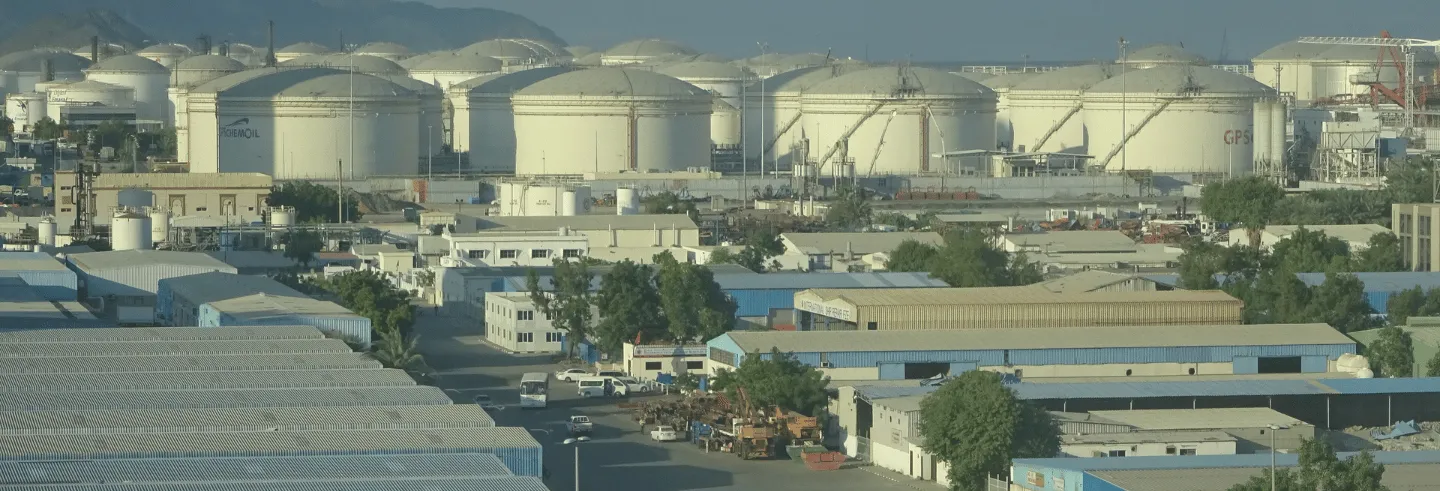
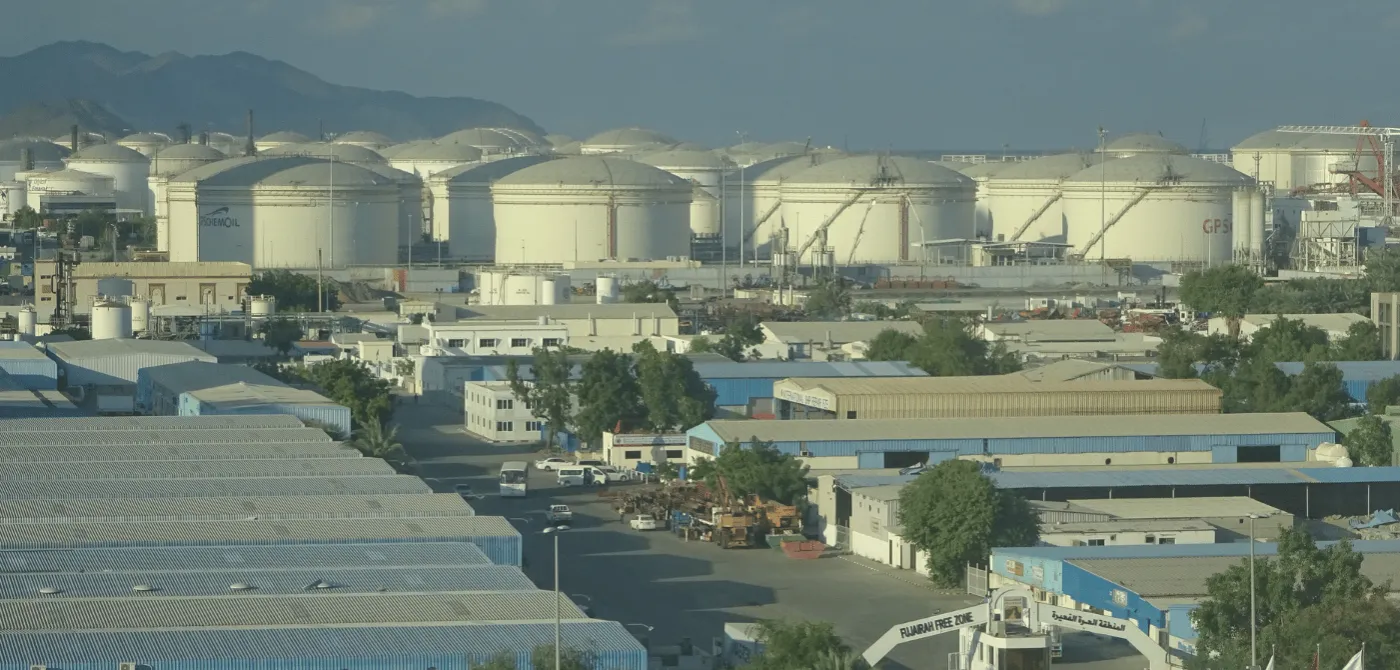
The May 2026 ISPRL-ADNOC agreement goes significantly further than earlier arrangements. According to S&P Global Platts and World Oil, the new deal explores expanding ADNOC’s crude storage capacity in India to as much as 30 million barrels. This would cover the existing facilities in Mangalore and potential future sites at Visakhapatnam and Chandikhole in Odisha. Crucially, the agreement also includes discussions on India storing its own strategic petroleum reserves in Fujairah, UAE, which would be linked to India’s strategic reserve system.
This reciprocal, bidirectional asset deployment is at the core of the strategic concern. ADNOC is already the only foreign company to have invested in India’s strategic petroleum reserves programme, having stored crude at Mangalore since 2018.
On the same day, Prime Minister Narendra Modi and UAE President Sheikh Mohamed bin Zayed Al Nahyan signed a Strategic Defence Partnership framework, covering defence industrial collaboration, maritime security, intelligence exchange, and joint military exercises. The simultaneity of these two agreements on energy and defence is not incidental. Together, they define a qualitatively new tier of strategic interdependence between India and a state that is now an active participant in the Middle East’s most volatile conflict.
Storage Becomes Strategy
The foundational error in treating the ISPRL-ADNOC deal as a purely commercial transaction is the nature of the asset itself. Strategic petroleum reserves are not ordinary commodities. They are the fuel a nation uses to survive a supply crisis, a war, or a blockade. When those reserves sit in foreign territory, their physical safety becomes inseparable from the host state’s political and military fate.
The moment Iranian missiles, drones, or naval operations threaten Fujairah’s oil infrastructure, India’s energy security will be directly imperilled.
India imports nearly 89% of its crude oil needs. Of that, approximately 40%, around 2.5 to 2.7 million barrels per day, transits through the Strait of Hormuz. The 2026 Middle East conflict has already demonstrated the real-world consequences of this dependence, and oil prices surged to nearly $120 per barrel in March 2026 because the Strait of Hormuz was effectively blocked.
Under these conditions, storing Indian strategic reserves in Fujairah is not simply a logistical decision; it is a geopolitical commitment. The moment Iranian missiles, drones, or naval operations threaten Fujairah’s oil infrastructure, India’s energy security will be directly imperilled. New Delhi would then face an impossible choice: remain neutral and watch its survival fuel burn, or align with the UAE and its protectors, the US and, by extension, Israel. India never voted on this binary. It arrived through a storage agreement.
The Fujairah Illusion
The government’s primary justification for the Fujairah component is geographic: the port lies outside the Persian Gulf, beyond the Strait of Hormuz, and therefore offers some insulation from threats of an Iranian blockade. This argument is logistically sound but strategically hollow.
Iran demonstrated in May 2019 that Fujairah is well within its operational reach when four commercial tankers anchored off the port were damaged in what the UAE and the US attributed to Iranian sabotage, which Tehran denied. Iran does not require control of the Strait of Hormuz to threaten Fujairah. Its medium-range ballistic missile arsenal, with documented ranges exceeding 2,000 kilometres, can reach any point in the UAE from multiple launch sites in Iranian territory.
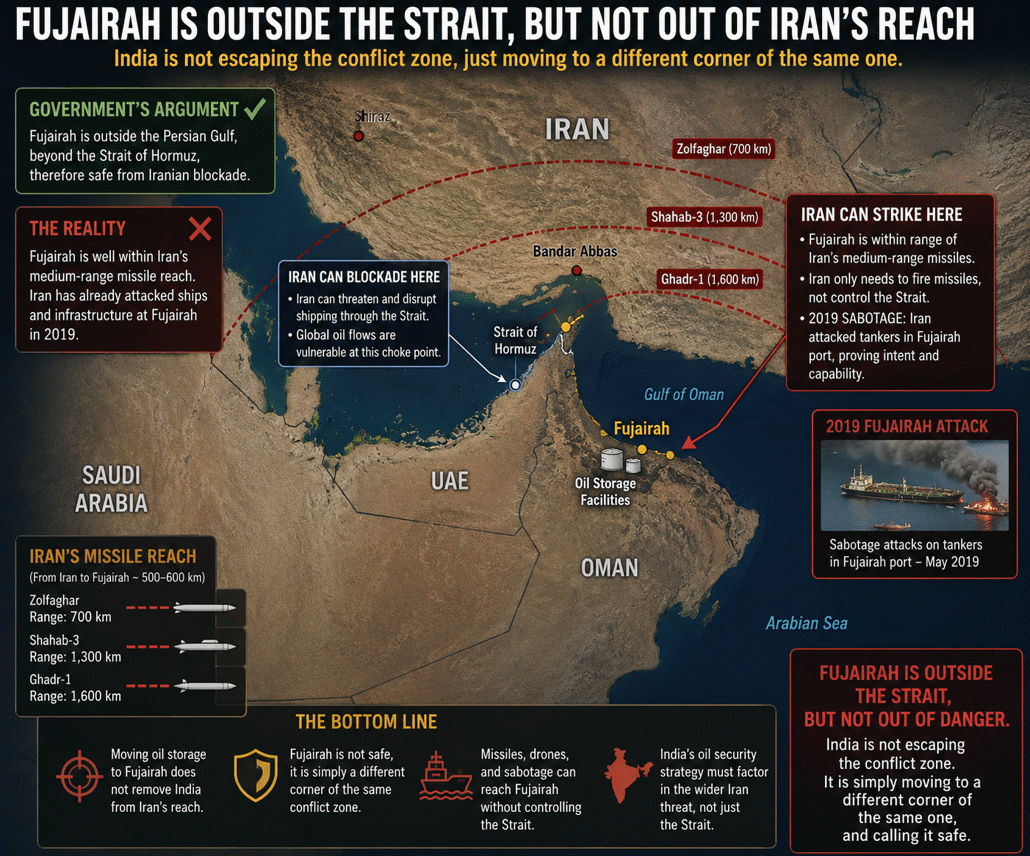
India is therefore not escaping the conflict zone by parking reserves at Fujairah. It is relocating its vulnerability from one corner of the same battlefield to another, while calling it a solution. The UAE’s 1.8 million barrel-per-day Habshan-Fujairah pipeline, which bypasses Hormuz, is precisely the kind of high-value infrastructure that becomes a priority target in any sustained Iran-UAE conflict.
Assets Create Alignments
Nobody issued a formal announcement of India joining the US-Israel axis. Yet, the structural logic of the May 2026 agreements points unmistakably in that direction. Consider the chain: Al Dhafra Air Base in Abu Dhabi hosts the largest US Air Force presence outside the continental US, with more than 5,000 American military personnel. The UAE formalised security cooperation with Israel through the Abraham Accords in 2020, and in May 2026, Israeli Prime Minister Benjamin Netanyahu’s secret visit to Abu Dhabi, revealed just two days before India’s defence pact signing, further deepened that security architecture.
According to one analysis in The Wire, “Any Indian military technology that reaches the UAE enters a security ecosystem that now includes Israel.” The I2U2 framework, linking India, Israel, the UAE, and the US for technology and logistics cooperation, which was launched on 14 July 2022, adds another institutional layer to this entanglement.
What this means in practice is that India’s strategic petroleum reserves stored in Fujairah are physically protected by the UAE's security infrastructure, which is underwritten by US military guarantees that now operate in coordination with Israeli strategic interests. India did not formally choose this protection architecture. It inherited it as a structural consequence of where it chose to park its oil.
Casualty of Neutrality
The clearest evidence that strategic autonomy is already compromised comes not from the storage agreement itself but from India’s diplomatic behaviour following the US-Israel strikes on Iran on 28 February 2026. India’s Ministry of External Affairs issued a statement expressing “deep concern” and calling on “all sides” to pursue dialogue. It did not say who launched the strikes, did not condemn the breach of Iranian sovereignty, and remained silent on the US’s abrupt withdrawal from negotiations with Iran when a deal was reportedly within reach.
Global Village Space’s analysis (June 2026) observed that India “failed” its own strategic autonomy test, not by picking the wrong side, but because “it found it could no longer speak to every side”. Prime Minister Modi had visited Jerusalem just two days before the strikes began, having elevated India-Israel ties to a Special Strategic Partnership. The timing, combined with deep economic interests in the UAE, made genuine neutrality structurally impossible.
India’s silence on the strikes, contrasted with its vocal condemnation of subsequent Iranian counterattacks on UAE infrastructure, created what analysts described as an asymmetric posture, one that Tehran, Moscow, and Beijing all noted.
Chabahar Casualty
Perhaps the most tangible strategic cost of India’s drift towards the UAE-US axis is the effective abandonment of Chabahar Port in Iran. In May 2024, India signed a landmark 10-year contract to equip and operate the Shahid Beheshti Terminal at Chabahar, committing $120 million in equipment and a $250 million credit line. The port was designed as India’s only land-access route to Afghanistan and Central Asia, bypassing Pakistan entirely, a two-decade strategic investment.
By 2026, that investment had been effectively stalled. The US sanctions waiver that kept the project operational expired on 26 April 2026, and was not renewed. India’s Union Budget 2026 allocated zero funds for Chabahar development.
The contrast is stark: India deepens energy and defence ties with the UAE, the state on the opposite side of the Iran conflict, while simultaneously allowing its only direct engagement with Iran to collapse under the pressure of US sanctions. Iran is a fellow BRICS member, and during the 2026 conflict, China, Russia, and South Africa expressed vocal support for Tehran, while India’s position was perceived as ambivalent, a diplomatic embarrassment for a country that holds the BRICS 2026 chairmanship.
Energy Security Paradox
India’s oil import dependency is not merely high today—it is structurally worsening. The IEA’s World Energy Outlook 2025 projects India’s oil import dependency rising from 87% in 2024 to 92% in 2035, making it the largest contributor to global oil demand growth over the next decade. This trajectory makes maintaining diverse supplier relationships not a diplomatic luxury but an existential necessity.
Real energy security for India requires the freedom to buy from Russia when prices fall, Iran when relations stabilise, and the Gulf when neither is available.
Yet, between 2025 and 2026, India has systematically narrowed those relationships under external pressure. Russian crude imports, which had risen to 1.84 million barrels per day in November 2025, fell to 1.04 million barrels per day by February 2026 after the US threatened tariffs to coerce India into reducing Russian oil purchases. The Iranian oil route was shut long before 2026 under previous sanctions. Now the Chabahar connectivity corridor is also being surrendered.
What India has done over the period 2025–2026 is to diverge from a multi-directional energy supply architecture, which was the only genuine guarantee of energy security for India’s import dependency, towards a deeper dependency on a single regional bloc. The ISPRL-ADNOC deal adds more barrels to that bloc. It does not add more strategic options.
Real energy security for India requires the freedom to buy from Russia when prices fall, Iran when relations stabilise, and the Gulf when neither is available. Every diplomatic obligation incurred through the UAE asset deal narrows that freedom further.
Deeper Principle
In international relations, where a nation places its most critical assets communicates its alignment more clearly than any foreign minister’s speech because physical presence creates real obligations that words never do. History proves this repeatedly: Soviet missiles in Cuba declared Cold War intent without a single treaty, US troops in West Berlin guaranteed alliance commitment more convincingly than any document, and Chinese bases in Djibouti announced a global ambition that ended decades of peaceful rise.
India’s decision to store its survival fuel in the UAE follows the same iron logic. The asset placement has already chosen sides, regardless of what New Delhi says about strategic autonomy. India has placed its survival fuel, the oil that would sustain the country through a crisis, in the territory of a country that is confronting Iran, hosting US troops, coordinating with Israel, and receiving India’s defence cooperation simultaneously.
The question is whether the specific architecture of asset interdependence being built through these agreements is compatible with the strategic autonomy doctrine India officially espouses.
Strategic autonomy is not a declaration. It is a capability, the ability to make independent choices when the pressure to choose sides is greatest. The ISPRL-ADNOC deal, signed at the peak of the Middle East crisis, has structurally diminished that capability by creating asset-level vulnerabilities that force India’s hand in exactly the scenarios where independence matters most.
Assets create obligations. Obligations create alignments. Alignments create enemies. And India’s most consequential potential adversaries, those controlling its land borders, trade routes, and energy corridors, are now watching New Delhi’s choices with careful attention.
India had a window in May 2026 to demonstrate genuine strategic autonomy: to store reserves at home or in genuinely neutral territory, to issue a balanced statement on Iran, to continue Chabahar funding despite American pressure. It chose otherwise. That choice, more than any formal treaty, defines where India actually stands.
Conclusions
The ISPRL-ADNOC Strategic Petroleum Reserves Agreement of May 2026 is, on the face of it, a sound commercial arrangement between the world’s third-largest oil importer and a major Gulf producer. On deeper examination, it is a geopolitical positioning document that quietly compromises the diplomatic independence India has spent seven decades cultivating.
By storing its most critical strategic asset in the heart of a conflict zone, entangling energy agreements with defence frameworks on the same day, and allowing the Chabahar project—India’s only independent Iran-corridor investment—to collapse under US sanctions pressure, New Delhi has traded strategic flexibility for logistical convenience.
The question for Indian policymakers is not whether the UAE is a valuable partner; it clearly is. The question is whether the specific architecture of asset interdependence being built through these agreements is compatible with the strategic autonomy doctrine India officially espouses.
The evidence from the first months of the 2026 Iran war suggests it is not. India’s silence was not strategic patience. It was strategic incapacity, the direct consequence of having parked its assets, and therefore its options, in someone else’s garage.
Amit Kumar is currently a Research Intern at the Sir Syed Center for International Relations & Risk Analysis (SSCIRRA), New Delhi.