



Introduction
The Kurds, whose population is estimated at approximately 50 million, are frequently characterised as the world’s largest stateless nation.
Although the post-World War I territorial order incorporated Kurdistan into the modern states of Turkey, Iran, Iraq, Syria, and Armenia, the newly demarcated borders failed to sever the historical, cultural, linguistic, and geographical continuities linking Kurdish society across the region. Instead, the sustained pursuit of common socio-political aspirations preserved enduring cross-border networks of solidarity and collective identification, fostering the emergence of a transnational Kurdish political consciousness while simultaneously reinforcing the interconnected and transregional character of Kurdish political mobilisation.
As a reflection of this enduring historical condition, a widely circulated expression in Kurdish political discourse evokes the tragic irony that while all four states possess a Kurdistan, the Kurds themselves remain without one.
Within this broader historical context, Kurdish resistance to the post-war political order evolved through political discourses and modes of struggle across different parts of Kurdistan, including early attempts to attain sovereignty in Iraqi Kurdistan and through the establishment of the Republic of Red Kurdistan in 1923.
Comparable political movements and projects in Iranian, Turkish, and Syrian Kurdistan have likewise persisted into the present day. As a reflection of this enduring historical condition, a widely circulated expression in Kurdish political discourse evokes the tragic irony that while all four states possess a Kurdistan, the Kurds themselves remain without one.
Iranian Kurdistan
The political vacuum that emerged in Iran during World War II created the conditions for the establishment of the first Kurdish political party, the Kurdistan Democratic Party of Iran (KDPI), as well as the second Kurdish republic in Mahabad on 22 January 1946 under the leadership of Qazi Muhammad. At the same time, a segment of the Kurdish movement in Iraqi Kurdistan, led by Mulla Mustafa Barzani, moved to Mahabad in support of the republic.
The Republic of Kurdistan in Mahabad, however, proved short-lived. On 15 December 1946, after only 11 months in existence, it collapsed following the entry of Iranian forces into Mahabad and the execution of Qazi Muhammad.
Members of the Kurdistan Democratic Party of Iran continued their political activities in Iraqi Kurdistan and various European countries until the 1979 Revolution, pursuing their political aspirations in exile. Following the 1979 Revolution, another leftist Kurdish political organisation emerged: Komala (the Revolutionary Organisation of the Toilers of Kurdistan), a Maoist-oriented revolutionary movement. Ironically, Kurdish control over the political space of Iranian Kurdistan once again proved short-lived during this period.
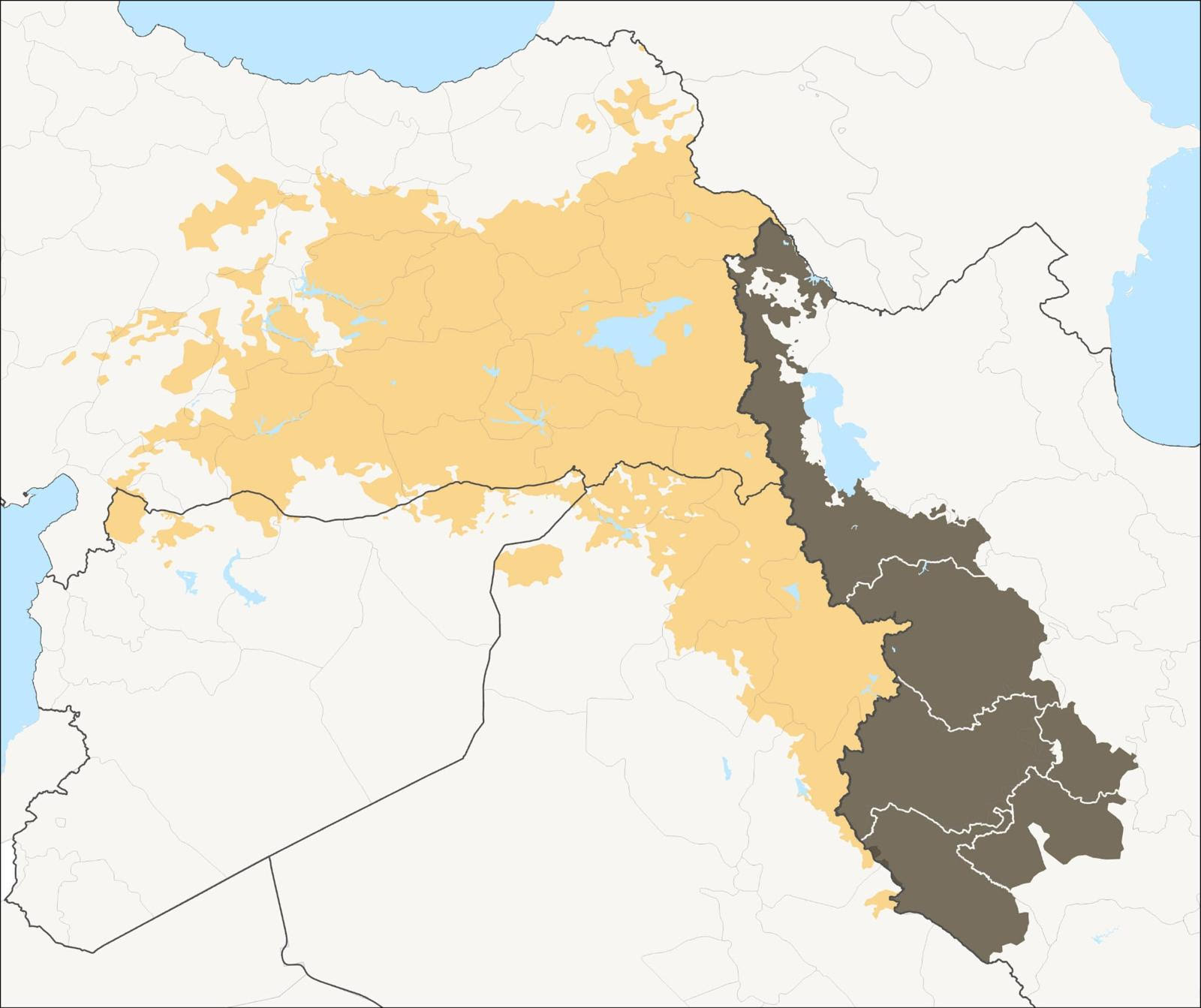
Following Ayatollah Khomeini’s declaration of jihad against the Kurds on 19 August 1979 and the gradual advance of the forces of the Islamic Republic of Iran into Iranian Kurdistan, the two political parties were compelled to relocate most of their bases to Iraqi Kurdistan by 1983. Nevertheless, Kurdish guerrilla warfare against the Iranian central government continued, with varying intensity, until 1990.
As opposition forces to the Islamic Republic of Iran, the two parties benefited from the support of Iraqi President Saddam Hussein, who was then at war with Iran. Hussein permitted their members and organisational bases to establish themselves within Iraq’s internationally recognised borders.
The United States-led intervention in Iraq in 1991 created a structural political opportunity. It enabled the two principal forces of the Kurdish national movement in Iraqi Kurdistan, the Kurdistan Democratic Party (KDP) and the Patriotic Union of Kurdistan (PUK), to establish a durable framework of self-rule and exercise sovereignty in this part of Kurdistan through the establishment of the Kurdistan Regional Government (KRG).
Despite maintaining cordial relations with these two parties, the Iranian Kurdistan parties remained vulnerable to the instability of the region’s political order. According to published reports, more than 600 of their members were assassinated in Iraqi Kurdistan between 1991 and 2005 by operatives affiliated with the Islamic Republic.
The persistence of this pattern, which continues to manifest itself through missile and drone attacks against Iranian Kurdish parties in Iraqi Kurdistan, cannot be divorced from the broader regional power structure within which Kurdish politics operates.
The political position of the Kurdistan Regional Government constrained the ability of the two principal Iranian Kurdish parties to sustain military operations against the Islamic Republic of Iran.
The extensive political, economic, and security ties maintained by the Kurdistan Democratic Party and the Patriotic Union of Kurdistan with neighbouring states—most notably the Islamic Republic of Iran—have situated Iraqi Kurdistan at the intersection of competing regional interests and geopolitical rivalries. Consequently, the region has become not merely a site of Kurdish self-rule but also an arena in which external powers exert considerable influence over local political outcomes.
In this context, both parties have consistently pursued strategies aimed at managing regional tensions and accommodating shifting alliances in ways that preserve a balance of power favourable to their political interests and institutional survival.
The political position of the Kurdistan Regional Government constrained the ability of the two principal Iranian Kurdish parties to sustain military operations against the Islamic Republic of Iran. In this context, the emergence of the Kurdistan Free Life Party (PJAK) in 2004 marked a new phase in Kurdish political and military struggle against the Islamic Republic and in the organisation of Kurdish society in Iran.
Ideologically influenced by Abdullah Öcalan, the Kurdistan Free Life Party combined armed confrontation with efforts to mobilise and organise Kurdish society. By 2011, through continuous clashes with Iranian forces, it had demonstrated considerable military capacity while simultaneously consolidating its influence within popular mobilisation networks and grassroots organisations in Iranian Kurdistan.
Despite these evolving political dynamics, both the Kurdistan Free Life Party and the other Iranian Kurdish parties have been constrained by the fragile political position of the Kurdistan Regional Government, as well as by their own precarious geopolitical circumstances. As a result, they have increasingly adapted their strategies to prevailing political realities by shifting their primary focus towards political, media, and cultural forms of activism. They have sought to preserve their societal ties with the Kurdish population in Iranian Kurdistan through this. This strategic orientation had, at the very least, remained in place until the second phase of military operations conducted against Iran by the US and Israel.
On 10 May 2026, Iraq and the Islamic Republic of Iran convened a meeting of their High Security Committees in Baghdad to address the activities of Iranian Kurdish parties based in the Kurdistan Region of Iraq. According to a statement issued by the office of Iraq’s National Security Advisor, Qassem al-Araji, the two sides reached a security understanding aimed at preventing armed activities perceived as threatening to the national security of either state. The meeting signalled a significant deepening of bilateral security coordination on the Kurdish question, following rounds of negotiations in May and August 2025 during which senior Iranian officials pressed Baghdad to intensify restrictions on Iranian Kurdish opposition groups.
Simultaneously, US President Donald Trump reiterated—in his fourth public statement concerning the Kurds—that Washington had transferred weapons through Kurdish parties with the intention of supporting anti-government protests inside Iran. He claimed, however, that the weapons ultimately never reached their intended recipients.
The attacks, attributed either to Tehran or to Iran-aligned armed groups, continued even after the ceasefire between Tehran and Washington, leaving at least 21 people dead and dozens wounded.
These developments unfolded amid the confrontation between Iran and the US and Israel, during which repeated drone and missile strikes targeted camps and positions belonging to Iranian Kurdish opposition groups in the Kurdistan Region of Iraq. The attacks, attributed either to Tehran or to Iran-aligned armed groups, continued even after the ceasefire between Tehran and Washington, leaving at least 21 people dead and dozens wounded. These attacks further underscored the increasing fragility of security along the Iraqi-Iranian frontier.
Nevertheless, the intensification of pressure on Iranian Kurdish parties in Iraqi Kurdistan substantially predates the recent escalation. Even before last year’s June confrontation, high-level security meetings involving Ali Shamkhani, Ali Larijani, and Qassem al-Araji had focused on institutionalising a broader policy of containment directed at Rojhelati (Iranian) Kurdish parties through dismantling their military infrastructure, removing armed units from border areas, and relocating them into tightly monitored civilian settlements.
The war nevertheless restored the Kurdish question to the centre of Iran’s regional security calculations. Two developments proved particularly consequential: first, the prospect of opening a new front in western Iran involving Kurdish actors; and second, allegations concerning the transfer of weapons to anti-government protest networks inside Iran through Kurdish political and armed structures.
Together, these dynamics revived broader questions regarding the political position of Iranian Kurdish parties and, more fundamentally, their relationship with the Kurdistan Regional Government, a relationship historically embedded in the wider evolution of Kurdish politics across Iran and Iraq.
A further turning point emerged with the Jin, Jiyan, Azadî (Woman, Life, Freedom) uprising in 2022, which originated in Iranian Kurdistan before expanding across Iran. In its aftermath, Kurdish public opinion and the Kurdish intelligentsia increasingly criticised the chronic fragmentation and political disunity of Iranian Kurdish parties, while intensifying calls for greater coordination and collective action.
Despite repeated efforts, meaningful cohesion failed to materialise before the first US-Israeli strikes against Iran in June 2025. In the aftermath of the initial attack, however, six Iranian Kurdish parties established a joint coalition framework that has since issued several statements on political developments in Kurdistan. During the second wave of attacks, expectations were that these parties might attempt to open a ground front from Iranian Kurdistan. Such a scenario, however, never materialised because there were no political guarantees from the US.
Nevertheless, the Islamic Republic’s perception of the Kurdish movement as the most organised opposition force inside Iran has continued to shape its security doctrine. This perception has driven the Islamic Revolutionary Guard Corps (IRGC) toward sustained drone, missile, and aerial attacks against the bases of Kurdish parties, alongside intensified security pressure within Iraqi Kurdistan itself. Repeated meetings between Iran’s Supreme National Security Council and Qassem al-Araji should therefore be understood within this broader strategic and security framework.
Where Do the Kurds Stand?
The political landscape of the Kurds in Iranian Kurdistan is now composed of three principal currents. The first consists of forces historically linked to the experience of the Republic of Mahabad in 1946, with the Kurdistan Democratic Party of Iran representing its central political expression.
The second current is grounded in a synthesis of Marxist political heritage and the Kurdish national question. Komala, together with its three splinter factions, constitutes the principal component of this ideological spectrum.
Under pressure from both Baghdad and Tehran, the Kurdistan Regional Government has at times been compelled to impose restrictions on the political and military activities of these parties.
The third current encompasses groups ideologically aligned with the political and intellectual framework of the Kurdistan Workers’ Party (PKK). The Kurdistan Free Life Party remains the most prominent representative of this tendency, while it has been careful to remain organisationally autonomous from the Kurdistan Workers’ Party itself.
Alongside these three major currents, the Kurdistan Freedom Party (PAK), which advocates an independence-oriented vision; the Khabat Party, with its two religiously oriented branches; and several Islamist organisations operating inside Rojhelat, also seek to maintain a presence in the political arena of Iranian Kurdistan.
Despite significant ideological and organisational divergences, a degree of political coordination continues to exist among these forces. Six parties have established the Alliance of Political Forces of Iranian Kurdistan and share broad common positions regarding both the Kurdish question and the future political structure of Iran. Their political vision is largely centered on the redistribution of power within Iran’s territorial framework, the establishment of a form of federalism, and the institutionalisation of secularism and women’s rights.
Given the longstanding presence of these parties within Iraqi Kurdistan, it is necessary to distinguish between the Kurdish question in Iran and the geopolitical realities of the Kurdistan Regional Government. Owing to its shared border with Iran, the Kurdistan Regional Government leadership remains acutely conscious of its political and geographical limitations within the framework of the Iraqi nation-state. Consequently, it has shown little inclination to engage in projects that could carry substantial regional consequences.
For this reason, although the Kurdistan Regional Government has provided these parties with refuge and varying forms of support, it has simultaneously sought to avoid involvement in any high-risk confrontation with the Islamic Republic of Iran. Under pressure from both Baghdad and Tehran, the Kurdistan Regional Government has at times been compelled to impose restrictions on the political and military activities of these parties.
At the same time, the Iranian Kurdistan parties based in the Kurdistan Regional Government, while fully aware of these constraints, have attempted to position themselves within broader regional dynamics through a cautious and long-term strategic outlook.
During the second wave of military operations carried out by the US and Israel against Iran, reports surfaced on the possible opening of a military front through Iranian Kurdistan against the Islamic Republic. Nevertheless, none of the Iranian Kurdistan parties agreed to participate in such a project. This position can be understood through at least three interrelated factors.
Engagement with any of these actors, combined with the continuing uncertainty surrounding the future political structure of Iran, has reinforced both strategic caution and political pragmatism among the Rojhelati parties.
First, the Iranian Kurdistan parties, while conscious of their fragile geopolitical position within the Iraqi Kurdistan, sought greater clarity on Washington’s ultimate strategic objective in Iran. Not only these parties, but also much of the international community, has continued to await a clearer understanding of whether the US seeks the complete overthrow of the Iranian political system or merely the containment of Iran’s nuclear and missile programmes.
The second factor concerns the historical nature of external support for the Kurdish question. The Kurdish political movement in Iranian Kurdistan has not forgotten the experience of the Republic of Kurdistan in Mahabad in 1946 and the subsequent withdrawal of the Soviet Union from Iran and Kurdistan.
At that time, the Soviet Union, having recognised the political potential of Kurdish society, played a decisive role in the establishment of the Republic of Kurdistan in Mahabad, yet ultimately withdrew without offering any durable political vision for the Kurdish question. The political memory of the Kurds in Iranian Kurdistan remains deeply unwilling to witness the repetition of such a tragedy, particularly on a potentially larger scale.
The third factor relates to the fragmented condition of the Iranian opposition itself. The Iranian Kurdistan parties cannot detach themselves from the broader political landscape of Iran. At present, the Iranian opposition encompasses highly diverse forces, ranging from supporters of the Pahlavi monarchy and the Mujahedin-e Khalq Organisation to religious groups, intellectuals, and political activists operating both inside and outside the country. Engagement with any of these actors, combined with the continuing uncertainty surrounding the future political structure of Iran, has reinforced both strategic caution and political pragmatism among the Rojhelati parties.
Limits on Political Decision-Making
At present, political horizons remain opaque. The strategic ambiguity surrounding American and Israeli policies, largely centered on dismantling Iran’s highly enriched uranium stockpiles, constraining its ballistic missile programme, and weakening its regional proxy networks has effectively left the question of a post-Islamic Republic order unresolved. So, no coherent political vision has yet emerged regarding the future structure of power in Iran beyond the current regime.
Since the onset of the second wave of attacks, the bases of the Iranian Kurdistan parties in Iraqi Kurdistan have been subjected to sustained missile and drone strikes. Concurrently, the civilian families affiliated with these parties have experienced escalating forms of security-related, psychological, and economic pressure. With the exception of the Kurdistan Free Life Party, which over the past decade has succeeded in establishing fortified military infrastructure deep within the mountainous frontier zones separating Iraq and Iran, the remaining parties continue to function under profoundly precarious security conditions.
The Islamic Republic continues to retain the capacity to pose an existential threat not only to the Rojhelati parties, but also to the Kurdistan Regional Government itself.
Both earlier and more recent meetings between security officials of the Islamic Republic of Iran and Qassem al-Araji, together with the legal and geopolitical constraints shaping the Kurdistan Regional Government’s relationship with the Rojhelati parties, have exercised considerable influence over the political calculations of these parties’ leaderships.
Within this restrictive structural context, two principal approaches are currently being debated within the political circles of the Rojhelati parties. The first advocates the return of armed cadres to the mountains of Kurdistan. The second, in the event of sustained pressure from the Islamic Republic, the Iraqi central government, and the Kurdistan Regional Government, involves the possibility of seeking political asylum in third countries.
Nevertheless, the historical experience of the Kurdish movement across all four parts of Kurdistan demonstrates recurring cycles of ascent and decline. Even in its most critical phases, periods of crisis have simultaneously generated new possibilities for political openings and the emergence of alternative spaces of opportunity. Yet, despite its deep structural fragility, the Islamic Republic continues to retain the capacity to pose an existential threat not only to the Rojhelati parties, but also to the Kurdistan Regional Government itself.
It is precisely within this complex structural environment that the Rojhelati parties appear to be attempting, with a clear awareness of prevailing constraints, to offset structural limitations through the strategic utilisation of political opportunities; opportunities they largely believe could materialise only through fundamental democratic changes in the political system of Iran. However, they are well aware that they are not in the position to bring about such changes on their own. In addition to strengthening their internal unity, the Rojhelati parties have therefore been actively seeking stronger ties with the diverse landscape of opposition forces in Iran.
Azad Haji Aghaie is a Kurdish academic and political analyst.