


Within a week in early 2026, the government of India performed a veritable miracle by agreeing to bilateral free trade agreements (FTAs) with the two largest economies, the United States and the European Union (EU). The two decisions have fundamentally altered India’s trade policy, the implications of which can only be understood when their granular details are revealed after they are officially endorsed by the governments.
The US-India FTA is mired in legal uncertainties following the US supreme court ruling against President Trump’s strategy of imposing unilateral reciprocal tariffs on trade partners, which were then used as a leverage to conclude trade deals.
However, as of now, the two FTAs are headed in different directions. The EU-India FTA is following the official procedures that are laid down for the 27-member bloc. The draft chapters of the FTA have been published in keeping with the transparency policy of the European Commission (EC). 1European Commission. 2026. EU-India: Text of the agreements. The European Commission has clarified that these “texts are published for information purposes only and may undergo further modifications, including as a result of the process of legal revision”.
The text of the agreement is awaiting approval of the Council of Europe before the two governments officially endorse it. 2The Council of Europe plays a crucial role in the shaping of trade deals of the 27-member bloc as it decides the negotiating mandate based on which the European Commission conducts the negotiations. At the conclusion of the negotiations, the Commission presents the outcome to the Council for the signature and conclusion of the agreement. Then, the European Parliament will ratify the agreement, setting the stage for its implementation. This effectively means that the details of the FTA will not be known until early 2027.
The US-India FTA is considerable thinner on details, with only a US-India Joint Statement available in the public domain. 3PIB. 2026. United States-India Joint Statement. 7 February. The Joint Statement reflects President Donald Trump’s decision to lower the 50% “reciprocal tariff” imposed on US imports from India in September 2025 to 18% and eliminate tariffs on select products. But the statement did not explicitly clarify if India can continue to provide adequate tariff protection to sensitive agricultural commodities essential for its food and livelihoods security. 4Dhar, Biswajit. 2026. “Ambiguities in the U.S.-India Trade Deal”. The Hindu. 23 February.
This FTA is currently mired in legal uncertainties following the US supreme court ruling against President Trump’s strategy of imposing unilateral reciprocal tariffs on trade partners, which were then used as a leverage to conclude trade deals. In its majority ruling, the supreme court argued that President Trump had used the International Emergency Economic Powers Act (IEEPA) to impose reciprocal tariffs even though this statute does not allow him to do so, and more critically, the US Constitution allows only the US Congress to impose tariffs and other taxes. 5Chief Justice John Roberts leading the majority decision quoted the US Constitution, which emphasises, “The Congress shall have Power To lay and collect Taxes, Duties, Imposts and Excises.” The Court, thus, opined that the framers of the Constitution “recognised the unique importance of this taxing power”—a power which “very clear[ly]” includes the power to impose tariffs, and that they “did not vest any part of the taxing power in the Executive Branch”. See, Learning Resources, Inc. v. Trump No. 24–1287, 784 F. Supp. 3d 209. The ruling of the supreme court put a question mark over the ability of the Trump administration to conclude trade deals without being authorised by the US Congress. 6Since 1974, the US Congress has enacted Trade Promotion Authority (TPA) legislation that underlines the negotiating objectives and priorities for trade agreements of the US. The TPA reaffirms the Congress’s overall constitutional role in the development and oversight of US trade policy, which seems to have been reinforced by the ruling of the supreme court. For details on the TPA, see USTR. n.d. Trade Promotion Authority.
With the US-India FTA back on the drawing board, this article analyses the likely implications of the EU-India FTA from the point of view of the additional market access India could expect. It is important to note that the EU-India FTA has a very different structure from the bilateral trade agreements India had negotiated before its decision to launch FTA negotiations with the EU in 2007.
Recent estimates show that non-tariff measures affect nearly 90% of global trade by volume and are six times more significant than they were three decades ago.
While the earlier FTAs included tariff-cutting exercises and the opening of markets for services, India agreed to include in the negotiating mandate a plethora of regulatory standards, or non-tariff measures (NTMs), 7A distinction should be made between these NTMs and non-tariff barriers (NTBs) like quantitative restrictions that are used explicitly for restricting imports. However, if product/process standards, for instance, become too stringent and do not have a scientific basis, NTMs can have similar import restricting effects as NTBs. typical of FTAs to which advanced countries are parties. In the EU-India FTA, NTMs include food safety standards and other product and process standards, measures for the protection of the environment, and labour standards, and they are included in six of the 20 chapters of the agreement. 8Intellectual property (IP) standards are the seventh regulatory standards included in the FTA. Like the other forms of regulatory standards, IP standards can also be included as a form of NTMs, as ratcheting up of these standards can adversely affect Indian industries, especially the generic pharmaceutical industry. This industry has benefited from the country’s Patents Act that includes provisions that are explicitly included. See Biswajit Dhar and Reji K. Joseph. 2019. “The Challenges, Opportunities and Performance of the Indian Pharmaceutical Industry Post-TRIPS”, in Kung-Chung Liu and Uday S. Racherla (eds), Innovation, Economic Development, and Intellectual Property in India and China, ARCIALA Series on Intellectual Assets and Law in Asia.
The incidence of NTMs has consistently increased since the establishment of the World Trade Organization (WTO), coinciding with a steady reduction in tariffs. 9Data provided by the World Integrated Trade Solution (WITS) shows that global average tariffs declined from about 14% in 1994, a year before the WTO was established, to just above 5% in 2023. Recent estimates show that NTMs affect nearly 90% of global trade by volume and are six times more significant than they were three decades ago. 10Gill, Indermit. 2026. “The Biggest Drag on Global Trade isn’t Tariffs, but Standards”. The Economist. 22 January. NTMs have thus more than compensated for the reduction in tariffs.
Despite their growing importance, the reality of NTMs has not been properly factored in by India’s trade policy makers in their assessments of FTA outcomes. Tariff reductions continue to guide their assessments of bilateral trade agreements.
This will be clear from the discussion in the following section, which provides a brief overview of the outcomes presented in government narratives. The next section deals with three specific forms of NTMs: food safety and product and process standards, standards for the protection of the environment, and labour standards. The likely impact of these NTMs on India’s future market access prospects is discussed in the final section.
I. Government Assessments
At the conclusion of the EU-India FTA negotiations, the most protracted ever for a bilateral trade deal, both governments are optimistic about the expected benefits. The Government of India described the deal as “a comprehensive partnership with strategic dimensions” and “one of the most consequential FTAs”. It pointed out that India secured preferential access in 97% of tariff lines, accounting for more than 99% of its exports by trade value to the EU, 11PIB. 2026. Factsheet: India and European Union Trade Agreement “Mother of All Deals” Unlocking Opportunities Empowering India@2047. and “high-value commitments in services complemented by a comprehensive mobility framework enabling seamless movement of skilled Indian professionals”. 12PIB. 2026. India–EU Free Trade Agreement Concluded: A Strategic Breakthrough in India’s Global Trade Engagement.
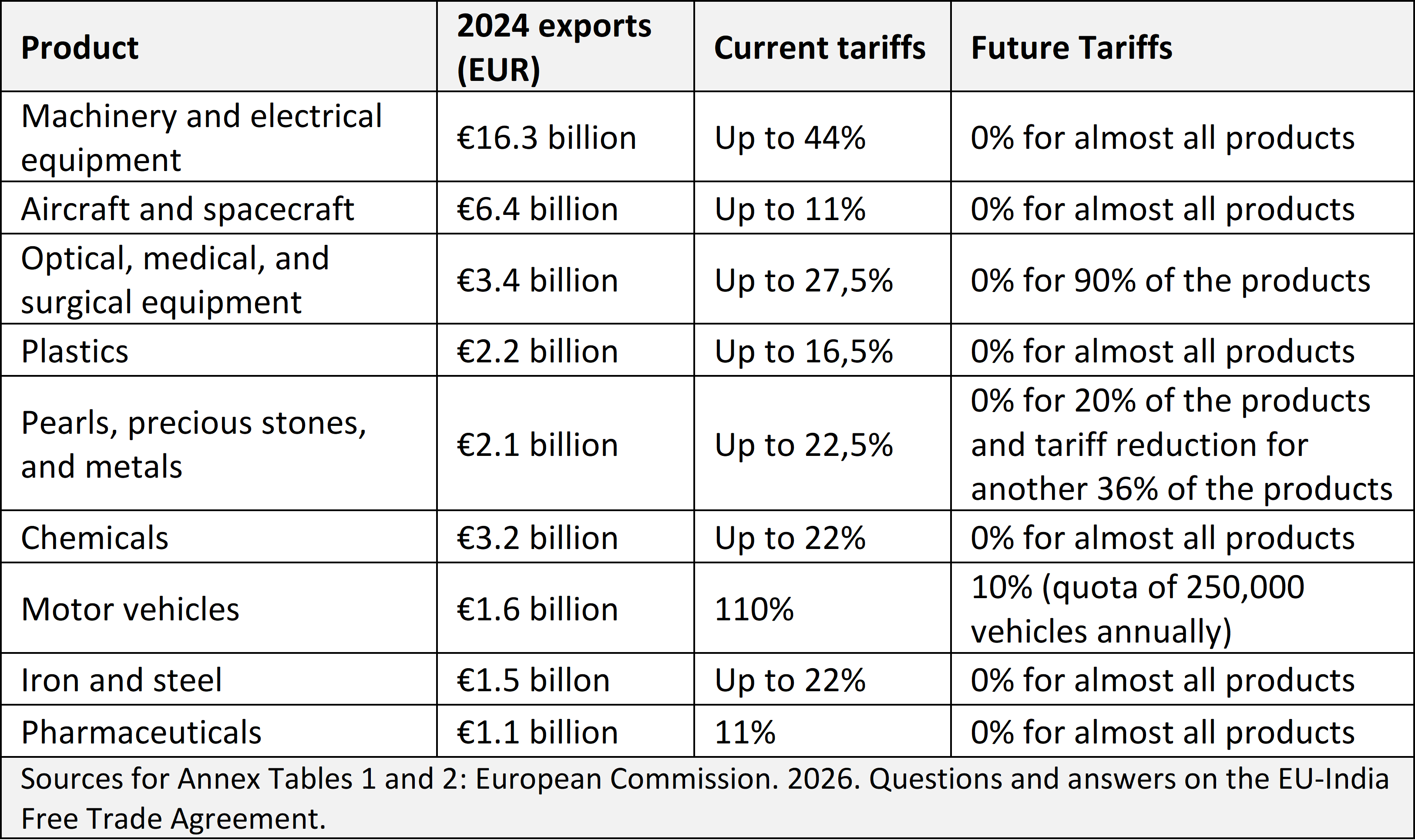
India’s hopes of increasing its merchandise exports to one of its largest trade partners, hinges on the EU’s decision to eliminate its tariffs on 99% of its exports terms of trade value. 13This assessment is based on the Government of India’s press release immediately following the conclusion of the deal. See, PIB. 2026 above. Of India’s current exports to the EU, 90.7% by value (or 70.4% of tariff lines at the 6-digit level) would attract no import duties once the FTA comes into effect. This would benefit several labour-intensive industries, including textiles, leather and footwear, sports goods, and gems and jewellery, as well as tea, coffee, spices, and certain marine products.
Import duties on a further 6.1% of tariff lines covering 6% of India’s exports would be reduced, with the beneficiaries including certain poultry products, preserved vegetables, and bakery products.
Duty-free access after three to five years would be available to 20.3% of tariff lines, accounting for 2.9% of India’s exports to the EU, benefiting certain marine products, processed food items, and arms and ammunition. Import duties on a further 6.1% of tariff lines covering 6% of India’s exports would be reduced, with the beneficiaries including certain poultry products, preserved vegetables, and bakery products.
In addition, tariff rate quotas (TRQs) would be put in place for cars, steel, and certain shrimp and prawn products. The Indian government expects agricultural and processed food exports to receive “a transformative boost” from EU tariff cuts, as lower tariffs would make these products more competitive in the EU.
Increasing service sector exports, especially through the temporary movement of professionals, has been one of India’s primary interests in bilateral trade deals. According to the Government of India, the EU has offered enhanced access to Indian businesses across 144 services subsectors, including information technology and IT-enabled services (IT/ITeS), professional services, education, and other business services.
The EU has also agreed to provide “seamless movement of skilled Indian professionals”—one of India’s key demands. Indian professionals would accordingly have better possibilities to provide services to EU clients in 17 sub-sectors in IT, research and development (R&D), and higher education, and in knowledge-driven trade.
The EU-India FTA is the first bilateral trade agreement negotiated by India that not only recognises Indian traditional medicine (ITM) services as health and wellness-related services but also facilitates trade in such services. The EU has allowed providers of these services to operate in its territory under the professional title obtained in India, provided that the supply of traditional medicine services is not considered a “regulated profession”.
In jurisdictions where such services are considered a “regulated profession”, traditional knowledge practitioners are required to possess specific professional qualifications, including a medical degree. 14India’s position regarding inclusion of labour standards in trade agreements remained unchanged since it was explicitly stated by the then Commerce Minister, Murasoli Maran at the Doha Ministerial Conference in 2001. This is an example of a regulatory standard that could influence India’s access to the EU’s services markets.
India has agreed to reduce or eliminate tariffs on almost 97.5% of its imports from the EU, covering 92% of tariff lines. 15These restrictions include, to strike work, to openly criticise government policies, to freely accept financial contribution, and to freely join foreign organisations. See, Lok Sabha. 2014. Ratification of ILO Conventions. Unstarred Question No:4513. The EU estimates that it could double its merchandise exports to India by 2032.
The EU’s two-decade-long wait for a bilateral trade deal with India appears fully justified, as it has secured substantial concessions to increase its presence in the world’s sixth largest economy. India has agreed to reduce or eliminate tariffs on almost 97.5% of its imports from the EU, covering 92% of tariff lines. 15These restrictions include, to strike work, to openly criticise government policies, to freely accept financial contribution, and to freely join foreign organisations. See, Lok Sabha. 2014. Ratification of ILO Conventions. Unstarred Question No:4513. The EU estimates that the reduction of import tariffs could double its merchandise exports to India by 2032. 16European Commission. 2026. EU and India conclude negotiations for largest trade deal in their history.
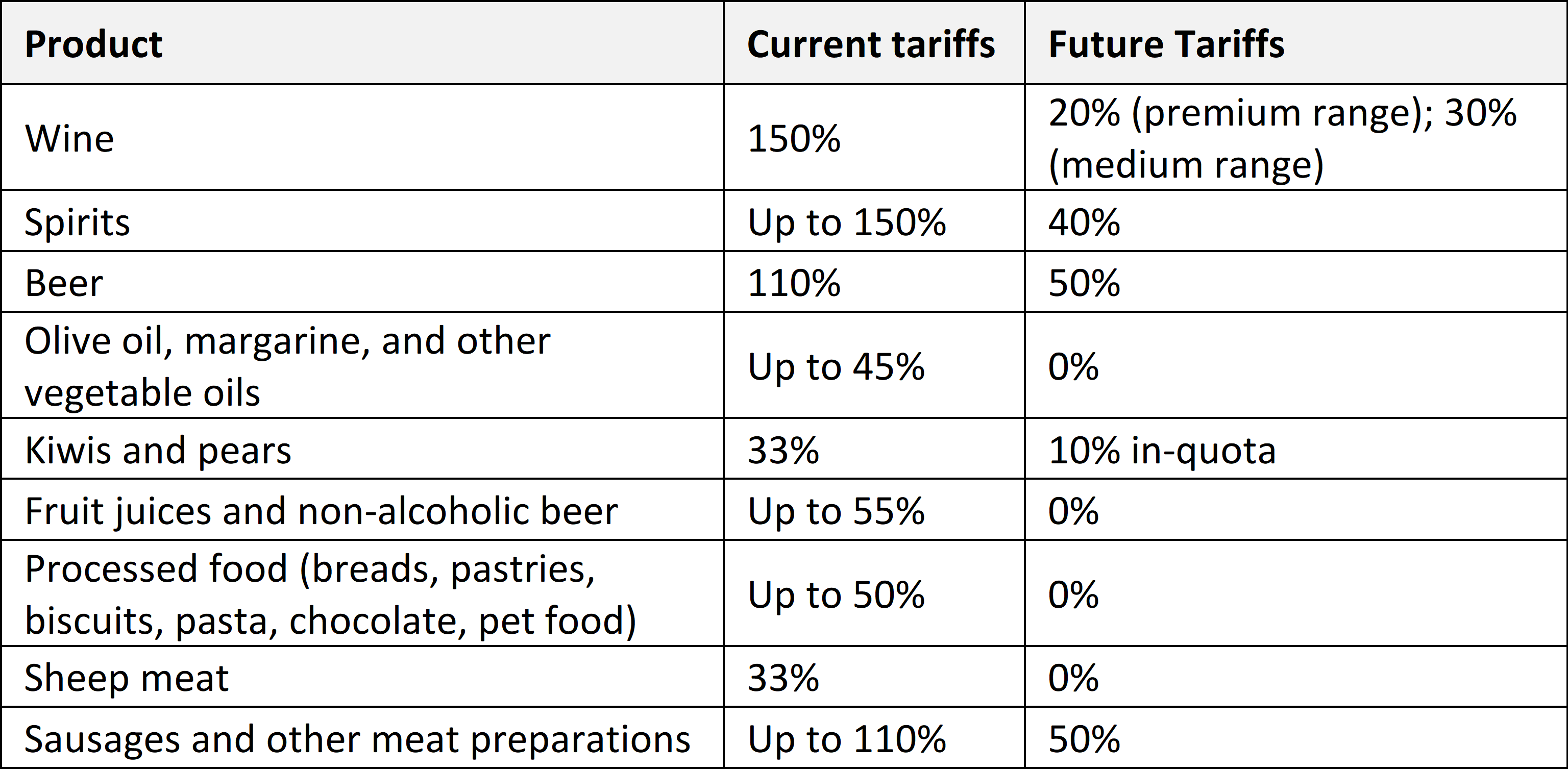
India would eliminate tariffs on almost 50% of the products it imports from the EU immediately after the FTA comes into effect, with import duties on another 40% of its imports to be eliminated within five to ten years. India would regulate imports of apples, pears, peaches, and kiwi fruit using tariff rate quotas.
Among India’s significant offers is reduction of tariffs on automobiles from 110% to 10%, though imports from the EU would be regulated through an annual quota of 250,000 cars. 17This discussion is based on the European Commission’s assessment of the trade deal. See, European Commission. 2026. EU–India Free Trade Agreement Concluded: Major Global Trade Milestone. This is a major gain for the EU as India’s refusal to reduce its automobile tariffs on automobiles was one of the main reasons for the stalemate in the negotiations. India has also agreed to reduce and/or import duties on pharmaceuticals, processed agricultural products and wines, though several products would see phased reduction/elimination of tariffs.
The two governments have not disclosed much about the nature of their commitments in the services sector. However, two annexes on financial services and telecommunications suggest that there would be significant policy coordination between the EU and India in these sectors.
India has been conservative in opening its financial services sector in all previous FTAs, but the EU appears to have extracted several concessions, including India’s de facto acceptance of the WTO’s Understanding on Commitments in Financial Services—which is not part of India’s commitments under the General Agreement on Trade in Services (GATS).
Among India’s significant offers is reduction of tariffs on automobiles from 110% to 10%, though imports from the EU would be regulated through an annual quota of 250,000 cars.
India’s implementation of this “Understanding” would result in an important change in its foreign direct investment (FDI) policy. While India does not currently allow 100% foreign ownership in several financial services, the “Understanding” requires that foreign financial service suppliers be given “the right to establish or expand within its territory, including through the acquisition of existing enterprises, a commercial presence”. In other words, India must allow the establishment of fully foreign-owned entities.
Furthermore, the EU has reported that India has “agreed to incorporate and implement most of the rules agreed under the WTO Domestic Regulation Joint Initiative”, of which India has been a strident critic. 18European Commission. 2005. Directive 2005/36/EC of the European Parliament and of the Council on the recognition of professional qualifications.
Though the Government of India is optimistic about its gains from this FTA, the realisation of expected benefits may not be as straightforward as it appears, given that the EU is an extensive user of regulatory standards, or NTMs. The EU has acquired the reputation of a “regulatory superpower”, shaping global markets through its regulatory standards. Though “EU regulations are meant to protect consumers, uphold human dignity and promote an ethical form of capitalism”, they also act as effective NTMs.
The EU has been adding to its inventory of regulatory standards as the single market has expanded and consolidated over the three decades of its existence. From its early days, the bloc was described as “Fortress Europe”, having adopted the “strategy of establishing one set of approved standards for certain products”.
Many of these key regulations are embedded in its FTA with India. A few aspects of the EU’s complex regulatory structure are discussed briefly below, to allow a better understanding of the challenges that Indian businesses could face once the EU-India FTA is implemented.
II. Regulatory Standards
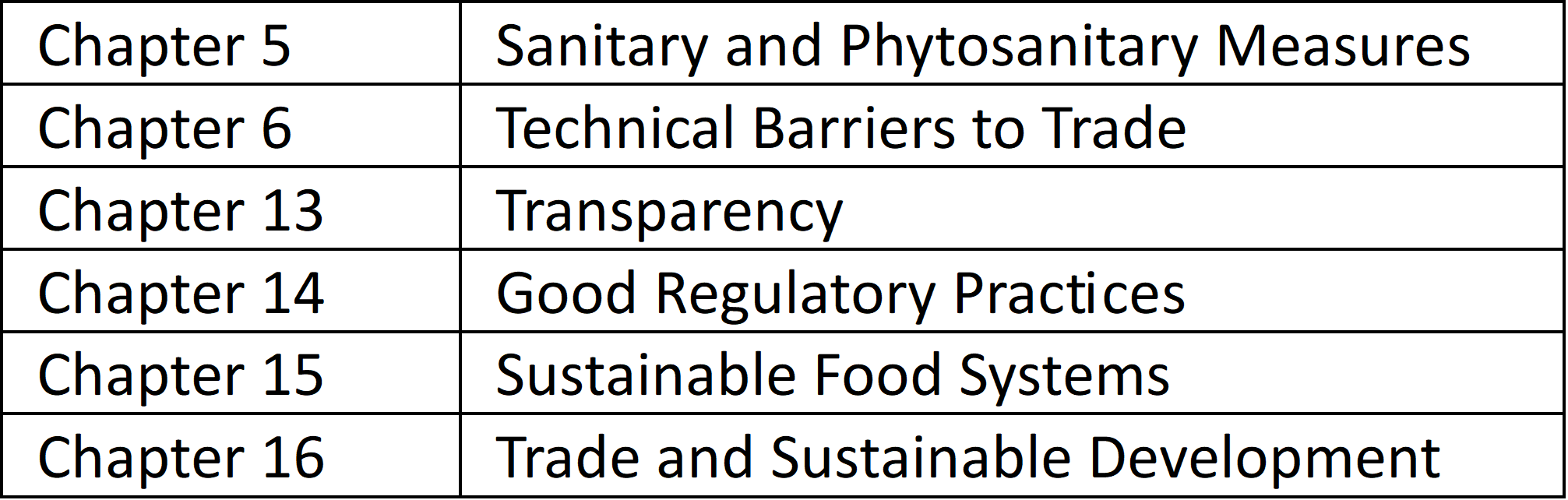
As noted earlier, of the 20 chapters in the EU-India FTA, NTMs are the subject matter of at least six chapters, not counting intellectual property protection. A list of these chapters is provided in Annex Table III. This section discusses four of the more important NTMs: sanitary and phytosanitary measures, technical barriers to trade, environmental standards, and international labour standards.
(i) Food Safety and Product Quality Standards
Compliance with the EU’s complex regulatory standards will be critical for Indian businesses seeking to realise the expected gains from this FTA. The European Commission has made clear the significance it attaches to these regulations, stating that “human, animal, and plant health are non-negotiable”. It has emphasised that the bloc follows very stringent, science-based standards to protect human, animal, and plant health, and that all products imported from India under the agreement would have to respect these standards without exception.
The European Commission has emphasised that the bloc follows very stringent, science-based standards to protect human, animal, and plant health, and that all products imported from India would have to respect these standards.
Critical to the implementation of EU food safety regulations are “Impact Assessments” that analyse the potential alignment of production standards between domestic and imported products, especially on pesticides and animal welfare.
The chapter on Sanitary and Phytosanitary (SPS) Measures demands greater transparency and predictability for trade in plant and animal products, including marine products. It introduces clear timelines and mechanisms for important procedures such as import conditions and approvals, audits, adaptation to regional conditions for animal and plant health, listing of establishments for products of animal origin, exchange of information, and certification.
The chapter on Technical Barriers to Trade (TBT) insists on effective implementation of the WTO Agreement on Technical Barriers to Trade. This agreement stipulates that “technical regulations are not prepared, adopted or applied with a view to or with the effect of creating unnecessary obstacles to international trade” and that they should “not be more trade restrictive than necessary to fulfil a legitimate objective”. 19Article 2.2 of the WTO Agreement on Technical Barriers to Trade. Additionally, technical regulations must be based on relevant international standards.
The EU has established elaborate domestic regulations to implement SPS and TBT measures. The General Food Law Regulation (Regulation 178/2002) provides an overarching and coherent framework for the development of food and feed legislation, covering all stages of food and feed production and distribution. Similarly, non-food consumer products are covered by the General Product Safety Regulation (Regulation [EU] 2023/988), which ensures that consumer products must be safe and that member states’ market surveillance authorities must act against dangerous products.
The Indian government expects its agricultural and processed food exports to receive “a transformative boost” from EU tariff cuts. In 2024-25, these products accounted for just over 7% of India’s total exports to the EU.
Both regulations include mechanisms to ensure effective implementation. The Rapid Alert System for Food and Feed (RASFF) ensures the exchange of information between EU member states, enabling food safety authorities to take swift action in case of risks to public health arising from the food chain. The Safety Gate is the rapid alert system for dangerous non-food products.
Over the years, the number of products originating from India that the RASFF has labelled as carrying varying levels of risk has consistently been high. In 2024 and 2025, the RASFF identified 217 and 211 products from India respectively as carrying potential risk, potentially serious risk, or serious risk—the second highest after Turkey. 20Author’s calculation using data from the RASFF database, See, European Commission. 2026. RASFF Window.
As noted earlier, the Indian government expects its agricultural and processed food exports to receive “a transformative boost” from EU tariff cuts. In 2024-25, these products accounted for just over 7% of India’s total exports to the EU, while during the same period India’s total agricultural and processed food exports accounted for over 12% of its total exports. There is thus potential for increasing exports to the EU—potential that can be realised if adequate investments are made in upgrading production facilities as well as regulatory institutions in the country.
(ii) Environmental Standards and International Labour Standards
The EU has been a strong votary of environmental protection and labour rights, both of which are articulated in the FTA in the chapter on Trade and Sustainable Development. This chapter introduces two sets of regulations intended to enhance environmental protection and the adequate protection of workers’ rights. India had consistently opposed the inclusion of these issues in trade agreements, arguing that doing so would constrict its sovereign policy space.
The EU has favoured strict measures for reducing the emission of greenhouse gases (GHGs) and introduced an Emission Trading System (ETS) to regulate their emission within its jurisdiction in 2005. From earlier this year, the EU has introduced the Carbon Border Adjustment Mechanism (CBAM) to restrict imports of products from countries whose GHG emissions are relatively higher. The CBAM is a carbon tax imposed at the border on imports, initially covering six carbon-intensive sectors deemed at high risk of carbon leakage: iron and steel, aluminium, cement, fertilisers, hydrogen, and electricity.
The EU is a significant market for two of the sectors covered under the CBAM—iron and steel, and aluminium—and this market has grown over the past few years.
The CBAM would increase compliance costs, as Indian exporters would have to meet the EU’s exacting emission norms to enter the single market. The EU is a significant market for two of the sectors covered under the CBAM—iron and steel, and aluminium—and this market has grown over the past few years. EU members accounted for almost 22% of India’s exports of iron and steel in 2019-20, rising to over 25% by 2024-25. Similarly, the share of aluminium exports to the EU increased from 8% to 14% during the same period.
The only silver lining is that the EU has offered to extend to India some concessions it had earlier provided to the US. In late 2025, the EU allowed concessions to smaller US exporters, exempting their EU importers from reporting requirements. 21European Commission. 2025. Report from the Commission to the European Parliament and the Council: On the application of the Regulation on the Carbon Border Adjustment Mechanism.
In all its FTAs, the EU has introduced international labour standards, insisting that partner countries commit to promoting trade in a way conducive to decent work for all, 22Decent work means “opportunities for everyone to get work that is productive and delivers a fair income, security in the workplace and social protection for families, better prospects for personal development and social integration”, and is the core of SDG8. as expressed in the International Labour Organization (ILO) Declaration on Social Justice for a Fair Globalization of 2008. India, on the other hand, had consistently opposed any explicit linkage between trade agreements and international labour standards, arguing that this would amount to the imposition of yet another formidable non-tariff barrier. 23India’s position on inclusion of labour standards in trade agreements remained unchanged since it was explicitly stated by the then Commerce Minister, Murasoli Maran, at the Doha Ministerial Conference in 2001.
In its FTA with the EU, India has made a major departure from its past position by agreeing to include provisions on “Multilateral labour standards and agreements”, explicitly introducing international labour standards into the agreement. The chapter on Trade and Sustainable Development includes two important provisions in this regard. First, India and the EU “recognise that violation of fundamental principles and rights at work cannot be invoked or otherwise used as legitimate comparative advantage”—in other words, labour exploitation cannot be used to gain unfair advantage. Second, labour standards should not be used for protectionist trade purposes, which suggests that non-implementation of international labour standards would not be used as justification for imposing trade barriers.
III. Final Word
India's largest FTA has brought with it expectations that the country’s merchandise exports would increase significantly. For these expectations to be realised, however, Indian businesses would have to prepare themselves to comply with the plethora of regulatory standards that the EU has included in the FTA.
In all its FTAs with major economies, projected gains have not been realised due to India’s lack of preparedness. These FTAs have witnessed an anomalous situation in which India’s trade deficits with its partners have consistently increased. The Government of India needs to work in close coordination with business to avoid repeating this dubious record while implementing what EU President Ursula von der Leyen described as the “mother of all deals”.
Biswajit Dhar is a development economist and former Professor, Jawaharlal Nehru University.