




On 27 December 1968, the crew module of Apollo 8 splashed down in the Pacific achieving several firsts for humankind. The three astronauts in it were the first humans to reach and orbit the Moon and return to Earth. The iconic image of earthrise taken by them from their lunar orbit remains etched in our minds. Almost 58 years later, on 10 April 2026, the Orion capsule with four astronauts returned to Earth after going around the Moon. And as it turned out, they too managed to observe earthrise while orbiting the Moon.
Although the American Pioneer 4 probe flew by the Moon soon after Luna 1, the next few American probes were not successful. The Soviet lead in space exploration was unchallenged.
The four astronauts were part of the ambitious Artemis programme whose stated goal is to “explore more of the Moon for scientific discovery, economic benefits and to build a foundation for the first crewed missions to Mars”. The name of the programme is significant—Artemis is the Greek goddess of hunting and nature who is Apollo’s twin sister and is associated with the Moon. In a sense, the programme is a sequel to the Apollo programme of landing on the Moon.
The Orion space capsule was part of Artemis II, the second in the series and the first crewed flight. Artemis I was an unmanned mission to test the launch vehicle as well as the systems on the Orion spacecraft. After a series of delays, the launch of Artemis I in November 2022 was successful and the spacecraft splashed down almost a month later after orbiting the Moon.
Missions to the Moon
Lunar missions have a long history. In 1959, just two years after the launch of the first artificial satellite Sputnik, the Soviet Union launched Luna 1, which became the first spacecraft to reach the vicinity of the Moon. A few months later, Luna 3 crash landed on the Moon after sending pictures of the far side of the Moon. Although the American Pioneer 4 probe flew by the Moon soon after Luna 1, the next few American probes were not successful. The Soviet lead in space exploration was unchallenged.
Then in 1961 President John F, Kennedy announced that the Americans would be “before this decade is out, landing a man on the Moon and returning him safely to Earth”. The Apollo programme, which had been initiated before Kennedy’s speech, was now provided with ample political and budgetary support to make this possible. The goal was achieved on 20 July 1969, with astronauts aboard Apollo 11 landing on the Moon.
Although the Apollo programme which went on till 1972 and was quite successful, the focus shifted to development of an orbital platform (Skylab) as well as building a reusable shuttle. The Soviets continued the Luna programme of unmanned lunar exploration. The American, Soviet (later Russian), and subsequently the Chinese, Japanese, and Indian space programmes have explored not just the Moon, but also other celestial objects such as Venus, Mars, Jupiter, Saturn and asteroids. However, after the Apollo programme, human presence in space has been restricted to low earth orbits.
Artemis to the Moon and Beyond
The Artemis programme began in 2017 with the express purpose of landing a man on the Moon as well as exploring the feasibility of a crewed journey to Mars. The idea was to develop new systems, test them, and ultimately use them to land on the Moon. The programme was sub-divided into five missions, each with increasing level of complexity culminating in the lunar landing of humans.
Their path not only took them to the farthest distance that humans have been from the Earth but also allowed them a fairly close-up view of the far side of the Moon.
The programme is designed to be a multinational collaboration based on the Artemis Accords, which were established in 2020. The rationale for the accord was to lay down a common set of governance principles for exploration of and use of outer space. Till date, 61 countries, including India, and several private companies have signed the accords. Notable exceptions to the signatories are Russia and China.
The basic hardware for the missions consists of a newly developed Space Launch System (SLS) for launching the Orion spacecraft to a trajectory which will carry it to the Moon. The Orion spacecraft has a crew module as well as a service module designed by the European Space Agency. Future missions will also have a Human Landing system, which is being designed by private companies Blue Origin and Space-X.
The SLS is the most powerful launch system in existence, more powerful than the Saturn V, which was used in the Apollo programme. It is not only the hardware that has advanced significantly since the days of the Apollo landings—exponential improvements in computational processing power over the last five decades mean that the various control and automation systems on the spacecraft are now far more advanced than those available when the Apollo astronauts went to the Moon.
Although the SLS had been tested in various test flights, the Orion spacecraft needed to undergo tests under actual conditions, and this was done with Artemis I. The test was successful but the heat-shield (the part of the spacecraft which protects the interior from extreme temperatures that result from the re-entry of the spacecraft into the Earth’s atmosphere) was seen to have developed some problems, and they were subsequently fixed.
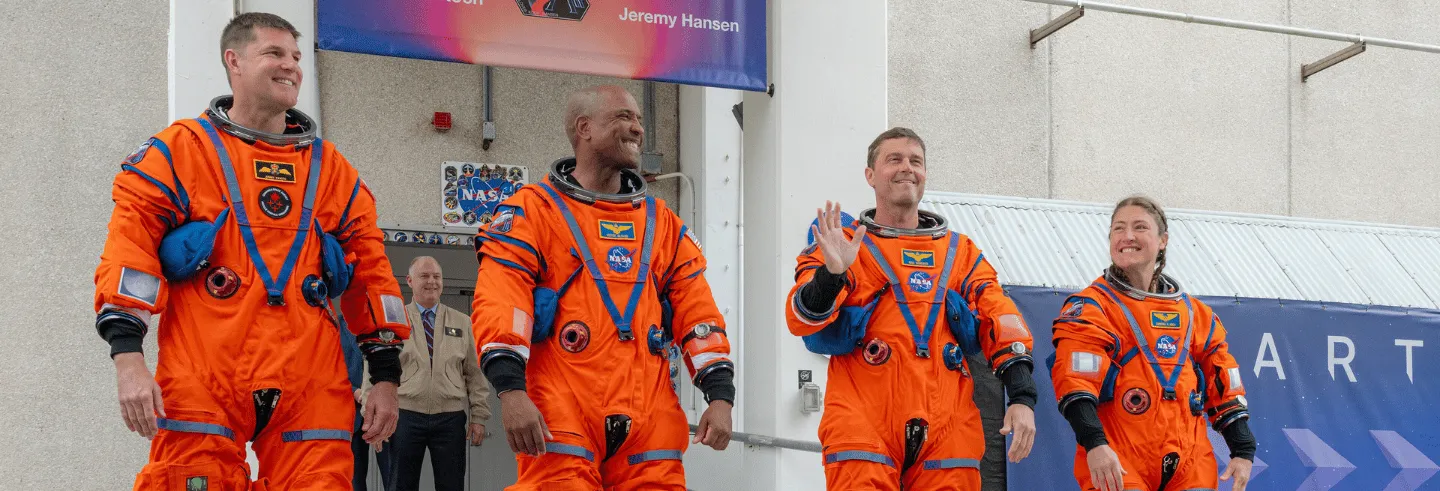
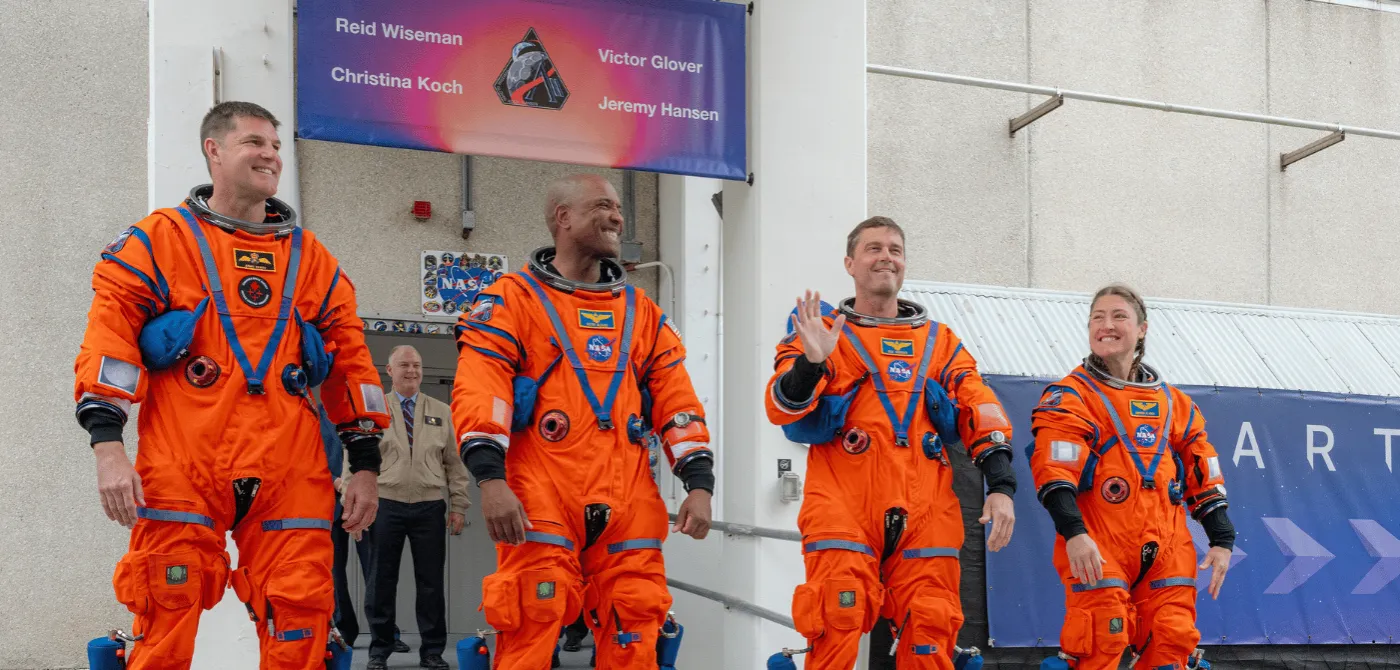
Artemis II, a crewed mission with four astronauts was launched on 1 April 2026. The Orion spacecraft that separated from the SLS carried three Americans (including, for the first time, a person of colour and a woman) and a Canadian on a trajectory resembling the figure 8 around the Moon and then back to Earth. Their path not only took them to the farthest distance that humans have been from the Earth but also allowed them a fairly close-up view of the far side of the Moon.
The far side or the dark side of the Moon is the lunar hemisphere that is not visible from the Earth because of a phenomenon called tidal locking. It is not dark and is slightly better illuminated than the visible side of the Moon. All the Apollo landings were on the bright side though several unmanned spacecraft, including the Chinese Chang’e 6 that collected lunar samples in June 2024, have explored it.
This was now the time of the Cold War and so von Braun and his teams’ complicity in the war crimes perpetrated by the Nazis was deemed to be secondary to “national security”.
Since Artemis II was essentially a mission to test technology, there were understandably no major scientific achievements. The technology though worked almost flawlessly but for a $23-million toilet on Orion that malfunctioned. This has set the stage for Artemis III, which will test the Human Landing System on the Moon. Actual landing of humans is scheduled for Artemis IV in 2028.
Subsequently, regular landings on the Moon are planned, with the intention of establishing a lunar base. This permanent base, with sustained human habitation on the lines of the International Space Station, is to be used to explore and exploit resources available on the Moon—among them several rare earths as well as helium-3.
More than Science
The Americans are not the only ones who are planning to return to the Moon and establish a base there. The Chinese plan to land a “taikonaut” on the Moon by 2030. In a way, we are witnessing a repeat of the space race that is traditionally thought to have begun with the Sputnik and culminated in the Apollo landings. As a matter of fact, the space race began much earlier with the end of World War II.
The fall of Nazi Germany led to a scramble by the Americans and the Soviets to lay their hands on German industry and technology. Among the prized assets were German space scientists who had developed the V2 rockets used to such devastating effect on Britain during the war. The Americans managed to grab Werner von Braun, the designer of the V2 and his team while the Soviets captured several hundred rocket engineers as well.
Von Braun and his team were taken to the US where they worked on the development of ballistic missiles and later on the American space programme. Of course, they never answered for their role in the development of the Nazi war machine. This was now the time of the Cold War and so von Braun and his teams’ complicity in the war crimes perpetrated by the Nazis was deemed to be secondary to “national security”. Von Braun was responsible for not only developing Intermediate Range Ballistic Missiles but also the workhorse of the Apollo programme, the Saturn V rocket. The Soviets also used German engineers and designers for their own military and space programmes.
And it is not just nations who are interested in this celestial land grabbing—various plutocrats have also joined the race.
There is, however, a basic difference between the earlier space programmes and the ones we see now. The earlier programmes were mostly used for scientific purposes though national pride was a major motivation. The technological spin-offs were incidental. The current space programmes are now not only focused on scientific discoveries (and of course nationalism) but also on economic benefits.
Phrases such as “colonisation” of space are now common currency. And it is not just nations who are interested in this celestial land grabbing—various plutocrats have also joined the race. The idea is to establish a self-governing and self-sustaining community of a million or so inhabitants on Mars.
Whether this will actually happen remains to be seen. But the fact that after stripping terrestrial resources, we have now set our sights on other planets is a testament to human greed couched as ambition. Sadly, the enormous human and ecological costs of empires and colonisation seem to have become a forgotten chapter in our history.
Shobhit Mahajan (Shobhit.mahajan@gmail.com) teaches Physics in Delhi University.