

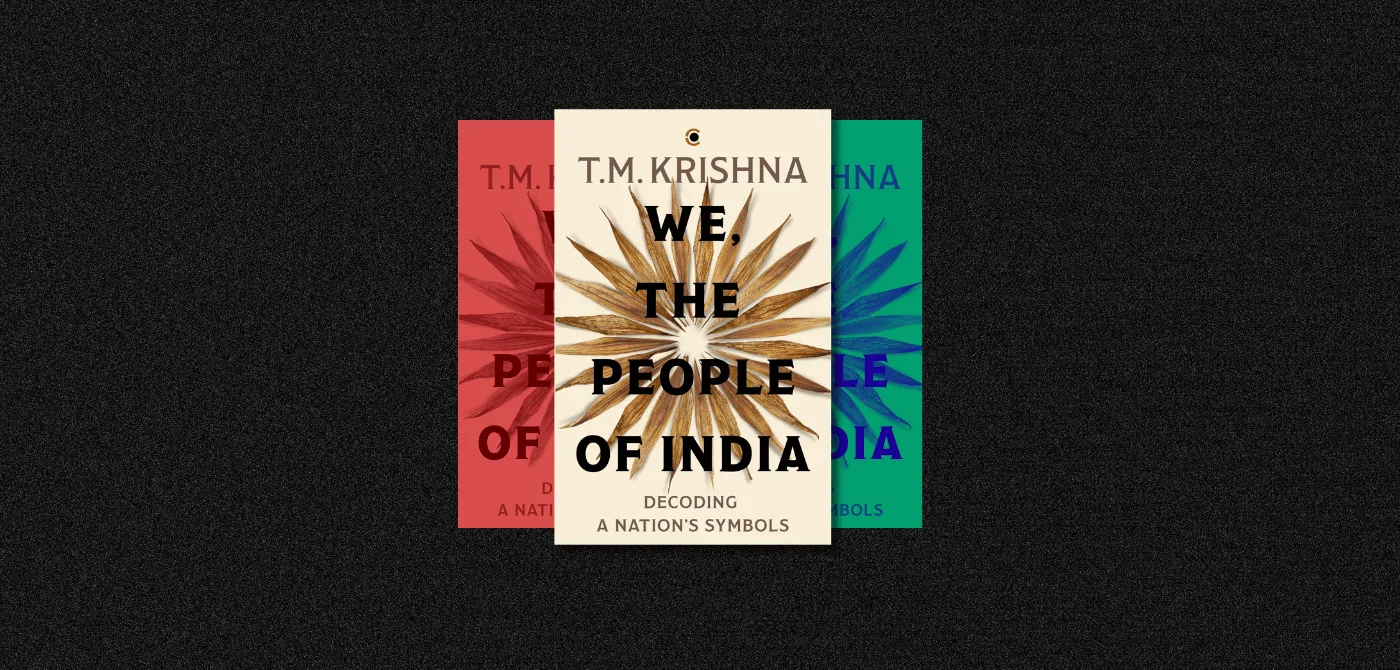



“Symbols,” T.M. Krishna writes, “are ideas that are abstracted from temporal objects and thus imbued with trans-temporal identities.” It is in the logic of symbolic forms that they transmit variegated meanings and open up possibilities for different interpretations. This open-endedness of symbols tends to disappear when/if some of them become associated with nation-states. They then acquire a frozen iconic status. This “freeze” distances the symbols from their original purpose.
The point that hovers over this onerous declaration is that the Preamble … was discussed, debated, and decided upon (or resolved) by a handful of around 300 people, of whom only 15 were women.
It is important to underline this last point since a nation’s symbols are deliberate constructions. The process of that construction may involve debate, discussion, and dissent but that only highlights the deliberateness that underpinned the construction. A nation’s symbols are deliberate and deliberated.
Krishna uses the rigours of scholarship and the imagination of an artist to reveal how some of India’s most significant symbols were conceived and constructed, and also to emphasise how open the symbols are to interpretations. This openness can go as far as to open up the possibility of denying the symbols and Krishna makes the point that there is nothing necessarily “anti-national” in that act or articulation of denial. The symbols that he discusses are the national flag, the national anthem, the national symbol, the national motto, and the preamble to Constitution of India.
The Preamble
Following the excellent injunction of Alice that it is best to begin at the beginning, let me start with the title of the book. “We, the people” are, of course, the three opening words of the Preamble to the Constitution of India (in passing, We the People is also the name of a rather well-known book by Leo Huberman). To be precise, the Preamble has an important comma after the “We”. So, the sentence reads, “WE, THE PEOPLE OF INDIA having solemnly resolved to constitute India into a SOVEREIGN SOCIALIST SECULAR DEMOCRATIC REPUBLIC …”
The point that hovers over this onerous declaration is that the Preamble (in fact, the entire Constitution) was discussed, debated, and decided upon (or resolved) by a handful of around 300 people, of whom only 15 were women. Thus, how representative was the “We”? The same point can be made about Jawaharlal Nehru’s famous speech, “Years ago we made a tryst with destiny”. Who constituted this “we”—not the victims of Partition, not the betrayed ratings of the Naval Mutiny, not the sharecroppers of Telangana and Bengal, and most certainly not M.K. Gandhi.
Krishna is not unaware of this problem. His answer is that the “we” is the articulation of a vision, a hope: an aspiration of a nation, which includes all who inhabit the nation state and republic called India. For Krishna, the Constitution of India is not just an operational document; at its most evocative it is also a document of non-exclusion. Hence, the “We”. I use the word evocative advisedly because Krishna sings the preamble just as he sings the Edicts of Ashoka, Devanampiya Piyadasi.
The National Anthem
The non-exclusion, or to use the more positive synonym, inclusion, is best celebrated in the national anthem, Jana Gana Mana. Krishna prefaces his discussion of the national anthem with a very detailed and well-researched analysis of the national song, Vande Mataram. It is important to remember that on 24 January 1950, when the last meeting of the Constituent Assembly was held and the Constitution was signed, its President, Rajendra Prasad, announced that Jana Gana Mana would be the national anthem, and he made a special reference to Vande Mataram. “The song Vande Mataram, which has played a historic part in the struggle for freedom, shall be honoured equally with Jana Gana Mana and shall have equal status with it,” he said.
Krishna presents—in my reckoning for the first time—the musical histories of both Vande Mataram and Jana Gana Mana.
It is worth noting that while the Preamble puts an undeniable and overwhelming emphasis on human agency—the people of India resolved to constitute etc. etc.—the national anthem takes away the agency. It hails the dispenser of India’s destiny—Bharata bhagya bidhata. The two most important symbols of India’s national symbols seem to contradict each other on this point.
Krishna presents—in my reckoning for the first time—the musical histories of both Vande Mataram and Jana Gana Mana. He is able to do this because he is a trained and a gifted singer whose musical range and knowledge cover different kinds of music, not just Carnatic music, which is his special field.
On Vande Mataram, Krishna presents evidence that suggests Rabindranath Tagore may not have been the first to set the first verse of the poem to music in 1896. Sometime between 1876 and 1881, Kshetranath Mukhopadhyay, a government official, composed a tune for the song. The tune was in the raga Malhar.
There is yet another claim that the first tune was composed by Jadunath Bhattacharya, a respected musician from Bishnupur. We have no notation for Bhattacharya’s tune. Malhar was probably chosen, Krishna says, because Bankim Chandra Chatterjee’s novel Anandamath (1882) included the song. In the middle of the 1880s, the song was also set to the raga Tilak Kamod.
Krishna’s analysis of Tagore’s rendering of the song is worth quoting: “He begins with ‘Vande’ at the Shadja (Sa) in the upper octave and then gradually descends, gently cajoles ‘mataram’ as he ascends a few svaras before settling on the Rishabha (Ri) in the middle octave. It is a yearning, a cry of desperation, not a battle cry. Tagore’s Vande Mataram feels like it is being rendered from the foothills of the Himalayas as he stretches his hand forward, uninhibited, welcoming his mother into his arms. This intimacy is ever present in the sound.”
For the national anthem, Krishna follows a similar analytical trajectory—tracing the various renditions the song passed through. Dinendranath Tagore (grandson of Rabindranath’s oldest brother, Dwijendranath) published a svaralipi in 1918 and this is the one that is followed in the singing/playing of the national anthem. But another notation was prepared in 1915 by Brajendralal Ganguli.
Krishna notes that there is a major difference between the two notations. In the 1915 version, the melody for the lines, tava shubha name jage/tava shubha ashisha mage is different from the version we sing. According to him, in the 1915 version, “Tava” begins at the Sa in the middle octave, then moves upwards during the rendering of “jage” settling on Ri. The “tava” in the next line begins on Ri, moves upwards when “mage” is sung and then settles on the Gandhara (Ga).
The national anthem as it is sung today begins on the Ga in the middle octave and differs in movement. Following this dissection, Krishna comments, “The emotive quality that the two melodies give rise to is also different. To my ear, the former is imbued with a greater degree of ‘plea’ while the latter is stronger. Every time the tune of a song changes ever so slightly, the sensibility it carries undergoes a revision.”
The Flag
Krishna’s detailed research also highlights the role of a relatively unknown figure who was the first to underline the importance and the design of the national flag. This is Pingali Venkayya of Andhra Jatheeya Kalasala, who, in Krishna’s words, “had been obsessed with creating a flag that represented all Indians”.
Taking readers through the history and evolution of the national flag, he writes, “Flags are no small matter. The fabric and design must convey the gravitas of an entire political apparatus.”
In 1916, he published A National Flag of India, a book that contained 30 designs of the flag. Krishna points out the work of Venkayya deserves recognition. Taking readers through the history and evolution of the national flag, he writes, “Flags are no small matter. The fabric and design must convey the gravitas of an entire political apparatus.”
National symbols by definition embody and articulate the spirit of nationalism. This is most emphatically true of the national anthem and the national flag since they are heard and seen most frequently, always on all ceremonial occasions across the nation.
Nationalism is Janus-faced. On the one hand, its spread produces pride and dignity; on the other it also generates a sense of superiority. Indian nationalism is not free from this. Many nationalist leaders articulated the uniqueness and the superiority of India that is Bharat in song and stories.
In a paean to the nation, which Krishna renders memorably, there is the line, “Emon deshti kothoy khunje pabe na ko tumi/sakal desher rani she je amar janmobhumi” (You will not find a country like this anywhere/ it is the queen of all countries – my birthplace). It is a song by Bengali writer D.L. Roy that was written during the Swadeshi movement. This sense of competitive superiority contains the embryo of hypernationalism.
The National Motto
Perhaps the only national symbol that is free of nationalism and its not so noble ramifications is India’s national motto, Satyameva Jayate, a line taken from the last chapter of the Mundaka Upanishad. Krishna’s analysis gives to the motto a different and powerful charge when he quotes the line in its entirety, Satyameva Jayate Nanrtam. The first three words translate as “truth alone triumphs”, but when the last word is added, the translation reads, “truth alone triumphs, not falsehood”. The full line needs to be remembered in this era of untruth and fake news. India’s national motto in its completeness is universal.
Like his music making, Krishna’s writing is profoundly evocative and moving. It enables us to hope against hope.
Running through Krishna’s book is a sense of hope for a future, when all Indians, irrespective of caste and class and region and religion will be part of the “We”. It is a utopia devoutly to be wished for with the caveat that utopia is never a precise destination. It is an unending journey that demands the courage to walk on a razor’s edge, often in looming darkness.
This is a significant, powerful, and enriching book. Like his music making, Krishna’s writing is profoundly evocative and moving. It enables us to hope against hope.
Sing, Krishna—sing of India’s plurality and inclusiveness; sing for humanity: “You are the music while the music lasts.”
Rudrangshu Mukherjee is Chancellor and Professor of History, Ashoka University.
The views are personal.