
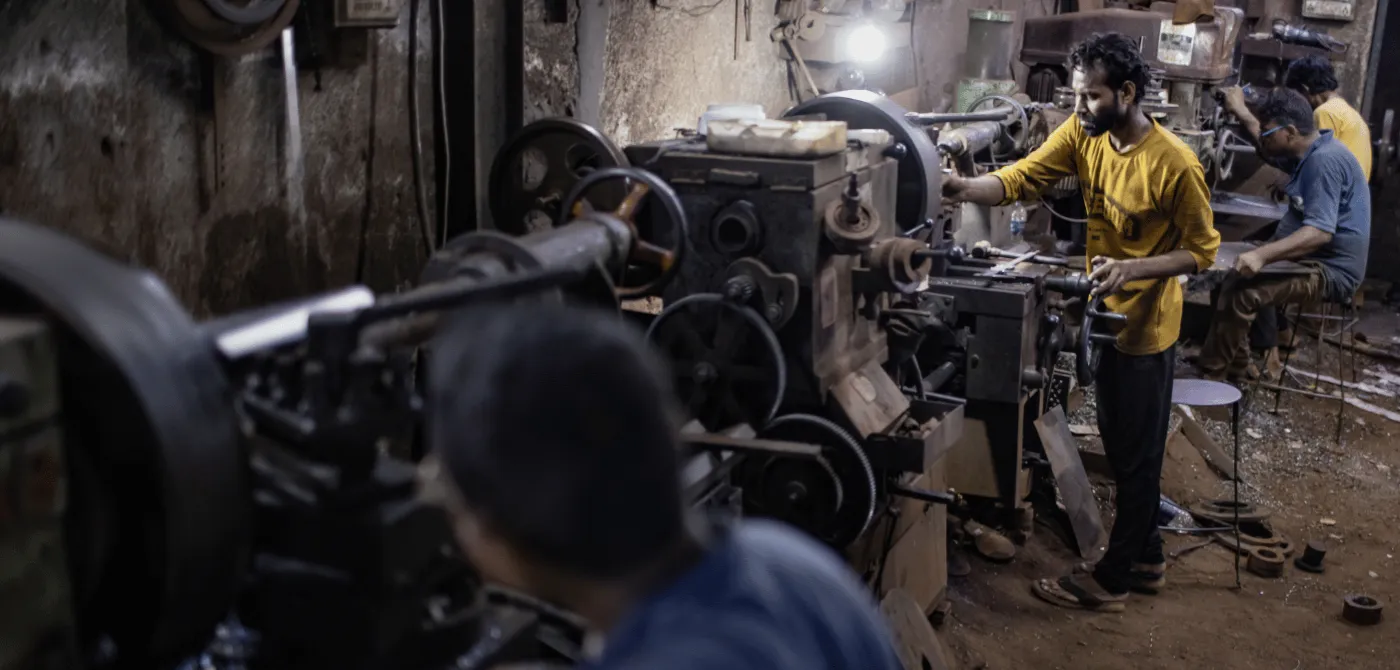



The months January to April 2026 witnessed protests in India’s National Capital Region. They were largely driven by unorganised migrant labourers working across major industrial areas, ranging from oil refineries to gig work to domestic spaces. Migrant workers raised several demands concerning wages, timely payments, provision of occupational safety gear, accident compensation, and social security benefits. While these protests were expressions of gradually brewing frustrations, they made visible the deeply embedded architecture of migrant worker exploitation.
India’s migrant labourers form a substantial part not only of the country’s internal (and precarious) workforce but also of its international migrants in the United Kingdom, the Arabian Gulf, and Israel.
There have been several commentaries and analyses of the anatomy of the protests. Such accounts have placed emphasis on “workers power” and their demands rather than on “the conditions that shape the ability of workers” to make those demands. Instead of asking “why are workers protesting?”, I would like to pose the question: How can we explain the labour relations that shape the possibilities (or the lack) of workers’ protests?
The “how” question also allows us to consider specific conditions that shape worker grievances and may lead to collective action (Breman 2026). It avoids explaining the phenomenon of protest solely through changes in labour laws or the (lack of) presence of a political organisation. The key condition is the deeply embedded contractual labour regime across different contexts of work in India, and how it shapes grievances and the likelihood of political action.
Contract-mediated Migrant Workforce
Recent data indicates that since the early 2000s, the Indian manufacturing sector has been fuelled by contract labour. Its share has more than doubled, reducing the possibility of workers unionising. However, when it comes to the unorganised sectors such as the construction and garment industries, a large proportion of the contractual workforce who are migrants work on unwritten contracts, despite the emergence of workers’ unions.
India’s migrant labourers form a substantial part not only of the country’s internal (and precarious) workforce but also of its international migrants in the United Kingdom, the Arabian Gulf, and Israel. As of 2025, up to 600 million people have migrated, within India of whom 200 million were labour migrants. A majority are from the states of Bihar and Uttar Pradesh, and 200 million of them are workers.
Most of India’s internal migrant workers are employed in kaam (insecure and precarious work), and not naukri (a salaried job), the latter bringing social security benefits as well (Parry 2019). Those who are doing kaam work under adverse conditions in different contexts, through a system of contracting. Construction work is one of the significant migrant-intensive industries.
To examine the labour contracting system, one has to go back to the late 19th and early 20th centuries. This is to understand the role of intermediaries, known as jobbers, mukadams, dafadars, and thekedars, whose primary job was to mediate labour recruitment (Roy 2008) for mills and factories. Gradually, however, across work contexts such as building construction, some of these intermediaries have become core to organising the everyday tasks of workers. This is the case in factory settings such as construction sites, garment factories, and electronics, but also in non-factory settings such as gig work, security guards, and home-based embroidery.
Historical evidence suggests that the contracting system, while extracting value from workers, also shaped the possibilities of political action in India.
The system of contracting, colloquially called the thekedari system, comprises a cascade of thekedars and a “main employer”. Some contractors may be registered to comply with labour laws, while others operate outside the legal architecture. In this way, the system blurs the boundaries of formal-informal in the building construction sector. At the same time, the legal regulations, in particular the Contract Labour (Regulation and Abolition) Act, 1970 and the Inter-State Migrant Workmen Act, 1979, encourage the contractor-mediated migrant labour regime (Munjal and Bamba 2023).
The contracting system has been historically created, maintained, and sustained by contractors, employers, and the state (Munjal and Bamba 2023). It has increasingly built a culture of exploitation (Chakravarti 2001) through two kinds of contracts. These are labour contracts, wherein the contractor only supplies labour for a fixed duration, and job contracts, wherein the contractor is responsible for getting a specific job done (Barik and Sahoo 2025). This mechanism of extracting value from workers has normalised and obscured exploitative labour conditions faced by the country’s migrant labourers. Clearly, we need to move away from examining contract labour as a relation emanating from or hinged on “labour laws”. We need to understand it instead as a social relation of extracting value from labourers.
Historical evidence suggests that the contracting system, while extracting value from workers, also shaped the possibilities of political action in India. This indicates the contradictions of a contract-mediated labour regime. This was evident from the textile mill workers’ strike led by jobbers who were also union leaders in the early 20th century (Chandavarkar 2008). However, recent research by Barik and Sahoo (2025) indicates that strikes and lock-outs at worksites have drastically decreased among the organised working class.
My research at building construction sites in the city of Hyderabad indicates that migrant workers are reluctant to join unions, for fear of disturbing their relations with thekedars. Moreover, while there is political action by unorganised migrant labourers at such sites, it is relatively short-lived and goes unnoticed. Yet worker frustration does result in collective action. This stems from the labour contracting regime that connects and separates migrant labourers from capital, under specific conditions. These are contradictory form of labour relations that enable exploitation but also shape the possibilities for political action.
Reading these protests as an expression of the contradictions embedded in contract-mediated labour relations helps us to situate worker grievances. It also helps us understand migrant workers as political actors produced through these contradictions. Such contradictions can be outlined in three broad terms, which I call the triple paradox of labour contracting.
Permanence of Temporality
The first paradox is that the contractor-mediated regime epitomises the myth of the permanent worker by repeatedly mobilising workers temporarily. Dominated mostly by upper-caste men, the business of contracting enables migrants from different caste and ethnic backgrounds to access a job away from their villages. This is done by offering some amount of cash to workers to reserve their time and capacity to work. In return, the thekedar sets the terms and conditions of the unwritten contract embedded in trust and familial relations.
The act of offering an advance lays the foundation for the accumulation of surplus. Labourers are deployed across different construction sites, and they need to work to pay back their debt to the thekedar. If one wants to work further, the thekedar offers another round of cash in advance to reserve labourers’ capacity to work, and the cycle continues.
If one wants to work further, the thekedar offers another round of cash in advance to reserve labourers’ capacity to work, and the cycle continues.
While contracting serves as a job-providing portal, it interlocks workers into intergenerational relations of debt. In this sense, the immersion of migrants in India’s growing economy is shaped by a process of inclusion via the contracting system. Yet this inclusion ignores how the system shapes the lives of migrant labourers.
Speaking with different thekedars working at construction sites, I found that labourers have been working for decades with the same or different thekedars across many worksites on a rotational basis. This is shaped by the demands of the specific industry. It enables the thekedari system to act as a valve that controls labour mobility and shapes what becomes circular, seasonal, or temporary forms of migration across both internal and international migration trajectories.
Different but similar iterations of contracting can also be found in the recently revamped kafala system in the Arabian Gulf, and in “temporary labour migration” or “seasonal worker visa” programmes across developed nations such as Australia, New Zealand, Canada, and the UK. They are also found within and across developing countries, such as Malaysia, and in transnational labour migration across global production networks such as garments and electronics. In this sense, while India’s thekedari system provides jobs on a temporary basis to workers, there is permanence of temporality in working for a thekedar.
Mediating Recruitment to Organising Exploitation
While thekedars are largely seen as recruiters, they organise exploitation by co-producing the daily organisation of construction work with builders. However, thekedars are also at the mercy of builders. Builders control how much surplus is accumulated on an everyday basis by regulating the flow of workers at construction sites.
One of the main reasons for protests at oil refineries was the holding of workers captive via a “gate pass” system, locking workers to a specific worksite. A gate pass serves primarily as an entry-exit system of contract between thekedars and builders. Its non-renewal restricts thekedars from finding alternative work and moving workers from one site to the other. This might seem similar to “reserving” labourers, but the broader aim of builders is not to disturb, let alone alter, the possibilities of surplus extraction.
The other strategy adopted by builders to accumulate surplus is to delay or defer payments to thekedars by up to four or five months. This is compounded by the system of wage payment, which is not straightforward.
While migrant workers receive a sum of money in advance of the work, thekedars provide them with weekly subsistence. Once the subsistence claimed by workers is adjusted against their advance, it reveals the amount owed either by thekedar or the worker. Alongside, a record of work is maintained. This enables the calculation of outstanding wages based on the daily wage rates set by the thekedars to maximise their profit margin per labourer. The outstanding wages are then readjusted against the amount owed as calculated earlier.
Workers find themselves trapped amidst the triangular relationship between employers, contractors, and the state. This results in the absence of recognised labour relations, of the right to organise, and of human rights.
When workers demanded an increase in wages based on wage reforms in other states, the key issue was how a wage is determined. It is determined as the difference between debt (what workers owe their thekedars), subsistence money, and wages earned for the day. Labourers call this system hisab, meaning calculation of wages. It indicates that wage payments involve a matrix of calculations and negotiation between thekedars and workers rather than a mere payment of wages. The weekly subsistence may get limited if builders delay payments to thekedars. Some thekedars, however, have a lot of holding capital to offset the impact of the delayed payments on their labourers.
Moreover, another demand by the workers revolved around overtime wages, which are, by law, higher than the daily wage rate for the usual working hours. Thekedars can either extend the working day, requiring workers to work for more than 10 hours a day, or otherwise intensify the work, leading to different kinds of work contracts.
However, the daily wage rate remains unchanged, which is a point of contention among workers. Thekedars control the wages despite the wage display boards of construction companies, which indicate the daily wages for workers. Such a system controlled by thekedars and builders results in delayed payment to labourers, causing severe frustration among the migrants (Prasad-Aleyamma 2017; Jayaram and Varma 2020).
Triangular Trap for Migrant Labour
While labour contracting is largely seen as a non-standard employment arrangement, it has set new standards in obfuscating the employer-employee relationship (Breman and Linden 2014). It serves as a win-win situation for employers and contractors, as they accumulate surplus while transferring risks onto each other. At the same time, it also conceals the employer-employee relation, indicating the fuzziness of this relationship (Singh et al. 2020). This was very evident during Covid-19, when migrant workers did not know who their employer was.
Effectively, workers find themselves trapped amidst the triangular relationship between employers, contractors, and the state (Wetlesen 2016). This results in the absence of recognised labour relations, of the right to organise, and of human rights (Lerche et al. 2017: 3). Throughout the protests, the workers blamed the state and also their thekedars, clearly indicating the effects of this triangular trap.
Similarly, the possibilities of meeting the workers’ demands remain hinged on this triangular trap. These demands include timely payment of government-mandated wages, an eight-hour work shift, a fixed day of payment, double pay for overtime, occupational safety gear, benefits such as holidays, basic facilities for daily survival, and compensation for accidents. In fact, despite the reconfiguration of labour laws into codes, it is this triangular trap that has silently eroded labour rights.
This poses further questions and challenges concerning the social security of migrant workers. It also provides a possible indication as to why workers’ welfare boards fail to protect their workers: the debate remains only on paper and limited to registration.
Lessons for Workers’ Struggle
Despite the triple paradox of labour contracting, the inhuman treatment of workers stemming from their exploitation has shaped worker protests. Labour contracting networks need to be seen as forms of political mediation. They harness the power of social media in shaping common demands of workers. Such networks connect but also disconnect labour from capital, shaping how one struggle can lead to another.
The recent protests emerge from this triple paradox of labour contracting. They press the urgent need to interrogate these systems of contracting in order to pave the way for worker rights.
The broader lessons here for workers’ struggle have to do with the possibilities and remit of worker politics. The classic barometer for gauging whether a social group is politically active or passive has remained tied to the ability to engage with or demand from the state. However, the social group may appear not to engage, or rather may retreat from its engagement with the state, by critically voicing concerns over its intentional neglect or repression by the state. When this happens, politics starts to take a different turn.
Politics is then no longer tethered to a governing institution but extends to the forces of power—in this case, the labour-capital relations that govern those institutions. While workers’ survival matters in triggering protests, the conditions and relations that enable or constrain their survival also need to be examined. Therefore, I argue, the reasons for the social group, in this case, migrant workers, to collectivise stem from taking cognisance of their struggle over relations of exploitation as organised under the thekedari system.
Workers’ accidental deaths, complemented by workers being beaten up, raised questions of safety and dignity. These translated into political action generating solidarity among migrant labourers. If and how workers experience exploitation, and what they do or can do about it, depends on the specifics of the contracting system that shapes labour relations across different work contexts.
The recent protests emerge from this triple paradox of labour contracting. They press the urgent need to interrogate these systems of contracting to pave the way for worker rights. At the same time, the rise of parallel or new forms of intermediary infrastructure, such as digital labour platforms, needs to be examined to see if they bypass or maintain such contracting systems. Such examination is needed in order to care deeply about the lives and the power of the working class in India.
Manish Maskara teaches global development at SOAS, University of London. His research examines class relations in the Indian context of labour migration for work.