
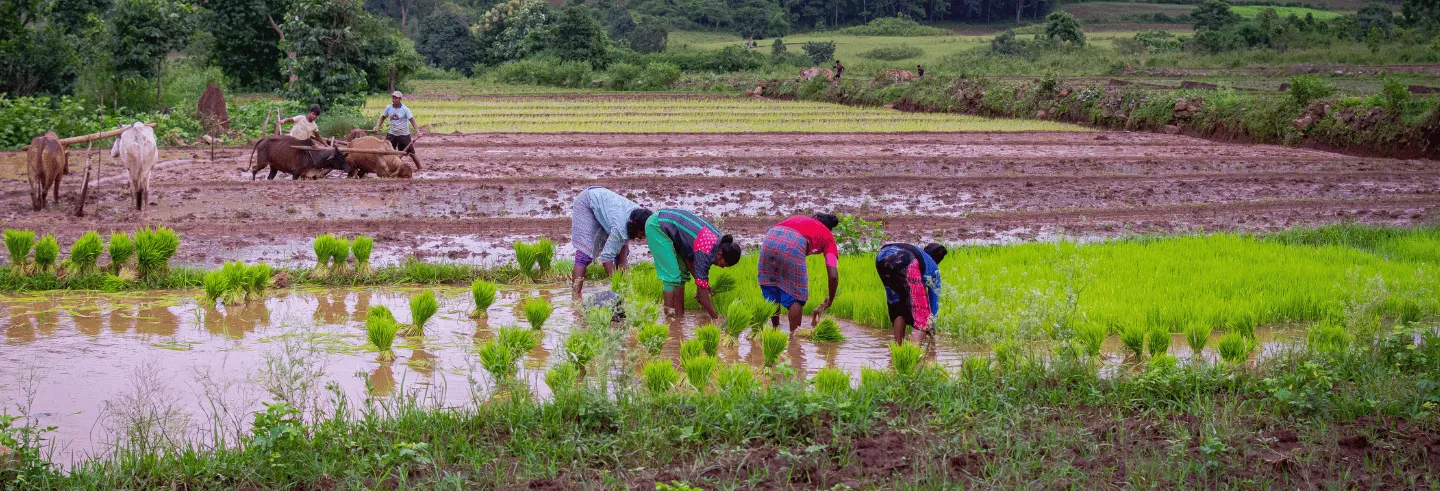
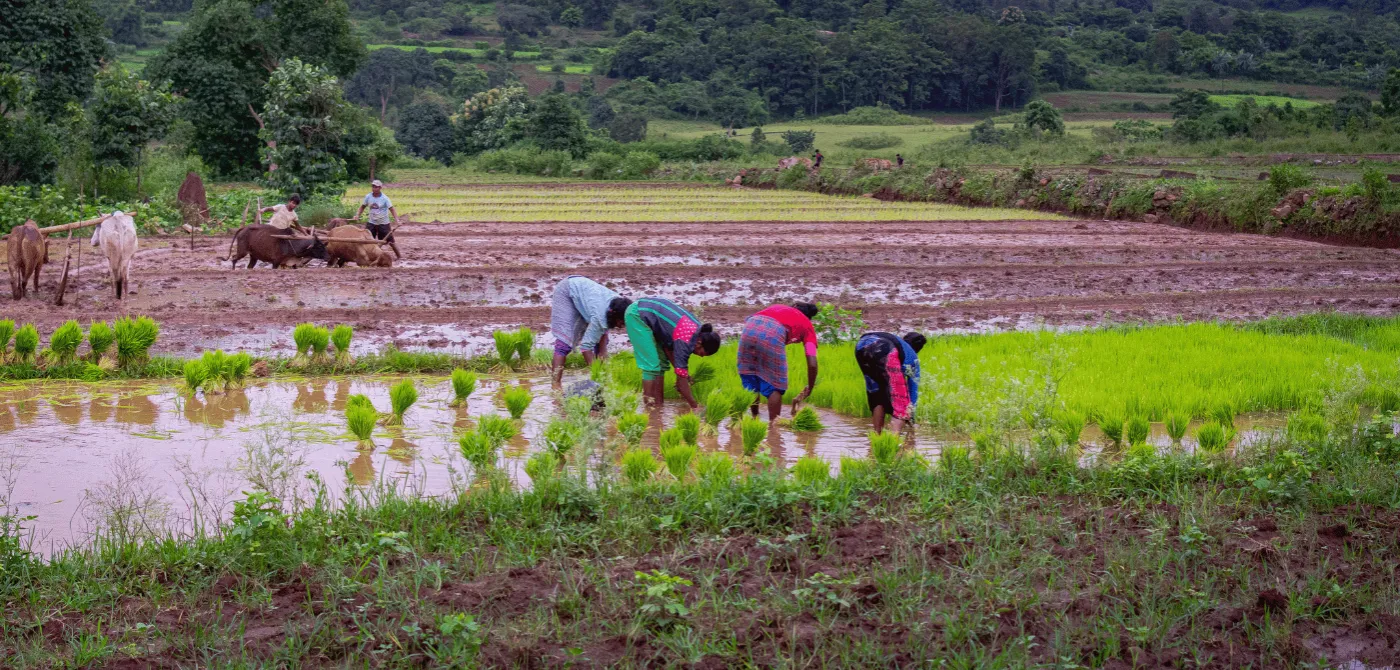



In one of the remote villages of Alluri Sitaramaraju (ASR) district in Andhra Pradesh, four Adivasi brothers cultivated forest land that had been in their names for years. They received a patta (land title) for their land under Forest Rights Act (FRA). 2006. Their patta had all the four names listed. They worked on their portions, and the arrangement was understood within the family.
AgriStack leaves out many Adivasi farmers in Andhra Pradesh who hold Individual Forest Rights (IFR) titles.
However, when the land records were digitised, the title was recorded under a single name. The other brothers did not physically lose the land, but they lost recognition in the digital system. This matters because a person may be recognised as a farmer in their community, since they cultivate and depend on the land, yet remain invisible as a farmer in digital land records.
The union government introduced AgriStack in 2021, which uses the existing digital land records for registration. Farmers who are not in these records, like the three brothers, will be excluded automatically. They may lose access to agricultural schemes such as the Pradhan Mantri Kisan Samman Nidhi (PM-KISAN) and services like formal credit. This time, the loss could be bigger, since AgriStack might become mandatory to access these schemes and services in future. As currently designed, AgriStack leaves out many Adivasi farmers in Andhra Pradesh who hold Individual Forest Rights (IFR) titles.
What is AgriStack?
AgriStack is a digital public infrastructure (DPI) introduced by the union government to make the delivery of agricultural schemes and services easier and faster. It has an outlay of Rs. 2,817 crore. A Farmer Registry is a key component of AgriStack. This database assigns each farmer an Aadhaar-linked Farmer ID that is linked to their land records. Farmers have to register themselves to obtain this ID, and a recognised land title is essential for this. The registry links farmers to agricultural schemes and services like PM-KISAN and crop insurance.
The registration for a Farmer ID has already been made mandatory for new PM-KISAN registrations in 19 states. By June 2026, 2.27 lakh IFR titles under the FRA were issued in Andhra Pradesh, most of them to Adivasi households. This makes it important to explore the challenges faced by IFR-holding farmers in Andhra Pradesh’s Adivasi areas in being included in the Farmer Registry.
Suspect Numbers
The FRA recognises several kinds of rights of forest-dwelling communities. These include IFR land titles, which recognise rights of a household over forest land used for habitation or cultivation. During our fieldwork in different parts of Andhra Pradesh’s Adivasi areas, we encountered several farmers who are yet to receive an IFR land title despite being cultivators for years. These farmers cannot register for a Farmer ID because they cannot produce a recognised land record.
According to the Union Ministry of Tribal Affairs, 1,525 claims for IFRs and Community Forest Rights (CFR) remained pending as of June 2026 in Andhra Pradesh. However, our field experience suggests that the scale of the problem may be much larger than what the official records show. At a recent civil society consultation we attended, four organisations working in 15 gram panchayats (GPs) in different districts of Adivasi areas in Andhra Pradesh reported around 800 forest rights claims pending in their areas. Officially, only 1,525 claims are pending across the entire state. How, then, can organisations active in just a small number of GPs report nearly 800 pending claims?
Whatever the true figure, farmers with pending claims remain at risk of exclusion. Farmer ID registration requires a recognised land title, which a pending claim does not provide.
Who is on the Farmer Registry?
Section 4(4) of the FRA requires an IFR title to be jointly registered in the names of the husband and wife, or in the name of one person in a single-person household. This reflects that the IFR title is an entitlement to a household. The physical title may also list other household members cultivating the land. So, an IFR title may relate to a household even if the land has not been divided into individual shares.
For unpartitioned revenue lands, multiple farmers can register and obtain separate Farmer IDs under the same survey number. No equivalent provision exists for IFR titles with multiple farmers.
Unlike IFR lands, revenue lands are individualistic in nature, which means a title belongs to an individual rather than a household. For unpartitioned revenue lands, multiple farmers can register and obtain separate Farmer IDs under the same survey number. No equivalent provision exists for IFR titles with multiple farmers. So, only one farmer is allowed to register for a Farmer ID and others in the household, like the three brothers, are excluded. This makes the Farmer Registry more accessible to revenue land farmers. In joint titles, it often means the wife is left out of the registry.
Updating Land Records
Several IFR titles we encountered remained in the names of those who originally received them years ago, usually a father or grandfather. Some of the original title holders died long ago. Land records have not been updated to include the names of current cultivators.
This is because there are no clear guidelines on updating IFR land records in the state, even after the digital integration of the FRA and revenue land records. We observed that frontline officials were themselves often unclear about details of the process. The process is crucial because Farmer ID registration demands an updated land record from farmers.
During registration, a farmer’s name has to be matched with the name on the digital land record. Registration cannot happen if land is still recorded in the name of a parent or grandparent and the present cultivator is the son or grandson. The state cannot expect a clean digital database without creating a clear process for updating the underlying IFR records.
AgriStack not for IFR Titles
A farmer must provide the survey number of his land to retrieve corresponding land details during registration. This is easier for revenue land records, where survey numbers are standard identifiers. IFR titles, however, were created through a different administrative process and do not always fit neatly into the survey-number-based system.
A separate route was later introduced for IFR farmers to register for Farmer ID. Yet challenges persist. An IFR farmer needs a land title and an Aadhaar number linked to a mobile number. During registration, two out of three one-time passwords (OTPs) will be sent to the Aadhaar-linked mobile number. A farmer without an Aadhaar-linked mobile number cannot complete the registration.
Governments must identify and process pending claims, establish clear procedures for updating IFR records, and make digital land identifiers accessible to title holders.
Also, to retrieve land details, an IFR farmer has to provide the unique digital number assigned to the land record. The physical titles were distributed first and the digital identifiers were assigned later. As a result, unique digital numbers are available in the government’s online repository but often not on the physical IFR title.
However, finding this number is challenging. A farmer needs access to a smartphone and a mobile network and must know how to navigate online, or else depend on a local functionary. We observed that many farmers, and even some functionaries, could not locate this number.
The government’s own numbers bear this out. According to a state-level official we spoke to, only about 52% of the IFR title holders in Andhra Pradesh had been registered for Farmer ID as of July 2026.
Adivasi Farmers and AgriStack
Neither the Farmer Registry’s 2024 official FAQs or handbook to states nor the union government’s correspondence with states on AgriStack mentions the FRA. As a result, existing gaps in unreliable and outdated IFR records are being carried into AgriStack. These gaps must be addressed before Farmer ID becomes mandatory for agricultural schemes and services.
Governments must identify and process pending claims, establish clear procedures for updating IFR records, and make digital land identifiers accessible to title holders. The Registry must also allow all joint title holders to obtain separate Farmer IDs.
Under the FRA, the gram sabha has an important role in recognising forest rights. The Provisions of the Panchayats (Extension to the Scheduled Areas) Act, 1996 also grants gram sabhas an important role in local governance. Yet, Farmer ID registration does not clearly provide for gram sabhas’ involvement when land records are incomplete, outdated, or disputed.
The four brothers with whom we began this article continue to cultivate their land. Three of them are missing only from the database. But if that database decides who is entitled to coverage by schemes and services, they will be missing for the government too.
Chakradhar Buddha and Rahul Mukkera are with LibTech India, an organisation focused on improving transparency, accountability, and democratic engagement in public service delivery.