



Delhi today boasts the largest metro network in the country and one of its largest city bus fleets. Yet, such public transport remains inaccessible and inadequate for many Delhi residents, who rely on a range of privately operated para-transit modes of transport: e-rickshaws, shared Gramin Sewa vans, autorickshaws, and taxis. The contradiction is understood not only by looking at the number of buses and metro lines the city has, but also at how Delhi has developed, whose neighbourhoods its transport system can reach, and who can afford to use it.
Para-transit plays a second role in Delhi apart from addressing public transport needs that remain unfulfilled by buses and metro: facilitating last-mile connectivity.
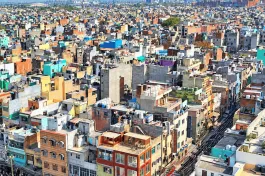
To understand Delhi’s public transport system, we must begin with the city’s geography. Whether a neighbourhood can be served by buses depends not simply on how many roads it has, but on whether those roads are wide enough and connected in a way that allows buses to pass through. Delhi has one of the highest road densities in India, but this city-wide figure conceals enormous differences between neighbourhoods. Large parts of Delhi developed outside a formal planning process and lack the connected hierarchy of roads required for efficient mass transport: short, narrow local streets connecting to wider neighbourhood roads served by buses, which in turn connect to major arterial roads carrying traffic across the city.
Consider Sangam Vihar, a predominantly working-class, low-income neighbourhood on Delhi’s southern periphery. With around 2,36,000 residents, it has only 19 bus stops in and around it. From the southernmost parts of the neighbourhood, the nearest bus stop can be as far as three kilometres away. Some 12 km away is the elite neighbourhood of Greater Kailash-1, which by contrast has 37 bus stops despite having only about one-third as many residents. It therefore has roughly six times as many bus stops per person as Sangam Vihar.
The difference emerges from how the two neighbourhoods developed. Greater Kailash has a planned network of local and wider roads that buses can use, whereas Sangam Vihar is dominated by narrow local streets.
We must note that unplanned development does not necessarily result in poor public transport access. Many of Delhi’s urban villages also have lanes too narrow for buses, or even cars, but they are compact enough for most residents to remain within about 500 metres of a main road. The scale of such unplanned development matters. Sangam Vihar extends over a much larger area, so substantial parts of the settlement lie far from roads that can accommodate conventional buses. The combination of narrow internal streets and the spatial extent of the settlement creates a binding constraint on public transport access.
Inadequate Planning
This contrast between the built environment of Sangam Vihar and Greater Kailash sits at the heart of why public transport in Delhi remains fragmented, and is itself an outcome of the historical processes that shaped the city's geography.
Delhi’s first Master Plan in the early 1960s set aside far less land for urban development than the city’s growing population would require over the following three decades (Delhi notified its subsequent master plan in 1990). This meant that housing stock was woefully inadequate, even more so for the city’s low-income population (Bhan, 2016). In response to this unmet demand, private developers acquired agricultural land and developed residential colonies outside the formal planning process. Sangam Vihar was one of those.
Today, a substantial proportion of the city's population lives in these unauthorised localities, many of them on the periphery of the city. Crucially, these colonies often did not follow planning and development regulations for roads of sufficient width. To maximise the use of land for residential or commercial use, a large majority of these localities often have narrow lanes, making it difficult for state-run buses, or even emergency services like fire trucks, to operate. 1Fire incidents in unauthorised localities where fire trucks cannot not reach is a direct outcome of this built environment. The Delhi government's proposal to have smaller sized fire trucks (4.5 m in length) is a solution that has a marked similarity in how public transport is provided in these locations. As a result, the ideal hierarchy of local streets, wider neighbourhood roads and arterial roads is either absent or heavily skewed towards narrow streets. The few wide roads that exist are heavily dominated by commercial users, with spillover from shops, street vendors, and on-street parking occupying much of the road space.
The same historical process that produced a shortage of formally planned housing has made large parts of the city structurally difficult to serve with conventional public transport like buses. It is to fill this gap in public transport service that Delhi continues to have a wide range of para-transit modes, characterised by their small size that can easily navigate roads that may be too narrow for a bus.
Who Can Travel?
Buses are unable to provide dense and frequent coverage across much of the city, making public transport accessibility in Delhi far lower than in comparable international cities.
Consider the following statistics. Delhi has around 6,000 bus stops for a population of 23 million, while London has 19,000 stops and New York has 15,000 for less than half of Delhi’s population (8.9 million and 8.6 million, respectively). In other words, an average resident of London or New York has access to seven to eight times as many bus boarding locations as a resident of Delhi. 2The comparison remains the same when expressed as per unit area instead of population. London has almost the same area, while New York is half as big as Delhi.
The same is true for metro and rail stations, which have a seven- to eight-times higher density per capita in London and New York than in Delhi. Within Delhi, metro accessibility is far worse than that of buses, as is generally true of rail systems compared with road-based transit. Delhi has only about 250 metro stations, making them, on average, farther from where people live or want to go than bus stops.
In Delhi, the metro’s relatively high fares put it beyond the reach of a large section of the population, and ridership is highly sensitive to fares.
As the distance or time required to access a transit stop increases, people tend to use that mode only for longer trips (Goel et al., 2016), or not at all. (In the other extreme, this is why private modes are used so frequently for very short trips). A quarter of all bus trips are shorter than 5 km, while less than a tenth of metro trips are within that distance range. In London, by comparison, three quarters of trips on buses are for distances shorter than 5 km.
There is one more crucial difference in patterns of transport usage between Delhi and the other two cities. In London, up to 85% of rail passengers walk to and from stations. In Delhi, only 40% of the last mile trips are made on foot. (The equivalent for bus travellers is more comparable: nearly 100% in London and close to 90% in Delhi (TRIPC, 2026)). Besides the longer distance to metro stations, transit users are also discouraged from walking due to a lack of walkable streets, with footpaths, when available, that are broken, discontinuous, encroached upon, or too narrow. London, in contrast, is one of the most walkable cities in the world.
Delhi’s metro thus generates millions of additional motorised feeder trips every day by a range of para-transit vehicles. For a daily metro ridership of 34 lakh and two last-mile legs for each of those metro trips, there are over 30 lakh passenger trips that depend on one of the para-transit modes. Para-transit therefore plays a second role in Delhi apart from addressing public transport needs that remain unfulfilled by buses and metro: facilitating last-mile connectivity.
Metro’s Primacy
The scale and character of Delhi’s bus shortage is best illustrated with another comparison with London. London operates around 8,800 buses for 8.9 million people. To provide the same number of buses per person, Delhi would need approximately 22,700 vehicles, but had an active fleet of only about 6,300 in 2024. The two cities have a similar number of routes, and their buses collectively cover roughly the same distance each day: close to 700 routes and about 1.2–1.3 million km. But Delhi has more than twice London’s population, and its bus routes are, on average, twice as long: an average of 27 km, versus London’s 13.1 km. Delhi’s bus services are therefore much more thinly spread, resulting in longer waits and fewer stops within walking distance.
Figure 1: Density of stops: Bus versus metro
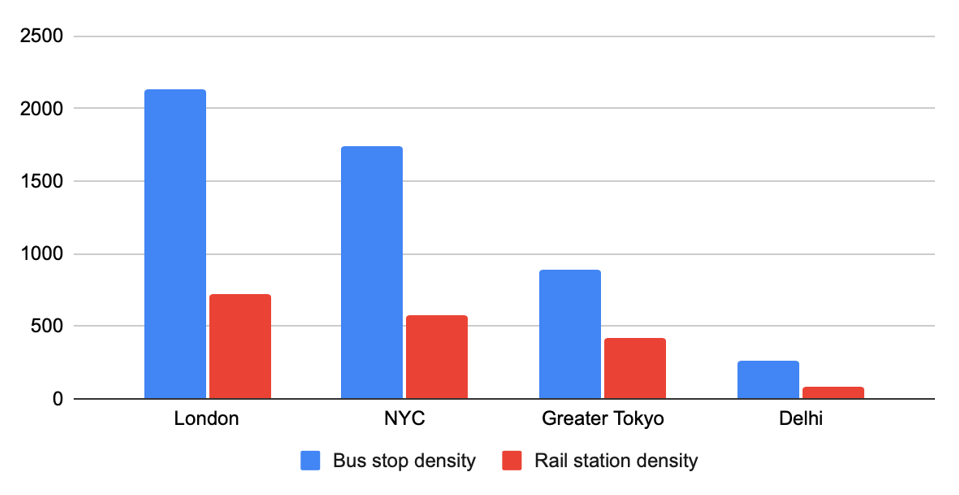
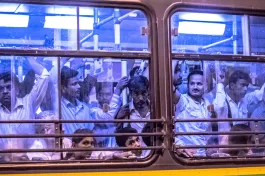
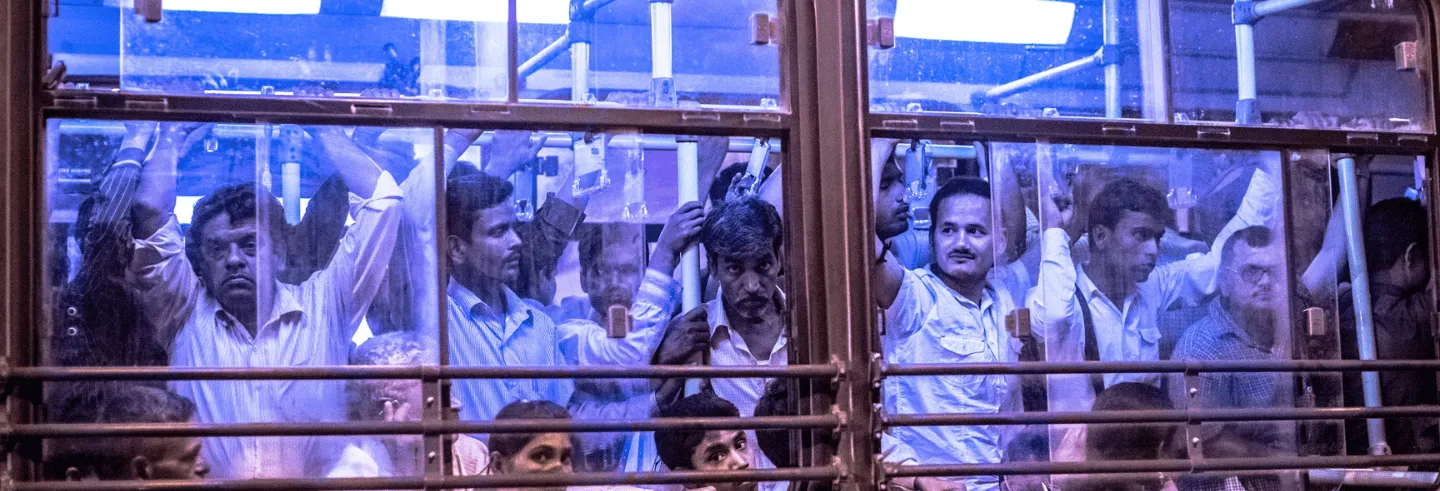
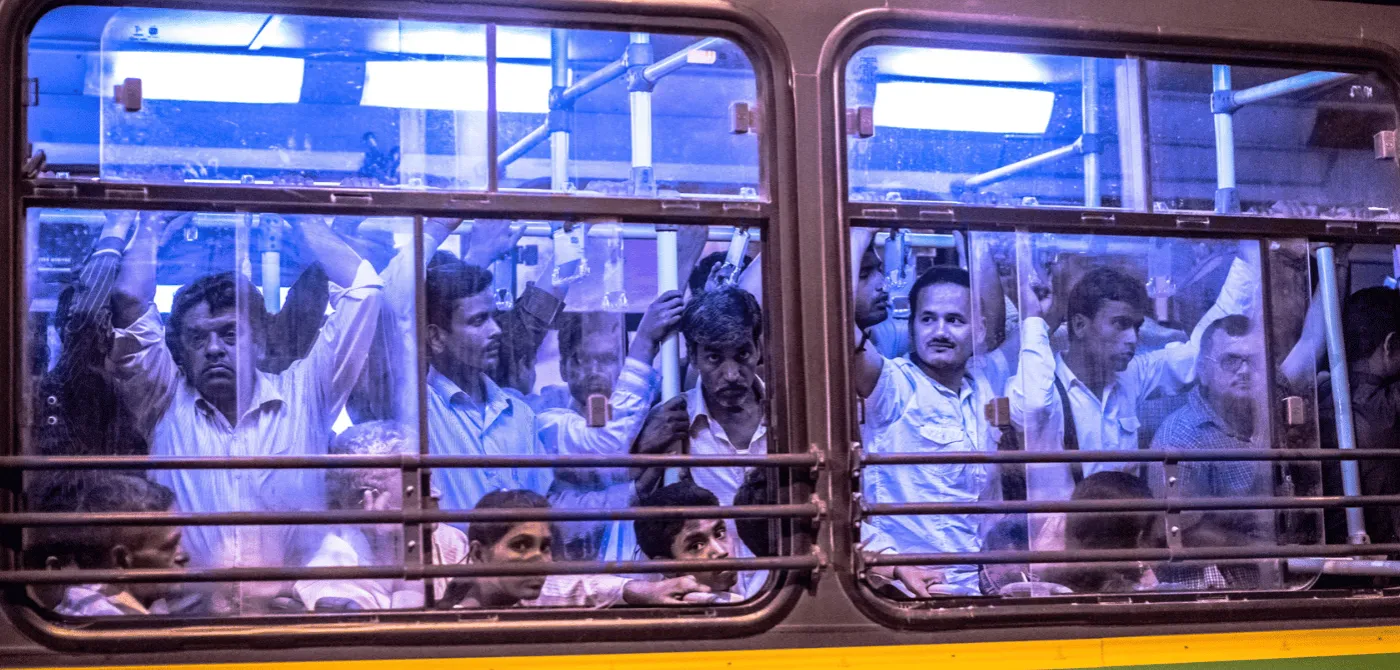
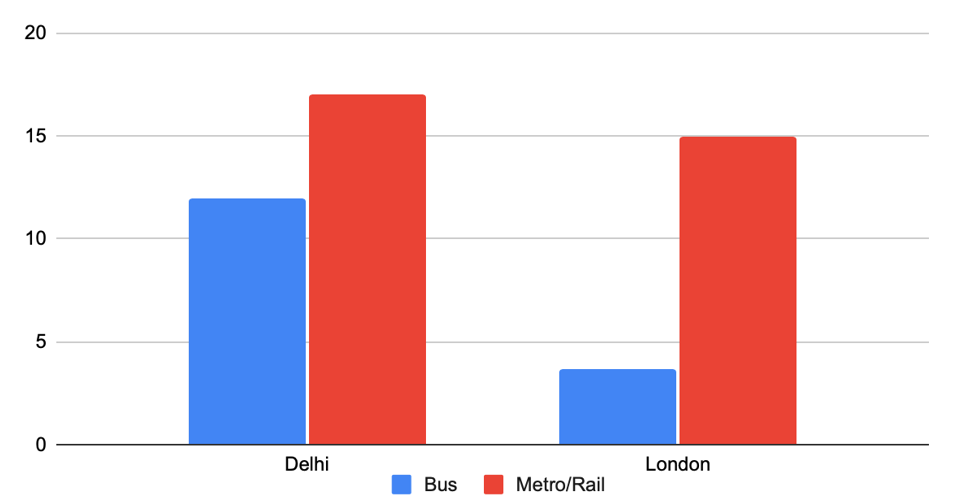
The different roles played by buses in the two cities can also be seen in the length of passenger journeys. An average bus trip is around 12 km in Delhi, compared with only 3.7 km in London. London’s buses form a dense local network that enables people to make short journeys. In Delhi, buses function more as long-distance services, while e-rickshaws, shared autorickshaws and other small vehicles provide much of the local connectivity. In effect, para-transit in Delhi performs many of the functions that frequent neighbourhood bus services perform in London.
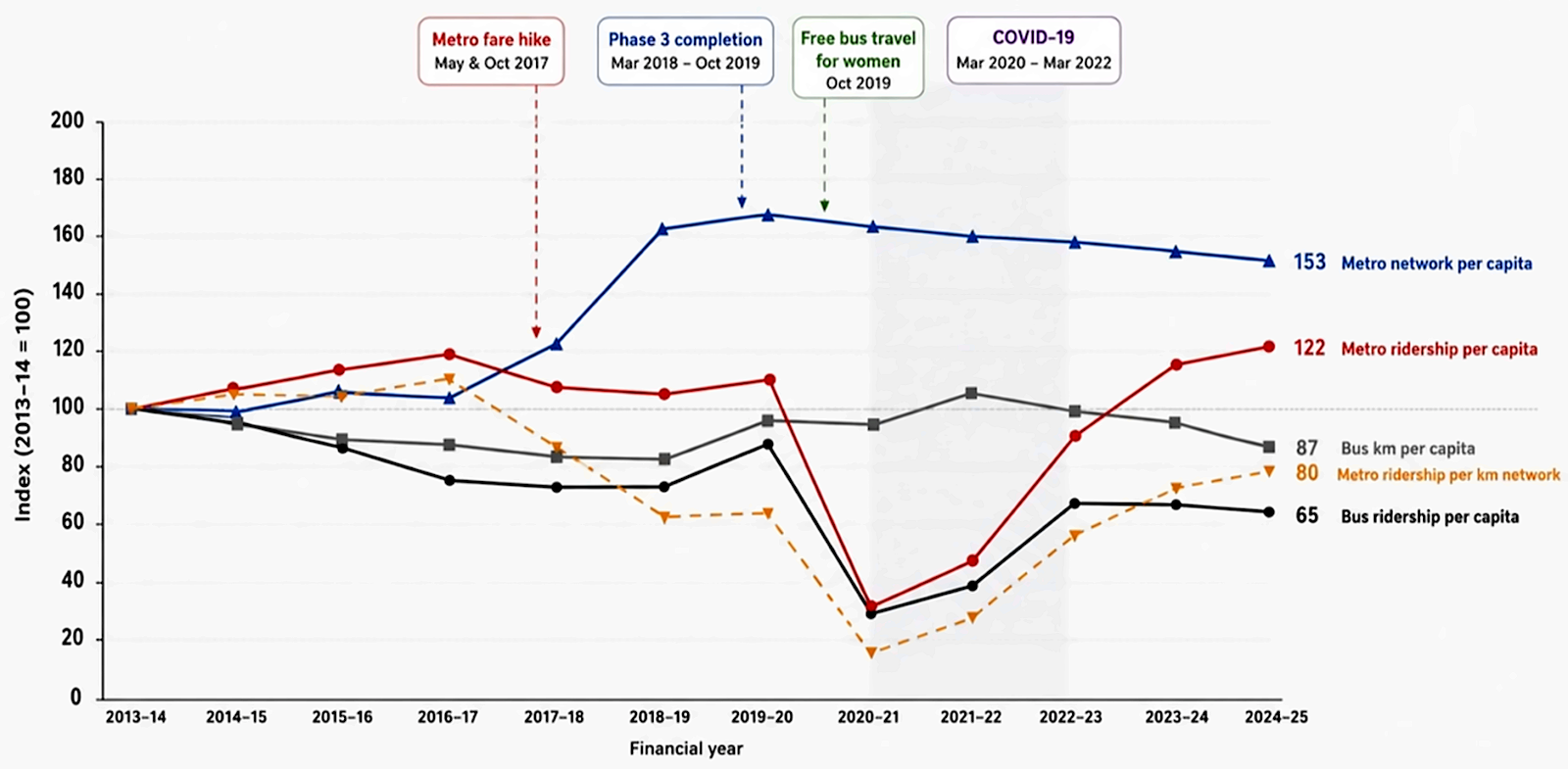
The expansion of the metro has coincided with a weakening of Delhi’s bus system, as Figure 2 shows. Between 2013–14 and 2024–25, the length of the metro network per person increased by 53%, while the distance covered by buses per person fell by 13%. Bus ridership per person declined even more sharply and was 35% lower in 2024–25 than in 2013–14. Delhi has therefore invested heavily in expanding the metro without making a comparable improvement in the more affordable and spatially accessible bus system.
Figure 2: Changes in bus service, bus ridership and metro service and ridership in Delhi, indexed to 2013–14 3The definition of Delhi Metro ridership changed from 2019–20. Earlier publications reported linked passenger trips, counting each passenger once regardless of transfers, while subsequent publications report passenger journeys, counting each line boarding separately. For 2019–20, both measures are available: 27.8 lakh linked trips and 51.64 lakh passenger journeys per day. To maintain a consistent time series, we converted figures from 2019–20 onwards to estimated linked trips using the observed ratio (27.8/51.64 = 0.538). This gives an estimated 33.95 lakh linked trips per day in 2024–25.
The figures point out how the relationship between buses and rail differs between the two cities. In London, the two systems perform complementary roles: buses largely serve shorter journeys, while rail carries passengers over longer distances. In Delhi, however, the metro’s relatively high fares put it beyond the reach of a large section of the population, and ridership is highly sensitive to fares.
This became particularly clear after the Delhi Metro Rail Corporation increased fares twice in 2017. Despite the metro network expansion by 64% between 2016–17 and 2018–19, average weekday ridership initially declined by about 7.5% over this period. Ridership eventually recovered to its pre-fare-hike level in 2024, but this recovery needs to be seen in the context of a much larger network. Even in 2024, the number of passenger journeys relative to the length of the metro network remained around 30% lower than before the fare increase (see Metro ridership per km network in Figure 2).
Delhi cannot solve its public transport crisis by expanding the metro alone. It needs many more buses, including smaller buses capable of reaching neighbourhoods where conventional buses cannot operate.
The metro has therefore expanded considerably without achieving a corresponding increase in its use. This suggests that fares, rather than inadequate network coverage alone, remain an important barrier to metro use in Delhi. Buses, in comparison, remain substantially more affordable and are used disproportionately by lower-income groups. A day pass for buses costs Rs 50, valid for unlimited travel. A single metro fare starts at Rs 11, and is Rs 32 for a distance between 5-12 km.
Close to two-thirds of bus users do not own a motor vehicle in their household, twice the city-wide average of 32%, compared with less than 20% of metro users (Lakhotia, 2019). The low-income population is poorly represented among metro users as the fare, and added cost of last-mile access, remains unaffordable for a large section of the population (Mukherjee et al., 2023; TRIPC, 2023). It is telling that two years after a steep fare hike by the metro, not only were the bus fares not increased, but state-run buses were made fare-free for women—a quarter of all bus riders at the time—making buses affordable for the poorest of the women in the city. This is a recognition by the state that even the low fares of buses can be unaffordable for a section of the population.
As a result, buses and the metro do not readily substitute for one another, nor do they work together as an integrated system. This contrasts with London, where buses predominantly serve shorter trips and complement rail for longer journeys. In London, the average bus ride is 3.7 km, and the average rail ride is 15 km. In Delhi, the difference is narrower: around 12 km for buses and 17 km for the Metro. The response to the metro fare hike is particularly revealing: when metro ridership fell following the increase, there was no apparent corresponding increase in bus ridership (Figure 2). At the aggregate level, therefore, buses did not absorb the decline in metro use, possibly because bus services remain poor given their limited capacity.
Figure 3: Usage patterns: Bus versus metro
Delhi therefore cannot solve its public transport crisis by expanding the metro alone. It needs many more buses, including smaller buses capable of reaching neighbourhoods where conventional buses cannot operate. The long-standing demand of 11,000 buses for Delhi, as per a high court order in 2007, remains unfulfilled close to 20 years later. It must also recognise e-rickshaws, shared autorickshaws and other small vehicles as an essential part of the transport system, while regulating them to improve safety and reliability. Finally, streets must be made safe and convenient for pedestrians to encourage walking to access public transit.
Acknowledgement: I am grateful to Srishti Agrawal for her support in producing some of the estimates reported in the article.
Disclaimer: The author is currently leading a project for the Delhi Transport Corporation that involves evaluating bus route planning and operations.
Rahul Goel is an associate professor at the Transportation Research and Injury Prevention Centre of the Indian Institute of Technology, Delhi.