




When B.R. Ambedkar wrote The Untouchables (1948), he dedicated the book to the memory of three ‘untouchable’ Bhakti saints—Nandanar, Ravidas, and Chokhamela—who are believed to have challenged Brahmanical orthodoxy and transcended caste barriers. Centuries of expansion of Vedic-Puranic Brahmanism—integrating local cults, acculturating and reorganising clan societies into castes, and serving as an ideological instrument of emerging states across the subcontinent—generated considerable intra-religious tension. Bhakti, which emerged in south India as a popular form of religion between the sixth and ninth centuries CE, is considered the earliest ‘movement’ to give powerful expression to these tensions. The texts of Bhakti saint-poets questioned the authority of the Vedas and priestly mediation. They propagated devotional egalitarianism, encouraged the singing of Tamil hymns rather than reciting Sanskrit mantras, and produced their own Tamil Vedas. Thereafter, such tensions assumed various forms and were felt across India.
Yet, these forms of dissent remained largely textual and theological, rarely translating into social practice. Challenges to social inequality soon waned, providing credence to the French sociologist Louis Dumont’s observation that “a sect cannot survive on Indian soil if it denies caste”. The later hagiographical texts, for instance, recounted the pious lives of ‘untouchable’ Bhakti saints, including those whose memories Ambedkar fondly invoked, and their quests for caste transgression through entry into Brahmanical temples.
This remained merely an aspiration: these premodern aspirational stories in fact indexed the impossibility of such transgressions. The material realisation of such dreams became possible only in recent times, and it required an extraordinary effort through social, political, legislative, and judicial struggles. What was once a matter of contention in the religious sphere had to evolve into a question of civil rights and constitutional morality.
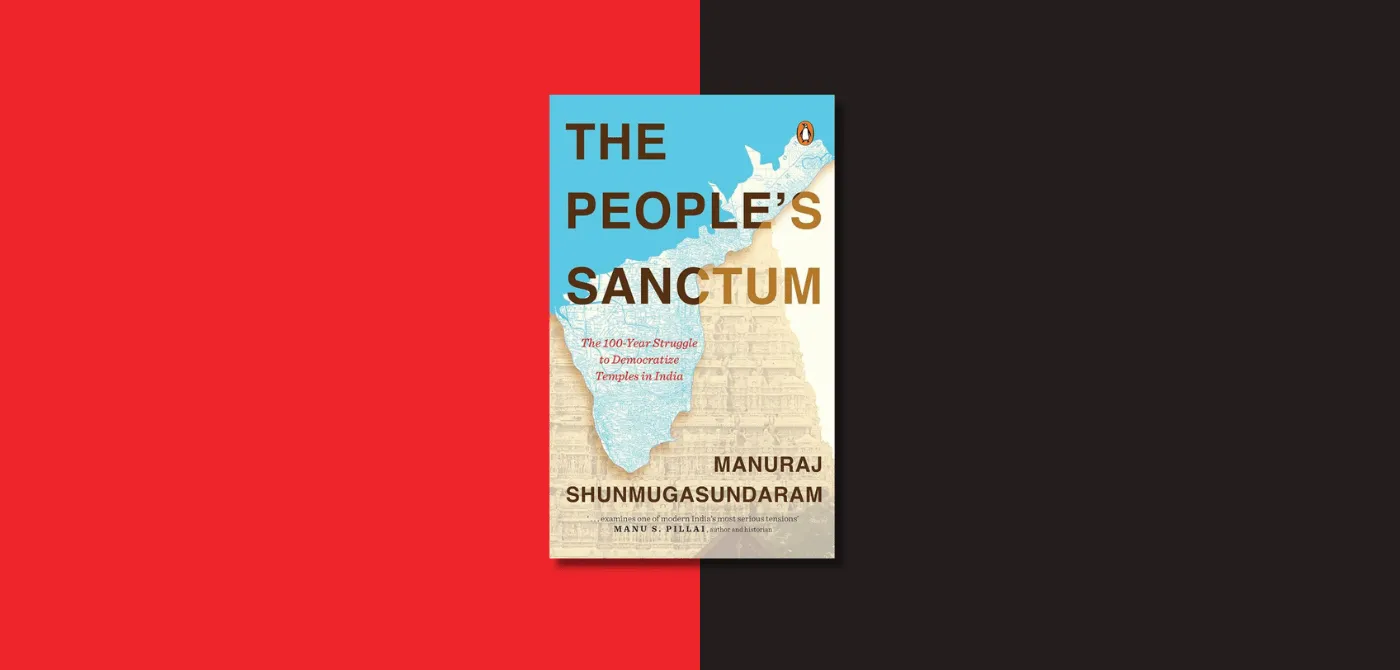
Manuraj Shunmugasundaram’s The People’s Sanctum: The 100-Year Struggle to Democratize Temples in India is a fascinating account of this struggle in South India. Spanning the last hundred years, it begins with the Vaikom agitation to open temple streets to backward classes in the early 1920s and ends with the appointment of temple priests without caste distinctions by the Dravida Munnetra Kazhagam (DMK) government in Tamil Nadu in the early 2020s. Shunmugasundaram narrates parallel developments—political agitations for reform, legislative changes, and court contestations—and argues that the erstwhile Madras presidency, corresponding to present-day Tamil Nadu, Keralam, Karnataka, Telangana, and Andhra Pradesh, was the epicentre of this struggle. 'Periyar' E.V. Ramasamy’s Self-Respect Movement, which took shape after the Vaikom agitation, emerges as a driving force behind this struggle. The People’s Sanctum is dedicated to this movement.
The Lesser-Known Ramasamy
The hero of this book, if there is one, is Ramasamy, the iconoclastic anti-caste reformer who remains relatively little known outside Tamil Nadu. While nationalist leaders such as M.K. Gandhi held political emancipation from colonial rule as their primary goal, anti-caste thinkers such as Ramasamy and Ambedkar argued that social independence from caste oppression was their primary goal. Ramasamy believed that the eradication of caste was impossible without a direct attack on irrational practices in Hinduism. Two journeys shaped him: a humiliating experience in Varanasi in 1904 turned him atheist, while his 1932 visit to Stalin’s Soviet Union, coordinated by the League of Militant Godless, reinforced that path. Between self-respect and self-rule, he prioritised the former, though he was not opposed to the latter.
Born into a wealthy business family, Ramasamy received elementary education and entered public life as a member of the Indian National Congress. His participation in the Vaikom agitations (1923–25) marks a significant moment in the history of the caste struggle to democratise temples. There were isolated attempts to occupy public spaces and enter temples in south India, even before local Congress leaders in the princely state of Travancore resolved in 1923 to protest the closure of streets surrounding the Mahadeva Temple at Vaikom to backward classes. Though the party’s central leadership fully supported the agitation, Gandhi, now leading the party, avoided participating in person as he wanted to see how a regional satyagraha led by local leaders could succeed. This pushed the local leaders to seek money and manpower from the party wing in neighbouring Madras, bringing Ramasamy to join the agitation.
Untouchability is contrary to fundamental rights. Government intervention is therefore necessary where temple practices and customs perpetuate it.
Ramasamy helped turn the movement into a mass agitation. The demand was now no longer merely to open the temple streets but also the temple itself. Agitations and arrests continued for several months. Gandhi finally visited Vaikom in March 1925 and mediated between the agitators and the queen regent of Travancore. As the agitation came to an end, Gandhi was happy that the local satyagraha experiment had succeeded. So was the queen, who could thwart the attempt to enter the temple. But the peace settlement disappointed Ramasamy.
Yet, motivated by the partial success in Vaikom, Ramasamy and others spearheaded temple-entry agitations in many parts of the Madras presidency. He also began the Self-Respect Movement (SRM) with the objective of eradicating caste inequality. By the 1930s, Ambedkar too led several such agitations in western India. The emerging political situation pushed Gandhi to prioritise interfaith harmony over the intra-religious struggle. In 1928, Ramasamy formally resigned from the Congress, accusing the party of tolerating caste.
Meanwhile, from 1919 onwards, Madras saw non-Brahmin political mobilisation under the Justice Party, with which Ramasamy’s SRM became increasingly aligned. When the Justice Party faced a leadership crisis, Ramasamy became its head. The party now came to be known as the Dravidar Kazhagam. Though absent from national politics, Ramasamy’s ground-level campaign entered legislative and constitutional discourse on civil rights in the Madras presidency. This, in turn, contributed to an Indian interpretation of secularism—one concerned not just with the separation of state and church or equality among religions, but also with equality within a religion. Shunmugasundaram therefore calls it the "Madras Model of Secularism"—the central argument of the book.
The Secular and Sacred in Temple affairs
Much of The People’s Sanctum covers the legal history of temple entry and the appointment of temple priests without caste distinction. The extent of state intervention in temple affairs and the tension between traditional temple practices and the principle of social equality are major concerns here.
Historically, temples were not just places of worship. They also performed multiple non-religious functions. They served to legitimise the power of states and functioned as powerful ideological tools for integrating and hierarchising communities through a dharmashastric worldview. In the modern period, by contrast, state intervention in temple affairs was needed to liberate people from the oppressive structures that such a worldview helped to build.
Shunmugasundaram traces the developments that established temple entry and the appointment of priests as secular matters subject to state regulation. Motivated by commercial interests, the colonial rulers initially appointed a board to collect revenue from religious institutions. The Madras Endowments and Escheats Act of 1817, the first legislation enacted by the government in this regard, formalised this arrangement. However, developments around the world, particularly calls for separation of state and religion, prompted the rulers to reconsider their policy and withdraw from temple management. By 1845, as the non-interference policy came into force, temple management was transferred to trustees or local administrations. However, this shift also gave rise to a debate over the secular and the sacred in temple affairs. Consequently, the Religious Endowments Act of 1863 empowered the government to regulate religious endowments.
The DMK government has undertaken large-scale recruitment of non-Brahmin temple priests, including men and women from different castes, following agamic training.
Between 1863 and 1920, various attempts were made to amend the act. The Justice Party-led elected government introduced the Madras Hindu Religious Endowment Bill of 1922, which, after considering 1,200 proposed amendments, became the Act of 1925 and was followed by the Act of 1927. These legislative developments established a distinction between the secular and the sacred, with significant consequences for bringing the secular aspects of temples under state oversight. Meanwhile, there were several instances of temple-entry agitations in the Madras and Bombay Presidencies, along with vibrant debates over opening temples to backward classes. The Temple Entry Proclamation of 1936 in Travancore formally abolished the ban on temple entry. It prompted further deliberation, leading to the Madras Temple Entry Indemnity Act of 1939 and the Temple Entry Authorisation Act of 1947.
Importantly, these legislative debates eventually found expression in the articles concerning management of Hindu religious institutions in the Indian Constitution. The Constitution restrained the state from promoting any religion, protected religious freedom (Articles 25–28), and laid out legislative measures to support the “throwing open” of temples to all Hindus under Article 25(2)(b). Thus, the Constitution ensured that the exercise of otherwise absolute religious freedom did not preclude laws protecting fundamental rights. Further, the sub-clauses of Article 25 enable the state to intervene in religious affairs and undertake reforms where religious practices contravene fundamental rights.
Therefore, the Constitution’s understanding of a secular state is one that allows religious freedom while also preserving the government’s power to initiate reforms to protect the fundamental rights of citizens. Untouchability is contrary to fundamental rights. Government intervention is therefore necessary where temple practices and customs perpetuate it. The distinction between the secular and the sacred, which emerged from the discourse on temple management in Madras, contributed to this interpretation. Shunmugasundaram argues that Article 25(2), crucial to defining Indian secularism, was largely shaped by this discourse—hence the ‘Madras Model’.
Making of a People’s Sanctum
Ramasamy died in 1973, with an unfulfilled desire to see persons from lower castes become temple priests. This eventually had to be pursued through government efforts. Thus began the second phase of the long struggle. Shunmugasundaram describes this development through a discussion of how customary temple practices were invalidated by the state and the courts to uphold equality within Hinduism.
Attempts by lower castes to enter temples became disputes that were eventually settled in the courts. Initial judgments in such disputes gave weight to what were considered customary practices. However, this approach gradually gave way to greater emphasis on individual rights. For instance, the Venkataramana Devaru case addressed the relationship between Article 25(2)(b) and Article 26(b)—the former providing for temple entry and the latter protecting the right of religious denominations to manage their affairs. This raised the question of whether religious denominations could deny temple entry by citing customs and practices. There was also uncertainty over whether private temples could be brought under these laws.
Court judgments clarified both issues in favour of temple-entry laws. The Shirur Mutt case (Karnataka) also addressed the tension between Articles 25(2)(a) and 26, questioning state intervention in temple affairs managed by Mutts. Judgments in the High Court and Supreme Court led to the enactment of a new act on temple management, the Madras Hindu Religious and Charitable Endowments Act, 1959 and the identification of ‘essential religious practices’.
From the 1970s onwards, court and public discussion shifted to the appointment of temple priests without caste distinction. But it would take nearly five decades to make a firm step forward. The M. Karunanidhi-led DMK government amended the act in 1970 to enable the appointment of temple priests “in a non-hereditary manner”. The act legalised the appointment of temple priests from all castes and removed the distinction between hereditary and non-hereditary services. Twelve petitions challenged the act. Seshammal and Ors. vs. State of Tamil Nadu discussed what constitutes an essential religious practice and held that appointing temple priests was a secular function, rejecting hereditary rights. Other judgments reiterated the position. A.S. Narayana Deekshitulu vs. State of A.P. addressed whether priestly appointment was a secular activity and held that the competent court or authority must decide what constitutes an essential part of religion. N. Adithayan vs. Travancore Devaswom Board dealt with the appointment of a non-Brahmin priest and rejected customs that violated human rights, dignity and constitutional equality.
Compared with western India, temple-entry agitations in Madras did not face violent state repression.
Emboldened by these developments, in 2006, Karunanidhi’s government ordered that “any person who is a Hindu and possesses the requisite qualification and training can be appointed as an archaka in Hindu temples”. As expected, the order was challenged in court. In Adi Saiva Sivachariyargal Nala Sangam vs. Government of Tamil Nadu, the petitioners, citing Seshammal, argued that the agamas must be considered in determining qualified Hindus for priestly service. Justice Ranjan Gogoi’s judgment upheld the government order. To remove ambiguities, the DMK government, now led by M.K. Stalin, released the Hindu Religious Institutions Employees (Conditions of Service) Rules in 2020, regulating the appointment of priests and other officers. The Adi Saiva-II case challenged these rules, contesting their disregard of rituals and customs prescribed by the agamas. Following the court’s direction, a committee was set up to identify temples governed by the agamas and appoint priests accordingly. When the High Court’s verdict was challenged in the Supreme Court, the latter observed that ‘constitutional legitimacy must supersede all religious beliefs and practices.’
The court’s interpretation of the laws considerably strengthened the Tamil Nadu state’s perspective, which evolved from and reflected a century of political activism in the state. In 1916, the Justice Party released the Non-Brahmin Manifesto, and in 1917, its Tirunelveli conference remembered lower-caste Bhakti saints and passed a resolution on temple entry. When the party (now the DK) came under Ramasamy’s leadership, it decided not to participate in electoral politics but to remain a pressure group advocating social reforms. When the DMK was founded in 1949, the DK remained its ideological guide, and major religious reforms were achieved when the party was in power, though intermittently.
Shunmugasundaram briefly surveys every DMK election manifesto to date, which invariably highlighted the issues of temple entry and priestly appointment. The Anna Dravida Munnetra Kazhagam (ADMK), which played a sort of Menshevik role in Dravidian politics, did not dilute this spirit. In recent years (2021–25), when the Bharatiya Janata Party has spearheaded a campaign to liberate temples from government control, the DMK government has undertaken large-scale recruitment of non-Brahmin temple priests, including men and women from different castes, following agamic training. It also included the appointment of Othuvars—singers of Tamil Bhakti hymns. Every step towards this objective was strongly contested and constitutionally defended. Beyond Tamil Nadu, Kerala was another state of the erstwhile Madras Presidency where non-Brahmin temple priests were appointed.
Doing Things Differently
Shunmugasundaram argues that the political mobilisation and religious reform in Tamil Nadu were ‘unique and exceptional’ and invokes the historian M.S.S. Pandian’s phrase, ‘we do things differently,’ to capture this phenomenon. This became possible because of the social acceptance of radical reforms.
As scattered references in the book show, although the movement was largely a non-Brahmin mobilisation, progressive Brahmin voices also supported it. In fact, Vaithiyanatha Iyer, a Brahmin, led the temple-entry movement at the Madurai Meenakshi Amman Temple. Compared with western India, temple-entry agitations in Madras did not face violent state repression. Therefore, in the context of social acceptance, I see the struggle not as a hundred-year one, but as one spanning more than 2,000 years. Dissent against Brahmanical orthodoxy and birth-based social inequality was a strong current in Tamil intellectual tradition, beginning with its earliest texts, the Sangam literature. The Bhakti saint Thirunavukkarasar sang that even if one is aavurithu thinnum pulayan (a Pulayar who skins and eats cow flesh), one should be revered if he is a devotee of Lord Shiva. Later Siddhar literature was more radical than earlier traditions, as were the writings of nineteenth- and twentieth-century Tamil intellectuals. Yet translating this textual and intellectual dissent into social reform and practice required extraordinary and unwavering political will, which the DMK seems to have demonstrated. One has to agree with the author that the struggle continues; there is still a long way to go.
S. Gunasekaran teaches history at Jawaharlal Nehru University, New Delhi.