




Food is extremely political in India, embroiled in the larger politics of religion and caste. Over the last decade, these controversies have been further heightened. Basic nutritional food like eggs for children in schools has been scrapped in several states. Eating one’s favourite mutton curry during Hindu festivals may not be possible as the state shuts down meat shops during that period. Public spaces are segregated based on diet preferences, like when a mess in IIT Bombay introduced 'pure veg’ dining table. Vigilante mobs have raided kitchens and fridges on suspicion of beef consumption, and state diplomatic banquets have turned into ‘pure vegetarian’ galas. These are not isolated incidents, but connected events engineered and enabled by the current majoritarian Hindutva regime.
Karpagam highlights the caste angle of vegetarian food in India, and how the vegetarian imposition is carried out in India by the state...
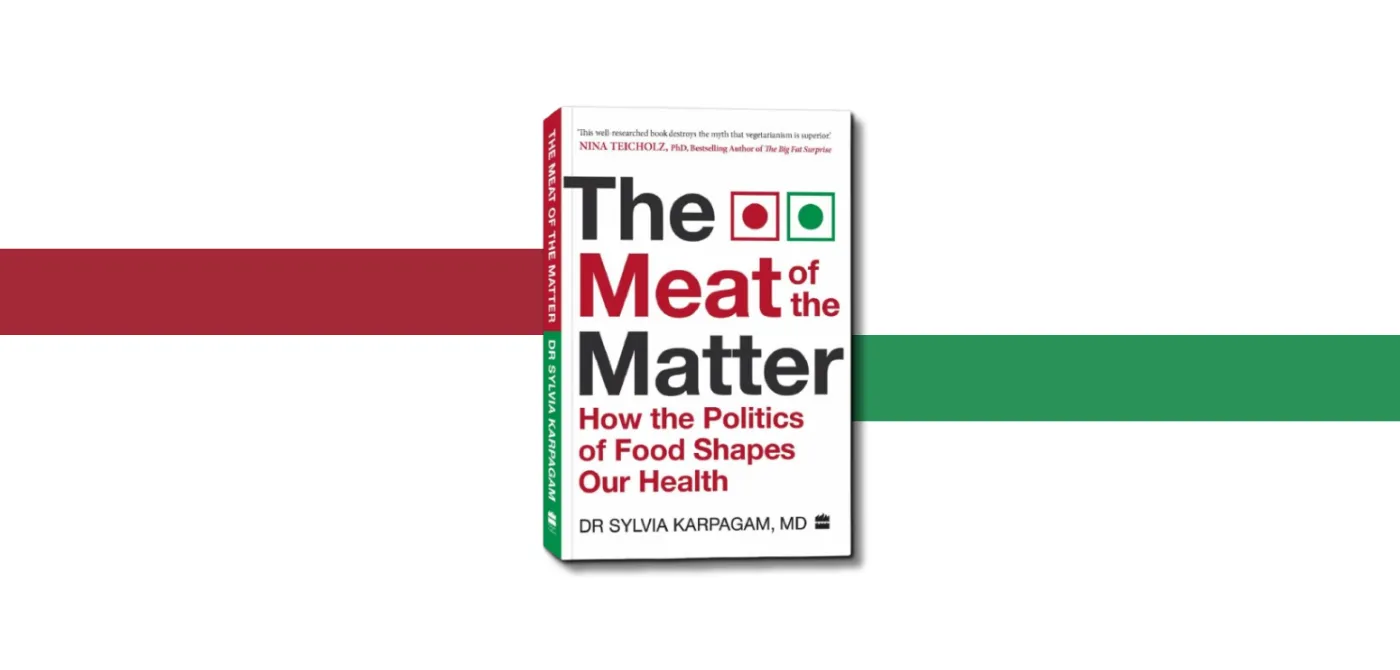
The Meat of the Matter: How the Politics of Food Shapes Our Health by Sylvia Karpagam sits at the intersection of nutrition science and the politics of meat and animal source foods that is being played out in contemporary India. She enters the debate on the political and nutritional economy of food and the politics of idolising normative diets. Karpagam is a medical doctor and has faced online trolling for her views on food and nutrition, something she mentions in the book as well—these include casteist slurs like ‘rice bag convert’. Her book picks up questions related to food politics in contemporary India, and elaborates on them through a synthesis of evidence and data from published studies related to nutrition and public health.
The narrative thread of the book is the fictitious story of Princess Amudam of Arogya Nadu, a prosperous kingdom high on the Human Development Index, journeying to Starva Pradesh, a kingdom performing poorly on every variable of human development and public health. Along the princess’s passage between the kingdoms, Karapagam weaves in her account of contemporary Indian malnutrition and food issues. This story is threaded into all the chapters. The book can be broadly categorised into three categories for the readers: human nutrition, the burden of malnutrition, and the vegetarian and meat discourse that shapes policies.
The first three chapters provide a clinical register of human nutrition from the role of various macro- and micro-nutrients like proteins, fats, minerals and vitamins. They are textbook styled, outlining the scientific understanding of nutrients, their sources, and their bodily benefits, through fact-boxes of facts and blobs of information in sections like “Did You Know?” and “Debunking Myths on the Plate”. The end of each chapter has bulleted “Key Takeaways”. While it felt slightly stretchy at parts, the synthesis of nutritional science over many decades builds a coherent narrative on nutrition.
From nutrition science, Karpagam moves onto malnutrition, drawing on population level data and studies across time periods and regions. She illustrates the high burden of undernutrition in India and its indicators like stunting, wasting, and underweight, through the National Family Health Surveys (NFHS) and the Comprehensive National Nutrition Survey (CNNS 2019). She also discusses the high prevalence of nutritional anaemia, mostly caused due to iron deficiency, to which women of reproductive age groups are the most vulnerable. Through these chapters, Karpagam also busts fads popular on social media, including 'Soya is Super Food', and 'Millets are Magical', through a careful explanation of nutrition bioavailability—how much of the theoretical nutrition of the food item the body can actually absorb—and dietary guidelines.
The third engagement of the book is with the politics of food and its manifestation in everyday life. Karpagam highlights the caste angle of vegetarian food in India, and how the vegetarian imposition is carried out in India by the state through ideological interference in public nutritional programmes. She highlights how concerns over ‘purity’ have caused eggs to be removed from midday meals in schools in several states.
In particular, she critiques the Akshya Patra Foundation (APF), whose collaboration with state governments in supplying school lunches promotes ‘sattvic food’. She mentions that “the foundation has a religious prerogative of advocating a de facto vegeterian diet, strictly avoiding meat, fish and eggs, and considers onions and garlic in food as lower modes of nature which inhibits spiritual advancement”. Not only this, but she also flags the APF’s financial opacity and its strong caste linkages and state patronages that it receives. These kinds of organisations are complicit in advancing and making a Hindutva state.
Karpagam challenges the narrative of the vegetarian discourse of nutrition by juxtaposing it with majoritarianism.
Karpagam also sheds light on the EAT-Lancet 2019 report and the “sustainable diet for planetary health” agenda that was being circulated and also platformed and promoted by India's food safety regulator. She touches upon the big food corporate nexus in nutrition policies. The EAT Lancet report 2019 propagated a global narrative to shift from a meat-based diet to a plant-based diet, and particularly idolised India as an ideal vegetarian society. She criticises the report's prescriptions: a clamp down on animal source foods, equating them as being as unhealthy as sugar, a hint at moving towards a plant based diet, and looking for “alternative proteins”. She mentions big corporations are privy to this and have appropriated the term “plant based”. Through reports like these, they manufacture new knowledge and consensus in creating systems that brings them more profits under the garb of science.
The Meat of the Matter provides a scientific understanding of major food and public health nutrition related controversies in India. Karpagam challenges the narrative of the vegetarian discourse of nutrition by juxtaposing it with majoritarianism. While she does not mention her methodology, or how she has collected her data, or selected her themes, this book can be read as a synthesis of the several structural harms that have been triggered by food and food cultures. A deeper reading of the history of caste and violence in food politics, as well as a critical perspective on policies that have led to our current nutritional systems. For instance, why do certain nutrients and foods become ‘heroes’ in certain decades or junctures. These include the rise of protein in the 1950s to the 70s, the micronutrients turn in the 90s, and later the emergence of ‘smarter foods’ like bio-fortification and fortification by nutrients. These events have shaped nutrition policies globally.
Although she mentions and acknowledges situated traditional knowledge of community in nourishment practices, we do not find in Karpagam's narrative a reference to the debates over how a biomedical approach to malnutrition can be a problematic hegemony, especially for countries in the Global South, where land dispossession, colonisation, caste location and socio economic factors shape nutrition. Yet, the accessible language used to present the science makes The Meat of the Matter an important book for people to understand food and nutrition politics in India.
Sayan Deori is a PhD scholar at Tezpur University, Assam.