

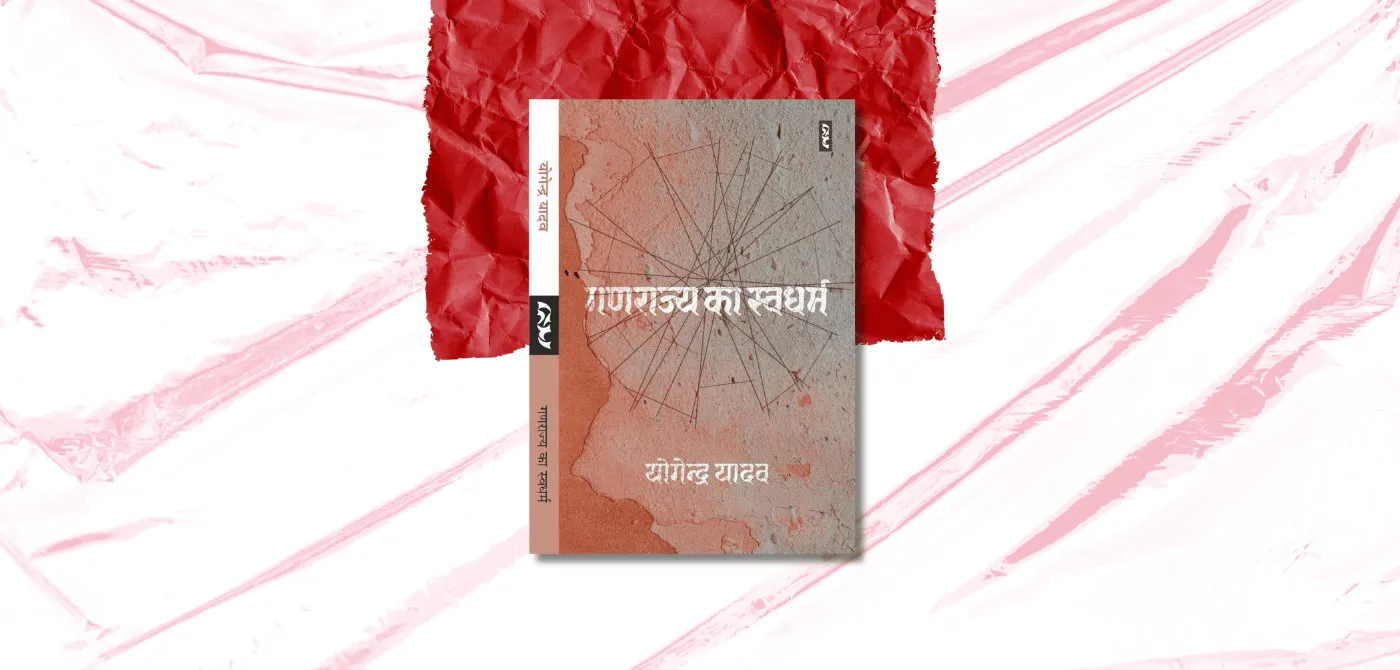



Yogendra Yadav’s essay collection, Ganrajya ka Swadharm (The Dharma of a Republic), is an attempt to confront one of the most unsettling questions of our times: how does a republic lose itself?
The volume brings together columns and commentaries written by Yadav over the last decade, supplemented by 75 pages of entirely new material. Often, a collection spanning such a long, turbulent period does not succeed in maintaining a singular thematic spine; individual essays risk becoming tied to the specific events or political controversies that birthed them. Yadav’s book overcomes this fragmentation. Beneath the diverse commentaries lies a constant, agonising concern: the systematic erosion of India’s republican character over the last 12 to 13 years.
A law can mandate equality before the state and prohibit explicit discrimination, but it cannot manufacture affection, trust, or an organic sense of belonging.
The decline of popular sovereignty, the deepening of social inequality, the shrinking of freedom, and the slow erasure of justice are not isolated fractures. They are deeply interconnected pathologies that strip a republic of its meaning. When one pillar weakens, the rot inevitably spreads to the rest, refusing to remain confined to any single section of society. It infects the entire social body.
Yet, at the centre of this multi-dimensional crisis lies the decline of a value that Yadav considers uniquely endangered: fraternity.
Decline of Fraternity
Fraternity is the quiet force that connects disparate groups, making a national community possible. It does not demand an artificial sameness. On the contrary, genuine fraternity begins by recognising difference, embracing plurality, and actively seeking to understand the “other”.
Fraternity cannot be legislated into existence. A law can mandate equality before the state and prohibit explicit discrimination, but it cannot manufacture affection, trust, or an organic sense of belonging. Fraternity grows voluntarily, cultivated through daily social relationships and shared ethical practices. The state can protect it, or it can choose to dismantle it. It cannot create it.
According to Yadav, it is precisely this fraternity that is being torn apart after 2014. He argues that the Indian state has not merely abdicated its constitutional role as a neutral arbiter; it has transformed itself into an instrument of establishing Hindu majoritarianism. For the first time in the history of the republic, the state is seen as working overtly against its Muslim and Christian citizens.
A battery of legislative moves—the Citizenship Amendment Act, laws targeting instant triple talaq, cow protection acts, anti-conversion measures, and the rhetoric surrounding a Uniform Civil Code—are routinely packaged in the language of reform, equality, or religious freedom. In practice, however, Yadav argues they have become state tools for surveillance, regulation, and subjugating minority lives.
Hindus are being fed a grievance narrative: that Muslims stole their history, and that the present is a historic opportunity to reclaim what was lost.
This crisis is not merely legislative; it is deeply cultural and linguistic. The political vocabulary of the ruling establishment—from the prime minister and the home minister downwards—consistently fosters a culture of suspicion and hostility toward minorities. The mainstream media, particularly television news, functions as an echo chamber, manufacturing a permanent narrative of paranoia.
Concurrently, administrative bodies and the police have increasingly compromised their neutrality. The disruption of prayers, the demolition of mosques, restrictions on Christian congregations, and attacks on churches have become disturbingly routine. Even Hindu religious festivals and cultural spaces have been weaponised for political mobilisation against Muslims.
Following the transition of power in 2014, mob lynchings became a recurring feature of our public life, while the daily intimidation faced by Christians in various pockets of the country continues to pass under a cloud of public indifference.
A new, dangerous historical imagination is being forged for the majority. Hindus are being fed a grievance narrative: that Muslims stole their history, and that the present is a historic opportunity to reclaim what was lost. Consequently, every symbol of Muslim presence in the subcontinent’s public memory is systematically targeted for erasure. Through this, the historical agency and participation of Muslims in the making of India are being actively invalidated.
What remains profoundly troubling is the lack of moral outrage from the wider Hindu society. Caught in a web of electoral calculations, opposition political parties hesitate to speak with clarity, terrified of being branded as “appeasers”. The tragic consequence is a growing emotional chasm between communities.
Many Hindus are being persuaded to believe they share nothing with their Muslim or Christian neighbours—that these groups are not just culturally alien, but are actively conspiring to usurp Hindu resources, culture, and history. Under such conditions, the very ground for fraternity is pulled away. For Yadav, this is the ultimate catastrophe. The destruction of fraternity is the destruction of the Indian Republic itself.
Yadav does not merely document this unravelling; he asks an uncomfortable question: how did we arrive here?
These titles expose the core polemic of the book. Yadav is tracing the intellectual defeat of Indian secularism.
To blame Hindutva forces alone, he suggests, is a form of intellectual evasion. It allows secular, liberal opponents of majoritarianism to bypass their own failures. Did we, through our actions or silences, contribute to the conditions that allowed majoritarian politics to take such deep root? Where did our imagination fail? Why were we blind to the gathering storm?
In these dark years, lines from Gajanan Madhav Muktibodh’s iconic poem Andhere Mein (In the Darkness) inevitably haunt the mind:
Darkness in the lanes, frightening—
as if because of me alone
that martial law has been imposed,
as if my inactive consciousness
invited this crisis,
as if because of me alone
This terrible event occurred.
Yadav’s book is an urgent attempt to interrogate this “inactive consciousness”.
Problem of "Borrowed Grammar"?
In the second edition of the book, he advises readers to begin with three crucial essays.
(i) “Rashtravad, Sanskriti aur Dharmik Virasat ki Upeksha ki Saza Kaat Rahe Hain Hum” (We are Paying the Price for Neglecting Nationalism, Culture, and Religious Heritage). (ii) “Sacchi Sampradayikta Se Nahin Lad Sakta Jhootha Secularism” (False Secularism Cannot Fight Genuine Communalism). (iii) “Udhar Li Hui Shabdavali Mein Chal Rahi Hai Rashtravad Ki Bahas” (The Debate on Nationalism is being Conducted through a Borrowed Vocabulary).
These titles reveal the core polemic of the book. Yadav is tracing the intellectual defeat of Indian secularism. Ironically, Hindutva politics has long accused liberal secularists of being alienated from the country’s religious and cultural traditions. Instead of simply dismissing this majoritarian critique, Yadav asks whether it holds an uncomfortable truth. This forms the core of his self-critique.
Yet, before we accept Yadav’s thesis, we must ask: would a Muslim or Christian thinker in India articulate the crisis of secularism using these exact coordinates Yadav uses? Would their anxieties be identical? Would an Adivasi, a Manipuri, a Naga, or a Tamil intellectual begin from the same premise?
These questions cannot be brushed aside. The fact that Yadav’s anxiety stems from a Hindu social location does not invalidate it; indeed, one of the most critical imperatives of our time is for Hindus of all persuasions to look within and ask how the failures of Hindu society contributed to the contemporary crisis.
Why should the intellectual horizon of Indian thinkers be limited to understanding only their own geography? Was M.K. Gandhi merely trying to decode India?
Sadly, Yadav does not do it. Instead, he treats the Hindu hurt as sincere and honest and blames the liberals for having injured the Hindu psyche by lampooning or mocking it. He wants us to believe him without giving any example of the secularists demeaning Hindu beliefs or practices.
Yadav’s critique extends beyond political strategy into the realm of the intellect. He views the contemporary crisis as a failure of imagination. Why did modern, secular intellectuals vacate the emotional and cultural landscapes that Hindutva so easily captured? Why did they leave the vast terrain of culture wide open for exclusionary forces?
Yadav finds his answer in what he terms a “borrowed grammar”. He writes, “Europe and America took upon themselves the responsibility of understanding not only their own countries but the entire world. Our responsibility was only to understand our own country. But even this task we failed to perform through a borrowed grammar.”
This assertion demands scrutiny. Why should one be so diffident as to restrict the intellectual horizon of Indian thinkers to understanding only their own geography? Was M.K. Gandhi merely trying to decode India? Was his vision of swaraj or his philosophy of ahimsa meant exclusively for domestic consumption? Was Rabindranath Tagore’s critique of nationalism only a local warning? Were Jawaharlal Nehru’s Panchsheel, B.R. Ambedkar’s absolute critique of inequality, or the foundational idea of Indian secularism confined by national borders?
Ideas travel. They cross frontiers, undergo translation, and acquire radical new lives. The modern world is a product of these chaotic, cross-cultural translations. Even the most robust civilisations have survived by borrowing. Languages borrow words; literatures borrow forms; political visions cross oceans. The test of an idea is not its place of origin, but its capacity to help human beings comprehend their condition and build a more just society.
The phrase “borrowed grammar” carries an unnecessary weight of cultural insecurity. If democracy—with its insistence on individual liberty, popular sovereignty, and the separation of religion from state power—found a specific historical articulation in Europe, does its adoption in India signify an inferiority complex? Is borrowing a sign of weakness inherently?
Poet Arun Kamal provides a sobering counter-perspective:
What is truly ours in this life?
Everything is borrowed.
All the iron belongs to others;
Only its sharpness is ours.
Should the rest of the world feel intellectually subservient because it learned the grammar of non-violent resistance from Gandhi? No culture exists in pristine isolation. Marxism, feminism, or existentialism may have European roots, but their origins do not prevent them from illuminating the struggles for freedom, dignity, and rights elsewhere.
This very hesitation explains why the profound vulnerability felt by Indian Muslims is rarely felt with the same visceral intensity by liberal Hindus.
The challenge before us is not to purge the “foreign”, but to understand what can be dynamically transformed within our own material realities. Comparative thinking is not intellectual dependency; it is the very definition of a living intellect.
What about Fascism?
Yadav displays a distinct discomfort with drawing parallels between contemporary India and Europe’s dark past, objecting to those who look for “the symptoms of our present in some dark corner of Europe’s past”. But the chilling resemblances between India post-2014 and Europe post-1933 cannot be wished away. Is there truly no structural similarity between contemporary Hindutva and classical European fascist movements?
Drawing these comparisons does not mean denying the specificities of Indian politics. Rather, it helps us identify the unique forms that majoritarian authoritarianism takes in our own context. It warns us that if we wait for the literal appearance of gas chambers to label a regime fascist, we will remain blind to the everyday fascism unfolding before our eyes. Interestingly, Yadav himself evokes European history when he criticises those who act as if India is already standing at the gates of a gas chamber.
This recalls the debate from 2014, when the writer U.R. Ananthamurthy warned us of the onset of fascism. Many liberal and left intellectuals responded with pedantic checklists of European fascism to argue why India was different. For many, until the catastrophe reaches its absolute zenith, the danger is downplayed. This very hesitation explains why the profound vulnerability felt by Indian Muslims is rarely felt with the same visceral intensity by liberal Hindus.
To counter this drift, Yadav proposes recovering the swadharma of the Indian Republic, which he breaks down into four elements:
• Maitri (friendship, envisioned through the civilisational ideal of sulh-e-kul or equal respect for all faiths);
• Karuna (compassion and equality);
• Vinay (humility and democracy); and
• Deshachar (federalism).
Yadav asserts that Indian secularism, understood as sarva dharma samabhava, is not an alien import. He views this tradition not as a monolithic Hindu construct, but as a dialogic tapestry woven by Hindu, Buddhist, Jain, Islamic, Sikh, and Adivasi voices.
While academics might debate this formulation, the generosity of his intent is clear. Yadav is trying to rescue the Constitution of India from the majoritarian charge of being a “foreign document”. By anchoring constitutional values within indigenous intellectual lineages, he seeks to make them resilient against nativist attacks.
They asked: What does a civilisation mean if it robs millions of their basic dignity? What is the worth of a tradition that sanctifies inequality?
This search for modern values within Indian experience has a long lineage. Nehru’s The Discovery of India was precisely such an ethical and political project. Figures like Ashoka and Akbar, whom Nehru admired, are also Yadav’s ideals.
Similarly, Gandhi’s India was not a passive inheritance; it was forged through a complex encounter with Western thought, his experiences in South Africa, and his quest for an alternative modernity. Thinkers like Sir Syed Ahmad Khan, Muhammad Iqbal, the Ali brothers (Mohamed Ali and Shaukat Ali), Tagore, Subramania Bharati, and Sarojini Naidu all participated in this search, collectively dismantling James Mill’s colonial tri-partition of Indian history into rigid Hindu, Muslim, and British periods—a framework that reduced a history of co-existence into a permanent religious war.
Yet, this discovery of tradition was never an uncomplicated celebration. Nehru and other leaders were acutely aware that the same civilisation that produced the Upanishads and Ashoka also institutionalised untouchability and rigid social hierarchies.
Therefore, the question has never been a simple “What is India?” The far more radical question was posed by thinkers like Jyotirao Phule, E.V. Ramasamy (Periyar), and Pandita Ramabai: Which India should form the bedrock of our future?
These radical iconoclasts complicate any easy civilisational romanticism. They did not look to the past for psychological comfort; their primary gaze was fixed on the suffering of the oppressed in the present. They asked: What does a civilisation mean if it robs millions of their basic dignity? What is the worth of a tradition that sanctifies inequality?
Phule’s scathing critique of caste, Periyar’s rejection of religious lore, and Ramabai’s defiance of patriarchal Hindu traditions were not “anti-Indian”. They were desperate, profound demands for a different, just India.
The historical truth is that India possesses traditions of compassion and equality, alongside deeply entrenched traditions of exclusion, hierarchy, and violence. Both are authentically Indian. The ethical task before us is not a passive recovery of tradition, but a conscious, political choice between competing traditions.
This is where Yadav’s neat contrast between swadharma and paradharma falters. He writes, “In its Indian meaning, context and temperament, democracy is the swadharma of the Indian Republic. The daily practice of democracy, in which those in power constantly attempt to keep democracy under their thumb, is adharma. And the attempt to decorate Indian democracy in the liberal clothing of Western democracy is paradharma."
Ultimately, Yadav correctly identifies that the crisis of secularism is a crisis of democracy itself.
This formulation is rhetorically elegant but conceptually fraught. What is this pristine “Western democracy” or its “liberal clothing”? If democracy implies that citizens are sovereign, that power is accountable, and that the state cannot discriminate on the basis of identity, why label these ideas foreign? Ideas cannot be dismissed by their geography. Freedom does not become alien simply because another society gave it a specific vocabulary first.
Modern India has never developed in a vacuum. The freedom struggle was an international conversation. Gandhi was shaped by Leo Tolstoy, John Ruskin, and Henry David Thoreau; Ambedkar’s vision of equality was sharpened by global political philosophy; Nehru’s democratic socialism was inspired by international anti-colonial movements. Their Indianness was not diluted by this openness; it was vitalised by it. The opposite of imitation is not insularity, but creative, confident synthesis.
Ignoring Internal Structures of Separation
Perhaps the most fragile claim in Yadav’s text is his assertion that the hatred fostered by Hindutva is a European import. “The seed of hatred is an imported product of Europe. It was never made for the soil of this country. We must get the plant again that has grown in the plains of the Ganga and Yamuna for five thousand years.”
The romanticism of this statement is clear, but historically it is unsustainable. A society that sustained the violence of the caste system and the daily humiliation of untouchability for millennia cannot claim that hatred and exclusion are imports. The exclusion of the Dalit or the subjugation of women was not drafted in Europe.
Premchand understood this deep structural malady. Writing on communalism, he noted that majoritarian hatred against Muslims looks natural precisely because our society already possesses internal structures of separation. A society accustomed to treating its own people as untouchable is uniquely conditioned to accept the demonisation of the “other”. Caste is, by definition, the negation of fraternity. The problem is not a foreign poison entering a pristine body politic; the vulnerabilities are entirely internal.
One needs to confront the internal vulnerabilities in Hindu society, which lead to anti-Muslim hatred and violence. Yadav does not do it even once in this book.
Ultimately, Yadav correctly identifies that the crisis of secularism is a crisis of democracy itself. The moot question for all political parties is: How do we form a political majority? A constitutional democracy requires a majority built through open, shifting civic alliances. Majoritarianism, however, relies on a permanent, frozen majority manufactured by excluding a minority.
If the crisis of secularism is explained primarily through Hindu cultural anxieties or the use of a “borrowed grammar”, the specific, raw experience of minority persecution gets sidelined.
The trauma of Partition and colonial scripts left behind a fertile ground for this majoritarian arithmetic. While Nehru consistently warned against this, other democratic forces fell to the temptation of forming majorities through majoritarian appeals. In their obsession with defeating the hegemony of the Congress, socialist and left parties repeatedly compromised, aligning with the Rashtriya Swayamsevak Sangh (RSS) and the Jana Sangh at various historical junctures, inadvertently mainstreaming and normalising a politics that had once been treated as democratically toxic. One must also note that the majoritarian tendencies were very much present in the Congress Party itself. Nehru was surrounded by right-wing leaders like Patel, Rajendra Prasad, Govind Vallabh Pant, Sampoornanand and many others who nursed suspicion, if not hatred against Muslims.
Deeper Failures of Indian Secularism
The crisis cannot be reduced merely to the secular elite’s neglect of religion, as Ashis Nandy has argued. Yadav seems to agree with this formulation. However, Nandy’s critique that official secularism dismissed the religious imagination of ordinary believers is a gross simplification. The deeper failure of Indian secularism was not its stance on faith, but its failure to deliver material and social justice. It promised equal citizenship on paper but tolerated systemic marginalisation in practice.
As historian Taylor Sherman demonstrates in Nehru’s India, the secular vision was rarely fully integrated into the daily practices of the state administration. Everyday life continued to reproduce suspicion and structural violence against Muslims and marginalise them. While democratic mobilisation enabled Dalits and Backward Classes to secure greater political representation, Muslims remained politically vulnerable, subjected to recurrent communal violence with growing social acceptance within the Hindu society.
Like Sherman, Javed Gaya, in his recently published Heartland Rising: The Making of Majoritarian India, traces the rise of Hindutva and the failure of secularism to the very manner in which laws were made in India, which had majoritarian biases. Contrary to what Yadav feels, the Indian state, in its legal and administrative acts has always been marginalising Muslims.
This exposes the limitation of Yadav’s framework. If the crisis of secularism is explained primarily through Hindu cultural anxieties or the use of a “borrowed grammar”, the specific, raw experience of minority persecution gets sidelined. The terror and vulnerability of the Muslim and Christian must be central to the analysis, not a footnote to a debate on cultural roots.
Similarly, Yadav’s critique of Nehru and the Left for being “weak” on nationalism and national security oversimplifies history. As scholars like Srinath Raghavan have shown, the early Indian state’s engagement with national security was deeply sophisticated and realistic. Furthermore, Krishna Kumar’s study of textbooks reveals that Indian education was never deficient in nationalism. If anything, it suffered from an excess of a specific nationalist narrative that pushed structural contradictions like caste and class into the shadows to preserve a sanitised story of national unity.
In the end, despite these critical limitations, the value of Yadav’s Ganrajya ka Swadharm remains undiminished. Its importance lies in the honesty of the anxieties it addresses. It forces us to confront the foundational questions: what does it mean to be an Indian? Can democracy survive without the moral glue of fraternity? But the book, sadly, while raising this important question, finds shelter in easy simplifications.
Apoorvanand is a teacher and writer.